Key Concept #12: Third Culture Kids Translated into Chinese

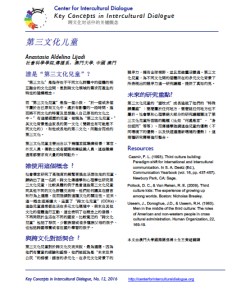
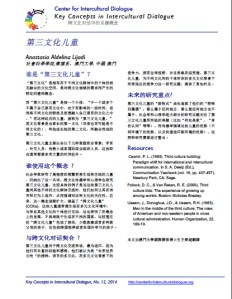
Key Concepts in ICDContinuing translations of Key Concepts in Intercultural Dialogue, today I am posting KC12: Third Culture Kids, written by Anastasia Lijadi in English in 2014, and now translated into both traditional and simplified Chinese by Wang Qi Chao; they are both affiliated with the University of Macau, China.

As always, all Key Concepts are available as free PDFs; just click on the thumbnail of the translation you wish to read. Lists of Key Concepts organized chronologically by publication date and number, alphabetically by concept, and by languages into which they have been translated, are available, as is a page of acknowledgments with the names of all authors, translators, and reviewers.

KC12 TCKs_Chinese trad
Traditional Chinese
KC12 TCKs_Chinese sim
Simplified Chinese


Lijadi, A. A. (2016). Third culture kids [Simplified Chinese]. Key Concepts in Intercultural Dialogue, 12 (Q. C. Wang, Trans.). Available from:
https://centerforinterculturaldialogue.org/wp-content/uploads/2016/07/kc12-tcks_chinese-sim.pdf

Lijadi, A. A. (2016). Third culture kids [Traditional Chinese]. Key Concepts in Intercultural Dialogue, 12 (Q. C. Wang, Trans.). Available from:
https://centerforinterculturaldialogue.org/wp-content/uploads/2017/01/kc-12-tcks_chinese-trad2.pdf

If you are interested in translating one of the Key Concepts, please contact me for approval first because dozens are currently in process. As always, if there is a concept you think should be written up as one of the Key Concepts, whether in English or any other language, propose it. If you are new to CID, please provide a brief resume. This opportunity is open to masters students and above, on the assumption that some familiarity with academic conventions generally, and discussion of intercultural dialogue specifically, are useful.

Wendy Leeds-Hurwitz, Director
Center for Intercultural Dialogue


Creative Commons License
This work is licensed under a Creative Commons Attribution-NonCommercial-NoDerivatives 4.0 International License.

Kenan Çetinkaya Profile

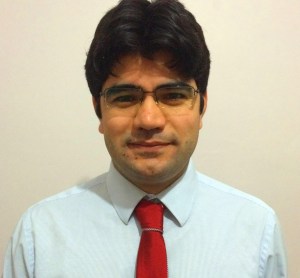
ProfilesKenan Çetinkaya (Ph.D.) was born in Malatya, Turkey. He has been working at Bozok University Department of Philosophy and Religious Studies, Turkey since 2013.

kenan cetinkaya photoHe holds a BA (2006) in Islamic Education from Ankara University, and a MA (2009) in the Theological Studies from the University of Saint Thomas, Houston, TX.  He earned his Ph.D. (2014) from the Department of Religion, Temple University, Philadelphia, PA. His dissertation title is Turkish Response to the Christian Call for Dialogue. He is editor of a Turkish book, Birlikte Yaşama Kültürü ve Diyalog [Coexistence and Dialogue] which was published in 2014.

Some of his published papers include:

Çetinkaya, K. (2015). The importance of dialogue in Turkey. Journal of Ecumenical Studies, 50, 167-173.

Çetinkaya, K. (2014). Three Turkish views of interfaith dialogue. In Nathan R. Kollar & Muhammad Shafiq (Eds.),  Sacred texts and human contexts: A North American response to “A common word between us and you.” North Charleston, SC: CreateSpace Independent Publishing Platform.


Work for CID:

Kenan Çetinkaya wrote KC96: Interreligious Dialogue. He also translated  KC1: Intercultural Dialogue, KC8: Public Dialogue, KC22: Cultural Identity and KC62: Diaspora into Turkish.

Key Concept #51 Critical Discourse Analysis Translated into Italian

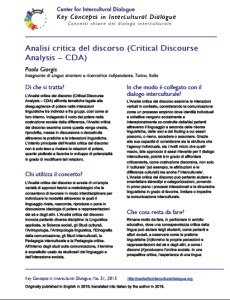
Key Concepts in ICDContinuing translations of Key Concepts in Intercultural Dialogue, today I am posting KC51: Critical Discourse Analysis, written by Paola Giorgis in English in 2015, and now translated by her into Italian.

As always, all Key Concepts are available as free PDFs; just click on the thumbnail of the translation to read it. Lists organized chronologically by publication date and numberalphabetically by concept in English, and by languages into which they have been translated, are available, as is a page of acknowledgments with the names of all authors, translators, and reviewers.

KC 51 CDA ItalianGiorgis, P. (2016). Analisi critica del discorso. Key Concepts in Intercultural Dialogue, 51. Available from: https://centerforinterculturaldialogue.org/wp-content/uploads/2016/07/kc51-cda_italian.pdf

The goal of the translation project is to expand the concepts available to discussions of intercultural dialogue beyond those who are fluent in English. What began with a request to translate a few concepts into 2 languages has now developed into a serious effort to translate most of them. Choice of languages is being left up to those who are doing the work, which has prompted much interesting discussion about whether to be organized about this (translating all of them into a single language, then moving on to the next). Obviously the decision was  not to take that route. Instead, authors are being given the opportunity to translate their own into whatever languages they know best; once they respond, their concepts are put on a list of those available to requests from others. If you are interested in translating one of the Key Concepts, please contact me for approval first because dozens are currently in process. As always, if there is a concept you think should be written up as one of the Key Concepts, whether in English or any other language, propose it. If you are new to CID, please provide a brief resume. This opportunity is open to masters students and above, on the assumption that some familiarity with academic conventions generally, and discussion of intercultural dialogue specifically, are useful.

Wendy Leeds-Hurwitz, Director
Center for Intercultural Dialogue


Creative Commons License
This work is licensed under a Creative Commons Attribution-NonCommercial-NoDerivatives 4.0 International License.

CFP Int’l Association for Dialogue Analysis 2017 (Italy)

The 2017 International Association for Dialogue Analysis (IADA) conference will be held from October 11th-14th, 2017 at the University of Bologna (Department of Education) and is sponsored by the School of Psychology and Education, the FAM (Fondazione Alma Mater), and the International Association for Dialogue Analysis.

The conference focuses on the role of dialogue or interaction in displaying, maintaining, creating yet also defying the crucial dimensions of the world we live in. This process is particularly at play – although not necessarily noticed – in everyday life. Rather than a context, this phenomenological notion indicates the obvious, routine, quasi-natural quality of most human practices taking place in ordinary as well as institutional contexts. Quoting a well known formula by John Heritage (1984) yet applying it beyond the micro-level of the hic et nunc discursive environment, we propose to conceive dialogue as “context shaped and context renewing”. Overcoming the “interactional reductionism” (Levinson, 2005) implied in focusing solely on the emergent properties of language use, as well as any simplistic return to sociocultural, psychological an even material determinism, dialogue and interaction are seen as an “intermediate variable” (Ibidem) or faits d’interface (Descola, 2016) connecting the micro-order of everyday life and the macro-order of shared culture and social structure. As Rommetveit put it forty years ago, dialogue is “the skeleton” or “the architecture of intersubjectivity” (1976).

The 2017 International Association for Dialogue Analysis conference (Bologna, October 11th-14th, 2017) welcomes empirical and methodological extended abstracts and full papers from different disciplinary perspectives that focus on dialogue and interaction as carriers of, and tools for culture, social organization, moral horizons, identities and change.

The notion of action is at the core of the conference main theme: the contributors are asked to focus on dialogue and social interaction as –  at the same time – presupposing  and producing the crucial dimensions of the world we live in.

Theoretical papers are more than welcome insofar as they provide some empirical illustration of the paper’s theoretical point(s).

The conference includes but it is not limited to, the following subthemes:
Dialogue and Health (e.g. dialogue as therapy; dialogue in clinical settings; medical interaction; dialogue in multilingual-multicultural healthcare contexts; dialogue in social work).
Dialogue, Justice and Social Change  (e.g.; dialogue in policing including interrogation, citizen calls; criminal, civil and administrative law; transidioma and  asylum; intercultural institutional talk; social conflicts and Alternative Dispute Resolution practices; family and social mediation; restorative justice).
Dialogue and Materiality (e.g. inter-objectivity; Actor-Network-Theory; things as dialogic entities; humans and non-humans interaction; sociosemiotics; dialogue and technologically saturated environment; the object’s affordances and the user’s agenda).
Dialogue and Organization (e.g. dialogue as an organizing phenomenon; leadership and dialogue; expert-novice interaction; authority and power in organizational communication).
Dialogue, Socialization and Education (e.g. dialogue in friendship and peer culture; family everyday talk; language socialization; classroom talk; dialogue in everyday school-life; assessment as a dialogic practice; teachers-parents conference; L2 learning activities; coaching and training).
Dialogue, Text and Language (e.g. dialogue as text; dialogue in literary texts, CMC and audiovisual texts; text and reader dialogue; textual representations of dialogues; dialogue in advertising, advertising as dialogue; dialogue in propaganda and political speech; grammar, lexicon and cultural norms in everyday talk).We invite extended abstracts (500 to 700 words) or full papers of a maximum of 30 pages, including references. Any citation style is permitted (e.g., MLA, APA, Chicago).

Submission opens on June 30th, 2016, and closes on November 30th, 2016 at 23:59 local time in Italy. Notification of acceptance in March 2017.

For details and instructions see the Submission page: https://eventi.unibo.it/international-conference-iada-bologna2017/submission

We look forward to your contributions!

Innovating in the Cultural Sector (Greece)

Innovating in the Cultural Sector: Appreciating the Past and Creating Jobs for the Future
Corfu, Greece
22 – 24 September 2016

CulturePolis, a non-profit organisation based in Corfu, Greece is organising an international conference on Innovating in the Cultural Sector: Appreciating the Past and Creating Jobs for the Future, to be held in Corfu, Greece, on 22 – 24 September 2016. CulturePolis is a Forum for Culture, Sustainability and Innovation, aiming to promote innovative approaches to cultural resource management, sustainable tourism, cultural and creative entrepreneurship, intercultural dialogue, and social action and civic engagement through culture and creativity at the local and European level. The founder and president is Dr Vasileios Laopodis.

The summit of innovators, supporters and friends on the island of Corfu has the following objectives:
*to identify and spread new ideas for connecting culture and heritage with citizens, communities and development;
*to celebrate CulturePolis’ 10 years of impact and insights, announce CulturePolis’ new strategy for the next 10 years, and expand the community of partners and supporters.

The participants will be representatives of cultural and heritage institutions and foundations, cultural managers, entrepreneurs and innovators in the cultural sector and creative economy, local and regional authorities, business leaders and consultants, representatives of citizen groups.

For more information on the Corfu summit, please contact: Ms. Aphrodite Bouikidis, Partnership Coordinator at partnership[at]culturepolis.org and aphrodite.bouikidis[at]gmail.com

Contact:
CulturePolis, Alepohori Kamaras, 49084 Corfu, Greece;
e-mail: secretariat[at]culturepolis.org; vasileios.laopodis[at]gmail.com

Key Concept #59 Teng Translated into Chinese

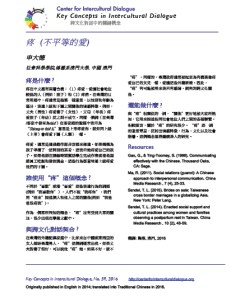
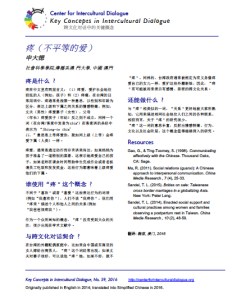
Key Concepts in ICDContinuing translations of Key Concepts in Intercultural Dialogue, today I am posting KC59: Teng, written by Todd Sandel, in English in 2015, and now translated into both traditional and simplified Chinese by Bei Ju (Jenny), both of the University of Macau, China.

As always, all Key Concepts are available as free PDFs; just click on the thumbnail of the translation you wish to read. Lists of Key Concepts organized chronologically by publication date and number, alphabetically by concept, and by languages into which they have been translated, are available, as is a page of acknowledgments with the names of all authors, translators, and reviewers.

KC59 Teng Chinese-trad
Traditional Chinese
KC59 Teng Chinese-simplified
Simplified Chinese


Sandel, T. (2016). Teng [Traditional Chinese]. Key Concepts in Intercultural Dialogue, 59 (B. Ju, Trans.) Available from:
https://centerforinterculturaldialogue.org/wp-content/uploads/2016/06/kc-59-teng-chinese-trad.pdf

Sandel, T. (2016). Teng [Simplified Chinese]. Key Concepts in Intercultural Dialogue, 59 (B. Ju, Trans.) Available from:
https://centerforinterculturaldialogue.org/wp-content/uploads/2016/06/kc-59-teng-chinese-sim.pdf

The goal of the translation project is to expand the concepts available to discussions of intercultural dialogue beyond those who are fluent in English. What began with a request to translate a few concepts into 2 languages has now developed into a serious effort to translate most of them. Choice of languages was left up to those who are doing the work, which has prompted much interesting discussion about whether to be organized about this (translating all of them into a single language, then moving on to the next). Obviously the decision was  not to take that route. Instead, authors are being given the opportunity to translate their own into whatever languages they know best; once they respond, their concepts are put on a list of those available to requests from others. If you are interested in translating one of the Key Concepts, please contact me for approval first because dozens are currently in process. As always, if there is a concept you think should be written up as one of the Key Concepts, whether in English or any other language, propose it. If you are new to CID, please provide a brief resume. This opportunity is open to masters students and above, on the assumption that some familiarity with academic conventions generally, and discussion of intercultural dialogue specifically, are useful.

Wendy Leeds-Hurwitz, Director
Center for Intercultural Dialogue


Creative Commons License
This work is licensed under a Creative Commons Attribution-NonCommercial-NoDerivatives 4.0 International License.

Lancaster University job ad (UK)

Senior Lectureship in Intercultural Communication
Linguistics & English Language
Lancaster University, UK
Closing Date: Friday 12 August 2016
Interview Date: Wednesday 24 August 2016
Reference: A1578

We are seeking a scholar who has a strong international reputation. You will have a PhD, extensive teaching experience (especially at postgraduate level), a portfolio of publications that are recognised for their excellence, and a proven track-record in attracting funding for your research. You will join a large group of internationally renowned linguists that includes specialists in: English Language study, Corpus Linguistics, Discourse Studies, Forensic Linguistics, Sociolinguistics, Cognitive Linguistics, Psycholinguistics, Literacy Research and Second Language Teaching, Learning and Assessment.

You will pursue research and publications at a level appropriate for a strong submission to the next Research Excellence Framework and will be expected to supervise BA, MA and PhD students. You will lead the development of new modules and programmes in Intercultural Communication, particularly at postgraduate level. You will contribute to administration at a level commensurate with a Senior Lectureship.

This is an indefinite post beginning 1 January 2017.

Informal enquiries can be made to Professor Elena Semino, Head of Department: e.semino[at]lancaster.ac.uk

We welcome applications from people in all diversity groups. Apply online.

Quote of the Day: Culture, Sustainability, Intercultural Dialogue

Intercultural Dialogue QuotesOccasionally when I read, a quote related to intercultural dialogue strikes me as particularly noteworthy for being insightful, concise, beautifully written, and/or original. One example is provided below. If you have quotes you would like to see posted, submit them for consideration to intercult.dialogue@[at]gmail.com

“Participation in cultural activities fosters young people to be more imaginative and innovative: the processes of creation and cultural participation provide knowledge and techniques to imagine and expand horizons, integrate diverse elements, and create something new. Cultural experiences can be important platforms for the development of capacities that expand self-knowledge, self-expression, self-determination, and life satisfaction and well-being.”

“Educational systems at all levels should include the acquisition of cultural skills and knowledge pertaining to intercultural dialogue; the recognition and valuing of diversity, creativity, tangible and intangible heritage; and the development of skills using digital tools for cultural transmission, innovative expression, and bridging of cultures.” (p. 30)

Duxbury, N., Hosagrahar, J., & Pascual, J. (2016). Why must culture be at the heart of sustainable urban development? Barcelona, Spain: United Cities and Local Governments.

Wendy Leeds-Hurwitz, Director
Center for Intercultural Dialogue

Key Concept #76 Intercultural Sustainability Translated into German

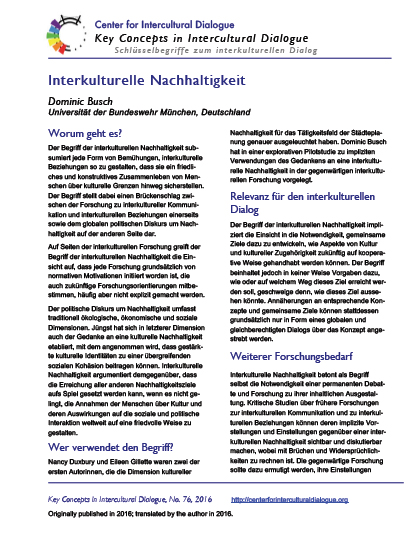
Key Concepts in ICDAs explained recently, some of the Key Concepts in Intercultural Dialogue are being translated into other languages than English. Today I am posting KC76: Intercultural Sustainability, originally written in English in 2016, and now translated into German, by Dominic Busch, of the Universität der Bundeswehr München, Germany.

As always, all Key Concepts are available as free PDFs; just click on the thumbnail to download the PDF. Lists of Key Concepts organized chronologically by publication date and number, alphabetically by concept, and by languages into which they have been translated, are available, as is a page of acknowledgments with the names of all authors, translators, and reviewers.

KC76 intercultural sustainiability-GermanBusch, D. (2016). Interkulturelle Nachhaltigkeit. Key Concepts in Intercultural Dialogue, 76. Available from:
https://centerforinterculturaldialogue.org/wp-content/uploads/2016/06/kc-76-intercultural-sustainability-german.pdf

If you are interested in translating one of the Key Concepts, please contact me for approval first because dozens are currently in process. And, as always, if there is a concept you think should be written up as one of the Key Concepts, whether in English or any other language, propose it. As of this writing, 78 have been published in English, but words from Chinese, Portuguese, Japanese, Spanish, Belarusian, German and Arabic have also been introduced (with the discussion provided in English). As of this writing, I have received offers to translate one or more concepts into Arabic, Belarusian, Chinese, Finnish, French, German, Italian, Japanese, Kapampangan, Polish, Portuguese, Russian, Spanish, Tagalog, and Turkish (in alphabetical order). There is even a possibility of videos presenting American Sign Language versions. So if anyone else wants to join in the fun, just let me know.

Wendy Leeds-Hurwitz, Director
Center for Intercultural Dialogue


Creative Commons License
This work is licensed under a Creative Commons Attribution-NonCommercial-NoDerivatives 4.0 International License.

Fulbright U.S. Scholar Awards in Communications and Journalism

The Fulbright U.S. Scholar Program offers nearly 500 teaching, research or combination teaching and research awards in over 125 countries for the 2017-2018 academic year. Opportunities are available for college and university faculty and administrators as well as for professionals, artists, journalists, scientists, lawyers, independent scholars and many others.

This year, the Fulbright Scholar Program is offering over 100 awards in the field of communications and journalism. Opportunities include:

–      Ghana: Mass Communications, Journalism and Broadcasting

–       Ukraine: Journalism, Communications

–       Japan: Journalism

Additional awards in the field of communications and journalism. There you will find award highlights and examples of successful projects in the discipline, and scholar testimonials which highlight the outcomes and benefits associated with completing a Fulbright Scholar grant.

See eligibility factors, detailed application guidelines and review criteria. Applicants must be U.S. citizens and the current competition will close on August 1, 2016.

Please contact Sophia Yang at syang[at]iie.org with questions about any of the opportunities listed above or the Fulbright U.S. Scholar Program in general.

The Fulbright Program, sponsored by the U.S. Department of State’s Bureau of Educational and Cultural Affairs, is the U.S. government’s flagship international exchange program and is supported by the people of the United States and partner countries around the world.