King’s College: Arts & Humanities Studentships (UK)

“Studentships“

Arts and Humanities Studentships, King’s College London, UK. Deadline: 13 February 2026.

The Doctoral School for Arts & Humanities is the home of the new Arts & Humanities Doctoral Studentships, offering a range of full and partially funded PhD scholarships. Starting October 2026, the programme offers 13 fully funded studentships, including 2 AHRC Doctoral Landscape Awards, plus four fees-only studentships.

Studentships cover all PhD programmes offered by the Faculty of Arts and Humanities, namely:

  • Byzantine & Modern Greek Studies
  • Classics
  • Comparative Literature
  • Creative Writing
  • Culture, Media & Creative Industries
  • Digital Humanities
  • English
  • Film Studies
  • French
  • German
  • History
  • Interdisciplinary Humanities
  • Music
  • Palaeography & Manuscript Studies
  • Philosophy
  • Spanish, Portuguese & Latin American Studies
  • Theology & Religious Studies

Funding will be for 3.5 years (full-time) or 7 years (part-time). Full tuition fees covered, including international fees.

U Hong Kong: Postdoctoral Fellowships in Humanities (Hong Kong)

Postdocs
Postdoctoral fellowships in the Society of Fellows in the Humanities, University of Hong Kong, Hong Kong.  Deadline: 28 February 2026.

The Society seeks outstanding applicants (appointed at the rank of Research Assistant Professor), with a flexible commencement date between June and August 2026 for a period of three years.

The Society aims to establish a vibrant research community where Fellows interact with each other and other members of the Faculty. Fellows will be expected to teach two courses during the term of their appointment and are required to submit a brief annual summary of their activities and accomplishments. The University of Hong Kong is an English-medium university. A host department within the Faculty of Arts will be selected on the basis of a Fellow’s proposed area of research.

Applicants must have a PhD conferred after January 1, 2024, but not later than June 30, 2026. They will not be currently employed in tenure-track positions.

CID Poster 4: Types of Cultural Communication Translated into Italian

CID PostersThis poster was designed by Linda J. de Wit, and published previously; it now has been translated into Italian. This one clarifies the differences between intercultural, intracultural, cross-cultural, and international communication.

The Italian translation was provided by Maria Flora Mangano, and the graphic design work necessary to revise was by Yan Qiu. Here then is CID Poster 4: Tipi di comunicazione tra culture.

Poster 4 Types of cultural communication translated into ItalianJust in case anyone wants to cite this poster, the following would be the recommended format:

Center for Intercultural Dialogue. (2025). Tipi di comunicazione tra culture. [M. F. Mangano, trans.]. CID Posters, 4. Available from: https://centerforinterculturaldialogue.org/wp-content/uploads/2025/11/cid-poster-4-cultural-communication-italian.png

As with other series, CID Posters are available for free on the site; just click on the thumbnail to download a printable version. They may be downloaded, printed, and shared as is, without changes, without cost, so long as there is acknowledgment of the source.

As with other CID Publications, if you wish to contribute an original contribution, please send an email before starting any work to receive approval, to minimize inadvertent duplication, and to learn about technical requirements. As is the case any series, posters should be created initially in English. If you want to volunteer to translate a poster into a language in which you are fluent, send in a note before starting, to receive approval and to confirm no one else is working on the same one.

Wendy Leeds-Hurwitz
Director, Center for Intercultural Dialogue
intercult.dialogue AT gmail.com


Creative Commons License
This work is licensed under a Creative Commons Attribution-NonCommercial-NoDerivatives 4.0 International License.

UCL: Intercultural Communication (Dissertation Supervisor) (UK)

“JobLecturer in Intercultural Communication (Dissertation Supervisor), University College London, England, UK. Deadline: 11 January 2026.

The Department is appointing two Dissertation Supervisors at 0.15 FTE. The post holders will supervise MA dissertations in Intercultural Communication and related areas. The main activities are as follows:

  • Supervising 10 dissertations in Intercultural Communication, specifically in the areas of intercultural communication in the workplace, intercultural education, language and identity, language learning and intercultural communication, technology-mediated intercultural encounters, critical intercultural communication, intercultural creativity, interculturality, discourse and intercultural communication and the ethics of intercultural communication.
  • Supporting the running of the Dissertation module throughout the academic year, as required.
  • Attending induction and standardisation meetings for the activities above as required.
  • Attending programme and team meetings as required.

Trinity College Dublin: Assistant Professor of International Politics (Ireland)

“JobAssistant Professor of International Politics, Trinity College Dublin, Ireland. Deadline: 15 January 2026.

The Department of Political Science, School of Social Sciences and Philosophy, are seeking to appoint an Assistant Professor in International Politics, with a start date of 3 August 2026. They are looking for applicants with vision and enthusiasm, a genuine commitment to both research and teaching, and a demonstrated ability to engage students with innovative teaching methods. The successful candidate should have a proven research record, relative to career stage, with clear potential for further contributions to the field of political science.

Interdisciplinary Contributions to Interreligious and Intercultural Teacher Education

Resources in ICD“ width=

Pruchniewicz, S., & Sarιkaya, Y. (Eds.). (2025). Interdisciplinary contributions to interreligious and intercultural teacher education: The impact of IMPACCT. Germany: Karl Alber.

Internationalisation, interculturality and interreligiosity are buzzwords that have also been pervading the field of education for years. But what happens and what moves when they are realised within the framework of a transnational academic project? This volume provides multi-perspective insights into the IMPACCT (International Mobility with Partners Abroad for Culturally Competent Teachers) project from an organisational, student and teaching perspective. The experiences, topics and future prospects of internationalised teacher education are also addressed in a reflective manner. In its various contributions, the volume shows the opportunities, challenges and levels of international co-operation between study locations in Sweden, Austria, Germany, Turkey and Switzerland. Insights that encourage us to cross borders.

UCL International Centre for Intercultural Studies Seminar Series: Intercultural Creativity (UK)

EventsUCL International Centre for Intercultural Studies Seminar Series: Intercultural creativity: Exploring the potential offered by intercultural creativity as praxis, Spring 2026.

11 Feb, 5-6pm Dr Gloriana Rodriguez Alvarez, Kings College, London
A World Where Many Worlds Fit: Indigenous Knowledges and Intercultural Creativity

18 March, 5-6pm Dr Jessica Bradley, University of Sheffield
Making and re-making everyday lives: Practitioner experiences in participatory arts and wellbeing spaces

7 May, 1-2pm Dr Cristina Ros i Solé, Goldsmiths, University of London
Beyond the glass-cabinet view of cultures: using objects to re-arrange the world

14 May, 1-2pm Prof Phan Le Ha, Honorary Professor, UCL IOE
Engaging Intercultural Creativity through Multiple Selves and Doors

In Conversation With
28 April, 5-6pm Dr Giuliana Ferri in conv. with Dr Ashley Simpson
Re-thinking the Collective and the Community in Interculturality

ESA PhD Summer School 2026 (Poland)

Professional OpportunitiesCall for Applications: European Sociological Association PhD Summer School, 22-24 August 2026, Warsaw, Poland. Deadline: 30 January 2026.

The European Sociological Association (ESA) invites PhD candidates to apply for the ESA PhD Summer School 2026, an intensive on-site programme in Warsaw, 22–24 August 2026. Within the intensive Summer School program, participants will present aspects of their ongoing doctoral research projects, primarily in relation to the key topics of the conference: democracy, social action, solidarity, and sustainable future. Instructors’ and fellow peer feedback will be provided, focusing on the theoretical basis, epistemological approach, methodological features, as well as scientific and practical implications of the research presented. In the concluding plenary session, an open debate will deal with the widest scope of queries and challenges that early career scholars encounter in their PhD journeys. This event represents an outstanding opportunity for networking with peers all across Europe and beyond and thus enhancing academic career prospects.

🔹 Who can apply: PhD students in Sociology or allied disciplines at a European university (ESA membership required)

🔹 What’s included:
• 3 nights’ accommodation and meals
• Travel reimbursement up to €350
• Feedback on theoretical, methodological, and practical aspects of research
• Peer networking and mentoring opportunities

🔹 Language: English

👥 Available places: 25 participants (+ 5 on waiting list)

Funds will be provided for 3 nights’ accommodation and meals in Warsaw (booked by ESA). Up to 350,00 Euro will be available to each student towards their travel costs (reimbursement after the event).

UNESCO: Dialogue for Social Cohesion

Resources in ICD“ width=

UNESCO. (2025). Dialogue for social cohesion. Paris, France: UNESCO.

At a time where division threatens the fabric of societies, dialogue offers a path forward. The Dialogue for Social Cohesion brief, developed by UNESCO in collaboration with the Berghof Foundation and Search for Common Ground, blends real-world case studies with practical recommendations, offering policymakers, practitioners, and civil society essential guidance to harness intercultural dialogue — an approach championed by UNESCO — to build resilient, cohesive societies. From theatre in South Sudan to classrooms in Germany, discover how communities are using dialogue as an adaptable, creative, and culturally rooted approach to mend fractured relationships, rebuild trust, and strengthen social bonds.

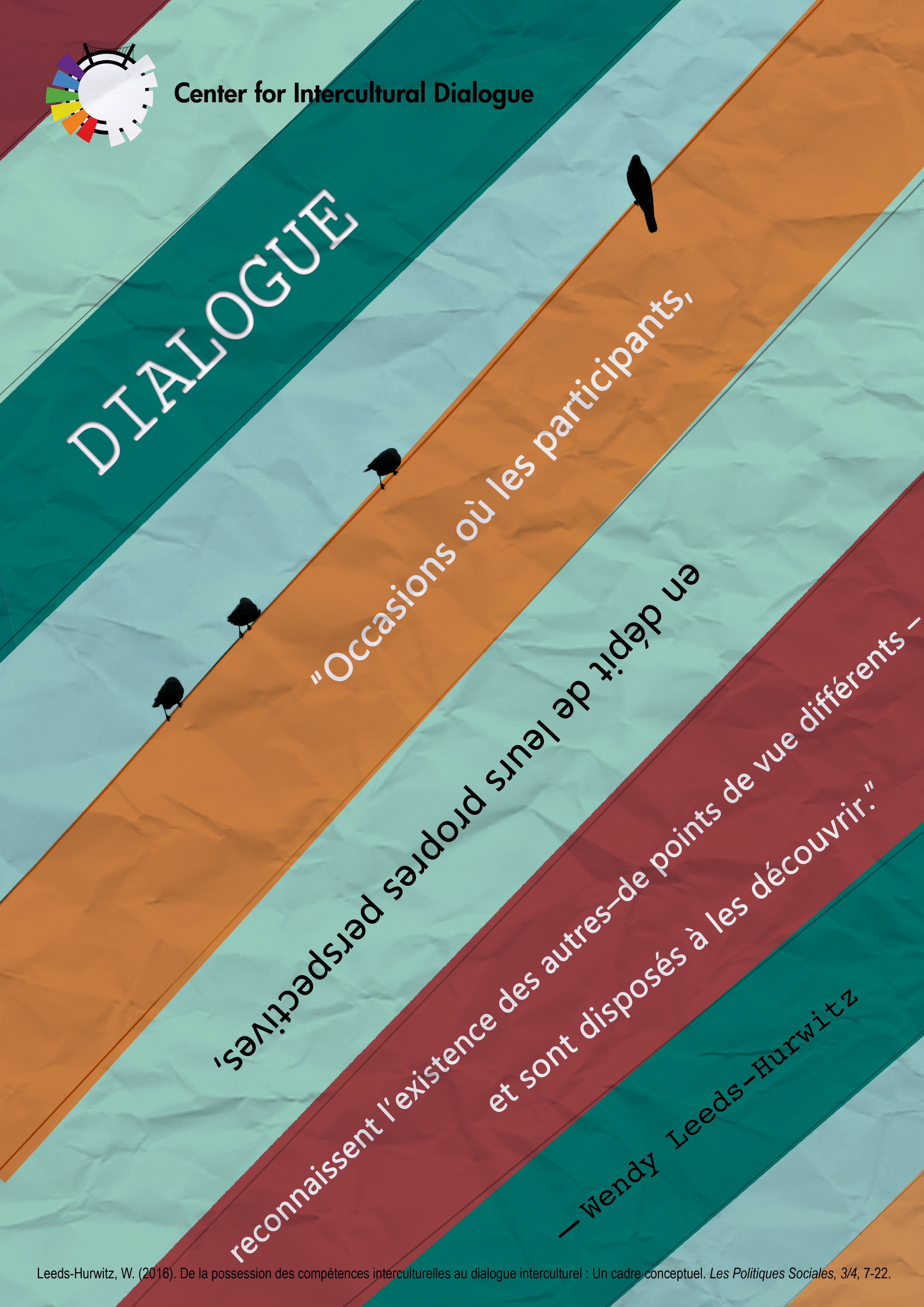
CID Poster 3: Intercultural Dialogue Definition Translated into Italian

CID PostersPoster 3 was designed by Linda J. de Wit, in her role as CID intern. The quote by Peter Praxmarer does not come from a publication, but from a Skype conversation we had on April 25, 2017. I was struck by what he said, and how nicely it summed up the concept of intercultural dialogue, and requested permission to turn the definition into a poster, and he graciously agreed. In terms of visual design, Linda indicated “art” by the picture frame, and “science” by the design in the background. Hopefully this definition will find a wide audience, because I think it does a better and more concise job of explaining intercultural dialogue than other definitions I’ve seen.


The Italian translation was provided by Maria Flora Mangano, and the graphic design work necessary to revise by Yan Qiu. Here then is CID Poster 3: Definizione di dialogo interculturale.

CID Poster 3: Art and science translated into ItalianJust in case anyone wants to cite this poster, the following would be the recommended format:

Center for Intercultural Dialogue. (2025). Definizione di dialogo interculturale [M. F. Mangano, trans.]. CID Posters, 3. Available from:
https://centerforinterculturaldialogue.org/wp-content/uploads/2025/12/cid-poster-3-art-and-science-italian.png

As with other series, CID Posters are available for free on the site; just click on the thumbnail to download a printable PDF. They may be downloaded, printed, and shared as is, without changes, without cost, so long as there is acknowledgment of the source.

As with other series, if you wish to contribute an original contribution, please send an email before starting any work to receive approval, to minimize inadvertent duplication, and to learn about technical requirements. As is the case with other CID Publications, posters should be created initially in English. Given that translations of the Key Concepts in Intercultural Dialogue have received so many views, anyone who wishes to translate their own poster into another language (or two) is invited to provide that as well. If you want to volunteer to translate someone else’s poster into a language in which you are fluent, send in a note before starting, to receive approval and to confirm no one else is working on the same one.

Wendy Leeds-Hurwitz
Director, Center for Intercultural Dialogue
intercult.dialogue AT gmail.com


Creative Commons License
This work is licensed under a Creative Commons Attribution-NonCommercial-NoDerivatives 4.0 International License.