CFP Intercultural Public Relations

“PublicationCall for Chapter Proposals: Intercultural Public Relations: Realities and Reflections in Practical Contexts. Editors: Lan Ni , University of Houston, Qi Wang, Villanova University,  Bey-Ling Sha, California State University, Fullerton. Extended Deadline: April 30, 2020.

The editors are pleased to invite submissions for chapter proposals for a forthcoming Routledge book, Intercultural Public Relations: Realities and Reflections in Practical Contexts. This book is a continuation from their earlier theory book, Intercultural Public Relations: Theories for Managing Relationships and Conflicts with Strategic Publics.

This “practical contexts” book examines how the overall theoretical framework developed in the theory book can have implications to multiple levels of intercultural public relations practices, from training of practitioners to become more interculturally competent, identifying and understanding publics or stakeholders with different cultural backgrounds and identities, building and maintaining relationships with these publics/stakeholders, and managing conflicts with them. These areas represent the most critical functions that public relations and strategic communication contribute to organizational effectiveness and social change: scanning the environment, identifying strategic publics, and building long-term, quality relationships with these publics to reduce costs, gain support, and empower the publics themselves.

Contact Lan Ni for details.

Milton Machuca-Galvez Profile

Profiles

Milton Machuca-Galvez is International Collections Librarian at the University of Kansas, Lawrence, Kansas, USA.

Milton Machuca-Galvez

He holds a Licenciatura in Psychology from UCA in his native El Salvador and a Ph.D. in Anthropology from Temple University, Philadelphia. He is a freelance translator. He has a 25-year teaching-mentoring-advocacy interdisciplinary career in several U.S. higher education institutions. This experience was built upon his undergraduate studies and his work with indigenous communities in Central America; these experiences led to his anthropology Ph.D. and his work with Latino communities in the U.S. He also has administrative, collaborative and organizational development experience as Director of a study abroad program in Costa Rica and Coordinator of a Latin American and Latino Studies interdisciplinary program. He has served as Humanities Librarian and Visiting Scholar at the University of New Mexico, Visiting Instructor at Rutgers University, Visiting Assistant Professor of Latin American and Latino Studies at Swarthmore College, and he has also taught at Claremont Colleges, in California. For further information, see this excellent recent article about him and his work at Kansas.


Work for CID:
Milton Machuca-Galvez translated KC1: Intercultural Dialogue into Spanish, and has served as a reviewer for Spanish.

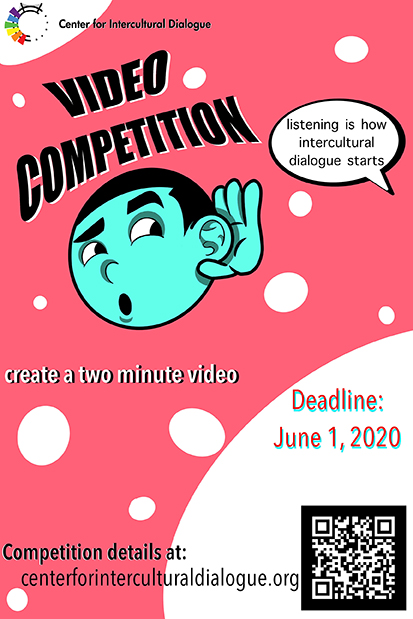
CID Video Competition 2020: Listening is How Intercultural Dialogue Starts

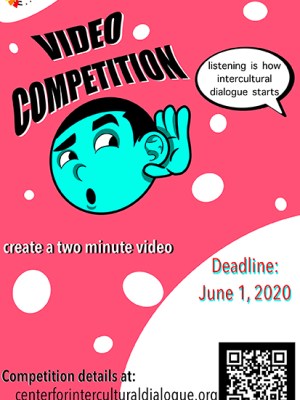
Job adsThe Center for Intercultural Dialogue announces its third annual video competition, open to students enrolled in any college or university during spring 2020. Deadline: June 1, 2020, at midnight (east coast US time). Submissions now open.
CID Video Competition 2020


This year’s competition asks students to focus on listening, as listening is how intercultural dialogue starts.

Listening gives shape to speaking, inviting other people into a dialogue…Our acts of listening, like all communication, are shaped by our cultural and individual differences. – Elizabeth S. Parks

Listening is what happens when people stop focusing on what they say or do, and start attending to what someone else is saying or doing. Without listening, there can be no intercultural dialogue.

Intercultural dialogue is the art and science of understanding the Other. – Peter Praxmarer

Intercultural dialogue can include international, interracial, interethnic, and interfaith interactions, but it is always active (people doing something) rather than passive (people thinking about something).

Faculty members are invited to discuss intercultural dialogue in a class, perhaps showing winning entries from 2018 or 2019, and to suggest that students produce very short videos as their response. Students are encouraged to be creative, show off their knowledge and skills, and have fun with the topic.

The top award winner will receive a $200 prize. And the top three winners will receive a copy of Elizabeth Parks’ 2019 book, The Ethics of Listening: Creating Space for Sustainable Dialogue, courtesy of the publisher, Lexington Books.

All award-winning entries will be posted to the CID YouTube channel, and highlighted on the CID website, LinkedIn group, Facebook group, and Twitter feed, through posts describing the creators and highlighting each of their videos. Perhaps most important to student learning, all entries will be sent comments from the judges. Past winning entries have come from Italy, the UK, Peru, Spain, Denmark, Hong Kong, and the USA.

In addition to the rules below, a list of Resources and FAQ have been posted, as well asReflection by winning students, which provides peer-to-peer advice. Contact Wendy Leeds-Hurwitz, CID Director, with any questions.

Competition Rules:

  1. Entries must be between 30 seconds to 2 minutes in length. Longer videos will be disqualified.

  2. Entries may be submitted May 1-June 1, 2020. CID is not responsible for any entry that is misdirected, corrupted, or not received by this date. Judging will occur in June, and winners will be announced in July.

  3. Submissions will be evaluated based on: originality, clarity, showing how listening permits intercultural dialogue, effective use of technology, and overall impact.

  4. All part-time or full time undergraduate or graduate students (post-graduates for those outside the USA) currently enrolled at any university or college or community/ technical college/school, anywhere in the world, are eligible. If high school students wish to join in, they are welcome as well. Students can work independently or in groups. Given the topic, incorporating more than one viewpoint may be particularly appropriate. Ensuring that at least someone in the group knows something about the idea of intercultural dialogue, and at least someone has created a video before, should be useful.

  5. Videos should be created by students, not edited and corrected ahead of time by their instructors. Students must submit videos themselves.

  6. In addition to a video, each entry must be accompanied by a completed brief information form about the creator(s). This will be used as a resource in contacting winners, and then in sharing information about them on the CID website and other social media at the end of the competition.

  7. By submitting your entry, you are attesting that you have the necessary authorization to use the images, audio, text, music, and any other content contained in your video. Please do not enter if you are in violation of, or uncertain of your rights to, any copyrights, patents, trademarks, video, music or other intellectual property. Consult your faculty advisor if you have any questions or doubts about the content of your entry. Online resources include the Documentary Filmmakers Statement of Best Practices in Fair Use and the Code of Best Practices in Fair Use for Online Video; these and other such best-practices codes are available from the Center for Media and Social Impact.

  8. Submissions found incomprehensible, inappropriate, or in violation of intellectual property rights for any reason in the sole judgment of CID will not be accepted into the competition.

  9. Funding for the first prize cash award is provided by the Broadcast Education Association (BEA), one of the members of CID’s parent organization, the Council of Communication Associations.

Hamad Bin Khalifa U: Intercultural Communication (Qatar)

“JobOpen rank faculty position in Intercultural Communication, College of Humanities and Social Sciences, Hamad Bin Khalifa University, Doha, Qatar. Deadline: March 28, 2020.

The College of Humanities and Social Sciences (CHSS) invites applications for Open Rank positions in the field of Intercultural Communication. The successful candidate will have long-standing experience in this field, a dynamic and innovative research agenda, as evidenced through an internationally recognized, strong record of peer-reviewed publications. The candidate will work closely with other programs in the college, in particular the PhD Program in Humanities and Social Sciences, and with national, regional and international partners and stakeholders.

The same university also has a position available in Translation Studies.

U Groningen: Intercultural Competence Trainer (Netherlands)

“Job

Senior Intercultural Competence Trainer (0.6-0.8 FTE), Language Centre, University of Groningen, Groningen, Netherlands. Deadline: 22 March 2020.

Design, build and delivery of a broad range of intercultural competence training for various faculties of the University, in the context of the University’s Language and Culture policy. The primary target audience will be faculty, but the candidate should be able to adapt training delivery style to the audience: students, external clients or businesses.
You will be part of a community of advanced practitioners, engaged in high level theoretical exchange, with an extensive international network.

Massey U Expedition & Internship Program (New Zealand)

Study AbroadMarketing and Communication, National Expedition and Internship Program, Massey University, Wellington, New Zealand, June 8-July 17, 2020. Deadline: March 16, 2020.

Massey University’s National Expedition and Internship Program is open to undergraduate students from any university wishing to study, travel, and intern in New Zealand for 6 weeks in June-July 2020. The program is organised by the ACEJMC-accredited School of Communication, Journalism and Marketing, and it begins with the two week ‘Image and Identity Tour’ which takes students across both Islands to delve into how successful the brands and images of the tourism industry are at capturing the attention of people new to the country and culture.

The tour finishes in the capital city of Wellington where students stay to complete a four week internship working on real world problems relevant to their degrees in Journalism, Media Studies, Public Relations, Advertising, Marketing, Communication, or related areas.

KC35 Media Ecology Translated into Portuguese

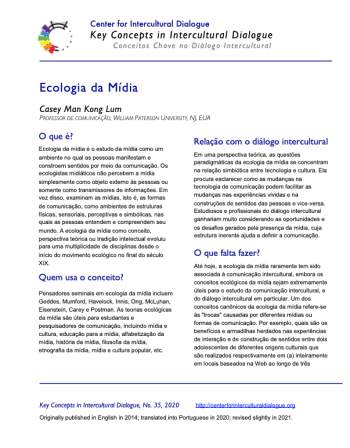
Key Concepts in ICDContinuing translations of Key Concepts in Intercultural Dialogue, today I am posting KC#35: Media Ecology, which Casey Man Kong Lum wrote for publication in English in 2014, and which Jessika Rezende Souza da Silva has now translated into Portuguese.

As always, all Key Concepts are available as free PDFs; just click on the thumbnail to download. Lists of Key Concepts organized alphabetically by conceptchronologically by publication date and number, and by languages into which they have been translated, are available, as is a page of acknowledgments with the names of all authors, translators, and reviewers.


KC35 Media Ecology_PortugueseLum, C. M. K. (2020). Media da ecology. (J. R. Souza da Silva, trans). Key Concepts in Intercultural Dialogue, 35. Available from:
https://centerforinterculturaldialogue.org/wp-content/uploads/2021/05/kc35-media-ecology_portuguese-v2.pdf

If you are interested in translating one of the Key Concepts, please contact me for approval first because dozens are currently in process. As always, if there is a concept you think should be written up as one of the Key Concepts, whether in English or any other language, propose it. If you are new to CID, please provide a brief resume. This opportunity is open to masters students and above, on the assumption that some familiarity with academic conventions generally, and discussion of intercultural dialogue specifically, are useful.

Wendy Leeds-Hurwitz, Director
Center for Intercultural Dialogue


Creative Commons License
This work is licensed under a Creative Commons Attribution-NonCommercial-NoDerivatives 4.0 International License.

MOOC Intercultural Communication (China)

“MOOCs”Intercultural Communication MOOC, Shanghai International Studies University (SISU), Shanghai, China. Opens March 2, 2020 with free access for 7 weeks from any start date between March-July 2020.

Virtual education is especially being promoted across China or other affected areas to limit the spread of the Corona virus. To help students from anywhere connect with the world during this time, the SISU “Intercultural Communication” course is being offered again as a MOOC (Massive Open Online Course).

This introductory 5-week course (doable in about 4 hours per week) seeks to engage global learners to better appreciate, adjust to, and work or study in different cultures. The weekly topics focus on (1) comprehending intercultural communication, (2) contextualizing cultural identities, (3) comparing cultural communication styles (4) clarifying and contrasting values, and (5) cultivating intercultural adaptation.

For those who may also be interested in languages, SISU/FutureLearn are also opening 3 other introductory courses for learning Chinese at the same time: Chinese Pronunciation and Tones, Chinese Grammar, and Chinese Conversation.


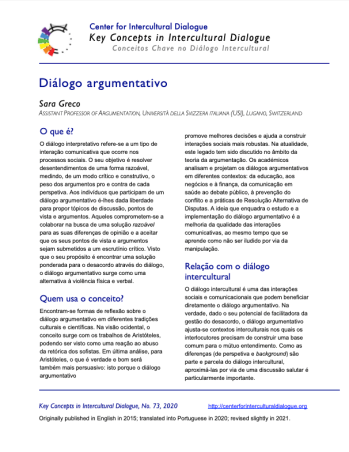
KC73 Argumentative Dialogue Translated into Portuguese

Key Concepts in ICDContinuing translations of Key Concepts in Intercultural Dialogue, today I am posting KC#73: Argumentative Dialogue, which which Sara Greco wrote in English for publication in 2015, and  which Filipa Subtil has now translated into Portuguese.

As always, all Key Concepts are available as free PDFs; just click on the thumbnail to download. Lists of Key Concepts organized alphabetically by conceptchronologically by publication date and number, and by languages into which they have been translated, are available, as is a page of acknowledgments with the names of all authors, translators, and reviewers.


KC73 Argumentative Dialogue_PortugueseGreco, S. (2020). Diálogo argumentativo. (F. Subtil, trans). Key Concepts in Intercultural Dialogue, 73. Available from:
https://centerforinterculturaldialogue.org/wp-content/uploads/2021/05/kc73-argumentative-dialogue_portuguese-v2.pdf

If you are interested in translating one of the Key Concepts, please contact me for approval first because dozens are currently in process. As always, if there is a concept you think should be written up as one of the Key Concepts, whether in English or any other language, propose it. If you are new to CID, please provide a brief resume. This opportunity is open to masters students and above, on the assumption that some familiarity with academic conventions generally, and discussion of intercultural dialogue specifically, are useful.

Wendy Leeds-Hurwitz, Director
Center for Intercultural Dialogue


Creative Commons License
This work is licensed under a Creative Commons Attribution-NonCommercial-NoDerivatives 4.0 International License.

Migration Policy Institute: Editor/Communications Officer (USA)

“JobMigration Policy Institute (MPI), a nonpartisan, nonprofit think tank dedicated to the study of U.S. and international migration policies (Washington, DC) is advertising two positions:

1. Communications Officer, Deadline: March 22, 2020.

MPI seeks a highly motivated Communications Officer to join its dynamic team in Washington, DC to help extend the organization’s visibility, reach, and impact. The successful candidate will play a significant role in developing the marketing content and strategies the Institute uses to disseminate its research and data, and helping shape its broader external relations, including identification of target audiences and effective engagement. As a core member of a high-functioning, fast-paced communications team, the officer’s duties will include digital content creation and strategy; media relations and writing of press releases and other short-form materials; outreach to new audiences; editing; and assisting in the promotion of MPI’s public and private events, conferences, and webinars. While assignments will vary day to day, the successful candidate must be a creative, detail-oriented, quick, versatile professional who can prioritize between quick turnaround projects and longer-term deliverables, working collaboratively with colleagues across the Institute yet able to operate independently as well.

2. Editor, Migration Information Source. Deadline: March 6, 2020.

MPI also seeks a highly motivated, exceptionally creative, and deadline-oriented editor and writer to become Editor of the Migration Information Source, an internationally recognized online journal. The Source is a unique publication that melds the best features of migration scholarship and policy/data analysis in ways that are newsy and accessible for readers who are interested in migration but not necessarily specialists.

The Editor will be responsible for all facets of production of the Source, which publishes articles online and promotes them via a bimonthly e-newsletter. The successful candidate will be able to craft and implement a strong editorial vision for the Source, identifying topics and cultivating authors who can best tell some of the most interesting and important developments in migration research, policy, and trends around the world. He or she will demonstrate superb editing skills (organizational, copy-editing, and fact checking), with a strong aptitude for translating academic- or policy-focused research for general-interest audiences; and will have demonstrated marketing and social media skills to promote the Source and its work in innovative and effective ways.The Editor will be based in Washington, DC, and will report to MPI’s Director of Communications.