CFP Networking East and West

CONFERENCE INVITATION AND CALL FOR PAPERS
Networking East and West: Communications, Commerce, Culture

For many centuries, the East and the West have been entangled in dense networks of communications and commerce. Yet only in our current age of globalization, influenced by a generation of media theorists shaped by the emergence since the 1970s of digital media, has it become customary to interpret these networks as a distinctive social relationship with a pervasive and enduring influence on culture, economics, politics, and international relations. For these theorists, media is more than a representation: in addition, and more fundamentally, it is an institutional practice laden with cultural meaning.

Media scholars in Asia, Europe, Australia, and North America from disciplines that include but are not confined to history, sociology, political science, literature, anthropology, geography, and media studies share a commitment to increasing our understanding of these networks so as to enhance mutual understanding, foster a common research agenda, and nurture an academic community that lowers cultural barriers. To promote this goal, a conference on the theme of “Networking East and West: Communications, Commerce, Culture” will be convened in Renmin University, China, on July 11 -12, 2014. The papers in this conference explore the conflicts, commonalities, and contrasts that have shaped communications networks linking East and West, with a focus on China, the Pacific Rim, and the United States in the period between the mid-nineteenth century and the Second World War.  The call for papers is intended to encourage submissions on a broad range of topics from various disciplinary perspectives. Possible topics include: journalistic ethics, technology transfer, telegraphy, print culture, and media theory.  Papers need not be explicitly comparative, though all should address the conference theme.

Specific details about the conference are as follows:
I.      Conference Title: “Networking East and West: Communications, Commerce, Culture”
II.     Hosts: Confucius Institute Headquarters (Hanban); Confucius Institute at Columbia University
III.    Organizer: School of Journalism and Communication, Renmin University, China
IV.     Co-organizers: Columbia Journalism School, Fudan Journalism School
V.      Theme: the conflicts, commonalities, and contrasts that have shaped communications networks linking East and West
VI.     Venue: Beijing, China
VII.    Date: July 11-12, 2014 (Registration deadline: July 10, 2014)

Participants should send the texts of their proposed papers by June 1 to the organizing committee at mediaculture2014@163.com. Successful proposals will be announced on June 15.  Participants are responsible for their own transportation and accommodation expenses.

Contact (U.S.):
Prof. Richard R. JOHN
Tel: (+1) 212-854-7837

Contact (China):
Dr. CHANG Jiang
Tel: (+86) 139-1151-1157

Further Details:
1.      The proposed paper can be written either in English or Chinese.
2.      The paper’s content shall be relevant to the conference theme.
3.      English-language papers shall be 6,000-10,000 words long; Chinese-language papers shall include 8,000-12,000 characters.
4.      Papers will include: title, name and introduction of the author, abstract, key words, main body, annotations, etc. For the Chinese-language papers, authors are required to supply an English-language title, abstract and keywords. There is no such requirement for English-language papers.
5.      All citations shall be formatted as endnotes in accordance with the conventions described in The Chicago Manual of Style (CMS).
6.      Proposals shall be sent to the organizing committee before June 1, 2014 in Microsoft Word format (.doc/ .docx).

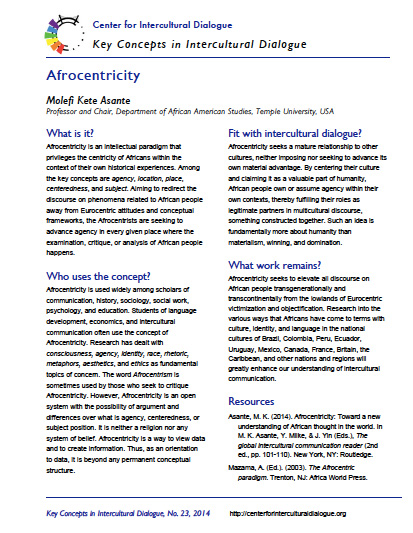
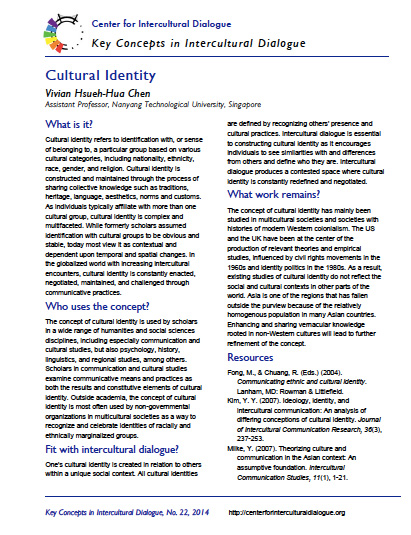
Key Concepts #10: Cross-Cultural Dialogue by Wendy Leeds-Hurwitz

Key Concepts in ICDThe next issue of Key Concepts in intercultural Dialogue is now available. This is KC10: Cross-Cultural Dialogue by Wendy Leeds-Hurwitz. As always, all Key Concepts are available as free PDFs; just click on the thumbnail to download.Lists organized  chronologically by publication date and numberalphabetically by concept in English, and by languages into which they have been translated, are available, as is a page of acknowledgments with the names of all authors, translators, and reviewers.

KC10-sm

Leeds-Hurwitz, W. (2014). Cross-cultural dialogue. Key Concepts in Intercultural Dialogue, 10. Available from:
https://centerforinterculturaldialogue.org/wp-content/uploads/2014/04/key-concept-cross-cultural-dialogue.pdf

The Center for Intercultural Dialogue publishes a series of short briefs describing Key Concepts in intercultural Dialogue. Different people, working in different countries and disciplines, use different vocabulary to describe their interests, yet these terms overlap. Our goal is to provide some of the assumptions and history attached to each concept for those unfamiliar with it. As there are other concepts you would like to see included, send an email to the series editor, Wendy Leeds-Hurwitz. If there are concepts you would like to prepare, provide a brief explanation of why you think the concept is central to the study of intercultural dialogue, and why you are the obvious person to write up that concept.


Creative Commons License
This work is licensed under a Creative Commons Attribution-NonCommercial-NoDerivatives 4.0 International License.

CFP Fulbrights 2015-16

The 2015-2016 Fulbright Core U.S. Scholar Program competition is now open.

The Fulbright Scholar Program offers teaching, research or combination teaching/research awards in more than 125 countries for the 2015-2016 academic year. Opportunities are available for college and university faculty and administrators as well as for professionals, artists, journalists, scientists, lawyers, independent scholars and many others.

Of the 583 awards being offered this year, there are over 64 awards available in the field of Communications.  Moreover, there are 371 All Discipline awards that welcome teaching and/or research proposals in any area of study, including interdisciplinary projects. These awards are offered in various regions around the world.

In order to meet the changing needs of academia and develop new options to accommodate better the interests and commitments of today’s scholars, the program has introduced several innovations to the 2015-2016 program, including: Fulbright Flex Awards, Fulbright Postdoctoral/Early Career Awards, Salary Stipend Supplements, and Teaching English as a Foreign Language Awards.

Interested faculty and professionals are encouraged to learn more about these opportunities, and hundreds of others, by visiting the Catalog of Awards.

The application deadline for most awards August 1, 2014.  U.S. citizenship is required.  For other eligibility requirements and detailed award descriptions visit our website  or contact us via email.

Save

Loughborough U (UK) Research Associate positions

2 Research Associate positions, Screening Socialism, Loughborough University, UK

These are 12 month, full-time Research Associate posts, required to work on the Leverhulme Trust-funded project Screening Socialism: Television and Everyday Life in Socialist Eastern Europe. Key tasks include independent archival research and interviewing in one countries and dissemination of results. Suitable candidates will hold a PhD in a relevant subject or be close to completion, and have the relevant research, analytical and linguistic skills to enable research on one of the former socialist countries: Poland, Hungary, Czechoslovakia, Bulgaria, Romania, Albania.

To apply, follow this link. You will need to search for the position using ‘Research Associate’ and then register to access the on-line form.

Closing date: 1 May 2014.
Interviews will be held on 15 May 2014.
Preferred starting date: 1 August 2014.

For informal queries contact: Dr. Sabina Mihelj, the Principal Investigator of the project.

Screening Socialism is an innovative new research project devoted to researching the history of popular television in socialist Eastern Europe, and its legacy on popular memories of the socialist period. After Stalin’s death, improved provision of consumer goods, increases in leisure time, and a rise in living standards were seen as a means for legitimising socialist rule. Popular television was an important conduit for this privatisation of politics, a space where the social imaginary of the socialist ‘good life’ was shaped and debated. Did socialist television de-politicise socialist culture and undermine public engagement in political processes, or did it succeed in bringing public affairs to a much wider audience? Screening Socialism sets out to find out.

CFP Health and Medical Discourses CDQ issue

CFP: Special Issue on Health and Medical Discourses
Communication Design Quarterly
(Fall 2015 special issue)

In today’s often bewildering world of scientific, technological, cultural, and political change, medicine faces human problems and possibilities that transcend traditional academic disciplines. As such, communication about health and medicine is ever more important in shaping our understandings of our cultures, our politics, and ourselves. In an effort to map the changing climate of health care and medical communication, Communication Design Quarterly invites proposals for a Fall 2015 special issue on health and medicine.

Recent discussions at the intersections of English Studies, communication studies, and technical and professional communication have emphasized the importance of key issues including dissemination, ethics, connections, theory, and methods. Further, scholars have noted the importance of considering how conversations about health care are always already inflected by popular understandings of genetics, disease, and embodiment. This special issue seeks to expand these conversations by contributing to a growing body of collaborative and interdisciplinary work in health, medicine, and society. Submissions may focus on exploring and critiquing communication design concepts and practices that shape our understandings of health and medicine; pathology, disease, and illness; ability, choice, and access; and/or wellness and fitness. We additionally welcome interrogation of tensions between public health and privatized health care, neuroscience and enculturated practice, and reproductive health care and privilege in popular communication as well as investigation of gendered and racialized patterns of care and their uptake in news media. We are especially interested in submissions that include discussion of interdisciplinary approaches, environmental rhetorics, visual communication, and experiential/embodied knowledges. Further, we are excited to consider proposals for pieces that subvert and transgress the conventions of traditional scholarly articles. Collaborative essays, multimodal works, photo essays, posters, and other alternative media are strongly encouraged.

Potential questions that submissions might address include:
*       What do evolving definitions of medical rhetoric/health communication make possible and/or limit?
*       What are the primary distinctions, contradictions, and connections between humanities-based orientations and social sciences-based orientations to health and medical communication?
*       What are best practices in the design of health and medical communication?
*       How do health and medical researchers disseminate their work and what implications do common rhetorical choices in those communications have?
*       What productive points of confluence in theory and methods work can help to produce more efficient health and medical communication? And for whom must health and medical communication be efficient?
*       What practices can technical communicators engage in to promote social justice in the contexts of health and medical communication?
*       How can various approaches to the design of health and medical communication affect public perceptions of risk and ethical accountability?
*       What research challenges do health and medical communications researchers face?
*       What roles do the Internet and social media play in health communication?
*       In what ways have recent political interventions altered the ways we communicate about health and medicine, and what might this mean for future health/medical communicators and practitioners?

Please send article proposals of up to 500 words and a short c.v. to Lisa Meloncon and Erin Frost.

Schedule is as follows:
*       Proposals due:  May 1, 2014
*       Notifications for full drafts: May 15, 2014
*       Full drafts due: December 1, 2014
*       Final revisions due: April 1, 2015

International Week Tampere U Applied Sciences (Finland)

Tampere University of Applied Sciences (TAMK), School of Vocational Teacher Education organizes an international week in Tampere 6th – 10th May 2014. Theme of the week is Individual Learning Paths. The program will consist of lectures and presentations, excursions and meetings. The presentations and lectures of participants are very welcome. It is also possible to discuss new project plans during the event. TAMK offers other international weeks for other audiences.

Registration is asked by 11th April 2014.

For more information about International Week, please contact Maija Joensuu.

SUNY Oswego job ad in strategic communication

Assistant or Associate Professor and Graduate Coordinator in Strategic Communication at SUNY Oswego

The Department of Communication Studies at the State University of New York at Oswego is searching for a tenure track Assistant or Associate Professor and Graduate Program Coordinator in Strategic Communication. The appointed candidate will play a principal role in developing a new graduate curriculum in Strategic Communication, while also teaching advanced undergraduate courses. The candidate should specify in her/his application the areas of teaching specialty including but not limited to the following: strategic use of new media, organizational communication, and health communication. Specialties in communication strategies in the global environment, workplace diversity, and leadership are a plus. Successful candidates for this position will also demonstrate a commitment to sustaining a program of original research and publication. Additional responsibilities will include academic advising, student mentoring, and participation in service activities. The successful applicant will be expected to display a demonstrated potential for excellence in teaching and scholarship, a commitment to undergraduate and/or graduate education, and possess communication and interpersonal skills sufficient to work effectively with an increasingly diverse array of students and colleagues. Review of applications will begin immediately.

Save

Radboud U (Netherlands) job ad

RADBOUD UNIVERSITY, NIJMEGEN, THE NETHERLANDS, Faculty of Social Sciences
Full Professor of Communication Science, News and Information Transfer

Radboud University invites applications for a full professor (0.8-1.0 fte). As Professor of News and Information Transfer, your main responsibility will be to consolidate the domain of mediated news and information transfer in research and in teaching. Positioned within the program of Communication Science, this domain focuses on the production and content and, particularly, the reception of news and information. The leading question is how government, news organizations and other institutions can inform citizens in today’s media environment where information is around us, everywhere and all the time, and where the role of media users (e.g. individuals, organizations) and their social networks is increasingly important.

Communication Science is part of the Faculty of Social Sciences, which is one of the largest faculties at Radboud University. The faculty’s ambition is to become one of the top social science institutes in Europe, providing high-quality research and study programs that rank among the best in the Netherlands.

This position concerns a temporary experimental chair with regular appointment for the duration of five years with the possibility of tenure as a permanent chair after five years. For more information on the vacancy and on the application procedure, please visit their website.

Application deadline: 17 April 2014

Roundtable on Intercultural Dialogue in Asia (Macau)


Roundtable portrait
Left to right, front row: Croucher, Sandel, Leeds-Hurwitz, L. Chen; middle row: V. Chen, Dawis, Lijadi, P. Lu, Huang, Jiang; back row: Buttny, Corbett, Witteborn, Young

The Roundtable on Intercultural Dialogue in Asia was held at the University of Macau on March 28-30, 2014. The organizers were Todd Sandel (Communication, University of Macau), John Corbett (English, University of Macau) and Wendy Leeds-Hurwitz (Center for Intercultural Dialogue). By design, this was a small event, designed to answer the question of whether, and in what ways, intercultural dialogue might be a useful term for discussing intercultural interactions in Asia. Sessions focused on such topics as what concepts aid in the study of intercultural dialogue, how intercultural competence fits with intercultural dialogue, and what needs to happen next, and various publication outlets. At least one special journal issue will result.

Martin Montgomery (Dean, Faculty of Arts and Humanities) officially welcomed participants on behalf of the University of Macau. Participants included Saskia Witteborn (Chinese University of Hong Kong), Richard Buttny (Syracuse University, currently doing research in Malaysia), Stephen Croucher (University of Jyväskylä, Finland), Ling Chen (Hong Kong Baptist University), Jiang Fei (Chinese Academy of Social Sciences), Huang Kuo (International Publishing Group, Beijing),  Aimee Dawis (University of Indonesia), Vivian Hsueh Hua Chen (Nanyang Technological University, Singapore, and University of Tasmania-Launceston, Australia), Peih-ying (Peggy) Lu (Kaohsiung Medical University, Taiwan), Melody Lu (Sociology, University of Macau), Priscilla Young (Peking University HSBC Business School, Shenzhen), and Anastasia Aldelina Lijadi (Psychology, University of Macau). Multiple masters and doctoral students in both Communication (Julie Zhong, Fiona Ng, Hazel Wan) and English (Carl, Dai Guangrong and Betty, Liu Suiling) managed some of the logistics, helping international visitors get around the city, picking up lunches, and serving as photographers and videographers. Administrative Staff, Barbara Chin (Communication) and Tina Chao (English) also spent many hours preparing documents and making travel, hotel, and other arrangements.

The highlight of the conference (at least for me) was gaining a sense of intercultural issues across Macau, Hong Kong, Taiwan, mainland China, Singapore, Malaysia and Indonesia, and simultaneously across disciplinary, theoretical and methodological boundaries. Since this was a small group, there were lots of opportunities for participants to connect, and at least one journal special issue and several new research collaborations are being planned, as well as a future conference. Most immediately, researcher profiles for more of the roundtable participants already are being posted to this website, and half a dozen have committed to writing Key Concepts in Intercultural Dialogue, to be posted over the next few weeks and months.

A short highlights video was prepared and is readily available. In addition, Aimee Dawis sent in a photo of coverage about the Roundtable in the International Daily News, a Chinese newspaper with the highest circulation in Indonesia:

International Daily News

Thanks to Aimee for arranging for this article, and to the University of Macau for being such a wonderful host institution for this event.

Wendy Leeds-Hurwitz, Director
Center for Intercultural Dialogue

Save

Save

John Corbett Profile

ProfilesJohn Corbett (PhD, Glasgow University 1992) is a Professor in the English Language and Literature Studies program at BNU-HKBU United International College in Zhuhai, China.

John CorbettHis work on intercultural language education engages with the roles curriculum design and classroom tasks play in the development of intercultural communicative competence, most recently in situations of conflict and extended crisis. He is also interested in the interaction between intercultural language education and professionalism in domains such as medicine and tourism. He is the author of An Intercultural Approach to English Language Teaching (Multilingual Matters, 2003, second edition 2022), Intercultural Language Activities (Cambridge University Press, 2010) and (with Peih-ying Lu) of English in Medicine: An Intercultural Approach to Teaching Language and Values (Multilingual Matters, 2012). He has authored and co-authored numerous articles and book chapters, including (with Wendy Anderson and Alison Phipps) explorations of intercultural language learning and telecollaboration. He was editor of the journal Language and Intercultural Communication between 2004-9. While he works in Asia, he also has strong links with Brazil, where he has been President of the BRAZ-TESOL Special Interest Group on Intercultural Language Education.

Go to his website for further details.


Work for CID:

John Corbett wrote KC9: Communicative Competence, was interviewed on this topic, and has co-authored a guest post on Critical Intercultural Pedagogy for Difficult Times. He also was one of the organizers of the Roundtable on Intercultural Dialogue in Asia, co-sponsored by CID.