Art & Intercultural Dialogue

“Book NotesGonçalves, S., & Majhanovich, S. (Eds.). (2016). Art and intercultural dialogue. Rotterdam: Sense Publishers.

How can art act as an intercultural mediator for dialogue? In order to scrutinize this question, relevant theoretical ideas are discussed and artistic intervention projects examined so as to highlight its cultural, political, economic, social, and transformational impacts. This thought-provoking work reveals why art is needed to help multicultural neighbourhoods and societies be sustainable, as well as united by diversity. This edited collection underlines the significance of arts and media as a tool of understanding, mediation, and communication across and beyond cultures. The chapters with a variety of conceptual and methodological approaches from particular contexts demonstrate the complexity in the dynamics of (inter)cultural communication, culture, identity, arts, and media. Overall, the collection encourages readers to consider themselves as agents of the communication process promoting dialogue.

Contents and Preface

Suzanne Majhanovich Profile

ProfilesSuzanne Majhanovich is Professor Emerita/Adjunct Research Professor at the Faculty of Education, Western University in London, Ontario, Canada.

Suzanne Majhanovich

She is the past Chair of the WCCES Standing Committee for Publications and the former editor of the journal Canadian and International Education. With Allan Pitman, she is the co-editor of the Series A Diversity of Voices published by Sense. She has served as guest editor of four special issues of the International Review of Education related to presentations from the World Congresses of Education held in Havana, Cuba; Sarajevo, Bosnia; Istanbul, Turkey and Buenos Aires, Argentina. Her research interests include first and second language acquisition, the teaching of English as a Foreign Language in international contexts, globalization, education restructuring, decentralization and privatization of education.

Selected publications:

Cristaldi, M., Majhanovich, S., & Pampanini, G. (Eds.). (2017). The orbital classroom. Global teachers committed to global democracy. Tehran, Iran: Nahj Al-Bakaghah International Research Institute.

Geo-JaJa, M. A., & Majhanovich, S. (2017). The promise and pitfalls of development aid: The elusive goal of aid that helps people help themselves. World Studies in Education18(1), 37-59.

Majhanovich, S., & Deyrich, M.-C. (Eds.). (2017).  Special issue: Language learning to support active social inclusion: Issues and challenges for lifelong learning. International Review of Education: Journal of Lifelong Learning, 63(3-4).

Geo-JaJa, M. A., & Majhanovich, S. (Eds.). (2016). Effects of Globalization on Education Systems and Development: Debates and Issues. Springer.

Gonçalves, S., & Majhanovich, S. (Eds.). (2016). Art and intercultural dialogue. Sense.

Majhanovich, S., & Malet, R. (Eds.). (2015). Building democracy through education on diversity.  Sense.

Intercultural Communication or Post-Cultural Communication?

Guest PostsGuest Post by Paola GiorgisIntercultural communication or post-cultural communication? Reflecting on mistakes in intercultural encounters.

Some years ago, I worked with a total of about 350 refugees who, with the help of some radical activists, had become squatters, taking over an empty building which occupied almost an entire block. Most were from Somalia, Eritrea and Sudan; the majority were young men, a few women with children, and there were one or two couples with babies. A group of associations had gathered to offer help and, as an activist and volunteer in an association for human rights, I decided to participate. With the on-and-off support of the local Institutions (mainly town council and prefecture), the group of associations developed a project which had the goal of meeting basic needs – food, shelter, health care – and then organizing the integration of the refugees into the region through accommodation, language classes and vocational training courses. What I liked about this project was that its goal was not assistance, but rather creating a path to autonomy and independence. The first to be integrated were the women with their children, then the vulnerable males (young men with diseases or handicaps), and then all the rest. The project lasted for about one year, and at the end of that time, all the refugees were, more or less successfully, integrated and settled in the region.

Read the full essay.

Lessons on Storytelling

Resources in ICD“ width=For anyone who needs to tell a story online, the following news may be relevant:

Pixar has partnered with the online alternative learning resource Khan Academy to provide free lessons on digital storytelling, in a new course called The Art of Storytelling. This is presented as part of a series entitled Pixar in a Box, intended to share information about how Pixar develops its films. Earlier sequences cover topics such as Animation and Simulation.

Radboud U Job Ad: Communication Science & Artificial Intelligence (Netherlands)

RADBOUD UNIVERSITY, The Netherlands

Radboud University is seeking a colleague to expand our research and teaching programs in communication science with specific expertise in the area of artificial intelligence, focusing on the communication between individuals and intelligent media technologies. The professor will have a strong focus on artificial intelligence and machine learning techniques for advancing the study of mediated communication and its uses and effects.
Application deadline: 15 March 2017

Georgetown U Postdoctoral Fellowship: Chinese Scholar of Religious Studies

Call for Applications: Postdoctoral Fellowship for Chinese Scholar of Religious Studies

Georgetown University‘s Berkley Center for Religion, Peace, and World Affairs in Washington, D.C., invites applications for a postdoctoral fellowship for the fall 2017 semester. Candidates should be based at a Chinese university or institute, engaged in research at the intersection of religion, society, and world affairs, and have a strong command of English. The 5-month fellowship (August-December 2017) is open with respect to academic discipline, and it carries a $20,000 stipend plus health insurance and travel allowance. The fellowship includes a 12 hour/week commitment to help develop Chinese-language resources for the Berkley Center and Georgetown websites.
Applicants should send a letter of interest, CV, and contact information for three references via email to berkleycenter@georgetown.edu by midnight on Sunday, March 26, 2017. Decisions will be made by late April 2017.

Central European U Job Ad: International Relations (Hungary)

Assistant Professor in International Relations
Department of International Relations
Central European University
Budapest, Hungary
Closes: 21st March 2017

Starting date: August 1, 2017

The Department of International Relations at Central European University invites applications for a full-time Assistant Professor position in International Relations with an emphasis in the field of International Organization, encompassing teaching and research responsibilities related to transnational or international integration processes, and formal and informal international institutions.

Preference will be given to applicants with rigorous methodological training and commitment to methodological pluralism. Further advantages include regional expertise in the European, post-Soviet or Middle East areas, a track record of fieldwork research and/or policy or civic engagement.

Applicants should have, or be close to completing, a PhD in international relations, political science, or sociology and provide evidence for high level achievements to date or outstanding potential in research and teaching. Specific responsibilities include teaching three graduate courses per academic year, master’s and doctoral supervision, engaging in high quality academic research, and attracting external research grants.

Review of applications will begin 3 April 2017 and will continue until the position is filled.

Central European University (CEU) is a graduate research-intensive university specializing in the social sciences, humanities, law, public policy and management. It is located in Budapest and accredited in the United States and Hungary. CEU’s promotes high level research, research-based teaching and learning and civic engagement, in order to contribute to the development of open societies in Central and Eastern Europe, the former Soviet Union, and other emerging democracies throughout the world. CEU offers both Master’s and doctoral programs, and enrolls about 1400 students from nearly 100 countries. The teaching staff consists of more than 180 resident faculty from over 40 countries, and prominent visiting scholars from around the world. The language of instruction is English.

Susana Gonçalves Profile

Profiles

Susana Gonçalves, PhD in Psychology, is Professor at the Polytechnic of Coimbra, in Coimbra, Portugal.


Susana Gonçalves

She is a researcher at NIEFI, the Research Unit for Education, Training and Intervention (Escola Superior de Educação de Coimbra) and she teaches Psychology and Intercultural Education and a range of topics in the field of cultural studies. She is a member of Children’s Identity and Citizenship in Europe Association, where she served as Secretary General from September 2007 to September 2019. She was Director of the Centre for the Study and Advancement of Pedagogy in Higher Education (CINEP) from 2011 until 2021. Her main research interests are higher education, multimedia pedagogical resources, citizenship, and art in education. Some of her edited books are Pandemic, Disruption and Adjustment in Higher Education (forthcoming, Brill), Pandemic and Remote Teaching in Higher Education (2021, CINEP), Art in Diverse Social Settings (Emerald, 2021), Art and intercultural Dialogue (Sense, 2016), The Challenges of Diversity and Intercultural Encounters (2013, Routledge) and Intercultural Policies and Education (2011, Peter Lang). She is also a visual artist and a photographer.

ORCID: Susana Gonçalves https://orcid.org/0000-0001-6810-0735
Ciência ID 171B-C3AA-9C66


Work for CID:

Susana Gonçalves translated KC18: Intractable Conflict, KC54: Critical MomentsKC71: Safe Space and KC77: Negotiation into Portuguese. She also has served as a reviewer for Portuguese.

CFP Connections & Inclusions: Intercultural Communication in Communication Studies Scholarship

CFP Communication Studies Special Issue- Connections and Inclusions: Intercultural Communication in Communication Studies Scholarship

Editors: Ahmet Atay (College of Wooster), Melissa Beall (University of Northern Iowa), and Alberto Gonzalez (Bowling Green State University)

Intercultural communication (IC) scholars in the CSCA region have often been questioned and sometimes challenged by scholars who have claimed that the Midwest is not an ideal locale for studying communication across cultures and among people from varying cultural backgrounds. However, over the years, scholars have established that intercultural communication is an important area of scholarship in the Midwest (and beyond), and that the region offers plenty of opportunities for studying the intersections of cultural perspectives in communication, ranging from racial and ethnic discrimination to the adaptation process of international students and from immigrant experiences to issues in queer cultures.

IC scholars not only have borrowed from communication research in other areas (both theoretically and methodologically) but also have contributed widely to the discussion on cultural issues as they relate to many areas of communication research. In this special issue, our goal is to present different aspects of intercultural communication research as they connect to and intersect with sub-disciples such as media studies, communication education, international communication, rhetorical studies, gender and sexuality studies, family communication, listening, popular culture, and organizational communication.

Because IC research does not exist in isolation, and it is always connected to larger frameworks or theoretical approaches within communication studies, contributors to this special issue should address how IC scholarship informs other areas of research and how IC scholars use the concepts and theoretical lenses of IC research to examine issues outside of IC. Although we focus on IC scholarship within the CSCA region, our scope extends beyond this regional boundary as well.

This call invites abstracts for a special issue that uses different methodological approaches; however, we highly encourage submissions of projects that take qualitative, interpretive, and critical and cultural perspectives in examining the connections between intercultural communication scholarship, and scholarship in other areas of communication studies.

Potential topics include, but are not limited to:

1-The usage of intercultural communication frameworks in other sub-areas of communication studies.
2-Theorizing intercultural communication
3- Intercultural communication and cultural identity
4- Intercultural communication, social media
5- Intercultural communication and intercultural relationships
6- Intercultural communication in rhetorical studies
7- Intercultural communication in local/national and global organizations
8- Intercultural communication and listening
9- Intercultural communication and international experiences
10- Intercultural communication in feminist and queer research
11- Intercultural communication and immigration
12- Intercultural communication in media studies
13- Intercultural communication and critical race studies
14- Postcolonial turn, decoloninzation and intercultural communication
15- Intercultural communication and communication studies methodologies

Abstracts are due by March 15, 2017, with a word length of no more than 200 words (not counting references, contact information, and a short bio of 100 words). Full-length manuscripts are due on July 15, 2017, with a word length of no more than 5,000-7,000 words and in APA style, including references, endnotes, and so forth. Please mail your abstracts as Word documents to Ahmet Atay (aatay AT wooster.edu) for an initial review.


IAICS 2017 (China)

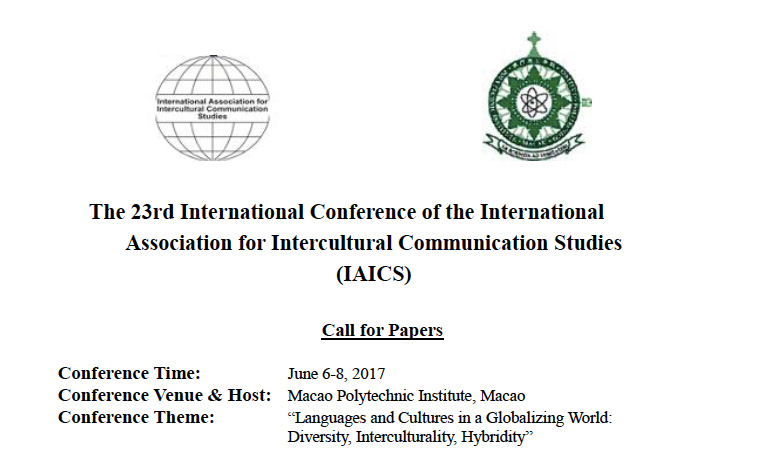
IAICS 2017In today’s world, globalization erases boundaries and leads to increased contact among various languages and cultures. While human contact and migration have always been present throughout history, e.g., on the Silk Road, today’s media and transport capacities facilitate contact and communication to an exponentially greater extent than ever before. As a consequence, the phenomena of diversity, interculturality and hybridity are intensified. Juxtaposed to increased contact ensuing from globalization are both the positive and negative aspects of the protectionist efforts of localism. The theme of this conference seeks to examine the context of these problems within the spheres of education, language, culture, and society.

Preregistration due February 28, 2017.

Save

Save