KC104 Constructive Intercultural Management Translated into Portuguese

Key Concepts in ICDContinuing translations of Key Concepts in Intercultural Dialogue, today I am posting KC#104: Constructive Intercultural Management, which Madeleine Bausch wrote for publication a few months ago, and has now translated into Portuguese.

As always, all Key Concepts are available as free PDFs; just click on the thumbnail to download. Lists organized chronologically by publication date and numberalphabetically by concept in English, and by languages into which they have been translated, are available, as is a page of acknowledgments with the names of all authors, translators, and reviewers.
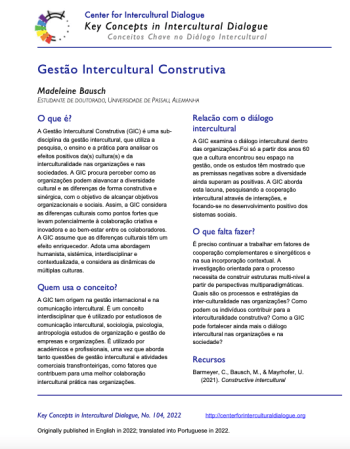
KC104 Constructive Intercultural Management_Portuguese Bausch, M. (2022). Constructive intercultural management [Portuguese]. Key Concepts in Intercultural Dialogue, 104. Available from: https://centerforinterculturaldialogue.org/wp-content/uploads/2022/03/kc104-constructive-intercultural-management_portuguese.pdf

The Center for Intercultural Dialogue publishes a series of short briefs describing Key Concepts in Intercultural Dialogue. Different people, working in different countries and disciplines, use different vocabulary to describe their interests, yet these terms overlap. Our goal is to provide some of the assumptions and history attached to each concept for those unfamiliar with it. As there are other concepts you would like to see included, send an email to the series editor, Wendy Leeds-Hurwitz. If there are concepts you would like to prepare, provide a brief explanation of why you think the concept is central to the study of intercultural dialogue, and why you are the obvious person to write up that concept.


Creative Commons License
This work is licensed under a Creative Commons Attribution-NonCommercial-NoDerivatives 4.0 International License.

Sport for One Humanity Grants

Grants

Sport for One Humanity grants, Turkish Airlines and United Nations Alliance of Civilizations (UNAOC). Deadline: 25 May 2022.

The main objective of the Sport for One Humanity initiative is to select and support innovative sports-based projects implemented by civil society organizations that promote a culture of peace, mutual understanding and cooperation among diverse communities and cultures around the world. The initiative will give priority to projects using and promoting sport as a tool for strengthening diversity and inclusiveness, education and empowerment of youth, empowerment of women and girls, inclusion of persons with disabilities and vulnerable groups and fostering peaceful and inclusive societies.

Submitted projects must contribute to promoting intercultural dialogue, strengthening diversity and fostering inclusive societies through sport, among other criteria.

CFP International Symposium on Bilingualism (Australia & Hybrid)

Conferences

Call for papers: 14th International Symposium on Bilingualism: Diversity Now, Macquarie University, Sydney, Australia, 26-30 June 2023. Deadline: 1 September 2022.

The conference theme of ISB14 is Diversity Now:
The United Nations General Assembly has declared the period between 2022 and 2032 as the International Decade of Indigenous Languages to draw attention to the critical status of many Indigenous languages across the world and encourage action for their preservation, revitalisation, and promotion. As we move into this decade, ISB14 encourages work especially involving lesser studied bilingual communities and interdisciplinary work to tackle bilingualism across the life-span, cultures and societies. In service to the International Decade of Indigenous Languages, IBS14 will focus on collaborative work with Australian Indigenous communities on various Indigenous languages and issues.

Proposals for symposia are invited. Symposia are 120-minute blocks that allow for extended, interactive discussion on a specific topic, focusing on a cluster of independent yet related papers. Each symposium consists of four slots, and should consist either of four presentations, or of three presentations and a discussion. Proposals must include a general abstract describing the symposium as a whole (max. 1 page), as well as abstracts for all individual presentations (each no longer than 1 page, plus up to 1 extra page for figures and references). Sufficient detail should be provided to allow peer reviewers to judge the merit of the proposal. The person submitting the symposium proposal is responsible for securing the permission and co-operation of all participants before the proposal is submitted.

KC11 Intercultural Discourse and Communication Translated into Turkish

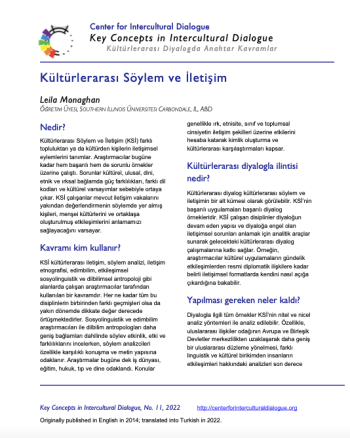
Key Concepts in ICDContinuing with translations of the Key Concepts in Intercultural Dialogue, today I am posting KC11: Intercultural Discourse and Communication, which Leila Monaghan first published in English in 2014, and which Candost Aydın has now translated into Turkish.

As always, all Key Concepts are available as free PDFs; just click on the thumbnail to download. Lists of Key Concepts organized chronologically by publication date and number, alphabetically by concept, and by languages into which they have been translated, are available, as is a page of acknowledgments with the names of all authors, translators, and reviewers.

KC11 intercult-discourse-comm_TurkishMonaghan, L. (2022). Intercultural discourse and communication [Turkish] (C. Aydın, Trans). Key Concepts in Intercultural Dialogue, 11. Available from:
https://centerforinterculturaldialogue.org/wp-content/uploads/2022/02/kc11-intercult-discourse-comm_turkish.pdf

If you are interested in translating one of the Key Concepts, please contact me for approval first because dozens are currently in process. As always, if there is a concept you think should be written up as one of the Key Concepts, whether in English or any other language, propose it. If you are new to CID, please provide a brief resume. This opportunity is open to masters students and above, on the assumption that some familiarity with academic conventions generally, and discussion of intercultural dialogue specifically, are useful.

Wendy Leeds-Hurwitz, Director
Center for Intercultural Dialogue


Creative Commons License
This work is licensed under a Creative Commons Attribution-NonCommercial-NoDerivatives 4.0 International License.
Save

Save

East-West Center: Education & Development (USA)

“Job

Senior Leadership Education and Development Specialist, East-West Center, Honolulu, Hawaii, USA. Deadline: Open until filled.

The East-West Center is accepting applications for a two-year limited position, with possibility for extension, as a Senior Leadership Education and Development Specialist. The East-West Center (EWC) was established in 1960 to promote better relations and understanding among the people and nations of the United States, Asia, and the Pacific. The Leadership Program is part of the larger Professional Development Program at East-West Center, which hosts capacity-building programs for participants from multiple nations, cultures, and professional sectors.

The Senior Leadership Education and Development Specialist is responsible for collaboratively managing program-specific teams to (a) plan, organize, and facilitate existing East-West Center leadership education and development programs and ensure they are relevant to the Asia Pacific, (b) develop, design, and deliver new programs and initiatives that anticipate and respond to the region’s leadership opportunities and needs, and (c) support partnership-development and fundraising efforts that help secure the Leadership Program’s regional mandate.

Zhejiang U: International Studies (China)

“JobSenior Lecturer/Associate Professor/Professor in International Studies, Zhejiang University, Hangzhou, China. Deadline: 28 April 2022.

The School of International Studies specialises in research fields and specialisations for the following areas: Second Language Acquisition, Pragmatics, Language Testing, Studies of Chinese as a Second Language, British & American Literature, Medieval English, Renaissance Literature, Theoretical Linguistics, Intercultural Communication, French Language and Literature, German Language and Literature, Japanese Language and Literature, Russian Language and Literature.

The university plans to recruit distinguished scholars from both China and abroad by the “Hundred Talents Program”. Ample funds are available for this program to ensure that scholars have a favorable academic environment and optimum working and living conditions so that they can be dedicated to academic research and the advancement of their fields.

Call for Nominations: Editor, Journal of Intercultural Communication Research 2022

Professional OpportunitiesCall for Nominations: Editor of the Journal of Intercultural Communication Research. Deadline: 15 May 2022.

The World Communication Association (WCA) is soliciting nominations for the editor of the Journal of Intercultural Communication Research (JICR). Self-nominations are welcome. The appointment is for 3 years, beginning on January 1, 2023. JICR publishes qualitative and quantitative research on interrelationships between culture and communication. Generally, research published in JICR emphasizes non-mediated contexts.

All manuscripts submitted for publication to the JICR are initially reviewed by the Editor for appropriate content and style. If approved by the Editor, manuscripts are then reviewed by two anonymous reviewers in a double-blind review process. Reviewers are chosen by the Editor based on their expertise with a submitted manuscript’s topic, methodology, and research foci. On special occasions or in special editions, the Editor may invite authors with a particular expertise to submit manuscripts for publication. In such cases, the publication decision rests with the Editor. Such manuscripts are designated as “Invited.”

A complete nomination package includes a letter of application from the candidate, which should include a mission statement for the editorship; the candidate’s vitae (CV); minimum of 2 letters of support from published scholars familiar with the candidate’s work, experience and suitability for the task of journal editing; and a letter of institutional support from the candidate’s home institution. The successful candidate will be a member of the Board of Directors of World Communication Association during the appointment term as Editor, and will be provided with some annual financial editorial support from the Association. Although the term begins on January 1, 2023, the successful candidate will work with the current editor during part of 2022 to facilitate the transition process.

Please send your nomination package at your earliest convenience to WCA Secretary-General Dr. Cheng Zeng.

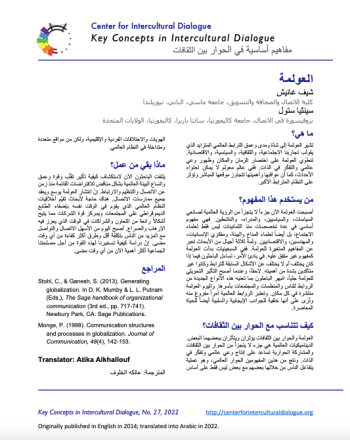
KC27 Globalization Translated into Arabic

Key Concepts in ICDContinuing translations of Key Concepts in Intercultural Dialogue, today I am posting KC 27: Globalization, which Shiv Ganesh and Cynthia Stohl wrote for publication in English in 2014, and which Atika Alkhallouf has now translated into Arabic.

As always, all Key Concepts are available as free PDFs; just click on the thumbnail to download. Lists of Key Concepts organized chronologically by publication date and number, alphabetically by concept, and by languages into which they have been translated, are available, as is a page of acknowledgments with the names of all authors, translators, and reviewers.

KC27 Globalization_ArabicGanesh, S., & Stohl, C. (2022). Globalization [Arabic]. (A. Alkhallouf, Trans.). Key Concepts in Intercultural Dialogue, 27. Retrieved from: https://centerforinterculturaldialogue.org/wp-content/uploads/2022/02/kc27-globalization_arabic.pdf

If you are interested in translating one of the Key Concepts, please contact me for approval first because dozens are currently in process. As always, if there is a concept you think should be written up as one of the Key Concepts, whether in English or any other language, propose it. If you are new to CID, please provide a brief resume. This opportunity is open to masters students and above, on the assumption that some familiarity with academic conventions generally, and discussion of intercultural dialogue specifically, are useful.

Wendy Leeds-Hurwitz, Director
Center for Intercultural Dialogue


Creative Commons License
This work is licensed under a Creative Commons Attribution-NonCommercial-NoDerivatives 4.0 International License.

Fulbright Opportunities 2023-24

FulbrightsFulbright has announced open awards competitions for both US scholars to travel abroad, and international scholars to travel to the US. Deadlines vary by program.

The Fulbright U.S. Scholar Program and Fulbright U.S Student Program are accepting applications for 2023-24. Application deadlines are in the fall.  

Student awards, most of which open in April, will include the Fulbright-National Geographic Storytelling Fellowship, and the English Teaching Assistant Programs.

For those outside the US, interested in a stay in the US, the Visiting Scholar Program is the obvious beginning point. In addition, the Scholar-in-Residence Program accepts applications from U.S. institution of higher education to host a scholar from outside of the United States for a semester or full academic year to teach courses, assist in curriculum development, guest lecture, develop study abroad/exchange partnerships and engage with the campus and the local community. 

UNESCO Silk Roads Youth Research Grant 2022

Grants
Silk Roads Youth Research Grant, UNESCO, Paris, France. Deadline: 31 May 2022.

The call for proposals for the second edition of the Silk Roads Youth Research Grant is now open. As part of the Silk Roads Programme’s ongoing work to better understand the rich history and shared legacy and spirit of the Silk Roads, UNESCO, with the support of the National Commission of the People’s Republic of China for UNESCO, launched the ‘Silk Roads Youth Research Grant’ in 2021 within the framework of the Social and Human Sciences Sector. The second edition has been launched on 1 March 2022.

This initiative, which aims to mobilize young researchers for further study of the Silk Roads shared heritage, will award 12 research grants to young women and men under 35 years of age. Grant applicants are invited to address areas of academic study which relate to the shared heritage and plural identities of the Silk Roads, as well as its internal diversity, and potential in contemporary societies for creativity, intercultural dialogue, social cohesion, regional and international cooperation, and ultimately sustainable peace and development.