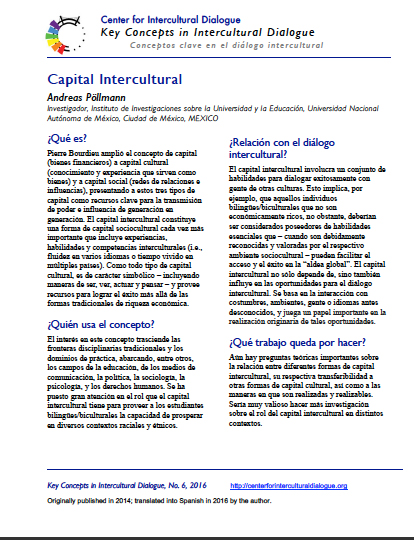
Key Concept #6 Intercultural Capital Translated into Spanish

Key Concepts in ICDContinuing translations of Key Concepts in Intercultural Dialogue, today I am posting KC6: Intercultural Capital, written in 2014 in English, and now translated into Spanish, by Andreas Pöllmann.

As always, all Key Concepts are available as free PDFs; just click on the thumbnail of the translation to read it. Lists of Key Concepts organized chronologically by publication date and number, alphabetically by concept, and by languages into which they have been translated, are available, as is a page of acknowledgments with the names of all authors, translators, and reviewers.

KC6 intercultural capital_Spanish

Pöllmann, A. (2016). Capital intercultural. Key Concepts in Intercultural Dialogue, 6. Available from:
https://centerforinterculturaldialogue.org/wp-content/uploads/2016/07/kc6-intercultural-capital_spanish.pdf

If you are interested in translating one of the Key Concepts, please contact me for approval first because dozens are currently in process. As always, if there is a concept you think should be written up as one of the Key Concepts, whether in English or any other language, propose it. If you are new to CID, please provide a brief resume. This opportunity is open to masters students and above, on the assumption that some familiarity with academic conventions generally, and discussion of intercultural dialogue specifically, are useful.

Wendy Leeds-Hurwitz, Director
Center for Intercultural Dialogue


Creative Commons License
This work is licensed under a Creative Commons Attribution-NonCommercial-NoDerivatives 4.0 International License.

Save

Communication Theory Book Reviews Wanted

Communication Theory
Call for Book Review Proposals

The journal Communication Theory invites book reviews of one to three texts (maximum length 1500 words) of works relevant to the topic of communication theory, particularly those contributing to diversity in perspectives. Although Communication Theory is currently limited to publication in English, this new feature seeks to promote inclusivity through reviews of publications that are themselves not available in English. We prefer proposals to review books that have been published within the last ten years. Our aim is to facilitate comprehensive dialogue across linguistic and other boundaries, on our core communication issues. Proposals for book reviews will be considered on a rolling basis. These reviews would address one to three texts in 500-1500 words.

Please send proposals to the Editor-in-Chief, Karin.wilkins[at]austin.utexas.edu, who will consult with Associate Editors in determining approval.

Communication Theory offers a distinguished global forum for dialogue on critical theoretical issues in communication, through publication of insightful and innovative articles and reviews. This journal is committed to integrity through rigorous peer-reviewed processes that promote standards of excellence. We encourage submissions that reflect and recognize strength in interdisciplinary approaches to the study of communication, that consider diversity in perspectives, and that contribute to public engagement. Research articles and reviews are appropriate when they clearly advance theoretical approaches relevant to communication scholarship. We respect and invite diversity in areas of academic interest and research approaches, as well as in gender, sexuality, ethnic, national, and regional origin.

Royal Roads University job ad: Leadership Studies (Canada)

Royal Roads University is seeking applications for the position of Faculty Member in the School of Leadership Studies, Faculty of Social and Applied Science, at the rank of Assistant Professor or Associate Professor, based on qualifications and experience. Reporting to the School Director, as a full-time Faculty Member you will be invited to contribute to all aspects of the School, with a particular focus on the Master of Arts in Global Leadership (MAGL). Launched in 2015, the MAGL program engages students in intensive on-campus residencies, online delivery of courses, international field excursions, and applied capstone projects.

The MAGL program is focused on theoretical and applied approaches to the understanding and practice of leadership in a global context for the NGO and social purpose sector. MAGL courses develop competencies in areas of personal leadership, cross-cultural communication, systems thinking, team facilitation, strategic decision making, public administration, community development, conflict resolution, and more. The program offers a holistic, transdisciplinary, approach to learning leadership.

The ideal candidate is a scholar-practitioner who brings informed professional practice, international and intercultural experiences, research accomplishments in multicultural or international contexts, and academic scholarship in graduate level course topics pertinent to the MAGL Program.

In the School of Leadership Studies, we believe that effective leadership can transform people, organizations, and communities. We embrace a theory of change that directly links leadership to learning and inquiry. Our vision is to connect scholarship with practice to change the world, one leader at a time. We use a co-teaching model to provide authentic, challenging, collaborative, and engaging learning experiences through our leadership programs and our research initiatives.

Our outcomes-based graduate-level programs have been honed over the years to continually deliver relevant leadership education that is practical and grounded in scholarship. We are a dedicated group of faculty and staff members who are passionate about learning and committed to our students getting the most from their leadership journeys. We also strive to incorporate emerging, innovative, and values-based leadership theories, research, and practices into our educational programming.

Core faculty members are expected to teach several courses a year, both face to face and via Moodle. This often includes course revisions and curriculum development work. RRU faculty members are expected to develop and engage in their own research and inquiry, resulting in publication and conference presentations. You will also have responsibilities in educational administration, including adjudicating applications into School programs and participating in a range of service activities in the School and across the University. You will be expected to take on additional roles, such as Program Head and becoming a member of the Research Ethics Board.

Qualifications:
The ideal candidate will possess:
*Doctoral degree in a field related to global leadership (e.g., Human Development and Organizational Systems, Public Administration, International Development, Community Development)
*Professional/applied leadership experience in global contexts
*Willingness and ability to take on significant academic administrative duties in a fast-paced environment
*Record of applied social research and familiarity with collaborative, action-oriented approaches to research
*Understanding of research ethics for applied student research in a range of organizations
*Demonstrated teaching excellence at the graduate level in a field related to global leadership, in face to face and online environments
*Experience in designing and delivering online instruction
*Experience in the integration and use of experiential, adult learning principles in curriculum design, delivery, and assessment, particularly at the graduate level
*Ability to work effectively in team-based course delivery
*Experience in facilitating and evaluating practice-based learning outcomes
*Ability to work within a transdisciplinary curriculum
*Experience in and understanding of organizational and community leadership and organizational or community change
*Experience in supervision of graduate students
*Demonstrated ability to work collegially as a team member with a variety of teams and stakeholder groups

In addition to a collegial learning community, RRU offers a comprehensive compensation package, with a starting salary and academic rank based on qualifications and experience.  This is an initial five-year appointment with the possibility of conversion into a continuing appointment, subject to performance and program needs.

The competition began on July 11, 2016 and the review of materials received will commence on September 20, 2016; however, the competition will remain open until a successful candidate is found.

To apply please forward your cover letter, curriculum vitae, and a statement of teaching philosophy (preferably in one document and PDF format) to:
rru-career-opportunities@royalroads.ca with a subject line of:
16-054-F0159 – Last name, First name
Or mail to: Human Resources – Career Opportunities
Royal Roads University
2005 Sooke Road
Victoria, BC   V9B 5Y2
Fax:  (250) 391-2570
Tel:  (250) 391-2511

While Royal Roads University values all applications we receive, only those candidates short-listed for further consideration will be contacted. RRU is an equal opportunity employer, committed to the principle of equity in employment.  All qualified candidates are encouraged to apply; however, Canadians and permanent residents will be given priority consideration.

If you are sending your application via e-mail, please ensure that your electronic file is saved in MS Word, Adobe PDF, or text format.

Key Concept #1: Intercultural Dialogue Translated into Turkish

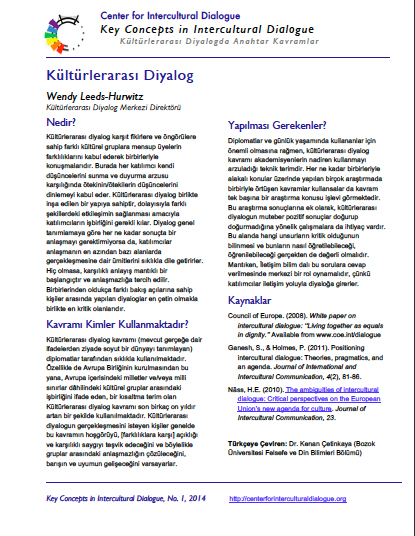
Key Concepts in ICDContinuing translations of Key Concepts in Intercultural Dialogue, today I am posting KC1: Intercultural Dialogue, which I wrote in English to start the series 2 years ago, now translated into Turkish by Kenan Çetinkaya.

As always, all Key Concepts are available as free PDFs; just click on the thumbnail of the translation to read it. Lists of Key Concepts organized chronologically by publication date and number, alphabetically by concept, and by languages into which they have been translated, are available, as is a page of acknowledgments with the names of all authors, translators, and reviewers.

KC1 ICD TurkishLeeds-Hurwitz, W. (2016). Kültürlerarası diyalog. Key Concepts in Intercultural Dialogue, 1 (K. Çetinkaya, Trans.). Available from:
https://centerforinterculturaldialogue.org/wp-content/uploads/2017/09/kc1-icd-turkish.pdf

If you are interested in translating one of the Key Concepts, please contact me for approval first because dozens are currently in process. As always, if there is a concept you think should be written up as one of the Key Concepts, whether in English or any other language, propose it. If you are new to CID, please provide a brief resume. This opportunity is open to masters students and above, on the assumption that some familiarity with academic conventions generally, and discussion of intercultural dialogue specifically, are useful.

Wendy Leeds-Hurwitz, Director
Center for Intercultural Dialogue


Creative Commons License
This work is licensed under a Creative Commons Attribution-NonCommercial-NoDerivatives 4.0 International License.

CFP Rhetoric Society of Europe (UK)

CFP: The Sixth “Rhetoric in Society” Conference of the RSE
University of East Anglia, Norwich
July 3rd-5th 2017

Hosted by:
The Rhetoric Society of Europe (RSE)
The Rhetoric and Politics Group of the UK Political Studies Association
The School of Politics, Philosophy, Language and Communication Studies, University of East Anglia
“Rhetorics of Unity and Division”

Keynote speakers include:
Gerard Hauser (University of Colorado, Boulder)
Quentin Skinner (Queen Mary University London)
Plus more to be confirmed.

CALL FOR PAPERS
Proposals are invited for panels, papers, roundtables and other forms of presentation to be delivered at the Sixth Conference of the Rhetoric Society of Europe. The conference will take place from July 3rd to 5th 2017 at The University of East Anglia in the medieval city of Norwich, in the United Kingdom.

We welcome proposals for:
– papers or panels which speak to the conference theme (explained below)
– papers or panels which address general issues related to the theory, analysis & practice of rhetoric in society
– other kinds of presentation such as roundtables or debates

Conference Theme: Rhetorics of Unity and Division
We particularly welcome proposals which speak to the conference theme of Rhetorics of Unity and Division. As Kenneth Burke showed us, rhetoric has the capacity to generate ‘identification’ between people, forging and affirming community. It also has the capacity to create divisions, distinctions and differences – as a way of creating new communities but also as a way of maintaining hierarchies and exclusions or of promoting and prolonging hostility. This is not only a social or political effect of rhetoric. It goes to the core of what rhetoric is: a practice which involves inventive ‘division’ – persuading people by breaking up issues and phenomena in particular ways, connecting some ideas while constituting others as antithetical.

It is possible to see the present day as marked by a rise in rhetorics of division – between ‘them’ and ‘us’, nations and regions, religions and classes. What forms does such rhetoric take? Does it repeat old and well-known rhetorical strategies or are there new forms of divisive rhetoric? To what extent is such rhetoric merely reflecting deep social divisions and to what extent does it create them? How are changes in the modes and means of communication enabling or disabling such division? Are these best conceived of as private or public, everyday and vernacular or exceptional and elite forms of rhetoric?

It is also possible to see the present as marked by a rise in new kinds of rhetoric of unity. There are many examples of new claims about identity and community (sometimes made against ‘traditional’ identifications) and contemporary means of communication are enabling people to form new rhetorics of unity across once impermeable borders (and with new kinds of intensity). How can we best understand these new kinds of rhetorical identity? What kinds of distinct strategies do we find in contemporary rhetorics of unity? What sorts of division, or unity, can be identified as outcomes of rhetorical strategies and actions?

We welcome proposals for papers or panels that address these themes and issues in any way.

General Papers
We also invite proposals for papers and panels more generally concerned with the theory, practice or analysis of rhetoric. This may include, for example, historical scholarship, theoretical analysis and contemporary cultural or political critique; work grounded in political theory, philosophy, languages and linguistics, argumentation, literary studies, communication studies, composition, media studies, psychology, sociology, history, cultural studies and more. Papers might be comparative, national or international in focus, concerned with particular orators, ideologies or movements; they might draw on queer theory, critical race theory, post colonialism and focus on spoken, written or audio-visual communication.

Alternative Presentations
We welcome proposals for forms of presentation other than panels and papers. This might include: roundtables addressing key rhetorical themes, works or phenomena; debates between contending positions; other, novel and effective ways of communicating research findings, claims and arguments.

How to Submit a Proposal
Please email: RSEconference6[at]gmail.com
In your proposal be sure to provide the following details:
*Your name and institutional affiliation
*What you are proposing (paper, panel, roundtable etc.)
*Title
*Abstract (250 words exclusive of references)
*If you are proposing a panel or roundtable please include details of the overall theme and of the other participants.

Deadline for Submissions: December 16th 2016.
Notification by: January 20th 2017.

Seeking Research Advisors For Live, International, Family-to-Family Dialogues

CID has been asked to publish the following opportunity for collaboration:

SEEKING RESEARCH ADVISORS FOR LIVE, INTERNATIONAL, FAMILY-TO-FAMILY DIALOGUES

I’m the founder of Learning Life, a small educational nonprofit based in Washington DC that’s developing a Citizen Diplomacy Initiative that will soon put lower-income American families (starting in DC) in live dialogue via internet video with similar families in other nations.

We’re currently developing a pilot project that will use experimental method to measure results of these live, family-to-family dialogues.  We’re accordingly looking for intercultural researchers who use experimental method, and who can help us answer questions (about method, especially, but also theory and the research literature on intercultural dialogue) by phone or email briefly (typically less than 30 minutes by phone) as questions come up.

We don’t have funding for research advisors, but we are happy to recognize our advisors on our website.
Feel free to email or call me with any questions. Thanks in advance for your response!

Paul Lachelier, Ph.D.
Founder & Director, Learning Life
paul[at]learninglife.info
Cell: 202-910-6966

Learning Life is a fiscally sponsored program of United Charitable, a 501(c)(3) nonprofit charity. Learning Life’s mission is to spread learning in everyday life. Learn more at our website.

Key Concept #12: Third Culture Kids Translated into Chinese

Key Concepts in ICDContinuing translations of Key Concepts in Intercultural Dialogue, today I am posting KC12: Third Culture Kids, written by Anastasia Lijadi in English in 2014, and now translated into both traditional and simplified Chinese by Wang Qi Chao; they are both affiliated with the University of Macau, China.

As always, all Key Concepts are available as free PDFs; just click on the thumbnail of the translation you wish to read. Lists of Key Concepts organized chronologically by publication date and number, alphabetically by concept, and by languages into which they have been translated, are available, as is a page of acknowledgments with the names of all authors, translators, and reviewers.

KC12 TCKs_Chinese trad
Traditional Chinese
KC12 TCKs_Chinese sim
Simplified Chinese


Lijadi, A. A. (2016). Third culture kids [Simplified Chinese]. Key Concepts in Intercultural Dialogue, 12 (Q. C. Wang, Trans.). Available from:
https://centerforinterculturaldialogue.org/wp-content/uploads/2016/07/kc12-tcks_chinese-sim.pdf

Lijadi, A. A. (2016). Third culture kids [Traditional Chinese]. Key Concepts in Intercultural Dialogue, 12 (Q. C. Wang, Trans.). Available from:
https://centerforinterculturaldialogue.org/wp-content/uploads/2017/01/kc-12-tcks_chinese-trad2.pdf

If you are interested in translating one of the Key Concepts, please contact me for approval first because dozens are currently in process. As always, if there is a concept you think should be written up as one of the Key Concepts, whether in English or any other language, propose it. If you are new to CID, please provide a brief resume. This opportunity is open to masters students and above, on the assumption that some familiarity with academic conventions generally, and discussion of intercultural dialogue specifically, are useful.

Wendy Leeds-Hurwitz, Director
Center for Intercultural Dialogue


Creative Commons License
This work is licensed under a Creative Commons Attribution-NonCommercial-NoDerivatives 4.0 International License.

Kenan Çetinkaya Profile

ProfilesKenan Çetinkaya (Ph.D.) was born in Malatya, Turkey. He has been working at Bozok University Department of Philosophy and Religious Studies, Turkey since 2013.

kenan cetinkaya photoHe holds a BA (2006) in Islamic Education from Ankara University, and a MA (2009) in the Theological Studies from the University of Saint Thomas, Houston, TX.  He earned his Ph.D. (2014) from the Department of Religion, Temple University, Philadelphia, PA. His dissertation title is Turkish Response to the Christian Call for Dialogue. He is editor of a Turkish book, Birlikte Yaşama Kültürü ve Diyalog [Coexistence and Dialogue] which was published in 2014.
Some of his published papers include:

Çetinkaya, K. (2015). The importance of dialogue in Turkey. Journal of Ecumenical Studies, 50, 167-173.

Çetinkaya, K. (2014). Three Turkish views of interfaith dialogue. In Nathan R. Kollar & Muhammad Shafiq (Eds.),  Sacred texts and human contexts: A North American response to “A common word between us and you.” North Charleston, SC: CreateSpace Independent Publishing Platform.


Work for CID:

Kenan Çetinkaya wrote KC96: Interreligious Dialogue. He also translated  KC1: Intercultural Dialogue, KC8: Public Dialogue, KC22: Cultural Identity and KC62: Diaspora into Turkish.

Key Concept #51 Critical Discourse Analysis Translated into Italian

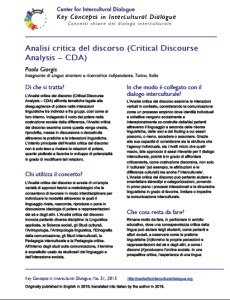
Key Concepts in ICDContinuing translations of Key Concepts in Intercultural Dialogue, today I am posting KC51: Critical Discourse Analysis, written by Paola Giorgis in English in 2015, and now translated by her into Italian.

As always, all Key Concepts are available as free PDFs; just click on the thumbnail of the translation to read it. Lists organized chronologically by publication date and numberalphabetically by concept in English, and by languages into which they have been translated, are available, as is a page of acknowledgments with the names of all authors, translators, and reviewers.

KC 51 CDA ItalianGiorgis, P. (2016). Analisi critica del discorso. Key Concepts in Intercultural Dialogue, 51. Available from: https://centerforinterculturaldialogue.org/wp-content/uploads/2016/07/kc51-cda_italian.pdf

The goal of the translation project is to expand the concepts available to discussions of intercultural dialogue beyond those who are fluent in English. What began with a request to translate a few concepts into 2 languages has now developed into a serious effort to translate most of them. Choice of languages is being left up to those who are doing the work, which has prompted much interesting discussion about whether to be organized about this (translating all of them into a single language, then moving on to the next). Obviously the decision was  not to take that route. Instead, authors are being given the opportunity to translate their own into whatever languages they know best; once they respond, their concepts are put on a list of those available to requests from others. If you are interested in translating one of the Key Concepts, please contact me for approval first because dozens are currently in process. As always, if there is a concept you think should be written up as one of the Key Concepts, whether in English or any other language, propose it. If you are new to CID, please provide a brief resume. This opportunity is open to masters students and above, on the assumption that some familiarity with academic conventions generally, and discussion of intercultural dialogue specifically, are useful.

Wendy Leeds-Hurwitz, Director
Center for Intercultural Dialogue


Creative Commons License
This work is licensed under a Creative Commons Attribution-NonCommercial-NoDerivatives 4.0 International License.

CFP Int’l Association for Dialogue Analysis 2017 (Italy)

The 2017 International Association for Dialogue Analysis (IADA) conference will be held from October 11th-14th, 2017 at the University of Bologna (Department of Education) and is sponsored by the School of Psychology and Education, the FAM (Fondazione Alma Mater), and the International Association for Dialogue Analysis.

The conference focuses on the role of dialogue or interaction in displaying, maintaining, creating yet also defying the crucial dimensions of the world we live in. This process is particularly at play – although not necessarily noticed – in everyday life. Rather than a context, this phenomenological notion indicates the obvious, routine, quasi-natural quality of most human practices taking place in ordinary as well as institutional contexts. Quoting a well known formula by John Heritage (1984) yet applying it beyond the micro-level of the hic et nunc discursive environment, we propose to conceive dialogue as “context shaped and context renewing”. Overcoming the “interactional reductionism” (Levinson, 2005) implied in focusing solely on the emergent properties of language use, as well as any simplistic return to sociocultural, psychological an even material determinism, dialogue and interaction are seen as an “intermediate variable” (Ibidem) or faits d’interface (Descola, 2016) connecting the micro-order of everyday life and the macro-order of shared culture and social structure. As Rommetveit put it forty years ago, dialogue is “the skeleton” or “the architecture of intersubjectivity” (1976).

The 2017 International Association for Dialogue Analysis conference (Bologna, October 11th-14th, 2017) welcomes empirical and methodological extended abstracts and full papers from different disciplinary perspectives that focus on dialogue and interaction as carriers of, and tools for culture, social organization, moral horizons, identities and change.

The notion of action is at the core of the conference main theme: the contributors are asked to focus on dialogue and social interaction as –  at the same time – presupposing  and producing the crucial dimensions of the world we live in.

Theoretical papers are more than welcome insofar as they provide some empirical illustration of the paper’s theoretical point(s).

The conference includes but it is not limited to, the following subthemes:
Dialogue and Health (e.g. dialogue as therapy; dialogue in clinical settings; medical interaction; dialogue in multilingual-multicultural healthcare contexts; dialogue in social work).
Dialogue, Justice and Social Change  (e.g.; dialogue in policing including interrogation, citizen calls; criminal, civil and administrative law; transidioma and  asylum; intercultural institutional talk; social conflicts and Alternative Dispute Resolution practices; family and social mediation; restorative justice).
Dialogue and Materiality (e.g. inter-objectivity; Actor-Network-Theory; things as dialogic entities; humans and non-humans interaction; sociosemiotics; dialogue and technologically saturated environment; the object’s affordances and the user’s agenda).
Dialogue and Organization (e.g. dialogue as an organizing phenomenon; leadership and dialogue; expert-novice interaction; authority and power in organizational communication).
Dialogue, Socialization and Education (e.g. dialogue in friendship and peer culture; family everyday talk; language socialization; classroom talk; dialogue in everyday school-life; assessment as a dialogic practice; teachers-parents conference; L2 learning activities; coaching and training).
Dialogue, Text and Language (e.g. dialogue as text; dialogue in literary texts, CMC and audiovisual texts; text and reader dialogue; textual representations of dialogues; dialogue in advertising, advertising as dialogue; dialogue in propaganda and political speech; grammar, lexicon and cultural norms in everyday talk).We invite extended abstracts (500 to 700 words) or full papers of a maximum of 30 pages, including references. Any citation style is permitted (e.g., MLA, APA, Chicago).

Submission opens on June 30th, 2016, and closes on November 30th, 2016 at 23:59 local time in Italy. Notification of acceptance in March 2017.

For details and instructions see the Submission page: https://eventi.unibo.it/international-conference-iada-bologna2017/submission

We look forward to your contributions!