CID Poster #9: Strangers into Friends

CID PostersThis is the last of the posters designed by Linda J. de Wit in her role as CID intern, and the first to illustrate a proverb. The relevance of proverbs for intercultural dialogue can be explained by a quote from Harold V. Cordry, who collected the one used here as well as many, many others: “For as my collection grew, I found myself increasingly fascinated by the striking similarity of proverbs from dissimilar cultures in different times and different places, and by the fundamental universality of human experience which the proverbs so clearly reflect.” (Cordry, H. V., 1997, The multicultural dictionary of proverbs, Jefferson, NC: McFarland, p. ix.). My thanks to Prof. Wolfgang Mieder for recommending this book (as well as others) when asked about how to locate potentially relevant proverbs. The full citation to the book is also provided at the bottom of the poster.
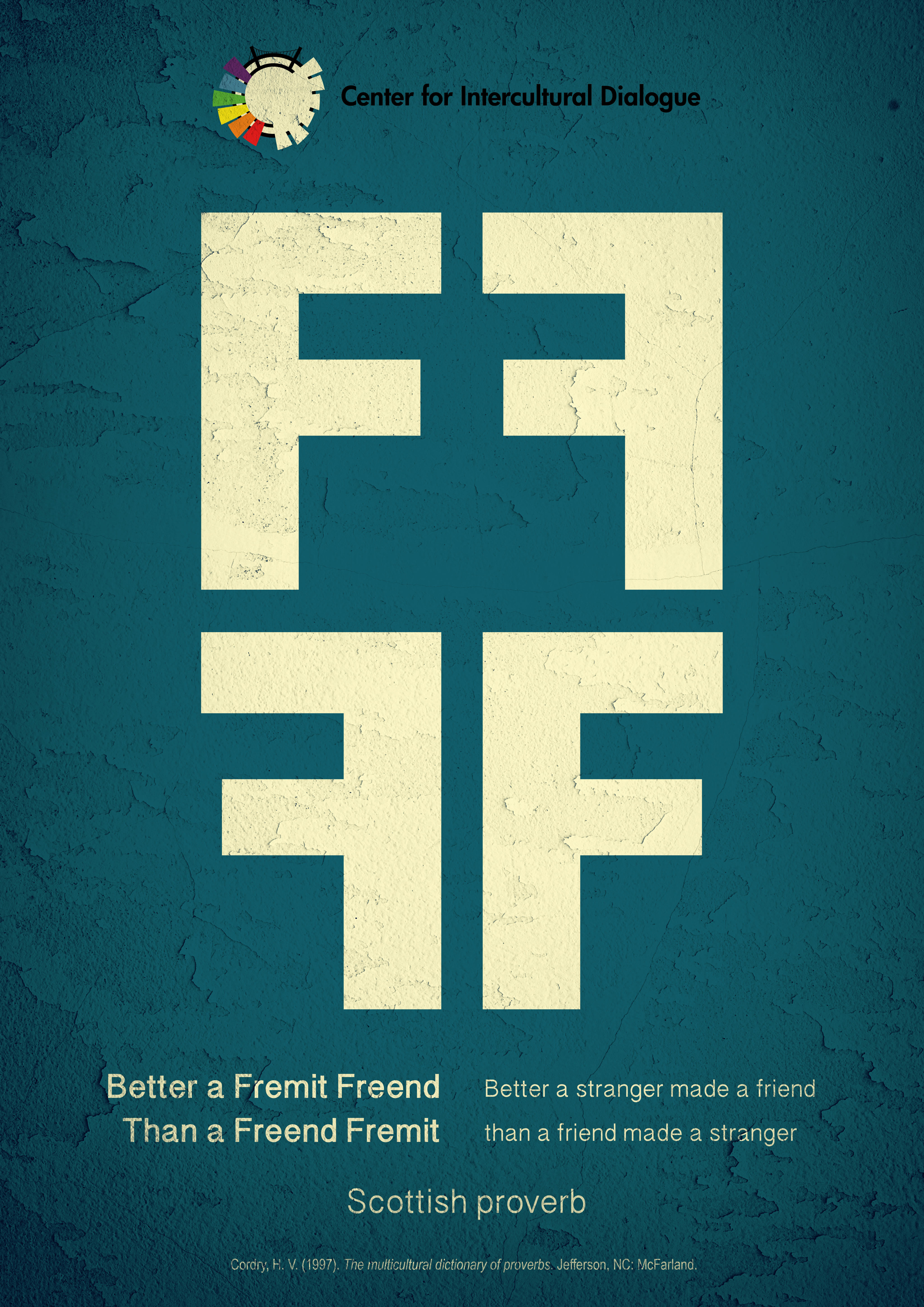
Strangers into FriendsJust in case anyone wants to cite this poster, the following would be the recommended format:

Center for Intercultural Dialogue. (2017). Strangers into Friends. CID Posters, 9. Available from:
https://centerforinterculturaldialogue.org/wp-content/uploads/2017/08/friend-stranger.png

As with other series, CID Posters are available for free on the site; just click on the thumbnail to download a printable PDF. They may be downloaded, printed, and shared as is, without changes, without cost, so long as there is acknowledgment of the source.

As with other series, if you wish to contribute an original contribution, please send an email before starting any work to receive approval, to minimize inadvertent duplication, and to learn about technical requirements. As is the case with other CID Publications, posters should be created initially in English. Given that translations of the Key Concepts in Intercultural Dialogue have received so many views, anyone who wishes to translate their own poster into another language (or two) is invited to provide that as well. If you want to volunteer to translate someone else’s poster into a language in which you are fluent, send in a note before starting, to receive approval and to confirm no one else is working on the same one.

Wendy Leeds-Hurwitz
Director, Center for Intercultural Dialogue
intercult.dialogue AT gmail.com


Creative Commons License
This work is licensed under a Creative Commons Attribution-NonCommercial-NoDerivatives 4.0 International License.

Intercultural Training Specialist UC Berkeley International House

Job adsIntercultural Training Specialist, University of California, Berkeley – International House
The First Review Date for this job is: August 21, 2017

International House is a non-profit, self-supporting residential and community-oriented program center located in the southeast foothills of the Berkeley Campus.  Its mission is to foster intercultural respect and understanding among people throughout the world across cultural, economic, and ethnic lines.  I-House provides nearly 600 students and scholars from the United States and around the world with an opportunity to live and learn together.  I-House’s rich array of programs serves the residents, the campus and local community.

The Robertson Center for Intercultural Leadership (CIL) is a center of excellence for training and research to advance leadership, understanding and collaboration across cultures.  CIL offers programs and trainings for International House, the UC Berkeley campus, the corporate world, and not-for-profit organizations.

We are in search of a unique candidate to join our dynamic Intercultural Leadership team.  This position reports to the Director of CIL. The successful candidate will be an experienced technical leader with a high degree of knowledge in the field and recognized expertise in specific areas. Problem-solving frequently requires analysis of unique issues/problems without precedent and/or structure. May manage programs that include formulating strategies and administering policies, processes, and resources. Functions with a high degree of autonomy. Serves as liaison with campus and community groups who have interest in the field of intercultural communication.


KC80: Cultural Discourse Analysis Translated into Ukrainian

Key Concepts in ICDContinuing translations of Key Concepts in Intercultural Dialogue, today I am posting KC#80: Cultural Discourse Analysis, which Sunny Lie wrote for publication in English in 2017, and which Olena Dotsenko has now translated into Ukrainian.

As always, all Key Concepts are available as free PDFs; just click on the thumbnail to download. Lists of Key Concepts organized chronologically by publication date and number, alphabetically by concept, and by languages into which they have been translated, are available, as is a page of acknowledgments with the names of all authors, translators, and reviewers.

KC80 Cultural Discourse Analysis_UkrainianLie, S. (2017). Cultural discourse analysis [Ukrainian]. (O. Dotsenko, trans). Key Concepts in Intercultural Dialogue, 80. Available from:
https://centerforinterculturaldialogue.org/wp-content/uploads/2017/08/kc80-cultural-discourse-analysis-ukrainian.pdf

If you are interested in translating one of the Key Concepts, please contact me for approval first because dozens are currently in process. As always, if there is a concept you think should be written up as one of the Key Concepts, whether in English or any other language, propose it. If you are new to CID, please provide a brief resume. This opportunity is open to masters students and above, on the assumption that some familiarity with academic conventions generally, and discussion of intercultural dialogue specifically, are useful.

Wendy Leeds-Hurwitz, Director
Center for Intercultural Dialogue


Creative Commons License
This work is licensed under a Creative Commons Attribution-NonCommercial-NoDerivatives 4.0 International License.

IMéRA Fellowships 2018-19 (France)

FellowshipsIMéRA and its partners are issuing 4 calls, one per programme. Each programme is associated with a general call and a set of specific residencies jointly managed by local, national or international partners. These specific residencies include chairs reserved for experienced researchers.

Interested researchers, writers or artists may apply for one programme only. Please indicate the type of residency you are requesting in your application (general program and/or specific residency) :
  • Art, Science and Society Programme
  • Mediterranean Programme
  • “Science Meets Humanities” Programme
  • Global Phenomena and Regulation Programme
  • Residence schemes (from 3 to 10 months) scheduled between September 2018 and July 2019
  • Deadline: Monday 18 September 2017 at 1:00 pm (French time)

IMéRA is the Institute for Advanced Study of Aix-Marseille University – AMU. As such, it is a member of Réseau Français des Instituts d’Etudes Avancées (RFIEA) [French Advanced Study Institutes Network] as well as of Réseau NETIAS [Eurias network] that includes the main European Institutes for Advanced Study.

IMéRA aims at fostering the emergence and development of world-class cross-disciplinary research approaches and grooms young researchers for such approaches on Aix-Marseille University ground.

IMéRA also enthusiastically welcomes projects bearing on Mediterranean territories or submitted by researchers from the Mediterranean rim.

Sachiko Terui Profile

ProfilesDr. Sachiko Terui is an Assistant Professor in the Department of Communication at the University of Memphis. She received her BA from Aichi Prefectural University (Japan), MA from the University of Louisiana at Monroe, and PhD from the University of Oklahoma.

Sachiko Terui

Terui’s research interests lie in the intersections of cultures, languages, social interactions, and health among marginalized and at-risk populations. She is interested in how individuals’ (both as patients and providers) language barriers influence patient-provider interactions. Moreover, with the idea that the meanings and functions of language barriers differ depending on the political and social environments, she conducts cross-cultural comparisons in Japan and the US. She presents her research at regional, national, and international communication conferences.

Sample publications

Terui, S. & Hsieh, E. (2016). “Not homeless yet. I’m kind of couch surfing.”: Finding identities for people at a homeless shelter. Social Work in Public Health. Advance online publication. doi:10.1080/19371918.2016.1188739

Terui, S. (2015). Conceptualizing the pathways and processes between language barriers and health disparities: Review, synthesis, and extension. Journal of Immigrant and Minority Health, 19(1), 215-224. doi:10.1007/s10903-015-0322-x

Hsieh, E. & Terui, S. (2015). Inherent tensions and challenges of provider patient communication: Implications for interpreter training in health care settings. Journal of Applied Communication Research, 43, 141-162. 


Work for CID:
Sachiko Terui has served as a reviewer for Japanese translations.

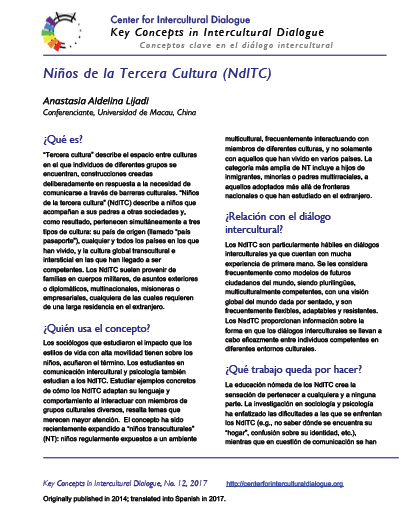
KC12: Third Culture Kids Translated into Spanish

Key Concepts in ICDContinuing translations of Key Concepts in Intercultural Dialogue, today I am posting KC#12: Third Culture Kids, which Anastasia Aldelina Lijadi wrote for publication in English in 2014, and which Sofia Ruth Nazir Nazir has now translated into Spanish.

As always, all Key Concepts are available as free PDFs; just click on the thumbnail to download. Lists of Key Concepts organized chronologically by publication date and number, alphabetically by concept, and by languages into which they have been translated, are available, as is a page of acknowledgments with the names of all authors, translators, and reviewers.

KC12 Third Culture Kids_SpanishLijadi, A. A. (2017). Niños de la Tercera Cultura. (S. R. N. Nazir, trans). Key Concepts in Intercultural Dialogue, 12. Available from:
https://centerforinterculturaldialogue.org/wp-content/uploads/2017/08/kc12-third-culture-kids_spanish.pdf

If you are interested in translating one of the Key Concepts, please contact me for approval first because dozens are currently in process. As always, if there is a concept you think should be written up as one of the Key Concepts, whether in English or any other language, propose it. If you are new to CID, please provide a brief resume. This opportunity is open to masters students and above, on the assumption that some familiarity with academic conventions generally, and discussion of intercultural dialogue specifically, are useful.

Wendy Leeds-Hurwitz, Director
Center for Intercultural Dialogue


Creative Commons License
This work is licensed under a Creative Commons Attribution-NonCommercial-NoDerivatives 4.0 International License.

U Albany Job Ad: Organizational/Interpersonal/Intercultural

Job adsThe Department of Communication at the University at Albany is seeking to fill a tenure track position with a scholar whose research focuses on either organizational communication, or interpersonal and/or intercultural communication (in relational, health, or organizational contexts).

The Department welcomes applications from scholars of all methodological orientations. Senior scholars must possess an established record of productive, externally funded research and a record of excellence in teaching; junior scholars should demonstrate the potential for productive research and some evidence of teaching effectiveness. Candidates must be willing to contribute to the Department’s initiatives in online teaching and learning. Applicants should share a commitment to the University’s strategic values for engaged learning and societal responsibility, and to its goal for increasing levels of external funding.

Applicants must address in their applications their ability to work with and instruct a culturally diverse population. Additionally, the applicant must currently possess a doctoral degree or expect to receive a doctoral degree by August 1, 2018, from a university accredited by the U.S. Department of Education or an internationally recognized accrediting organization.

The appointment will begin in Fall 2018. Review of applications will begin October 7, 2017.

Hebrew U Job Ad: Communication & Journalism (Israel)

Job adsHEBREW UNIVERSITY OF JERUSALEM
Department of Communication and Journalism
Tenure Track Position

The Noah Mozes Department of Communication and Journalism at The Hebrew University of Jerusalem invites outstanding candidates to apply for a tenure-track position starting July, 2018.

Applicants must hold a Ph.D. degree at the time of hire, and demonstrate an active research program, indicating the potential for outstanding scholarship. Ability to teach in Hebrew is required.

Deadline for applications: September 26, 2017.

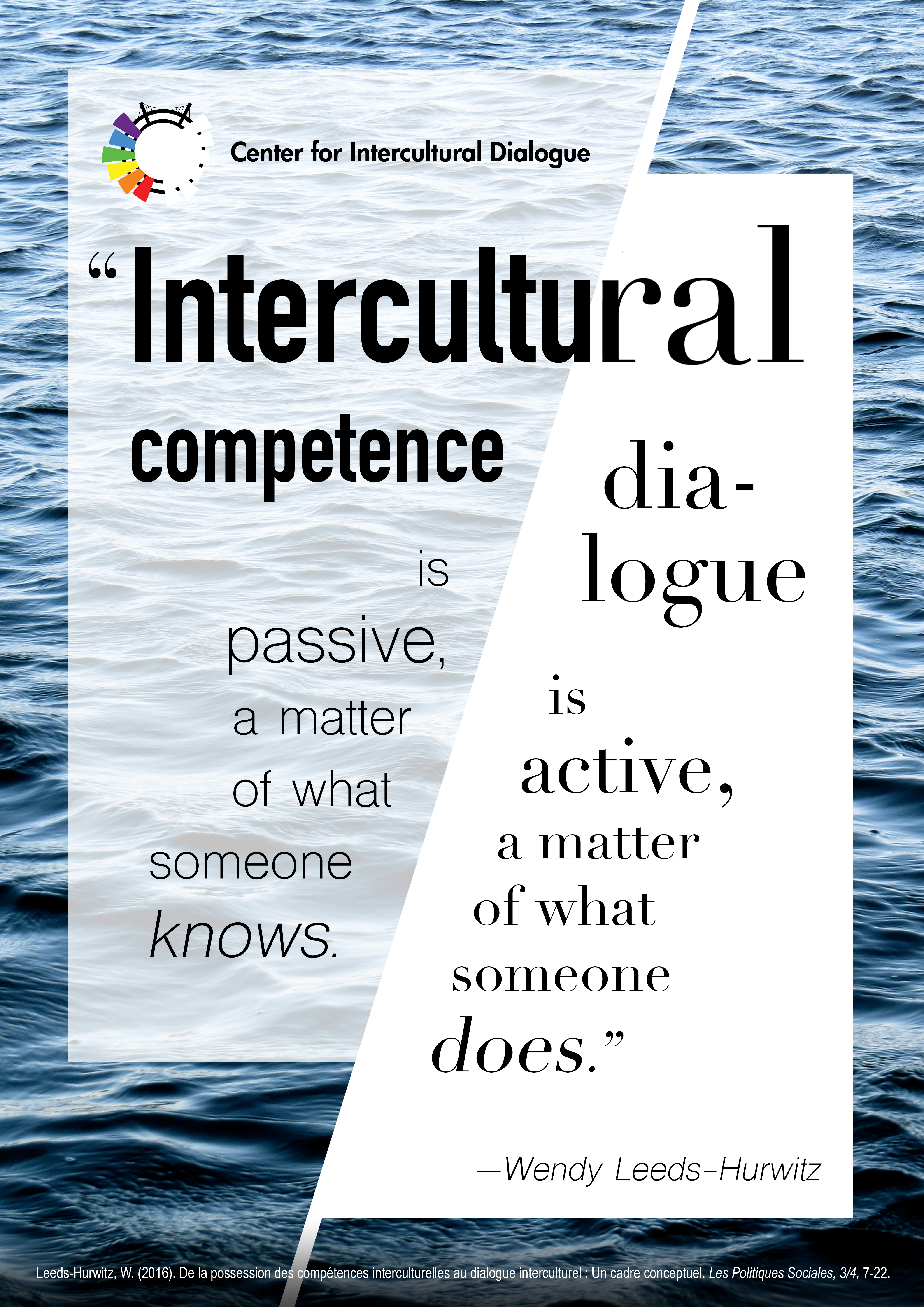
CID Poster #8: Intercultural Competence/Intercultural Dialogue

CID PostersThis is the next of the posters designed by Linda J. de Wit, in her role as CID intern. The quote is intended to clarify the concept of intercultural dialogue by showing how it relates to an older, more frequently used concept, intercultural competence. The photo of water used as background is Linda’s own. The citation for the quote is:

Leeds-Hurwitz, W. (2016). De la possession des compétences interculturelles au dialogue interculturel: Un cadre conceptuel [Moving from having intercultural competencies to constructing intercultural dialogues: A conceptual framework]. Les Politiques Sociales, 3/4, 7-22.

Intercultural competence/ Intercultural dialogueJust in case anyone wants to cite this poster, the following would be the recommended format:

Center for Intercultural Dialogue. (2017). Intercultural competence/Intercultural dialogue. CID Posters, 8. Available from:
https://centerforinterculturaldialogue.org/wp-content/uploads/2017/08/competence-dialogue.png

As with other series, CID Posters are available for free on the site; just click on the thumbnail to download a printable PDF. They may be downloaded, printed, and shared as is, without changes, without cost, so long as there is acknowledgment of the source.

As with other series, if you wish to contribute an original contribution, please send an email before starting any work to receive approval, to minimize inadvertent duplication, and to learn about technical requirements. As is the case with other CID Publications, posters should be created initially in English. Given that translations of the Key Concepts in Intercultural Dialogue have received so many views, anyone who wishes to translate their own poster into another language (or two) is invited to provide that as well. If you want to volunteer to translate someone else’s poster into a language in which you are fluent, send in a note before starting, to receive approval and to confirm no one else is working on the same one.

Wendy Leeds-Hurwitz
Director, Center for Intercultural Dialogue
intercult.dialogue AT gmail.com


Creative Commons License
This work is licensed under a Creative Commons Attribution-NonCommercial-NoDerivatives 4.0 International License.

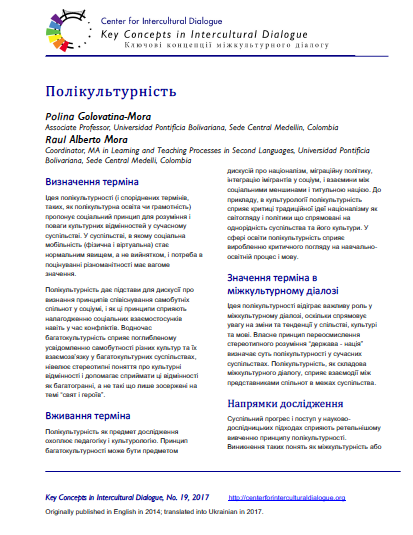
Key Concept #19: Multiculturalism Translated into Ukrainian

Key Concepts in ICDContinuing translations of Key Concepts in Intercultural Dialogue, today I am posting KC#19: Multiculturalism, which Polina Golovátina-Mora and Raúl Alberto Mora wrote for publication in English in 2014, and which Roxanna M. Senyshyn has now translated into Ukrainian.

As always, all Key Concepts are available as free PDFs; just click on the thumbnail to download. Lists of Key Concepts organized chronologically by publication date and number, alphabetically by concept, and by languages into which they have been translated, are available, as is a page of acknowledgments with the names of all authors, translators, and reviewers.

KC19 Multiculturalism_UkrainianGolovátina-Mora, P., & Mora, R. A. (2017). Multiculturalism [Ukrainian]. (R. M. Senyshyn, trans). Key Concepts in Intercultural Dialogue, 19. Available from:
https://centerforinterculturaldialogue.org/wp-content/uploads/2017/08/kc19-multiculturalism_ukrainian1.pdf

If you are interested in translating one of the Key Concepts, please contact me for approval first because dozens are currently in process. As always, if there is a concept you think should be written up as one of the Key Concepts, whether in English or any other language, propose it. If you are new to CID, please provide a brief resume. This opportunity is open to masters students and above, on the assumption that some familiarity with academic conventions generally, and discussion of intercultural dialogue specifically, are useful.

Wendy Leeds-Hurwitz, Director
Center for Intercultural Dialogue


Creative Commons License
This work is licensed under a Creative Commons Attribution-NonCommercial-NoDerivatives 4.0 International License.