U Albany Job Ad: Organizational/Interpersonal/Intercultural

Job adsThe Department of Communication at the University at Albany is seeking to fill a tenure track position with a scholar whose research focuses on either organizational communication, or interpersonal and/or intercultural communication (in relational, health, or organizational contexts).

The Department welcomes applications from scholars of all methodological orientations. Senior scholars must possess an established record of productive, externally funded research and a record of excellence in teaching; junior scholars should demonstrate the potential for productive research and some evidence of teaching effectiveness. Candidates must be willing to contribute to the Department’s initiatives in online teaching and learning. Applicants should share a commitment to the University’s strategic values for engaged learning and societal responsibility, and to its goal for increasing levels of external funding.

Applicants must address in their applications their ability to work with and instruct a culturally diverse population. Additionally, the applicant must currently possess a doctoral degree or expect to receive a doctoral degree by August 1, 2018, from a university accredited by the U.S. Department of Education or an internationally recognized accrediting organization.

The appointment will begin in Fall 2018. Review of applications will begin October 7, 2017.

Hebrew U Job Ad: Communication & Journalism (Israel)

Job adsHEBREW UNIVERSITY OF JERUSALEM
Department of Communication and Journalism
Tenure Track Position

The Noah Mozes Department of Communication and Journalism at The Hebrew University of Jerusalem invites outstanding candidates to apply for a tenure-track position starting July, 2018.

Applicants must hold a Ph.D. degree at the time of hire, and demonstrate an active research program, indicating the potential for outstanding scholarship. Ability to teach in Hebrew is required.

Deadline for applications: September 26, 2017.

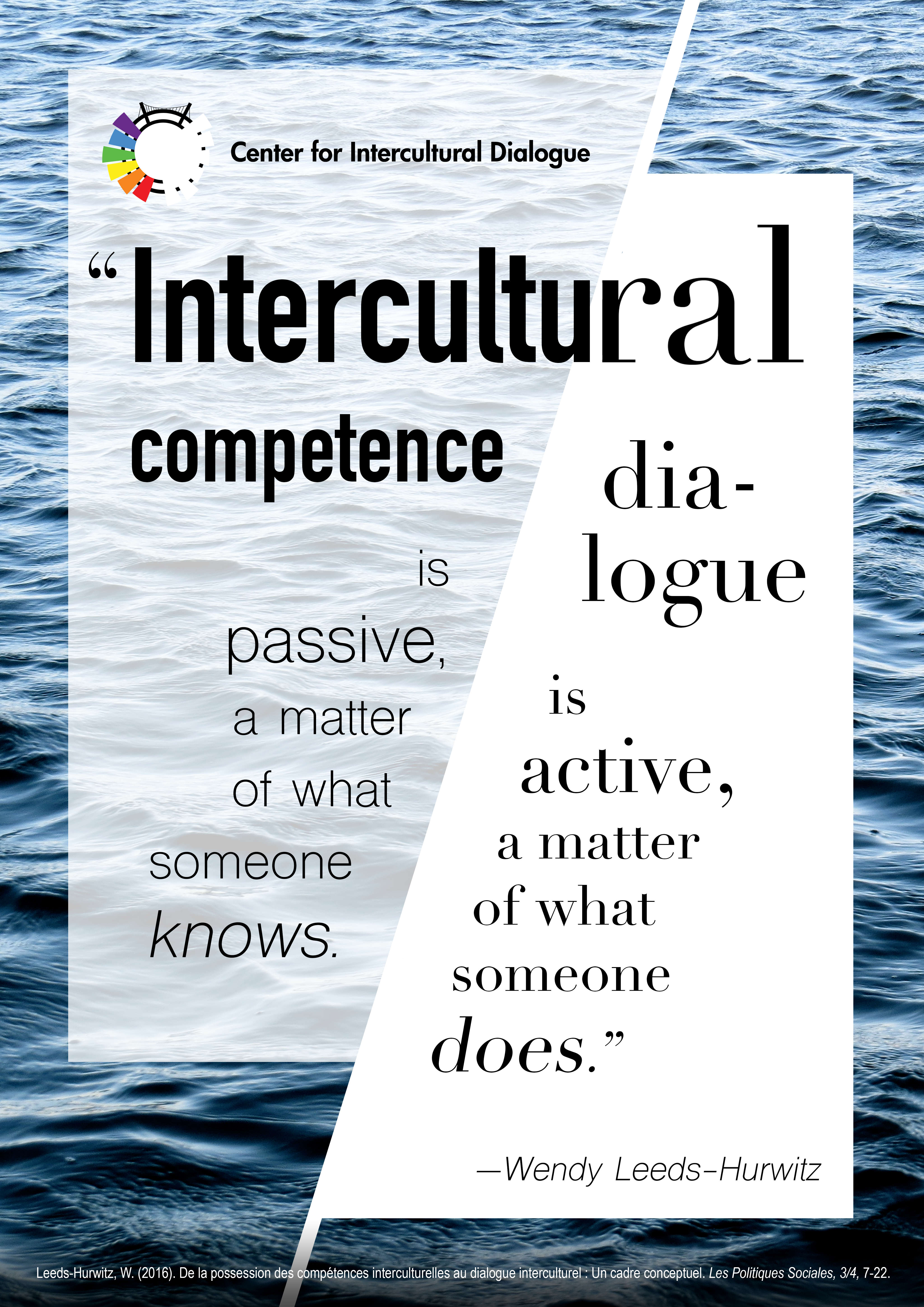
CID Poster #8: Intercultural Competence/Intercultural Dialogue

CID PostersThis is the next of the posters designed by Linda J. de Wit, in her role as CID intern. The quote is intended to clarify the concept of intercultural dialogue by showing how it relates to an older, more frequently used concept, intercultural competence. The photo of water used as background is Linda’s own. The citation for the quote is:

Leeds-Hurwitz, W. (2016). De la possession des compétences interculturelles au dialogue interculturel: Un cadre conceptuel [Moving from having intercultural competencies to constructing intercultural dialogues: A conceptual framework]. Les Politiques Sociales, 3/4, 7-22.

Intercultural competence/ Intercultural dialogueJust in case anyone wants to cite this poster, the following would be the recommended format:

Center for Intercultural Dialogue. (2017). Intercultural competence/Intercultural dialogue. CID Posters, 8. Available from:
https://centerforinterculturaldialogue.org/wp-content/uploads/2017/08/competence-dialogue.png

As with other series, CID Posters are available for free on the site; just click on the thumbnail to download a printable PDF. They may be downloaded, printed, and shared as is, without changes, without cost, so long as there is acknowledgment of the source.

As with other series, if you wish to contribute an original contribution, please send an email before starting any work to receive approval, to minimize inadvertent duplication, and to learn about technical requirements. As is the case with other CID Publications, posters should be created initially in English. Given that translations of the Key Concepts in Intercultural Dialogue have received so many views, anyone who wishes to translate their own poster into another language (or two) is invited to provide that as well. If you want to volunteer to translate someone else’s poster into a language in which you are fluent, send in a note before starting, to receive approval and to confirm no one else is working on the same one.

Wendy Leeds-Hurwitz
Director, Center for Intercultural Dialogue
intercult.dialogue AT gmail.com


Creative Commons License
This work is licensed under a Creative Commons Attribution-NonCommercial-NoDerivatives 4.0 International License.

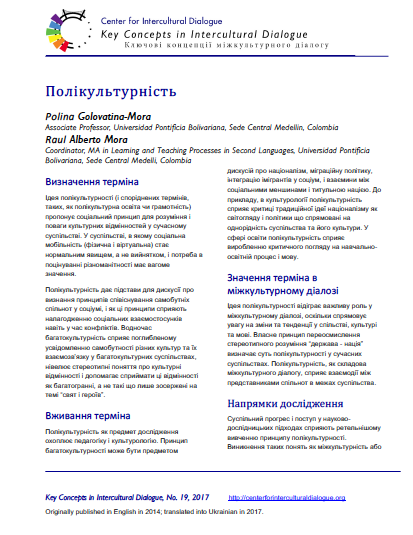
Key Concept #19: Multiculturalism Translated into Ukrainian

Key Concepts in ICDContinuing translations of Key Concepts in Intercultural Dialogue, today I am posting KC#19: Multiculturalism, which Polina Golovátina-Mora and Raúl Alberto Mora wrote for publication in English in 2014, and which Roxanna M. Senyshyn has now translated into Ukrainian.

As always, all Key Concepts are available as free PDFs; just click on the thumbnail to download. Lists of Key Concepts organized chronologically by publication date and number, alphabetically by concept, and by languages into which they have been translated, are available, as is a page of acknowledgments with the names of all authors, translators, and reviewers.

KC19 Multiculturalism_UkrainianGolovátina-Mora, P., & Mora, R. A. (2017). Multiculturalism [Ukrainian]. (R. M. Senyshyn, trans). Key Concepts in Intercultural Dialogue, 19. Available from:
https://centerforinterculturaldialogue.org/wp-content/uploads/2017/08/kc19-multiculturalism_ukrainian1.pdf

If you are interested in translating one of the Key Concepts, please contact me for approval first because dozens are currently in process. As always, if there is a concept you think should be written up as one of the Key Concepts, whether in English or any other language, propose it. If you are new to CID, please provide a brief resume. This opportunity is open to masters students and above, on the assumption that some familiarity with academic conventions generally, and discussion of intercultural dialogue specifically, are useful.

Wendy Leeds-Hurwitz, Director
Center for Intercultural Dialogue


Creative Commons License
This work is licensed under a Creative Commons Attribution-NonCommercial-NoDerivatives 4.0 International License.

Open City Fellowships (Belgium)

FellowshipsMigration in Europe has preoccupied policymakers and administrations, and prompted enormous policy reform, yet refugees and migrants are themselves often excluded from this policy debate and formulation, particularly those in more recent refugee and migrant populations. The Open City Fellowship responds to this need by supporting the leadership of refugees and migrants in policy development that directly affect urban integration.

The Open City Fellowship in this first year, will offer five fellowships. Four fellowships will involve collaborations with partner cities: Amsterdam, Athens, Barcelona, and Berlin. The fifth fellowship will be based in Brussels with a partner that specializes in refugee and migration policy within the European Union.

The aim is to improve integration through stronger participation of and consultation with refugee and migrant communities. Over time, our ambition is that Open City Fellows will become a cohort of experienced and recognized leaders who represent refugee and migrant communities, benefitting the individual fellows and the community more broadly.

The Open Society Foundations will pay Open City Fellows a stipend, will provide some funding for fellowship-related travel, and may cover other fellowship-related expenses during the course of the fellowship. The Open Society Foundations will additionally provide training and leadership development opportunities for the fellows. Fellowships will be 12 months, with the possibility of extending for an additional six months.

Eligibility Criteria

Eligible applicants must meet the following criteria:

  • have a background as a refugee or migrant
  • demonstrate a commitment to improving the lives of the refugee or migrant community and their integration through, for example, work, volunteering, organizing, or other activities
  • possess strong relationships with refugee or migrant communities in the city in which they are applying, as demonstrated through membership or other involvement in a group, organization, NGO, board of an NGO, council, association, initiative, or activities designed to serve refugee or migrant communities
  • currently be based in one of the fellowship cities (and applying for a fellowship in that same city): Amsterdam, Athens, Barcelona, Berlin, or Brussels
  • be legally entitled to accept a fellowship in current city of residence and be permitted to travel within the European Union
  • demonstrate civil society leadership potential
  • bachelor’s degree is strongly preferred (preferably with accreditation in the city where the fellow is applying)
  • available to start the fellowship in January 2018
  • meet additional eligibility criteria that may be stipulated by the Open Society Foundations

Applicants must meet the following language proficiency requirements:

  • proficient in English at a minimum B2 level
  • proficiency in the language of the city where they are applying (German C1; Greek, Dutch, Spanish, or Catalan B2)
  • fluency in the language of a refugee or migrant community is strongly preferred
Ineligibility Criteria

The Open City Fellowship does not fund enrollment in an academic institution for degree or non-degree study. Full-time students will not be eligible.

Applications will be accepted until September 15, 2017. Shortlisted candidates will be contacted by early October, and will be interviewed later that month.

Shuzhen Huang Profile

ProfilesShuzhen Huang (黄淑贞, she/her) is an Associate Professor in the Department of Communication Studies at the Commonwealth University of Pennsylvania (Bloomsburg Campus), USA.
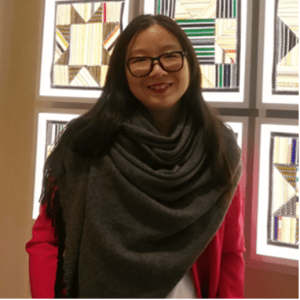
Shuzhen HuangHer research lies at the intersection of gender and sexuality studies, critical intercultural communication, and transnational feminism, serving as a critical intervention in knowledge production that centers and affirms marginalized cultural, gendered, and sexual experiences. Dr. Huang’s work has garnered multiple national and international awards.

With a background in Journalism, Gender Studies, and Communication Studies and life experiences in diverse cultural settings, Dr. Huang approaches her research with a uniquely interdisciplinary, transnational, and intersectional perspective. Her scholarship has been published in leading communication journals, including the Journal of International and Intercultural Communication, Communication and Critical/Cultural Studies, Quarterly Journal of Speech, and Women’s Studies in Communication.

Selected Publications

Huang, S. (2023). Reclaiming family, reimagining queer relationality. Journal of Homosexuality, 70(1), 17–34. https://doi.org/10.1080/00918369.2022.2106466

Wong, T. S., & Huang, S. (2023). Differently Chinese, differently queer: Queer Chineseness as heuristic and transnational queer imaginary. QED: A Journal in GLBTQ Worldmaking, 10(2), 8–26.

Huang, S., & Kang, J. (2022). Counterpublics beyond Western imaginaries. Quarterly Journal of Speech, 108(2), 221–226. https://doi.org/10.1080/00335630.2022.2055126

Huang, S. (2021). Alternatives to coming out discourses. In Oxford Research Encyclopedia of Communication. Oxford University Press. https://doi.org/10.1093/acrefore/9780190228613.013.1179

Huang, S. (2021). Why does communication need transnational queer studies? Communication and Critical/Cultural Studies, 18(2), 204–211.

Huang, S. (2020). Unbecoming queer: Chinese queer migrants and impossible subjectivity. QED: A Journal in GLBTQ Worldmaking, 7(1), 83–89.

Asante, G., Baig, N., & Huang, S. (2019). (De)politicized pleasures and the construction of (white) queer utopia in Netflix’s Sense8. Queer Studies in Media and Popular Culture, 4(3), 319–334.

Huang, S., & Wong, T. (2019). “More coming out, bigger market”: Queer visibility and queer subjectivity in the Chinese pink market. Queer Studies in Media and Popular Culture, 4(3), 287–302.

Huang, S. (2019). Fifty years since Stonewall: Beyond the borders of the United States. QED: A Journal in GLBTQ Worldmaking, 6(2), 69–75.

Huang, S., & Brouwer, D. (2018). Negotiating performances of “real” marriage in Chinese queer xinghun. Women’s Studies in Communication, 41(2), 140–158.

Huang, S., & Brouwer, D. (2018). Coming out, coming home, coming with: Models of queer sexuality in contemporary China. Journal of International and Intercultural Communication, 11(2), 97–116.

Huang, S. (2018). Beyond the sex-love-marriage alignment: Xinghun among queer people in mainland China. In M. Yarbrough, A. Jones, & J. N. DeFilippis (Eds.), Queer Families and Relationships after Marriage Equality (pp. 136–149). New York, NY: Routledge.


Work for CID:
Shuzhen Huang has served as a reviewer for Chinese translations.

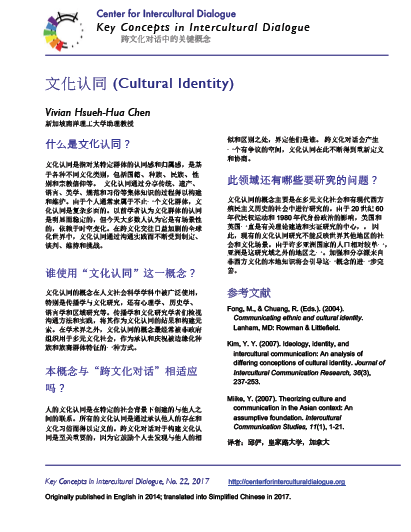
Key Concept #22: Cultural Identity Translated into Simplified Chinese

Key Concepts in ICDContinuing translations of Key Concepts in Intercultural Dialogue, today I am posting KC#22: Cultural identity, which Vivian Hsueh-Hua Chen wrote for publication in English in 2014, and which Yan Qiu has now translated into Simplified Chinese.

As always, all Key Concepts are available as free PDFs; just click on the thumbnail to download. Lists of Key Concepts organized chronologically by publication date and number, alphabetically by concept, and by languages into which they have been translated, are available, as is a page of acknowledgments with the names of all authors, translators, and reviewers.

KC22 Cultural Identity_Chinese-simChen, V. H.-H. (2017). Cultural identity [Simplified Chinese]. (Y. Qiu, trans). Key Concepts in Intercultural Dialogue, 22. Available from:
https://centerforinterculturaldialogue.org/wp-content/uploads/2017/08/kc22-cultural-identity_chinese-sim.pdf

If you are interested in translating one of the Key Concepts, please contact me for approval first because dozens are currently in process. As always, if there is a concept you think should be written up as one of the Key Concepts, whether in English or any other language, propose it. If you are new to CID, please provide a brief resume. This opportunity is open to masters students and above, on the assumption that some familiarity with academic conventions generally, and discussion of intercultural dialogue specifically, are useful.

Wendy Leeds-Hurwitz, Director
Center for Intercultural Dialogue


Creative Commons License
This work is licensed under a Creative Commons Attribution-NonCommercial-NoDerivatives 4.0 International License.

SSRC Transregional InterAsian Fellowships

FellowshipsThe Social Science Research Council Transregional Research Program aims at promoting excellence in transregional research and interrogating boundaries that have long divided world geographies and academic communities. In 2017, the SSRC will offer two separate fellowship competitions as part of its Transregional Research Program:

  • The first, the Transregional Research Junior Scholar Fellowship: InterAsian Contexts and Connections, builds upon the SSRC’s current transregional grants program through which more than 65 individual fellowships totaling nearly $2.5 million have been awarded. These longer-term fellowships are designed to support junior scholars as they work on first or second projects and to be disbursed flexibly over a sixteen-month period. Fellows can be affiliated anywhere, need not be full-time employed, and can use the funds for research or writing. Fellowship amounts will vary based on the proposed research activities, timeline, and location, and awards will be granted of $20,000–$45,000. These fellowships are awarded for projects that reconceptualize research on Asia as an interlinked historical and geographic formation stretching from West Asia (including Turkey) through Eurasia, Central Asia and South Asia to Southeast Asia and East Asia, as well as projects that explore linkages beyond this expanse. Proposals that explore the connections between Asia and Africa are particularly encouraged.
  • The second, the SSRC Global Summer Semester Residency at the University of Göttingen, is a short-term fellowship opportunity offered in collaboration with the Global and Transregional Studies Platform at the University of Göttingen in Germany, an InterAsia partner institution, or hub. These three-month residencies will take place during the 2018 summer semester at the University of Göttingen, which runs from April 15, 2018–July 15, 2018. These residencies are designed to support a small cohort of scholars who are working on projects that reflect the existing research expertise at the University of Göttingen and build upon the Global and Transregional Studies Platform research themes: Movements of Knowledge, Transregional Populisms, and Religious Networks. Recipients will receive 2,500 €/month for three months and one round-trip economy class plane ticket to Göttingen.

Lebanese American University: 6 Job Ads

Job adsLEBANESE AMERICAN UNIVERSITY 
The Department of Communication Arts at the Lebanese American University is currently advertising 6 faculty positions:

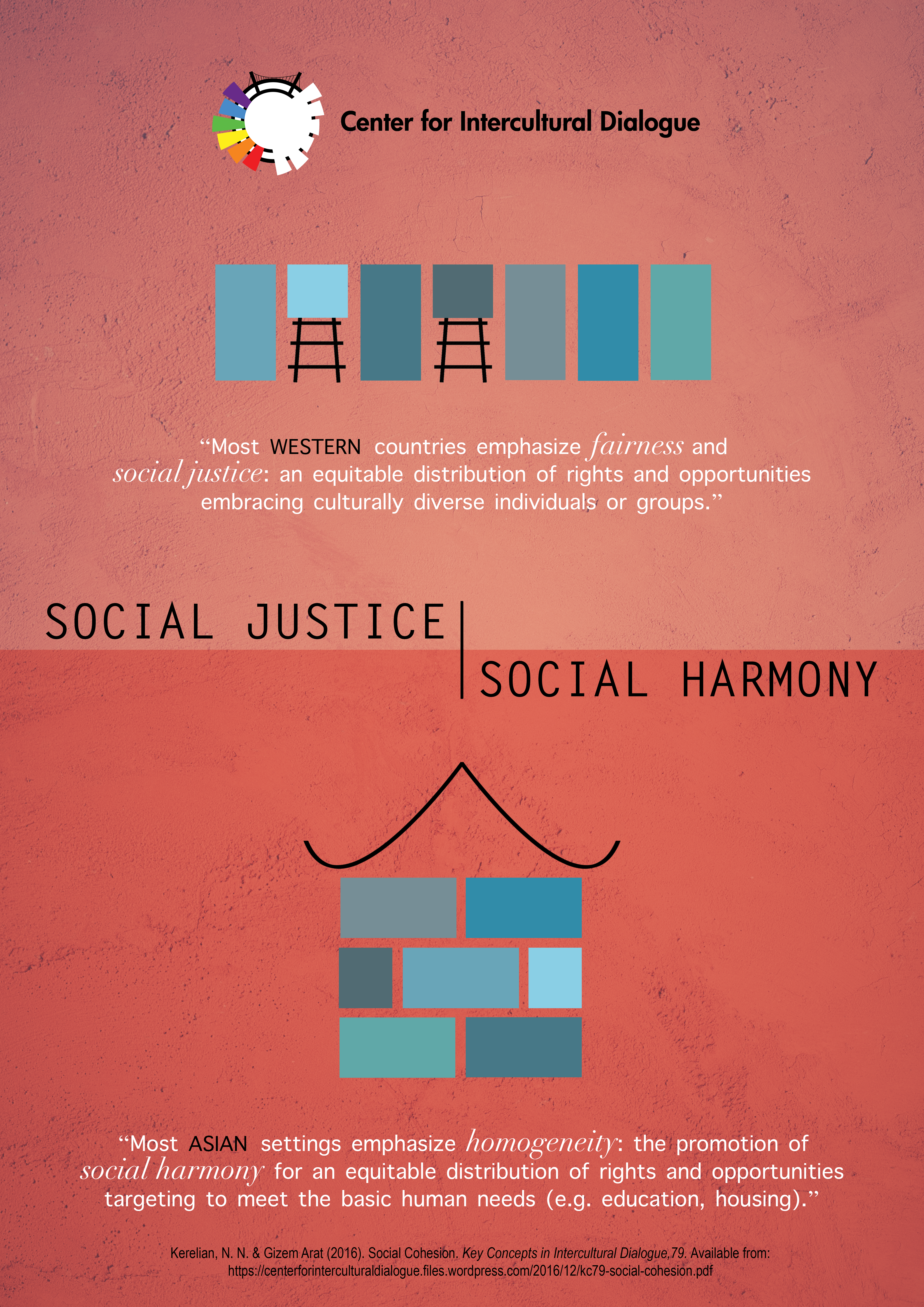
CID Poster #7: Social Justice/Social Harmony

CID PostersThis is the next of the posters designed by Linda J. de Wit, in her role as CID intern. This is the first poster to use one of the Key Concepts in Intercultural Dialogue as the source. The content here comes from KC79: Social Cohesion, written by Narine Nora Kerelian & Gizem Arat.

Social Justice/Social HarmonyJust in case anyone wants to cite this poster, the following would be the recommended format:

Center for Intercultural Dialogue. (2017). Social justice/social harmony. CID Posters, 7. Available from:
https://centerforinterculturaldialogue.org/wp-content/uploads/2017/08/social-justice-harmony.png

As with other series, CID Posters are available for free on the site; just click on the thumbnail to download a printable PDF. They may be downloaded, printed, and shared as is, without changes, without cost, so long as there is acknowledgment of the source.

As with other series, if you wish to contribute an original contribution, please send an email before starting any work to receive approval, to minimize inadvertent duplication, and to learn about technical requirements. As is the case with other CID Publications, posters should be created initially in English. Given that translations of the Key Concepts in Intercultural Dialogue have received so many views, anyone who wishes to translate their own poster into another language (or two) is invited to provide that as well. If you want to volunteer to translate someone else’s poster into a language in which you are fluent, send in a note before starting, to receive approval and to confirm no one else is working on the same one.

Wendy Leeds-Hurwitz
Director, Center for Intercultural Dialogue
intercult.dialogue AT gmail.com


Creative Commons License
This work is licensed under a Creative Commons Attribution-NonCommercial-NoDerivatives 4.0 International License.