
 Continuing translations of Key Concepts in Intercultural Dialogue, today I am posting KC 27: Globalization, which Shiv Ganesh and Cynthia Stohl wrote for publication in English in 2014, and which Candost Aydın has now translated into Turkish.
As always, all Key Concepts are available as free PDFs; just click on the thumbnail to download. Lists of Key Concepts organized chronologically by publication date and number, alphabetically by concept, and by languages into which they have been translated, are available, as is a page of acknowledgments with the names of all authors, translators, and reviewers.
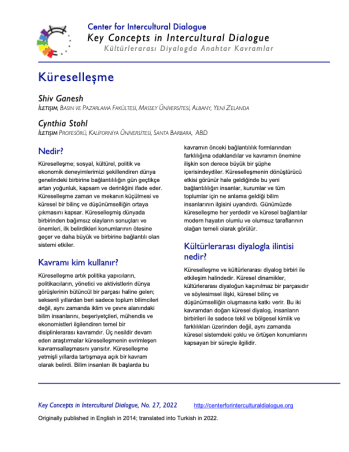 Ganesh, S., & Stohl, C. (2022). Globalization [Turkish]. (C. Aydın, Trans.). Key Concepts in Intercultural Dialogue, 27. Retrieved from: https://centerforinterculturaldialogue.org/wp-content/uploads/2021/12/kc27-globalization_turkish.pdf
If you are interested in translating one of the Key Concepts, please contact me for approval first because dozens are currently in process. As always, if there is a concept you think should be written up as one of the Key Concepts, whether in English or any other language, propose it. If you are new to CID, please provide a brief resume. This opportunity is open to masters students and above, on the assumption that some familiarity with academic conventions generally, and discussion of intercultural dialogue specifically, are useful.
Wendy Leeds-Hurwitz, Director
Center for Intercultural Dialogue

This work is licensed under a Creative Commons Attribution-NonCommercial-NoDerivatives 4.0 International License.






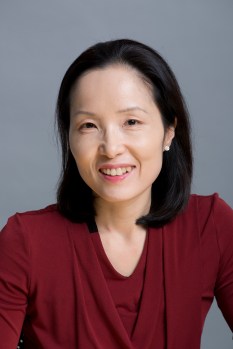 Jinhyun specializes in translation and interpreting and sociolinguistics with a focus on gender, intercultural communication, and language ideologies. Jinhyun’s research brings together interpreting and sociolinguistics to examine hitherto taken-for-granted cultural and linguistic phenomena through the unique prism of interpreters as social agents. By focusing on a shift in understanding away from the traditional mechanical view of interpreters as “translation machines” to a perspective which sees interpreters as social actors, she has been able to capture significant insights into the dynamics of dominant ideologies and societal power structures and their influences on linguistic and cultural practices in diverse socio-historical contexts.
 Center for Intercultural Dialogue