Digital Linguistic Diversity in the Global South (Germany but Online)

EventsThe ordinariness of digital linguistic diversity in the Global South, guest lecture by Sender Dovchin, sponsored by Digital Language Variation in Context, University of Hamburg, Germany. Online, 12 May 2022.

Recent debates of linguistic diversity have problematised paradigms such as bi/multilingualism, and code-switching for reifying static language boundaries and for their inability to account for communicative practices constructed out of a diversity of linguistic repertoires. Instead, trans- perspectives have been introduced to capture the critical linguistic diversity, especially in the context of digital platforms. This emergent trans- tradition in reflects the difficulty, if not futility, of demarcating linguistic features according to specific languages, for the fluid movement between and across languages.

Yet, this recent tradition still tends to celebrate and thus exoticize the presumed digital linguistic diversity in and from the Global South, although it is indeed ‘quite normal’, ‘unremarkable’ ‘ordinary’, ‘basic’, ‘everyday’, and by no means a new phenomenon. In so doing, scholarship inadvertently constructs and exoticizes a linguistic Other whose digital linguistic diversity are expected to be made legible according to normative epistemologies of diversity.

This lecture is based on the premise that the analytic potential of the trans- tradition can be enhanced through a stronger focus on such practices as reflective of everyday, quotidian, basic, mundane, unremarkable, banal, and ordinary occurrences, rather than of peculiar, exotic, eccentric or unconventional ones. It is important to recognise that digital linguistic diversity in and from the Global South is neither to celebrate nor to deplore, but something to observe and examine with interest like anything else, as it is inevitable that peoples and cultures have always been mixing and mingling. I conclude that ‘linguistic ordinariness’ is rather ‘diverse’ – a necessary condition of ‘linguistic diversity’ is its ‘ordinariness’.

Dr Sender Dovchin is an Associate Professor and Principal Research Fellow and Director of Research at the School of Education, Curtin University, Australia.

KC55 Stereotypes Translated into Turkish

Key Concepts in ICDContinuing translations of Key Concepts in Intercultural Dialogue, today I am posting KC55: Stereotypes, which Anastacia Kurylo wrote in 2014, and which İçten Duygu Özbek has now translated into Arabic.

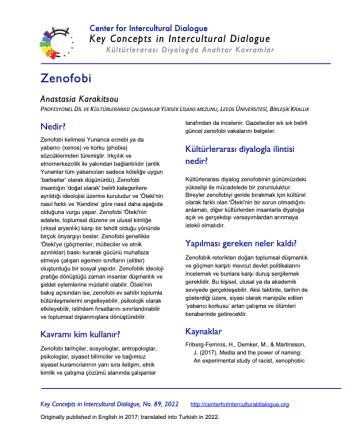
As always, all Key Concepts are available as free PDFs; just click on the thumbnail to download the PDF. Lists organized chronologically by publication date and numberalphabetically by concept in English, and by languages into which they have been translated, are available, as is a page of acknowledgments with the names of all authors, translators, and reviewers.

KC55 Stereotypes_TurkishKurylo, A. (2022). Stereotypes [Turkish]. (İ. D. Özbek, Trans.) Key Concepts in Intercultural Dialogue, 55. Available from: https://centerforinterculturaldialogue.org/wp-content/uploads/2022/03/kc55-stereotypes_turkish.pdf

The Center for Intercultural Dialogue publishes a series of short briefs describing Key Concepts in Intercultural Dialogue. Different people, working in different countries and disciplines, use different vocabulary to describe their interests, yet these terms overlap. Our goal is to provide some of the assumptions and history attached to each concept for those unfamiliar with it. As there are other concepts you would like to see included, send an email to the series editor, Wendy Leeds-Hurwitz. If there are concepts you would like to prepare, provide a brief explanation of why you think the concept is central to the study of intercultural dialogue, and why you are the obvious person to write up that concept.


Creative Commons License
This work is licensed under a Creative Commons Attribution-NonCommercial-NoDerivatives 4.0 International License.

French Institutes for Advanced Study: Fellowships 2023-24 (France)

Fellowships

Fellowships in 2023-2024, French Institutes for Advanced Study, 6 locations in France. Deadline: 2 June 2022 (later extended to 9 June 2022)

The French Institutes for Advanced Study Fellowship Programme offers 10-month fellowships in the six Institutes of Aix-Marseille, Loire Valley (Orléans-Tours), Lyon, Montpellier, Nantes and Paris. It welcomes applications from high-level international scholars to develop their innovative research projects in France. For the 2023-2024 academic year, FIAS offers 37 fellowship positions: 4 in Aix-Marseille, 3 in Loire Valley (Orléans-Tours), 10 in Lyon, 3 in Montpellier, 4 in Nantes, and 13 in Paris.

The call is open to all disciplines in the social sciences and the humanities (SSH) and all research fields. Research projects in other sciences and in arts that propose a strong interaction and dialogue with the SSH are also eligible. Some host IAS have scientific priorities that need to be taken into full consideration before applying.

The FIAS fellows will be free to organize their research while benefiting from the support and conducive scientific environment offered by the IAS characterised by a multidisciplinary cohort of fellows and by close relation to the local research centres and laboratories.

PLURAL+ Youth Video Festival 2022

Film Festivals
#PLURALplus22 call for videos: Youth video festival on migration, diversity, and social inclusion, a UNAOC and IOM initiative. Deadline: 17 June 2022.

In a world often characterized by intolerance and cultural divisions, the PLURAL+ Youth Video Festival recognizes youth as powerful agents of social change and empowers them to share their creative vision with the world and foster respect for diversity. Launched in 2009, PLURAL+ is a joint initiative of the United Nations Alliance of Civilizations (UNAOC) and the International Organization for Migration (IOM), with a network of more than 50 partner organizations around the globe. Every year, PLURAL+ gives young people around the world the opportunity to express their vision and their creativity through multimedia production. PLURAL+ invites young people of up to 25 years old to submit original and creative short films focusing on the themes of migration, diversity, social inclusion, and the prevention of xenophobia.

PLURAL+ video entries are five minutes maximum and can be of any genre (animation, documentary, music video, comedy, etc.) as long as they convey a message that can contribute to making the audience think in constructive ways about the pressing social issues of migration, diversity, social inclusion, and the prevention of xenophobia. In addition, videos can be in any language as long as English subtitles are provided.

Maria Flora Mangano: Saturday Morning (Intercultural) School

Guest PostsSaturday Morning (Intercultural) School. Guest post by Maria Flora Mangano.

NOTE: Maria Flora Mangano has previously written about dialogue as a space of relationship (2020, 2018, 20172014) as long-term followers of this site will remember. 

Since the end of 2021, I have been involved in an after-school activity for 4 to 12-year-olds. This volunteer work supports pupils doing their homework once a week, on Saturday mornings. This activity was created by a teacher at the beginning of the current school term, in October 2021, and it takes place in a parish of the city center of my town, Viterbo, near Rome. The initial aim was to reach non-Italian children from the city center, which is mostly inhabited by non-native families. In a short time, additional children arrived from different zones of the town and the surroundings.

What the children experience at home, with relatives and friends of their parents’ culture, often coexists, interacts, and enriches – we may say “is in dialogue” – with what they experience at school, as well as in this after-school activity. At the same time, their daily sharing with Italian and non-Italian people (peers, teachers, or neighbors, for instance) feeds their knowledge, and it frequently provides precious input to their families. Some, in fact, help their parents in improving their understanding of the Italian language, in talking, reading, or writing; others assist Italian people (even us) to better understand their parents’ and family’s needs.

Download the entire post as a PDF.

U Macau: Several Positions in Communication & Journalism (China)

“Job

Several positions, Department of Communication, University of  Macau, China. Deadline: 31 May 2022.

Associate / Assistant Professor in Communication

The Department of Communication of the Faculty of Social Sciences invites applications for the position of Associate/Assistant Professor in communication. They are looking for applicants to teach courses in journalism. A track record of high quality research and publication is a must. Qualifications and willingness to teach the following courses are expected: English News Writing; English News Editing;Advanced News Writing and Reporting in English; and Workshop: English Publication. Additional courses may be assigned to match the teaching needs of the department, faculty, and university.

Chair/Distinguished/Full Professor in Communication

The Department of Communication is inviting applications for a position at the rank of Chair/Distinguished/Full Professor in media and communication studies. The Department offers programmes at the undergraduate and graduate levels, with a Bachelor of Social Sciences in Communication, Master of Arts in Communication and New Media, and Ph.D. in communication studies. Students who enrol in the programmes study various dimensions of communication, including media studies, journalism, public relations, marketing, digital journalism, and creative media. Faculty members actively engage in research with focus on media and journalism, public relations, public communication, media analysis qualitative and quantitative, and intercultural communication.

U Vienna: Visiting Professor in Language Sciences (Austria)

“JobVisiting Professor of Language Sciences, Faculty of Philological and Cultural Studies, University of Vienna, Austria. Deadline: 9 May 2022.

This is a temporary position, beginning 1 October 2022. Successful candidates should be specialised in linguistics (Spanish), in particular in intercultural research and plurilinguism. They will teach both undergraduates and graduates in the Bachelor and the Master programme “Romanistik”. Their teaching load will be 8 hours per week.

Feeling Italian Instructional Video

Resources in ICD“ width=Feeling Italian: Citizens in a Multicultural Society. SIETAR Italia. The video is 27 minutes long, in Italian and English, with sub-titles in both languages.

Feeling Italian: Citizens in a Multicultural Society tells the stories and experiences of four people with a migratory background who live in Italy. It is composed of six modules and can be viewed in full or in modules, in order to stimulate a discussion on the following topics: stereotypes and discrimination, multicultural identity, dreams and aspirations, difficulties or challenges to the professional and social inclusion of people with migration, intercultural skills to be developed, diversity and inclusion management skills.

The didactic video is accompanied by training course materials and is part of a “train the trainers” course. In case you want receive the training course materials or you want more information about the course, contact the organizers by email. (Created and produced by Maura Di Mauro and Bettina Gehrke – Intercultural trainers, educators, and diversity and inclusion experts.)

For more information click here.

If you want to buy the video, click here.

Blue Metropolis International Literary Festival 2022 (Canada and Online)

Events

Blue Metropolis International Literary Festival, 28 April-4 May, 2022: Online. 5-8 May, 2022: In person, Montreal, Canada.

The 24th Blue Metropolis International Literary Festival offers numerous thought-provoking, unbridled, multilingual authors and multicultural events in English, French, Spanish, Portuguese, Italian, Hebrew, Welsh, Ukrainian and Arabic. The Festival is thrilled to be back with live events from May 5-8 and FREE online from Apr. 28-May 4. Explore contemporary literary conversations, performances and launches, with science and ecology’s relationships to literature, and ‘age, time and literature’ as some of this year’s themes, centering around the question: What age are we? Planet, society, people. In addition, this year there will be a special focus on Ukraine during the in-person sessions. Ukraine is in the throes of a tragedy. What can literature do against war? Plenty—war is inhuman; literature is one of the best outlets humanity has to offer.

KC104 Constructive Intercultural Management Translated into Spanish

Key Concepts in ICDContinuing translations of Key Concepts in Intercultural Dialogue, today I am posting KC#104: Constructive Intercultural Management, which Madeleine Bausch wrote for publication a few months ago, and has now translated into Spanish.

As always, all Key Concepts are available as free PDFs; just click on the thumbnail to download. Lists organized chronologically by publication date and numberalphabetically by concept in English, and by languages into which they have been translated, are available, as is a page of acknowledgments with the names of all authors, translators, and reviewers.

KC104 Constructive Intercultural Management_SpanishBausch, M. (2022). Constructive intercultural management [Spanish]. Key Concepts in Intercultural Dialogue, 104. Available from: https://centerforinterculturaldialogue.org/wp-content/uploads/2022/03/kc104-constructive-intercultural-management_spanish.pdf

The Center for Intercultural Dialogue publishes a series of short briefs describing Key Concepts in Intercultural Dialogue. Different people, working in different countries and disciplines, use different vocabulary to describe their interests, yet these terms overlap. Our goal is to provide some of the assumptions and history attached to each concept for those unfamiliar with it. As there are other concepts you would like to see included, send an email to the series editor, Wendy Leeds-Hurwitz. If there are concepts you would like to prepare, provide a brief explanation of why you think the concept is central to the study of intercultural dialogue, and why you are the obvious person to write up that concept.


Creative Commons License
This work is licensed under a Creative Commons Attribution-NonCommercial-NoDerivatives 4.0 International License.