The Nordic Institute of Asian Studies, University of Copenhagen (UCPH), invites candidates for a number of postdoctoral positions in Asian Studies. Wanted are early career scholars researching on modern and contemporary East and Southeast Asia, who could contribute to work in one or more of the following areas:
Climate and Sustainability
Digitalization
Gender Equality and Diversity
Democracy and Human Rights
Asia-Nordic Relations
The Rise of China
Geopolitics of the Indo-Pacific
Youth Politics and the Politics of Protest
Successful candidates will either work on their own projects or on collaborative research projects with NIAS and University of Copenhagen colleagues. The position is from 1 September 2022 or as soon as possible thereafter and until 31 December 2023.
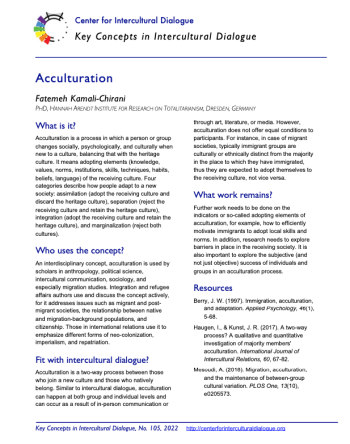
The Center for Intercultural Dialogue publishes a series of short briefs describing Key Concepts in Intercultural Dialogue. Different people, working in different countries and disciplines, use different vocabulary to describe their interests, yet these terms overlap. Our goal is to provide some of the assumptions and history attached to each concept for those unfamiliar with it. As there are other concepts you would like to see included, send an email to the series editor, Wendy Leeds-Hurwitz. If there are concepts you would like to prepare, provide a brief explanation of why you think the concept is central to the study of intercultural dialogue, and why you are the obvious person to write up that concept.
The applicant should have an outstanding, thematically relevant, doctorate in intercultural communication in particular with regard to its social and cultural-scientific reference disciplines (e.g., sociology, political science, social or cultural geography). The candidate should have an outstanding international reputation in one of the following areas in intercultural communication: a) global mobility and migration, b) diversity and processes of integration and inclusion in societal diversification. The candidate should be willing to extend his/her/their research agenda towards the second area, as both areas are fundamental for the tenure track procedure.
He/She/They should display potential for successful international publication activity as well as for high-quality teaching in a Bachelor‘s and Master‘s programs: Intercultural Business Communication (BA), Intercultural Music – and Event Management (BA), Intercultural Human Resource Development and Communication Management (MA), and our international double-degree programs. The language of instruction is mainly German. Candidate is expected to be open towards digital teaching concepts and have experience in intercultural training and learning contexts, international experience and the supervision of students and PhD-students.
Liaison Officer in Brussels, Anna Lindh Foundation (organization based in Egypt; position based in Belgium). Deadline: none listed; posted 22 July 2022.
“The Anna Lindh Foundation is looking for talented and prepared young at heart people ready to make a change in the region to join our multicultural team; who share our strategic vision and organisation values of empathy, inclusivity and creativity; and who want to work as part of a broader movement to create a culture of dialogue and exchange among and within our societies.
In its new phase 2022-2025, the Foundation aims at mainstreaming youth, gender equality and networking with a clear determination to lead aspiring regional and local intercultural dialogue initiatives that are useful for societies and institutions with a very pragmatic approach.
The ALF’s action is based on the two main bodies of the Foundation: The civil society and coordinators of its National Networks of more than 4.000 members across the Middle East, North Africa, Europe and the Balkans, and the 41 Member States of its Board of Governors.
The Anna Lindh Euro-Mediterranean Foundation for the Dialogue between Cultures (ALF), created in 2005 and based in Alexandria is registered by the Egyptian Ministry of Foreign Affairs as an international intergovernmental organisation and its aim, according to its statutes, is to promote the dialogue between cultures and to contribute to the visibility of the Barcelona Process through intellectual, cultural and civil society exchanges.”
Research Communications Administrator, Insight SFI Research Centre for Data Analytics, Dublin City University, Dublin, Ireland, UK. Deadline: 29 July 2022.
The Research Communications Administrator reports to the Centre Manager and Centre Director at the Insight SFI Research Centre for Data Analytics. The Research Communications Administrator will principally support the collection, development and writing of research communications content. This content will fold into the Insight communications strategy, be related to events promotion and development of publicity materials for research projects across Insight@DCU. The successful candidate will have the opportunity to make the role their own depending on their interests and experience, in response to the priorities of the Site.
The ideal candidate must have a primary degree in the area of marketing, media or other relevant area.
The successful candidate should have a minimum of three years’ relevant experience working in communications.
The successful candidate will be well organised, capable of co-ordinating and progressing tasks on their own initiative and be able to contribute in a collaborative way to the Operations team.
S/he will have excellent written, communication and interpersonal skills.
A qualification or experience working in science communication would be a distinct advantage.
Experience working in a Research Centre or University environment would be a distinct advantage.
The Comparative and International Education Society (CIES) 2023 theme is Improving Education for a More Equitable World. Educational improvement is not merely a technical term, evidenced by the emerging, fast-growing, and interdisciplinary field of educational improvement studies. It constitutes a powerful approach and a dynamic process to advance education, through which reality and uncertainty are examined and problems are tackled. It varies across educational levels, forms, and contexts, including but not limited to equity, inclusion, diversity, quality, effectiveness, and sustainability. Each deserves stronger policy actions and more integrated theories and applications, requiring capacity- and community-building, a systemic approach, and multi-perspective inquiries.
Comparative and international perspectives are essential to fulfilling the dream of educational equity. How should we critically look at and meet desired outcomes across time and space? In what ways may micro, meso, and/or macro educational strategies, structures, and processes be improved along with their environments? How do we know through rigorous methods that we ARE making progress responsively? What changes can bring about responsible and sustainable advancement in learning, teaching, and schooling? What implications may these changes have on individual systems, contexts, and the already vulnerable planet? And how may our endeavors help redefine comparative and international education in a way that reconnects it with contextualized educational policy and practice?
The next issue of the Journal of Transdisciplinary Peace Praxis (JTPP) will focus on the broad theme of social identity.
They encourage co-authored works that stretch common assumptions about what constitutes the traditional academic disciplines, looking forward to broad participation from scholars, activists, and peacemaking professionals grappling with the immense complexities of social identity in conflict.
Those interested in submitting to the journal are encouraged to frame their contributions in ways that shed light on the challenges and complex dynamics of proactively engaging actors’ social identity in social conflict. They are especially interested in academic manuscripts, books reviews, and/or shorter creative expressions which address the following sub-topics and themes:
The interplay between multiple social identities in change movements (e.g., women’s/LGBTQIA rights, anti-racism, and/or religious-based movements for social justice);
Separating and teasing out elements of culture in expressions of social identity;
Exploring the clashing values of competing social identities;
Differentiating the impacts of victim identity narratives from more positive identity constructions.
Symposium editors: Anne MacLennan (York University) and Masudul Bissau (Loyola University).
Radio connects communities regionally, nationally, and transnationally. Multilingual, multicultural, migrant & diasporic radio, audio, and podcasting connect communities within larger communities crossing boundaries and barriers. This call for papers for a symposium in the May 2023 issue of the Journal of Radio & Audio Media.
Organizers invite submission of research on the roles of multicultural, multilingual, migrant, and diasporic radio stations audio and podcasting in a multicultural society. The scope of research can be geared towards the community radio stations that serve immigrant, refugee, ethnic minority, or diasporic communities. Research on how mainstream radio stations incorporating multi-lingual programming to reach a wide range of audiences as well as diasporic podcasting and audio can fall within the purview of this special edition.
The successful candidate is expected to submit a PhD thesis after 3 years under the supervision of Prof. Dr. Birte Nienaber. He/she will:
Conduct research in the frame of the PhD thesis
Write the PhD thesis in the field of migration, intra-European mobility, integration, asylum and/or reception
Participate in the UL Doctoral School in Humanities and Social Sciences
Disseminate PhD results at international conferences
Support teaching in the Master in Border Studies and Master in Geography and Spatial Planning
Publish academic articles in peer-reviewed journals
Perform any other task within the framework of the position
Expected from you…
M.Sc. (or equivalent) in Geography, Border Studies, Migration Studies, or any other related field
Knowledge in the field of migration studies
Knowledge in the field of border studies would be an advantage
Ability to work independently and within an interdisciplinary team
Experience in qualitative research methods will be an asset
As the candidate will have to work in a multilingual context, he/she must be fluent in English (written and spoken) and French or German (written and spoken).
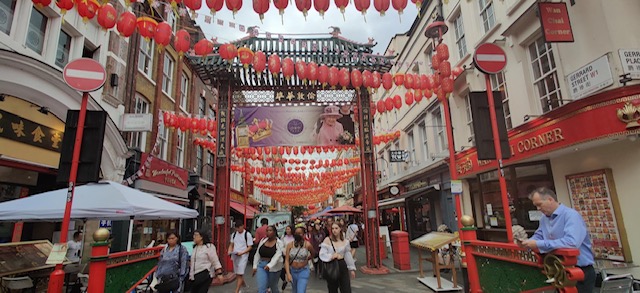
In addition to state (or public) primary and secondary schools, with students in my study abroad program, which ended on July 18, 2022, I visited two NGOs during our second week of study, the London Chinese Community Centre (CCC) in London’s Chinatown and the Islington Centre for Migrants and Refugees in the Islington district just north of the City of London. Our goal was to have direct exposure to how community-based organizations help newcomers in their intercultural adaptation in the U.K., as well as some of their challenges and successes in this regard.
London’s Chinatown, a communal center for generations of immigrants of Chinese heritage in the U.K. (Photo credit: Casey Lum)
During the initial stage of adaptation, one of the most immediate needs of new migrants is the acquisition of services in helping them settle into their new daily routines. Such can prove to be a difficult task, especially for those who do not have a sufficient level of social or functional English. As such, community-based NGOs like the two we visited last week can play a vital role. For example, CCC routinely assists their immigrant members with legal aid for securing social services from the local government or otherwise offering a place for them to build a new social network with their compatriots.
On the other hand, the Islington Centre also regularly helps their clients, many of whom are refugees from conflict regions, with various kinds of legal aids referral services to help them address issues such as political asylum status application, as well as various other everyday life matters related to poverty or job seeking, health maintenance (some of their clients do not know how to fill their medical prescriptions), housing or homelessness, learning about their rights like all other citizens, learning their way around the city, and so on.
One of the challenges facing the staff at these organizations has to do with how, and the extent to which, they can maintain a balance between their professional obligation to their clients and their own personal emotional well-being. On the one hand, one needs to be compassionate about the lives of the newcomers – especially since many of the refugees come from conflict or war-torn regions or escape from political persecution – and many of these people are going through an extremely traumatic stage of their lives. One legal aid staff member of the Centre confided that their day rarely concludes at the end of the workday as their clients’ (at times desperate) needs do not end then.
But there also are moments of joy and great satisfaction. Many members at the Chinese Community Centre enjoy taking part in the various Chinese arts and culture events and workshops, as well as English-language classes. This has been a source of encouragement for the center’s staff and volunteers to continue with their work. An executive at the Islington Centre told us that at times they organize field trips for their clients, to visit museums or attend cultural events across London. During these field trip events and various other such social activities, they sense noticeable joy among their clients. As their clients see or learn something new, their cultural experiences allow them to begin to regain some sense of normalcy in their intercultural adaptation to an otherwise unfamiliar social landscape.
Casey Man Kong Lum, Associate Director
Center for Intercultural Dialogue






 Center for Intercultural Dialogue