From May 14-17, 2014, I stopped in Turin, Italy to meet Professor Francesca Gobbo, recently retired from the University of Turin. In addition to talking about common interests in intercultural dialogue and classroom ethnography, I was able to connect with a number of her doctoral students. In fact, one of them, Federica Setti had just been awarded her PhD, and was gracious enough to include me and my husband in her celebration party (thanks again, Federica!). Another, Paola Giorgis, was in the process of preparing a post-doctoral fellowship application to EURIAS, and I was able to provide some advice, having served as one of their reviewers in the past. Rebecca Sansoé and Giorgia Peano were also in attendance that evening. Prof. Gobbo was particularly generous with her time, and we were able to fit in quite a bit of sightseeing around Turin during my visit, including their famous Egyptian museum.
Over the next few weeks, I will be posting researcher profiles as Prof. Gobbo and her doctoral students have time to send me information.
Wendy Leeds-Hurwitz, Director
Center for Intercultural Dialogue
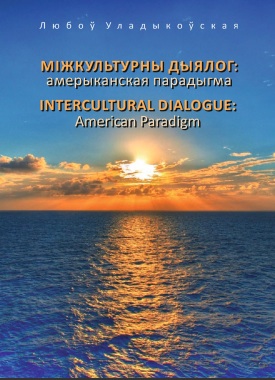
Любоў Уладыкоўская. Міжкультурны дыялог: амерыканская парадыгма / Л.Уладыкоўская. – Мінск, Установа “Міжкультурны дыялог”, 2014. – 92 с.
The scientific monograph Intercultural Dialogue: American Paradigm by Liubou Uladykouskaja has just been published. This is the first book in Belarus devoted to intercultural dialogue issues. The book is written in Belarusian, with an introduction and information about the author in English. The book reveals the essence of the American paradigm of intercultural dialogue (including mention of the Center for Intercultural Dialogue) in its comparing with the European conceptions. Uladykouskaja explains why the American approaches in the field of intercultural dialogue are important for Belarus. She believes that the secret to American success with intercultural dialogue is the precondition for, and has the result of, democracy.
According to Uladykouskaja, the American paradigm of intercultural dialogue includes the following characteristics:
— Universality, inclusiveness, and tolerance;
— Global standards of life of persons;
— Organic interaction of technology, traditions, and nature;
— Unconditional priority of freedom, life, equality, and justice;
— Dialogical thinking;
— Human and national dignity;
— Simplicity, expediency, functionality; and
— Strive for achievements, buoyancy.
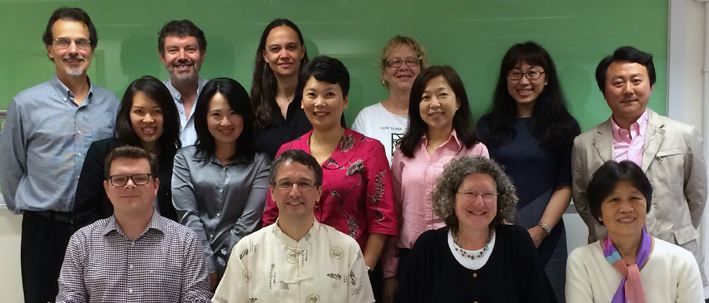
Left to right, front row: Croucher, Sandel, Leeds-Hurwitz, L. Chen; middle row: V. Chen, Dawis, Lijadi, P. Lu, Huang, Jiang; back row: Buttny, Corbett, Witteborn, Young
The Roundtable on Intercultural Dialogue in Asia was held at the University of Macau on March 28-30, 2014. The organizers were Todd Sandel (Communication, University of Macau), John Corbett (English, University of Macau) and Wendy Leeds-Hurwitz (Center for Intercultural Dialogue). By design, this was a small event, designed to answer the question of whether, and in what ways, intercultural dialogue might be a useful term for discussing intercultural interactions in Asia. Sessions focused on such topics as what concepts aid in the study of intercultural dialogue, how intercultural competence fits with intercultural dialogue, and what needs to happen next, and various publication outlets. At least one special journal issue will result.
Martin Montgomery (Dean, Faculty of Arts and Humanities) officially welcomed participants on behalf of the University of Macau. Participants included Saskia Witteborn (Chinese University of Hong Kong), Richard Buttny (Syracuse University, currently doing research in Malaysia), Stephen Croucher (University of Jyväskylä, Finland), Ling Chen (Hong Kong Baptist University), Jiang Fei (Chinese Academy of Social Sciences), Huang Kuo (International Publishing Group, Beijing), Aimee Dawis (University of Indonesia), Vivian Hsueh Hua Chen (Nanyang Technological University, Singapore, and University of Tasmania-Launceston, Australia), Peih-ying (Peggy) Lu (Kaohsiung Medical University, Taiwan), Melody Lu (Sociology, University of Macau), Priscilla Young (Peking University HSBC Business School, Shenzhen), and Anastasia Aldelina Lijadi (Psychology, University of Macau). Multiple masters and doctoral students in both Communication (Julie Zhong, Fiona Ng, Hazel Wan) and English (Carl, Dai Guangrong and Betty, Liu Suiling) managed some of the logistics, helping international visitors get around the city, picking up lunches, and serving as photographers and videographers. Administrative Staff, Barbara Chin (Communication) and Tina Chao (English) also spent many hours preparing documents and making travel, hotel, and other arrangements.
The highlight of the conference (at least for me) was gaining a sense of intercultural issues across Macau, Hong Kong, Taiwan, mainland China, Singapore, Malaysia and Indonesia, and simultaneously across disciplinary, theoretical and methodological boundaries. Since this was a small group, there were lots of opportunities for participants to connect, and at least one journal special issue and several new research collaborations are being planned, as well as a future conference. Most immediately, researcher profiles for more of the roundtable participants already are being posted to this website, and half a dozen have committed to writing Key Concepts in Intercultural Dialogue, to be posted over the next few weeks and months.
A short highlights video was prepared and is readily available. In addition, Aimee Dawis sent in a photo of coverage about the Roundtable in the International Daily News, a Chinese newspaper with the highest circulation in Indonesia:
Thanks to Aimee for arranging for this article, and to the University of Macau for being such a wonderful host institution for this event.
Wendy Leeds-Hurwitz, Director
Center for Intercultural Dialogue
Intercultural dialogue: Modern paradigm and experience of the neighborhood has just been published as an ebook, and is available for free (just click on the thumbnail below if you want a copy). The editor is Liubou Uladykouskaja, Director of the Institution Intercultural Dialogue in Minsk, Belarus.
In the original Cyrillic, the citation would be:
Міжкультурны дыялог: сучасная парадыгма і вопыт суcедства : зб. навук. арт. / склад. і навук. рэд.Л. Уладыкоўская. – Мінск : ДIКСТ БДУ, 2014.
This collection includes selected materials from the international scientific conference of the same name organized by the Polish Institute in Minsk, the State Institute of Management and Social Technologies of the Belarusian State University, the Institution “Intercultural Dialogue” (held in Minsk on May 24, 2013) , as well as scientific developments of foreign authors. The articles discuss various aspects and modern concepts of intercultural dialogue and the basis of its research methodology. Chapters are written in Belarusian, Polish, English and Russian; the authors are from the US, Belarus, Poland, and Ukraine.
The one chapter in English is by the CID Director, Wendy Leeds-Hurwitz, based on a paper delivered at the World Forum on Intercultural Dialogue in Baku, Azerbaijan in 2011. In English, that citation would be:
Leeds-Hurwitz, W. (2014). Dialogue about dialogue: Taking a (meta)communication perspective on intercultural dialogue. In L. Uladykouskaja (Ed.), Intercultural dialogue: Modern paradigm and experience of the neighborhood (pp. 6-13). Minsk, Belarus: Belarusian State University.
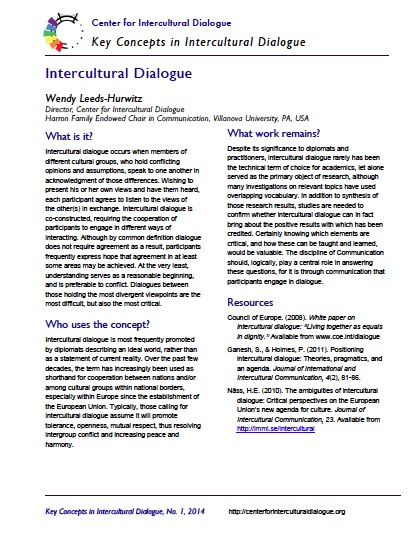
You may have already noticed that the menu bar on the site has a new entry: publications. Starting today, the Center for Intercultural Dialogue is initiating a series of short briefs describing Key Conceptsin intercultural Dialogue. The logic is that different people, working in different countries and disciplines, use different vocabulary to describe their interests, yet these terms overlap. It should be useful to sort out some of the assumptions and history attached to each concept for those unfamiliar with it. Key Concepts will be made available as PDFs on the CID website and may be downloaded for free. The first few concepts will be intercultural dialogue, cosmopolitanism, intercultural competence, and coordinated management of meaning. As you think of other concepts you would like to see included, send an email to the series editor, Wendy Leeds-Hurwitz. If there are concepts you would like to prepare, provide an explanation of why you think the concept is central to the study of intercultural dialogue.
The first key concept described is, for obvious reasons, Intercultural Dialogue. Click on the thumbnail to download the PDF.
NOTE for students: As these will be written by academics, they may be used as resources in academic papers (unless your professor in a particular course tells you otherwise). The citation format in APA would be:
The Ariane de Rothschild Fellowship is now accepting applications. This unique program blends business training in social entrepreneurship and innovative thinking in social science with experiential dialogue. Fellows will spend two weeks in August 2014 at the University of Cambridge.
Deadline for complete applications is February 9, 2014 (midnight, CET).
NOTE: Application deadline has been extended to Feb 23, 2014
In 1980, Barnett Pearce and his colleague, Vern Cronen, published Communication, Action and Meaning, a seminal work introducing scholars to the theory of the coordinated management of meaning (CMM). Over the ensuing decades, CMM theory has continued to grow, reaching a wider and wider audience as the practical and theoretical relevance of Barnett’s work became increasingly acknowledged.
In recognition of Barnett’s outstanding scholarship, a conference, entitled the Transformative Power of Dialogue, was held in his honour in January 2011. The essays in this book collection emerged from that conference. I am one of the contributors to this volume and, as such, this review is more of a commendation than any conventional critical review.
The book opens with an essay written by Barnett shortly before his death, reflecting on what it could take for personal and social revolution to be brought about. As he put it, he has “bet my professional life” on following the risky, high stake path that this evolution “could be promoted by explicit attention to what we are making together in the forms of communication in which we engage” (p. 44).
Barnett’s bet has reaped its rewards, not the least of which is the extent to which he has inspired, encouraged and collaborated with an extraordinary range of scholars and practitioners, a sample of which is contained in the current volume. The very breadth, scholarship and wide-ranging practical import captured in the 15 essays bear witness to the rich offerings to be found in CMM and its broader communication perspective.
For those interested in intercultural dialogue, the central importance placed on dialogue in Barnett’s work, and in the essays in this volume, makes the book especially pertinent. One part of this volume is specifically devoted to the theme of dialogue. The topics include the role of systemic questioning (Victoria Chen), moral conflict and managing difference (Stephen Littlejohn), framing and conflict transformation (Linda Putnam), and generative community dialogue (Stanley Deetz).
Dialogue also emerges as a powerful theme throughout the other parts in the book. For example, I (Penman) consider the core relationship between dialogue and presence and what this means for understanding participation in mediated life. John Lannamann explores the key role of dialogue and its practice in cosmopolitan communication in making better social worlds. And Kim Pearce sums up the volume by talking about the pathway to personal and social evolution in terms of the “life of dialogue…that holds in tension, and compassion, the various stories, actions and people who loves us, or don’t, who are like us. . . . , or aren’t and who may challenge us to the core to remain civil and open” (p. 328).
For anyone interested in dialogue and its role in making better social worlds, this book should be a rewarding read.
UPDATE May 12, 2014: This round of micro grants has been completed – see the results. As further micro grants become available, they will be described on the website.
The Center for Intercultural Dialogue will distribute micro grants for intercultural dialogue from a pool of $5000 made available by the Association for Business Communication. These micro grants are intended to support either or both of the two types of activities described in the mission of the Center: study of intercultural dialogues by Communication scholars, and/or participation in intercultural dialogue through academic interactions between Communication scholars based in different countries, or different linguistic and cultural regions. These grants are sufficient to provide seed funding only: no more than $1000 maximum can be awarded to any one individual. The goal is to encourage international, intercultural, interlingual collaborative research by giving enough funding to offset the cost of airfare only, while providing opportunity (and cause) for matching grants from universities.
If you already have multiple international connections, this grant is not for you – obviously you don’t need it. But if you are at a small college, or if you are a new scholar, or have not yet established significant international connections related to research, you are the intended audience for this competition. If you have been reading publications by an international scholar on a topic of potential relevance to your own research, consider a short trip to discuss ways to collaborate on a future project. If you do not know who has been doing relevant work, check the sources you’ve been reading lately, ask your colleagues, and/or think about who you know from graduate school or who you have met (or heard present an intriguing paper) at a conference. Find someone with similar interests but who takes a different theoretical or methodological stance by virtue of being based in a different cultural context.
The intention is to support the development of new intercultural, professional connections. Thus continuing collaborations are ineligible. Those based in the US are expected to propose travel outside the country. International scholars currently living outside their country of origin are asked to establish a new affiliation in a different region rather than proposing a return to their homeland. We recognize that much interesting work can be done within a country between cultural groups, however this grant program focuses on connecting researchers who are not yet connected, across cultural regions that are typically disconnected. This rationale of cross-cultural connection must be explicit in the project description.
The ABC Micro Grants Application requires applicants to describe their project, provide a brief resume, a short note from their department chair documenting their current status, and one from the host scholar expressing interest in holding conversations related to research. The initial deadline for review of proposals is February 1, 2014. If funds remain after the initial set of grants have been awarded, April 15, 2014 will be the second deadline.
The National Communication Association set aside similar funding for micro grants in 2012-13. Those projects have already been completed, and have been described in sufficient detail that they may serve as models for this year’s applications.
UNESCO sees intercultural dialogue as a central topic, and publishes frequently on related issues. In addition to the Intercultural Competences booklet that I worked on last year, which has had hundreds and hundreds of downloads from this site alone, several other publications may be of interest to intercultural scholars.
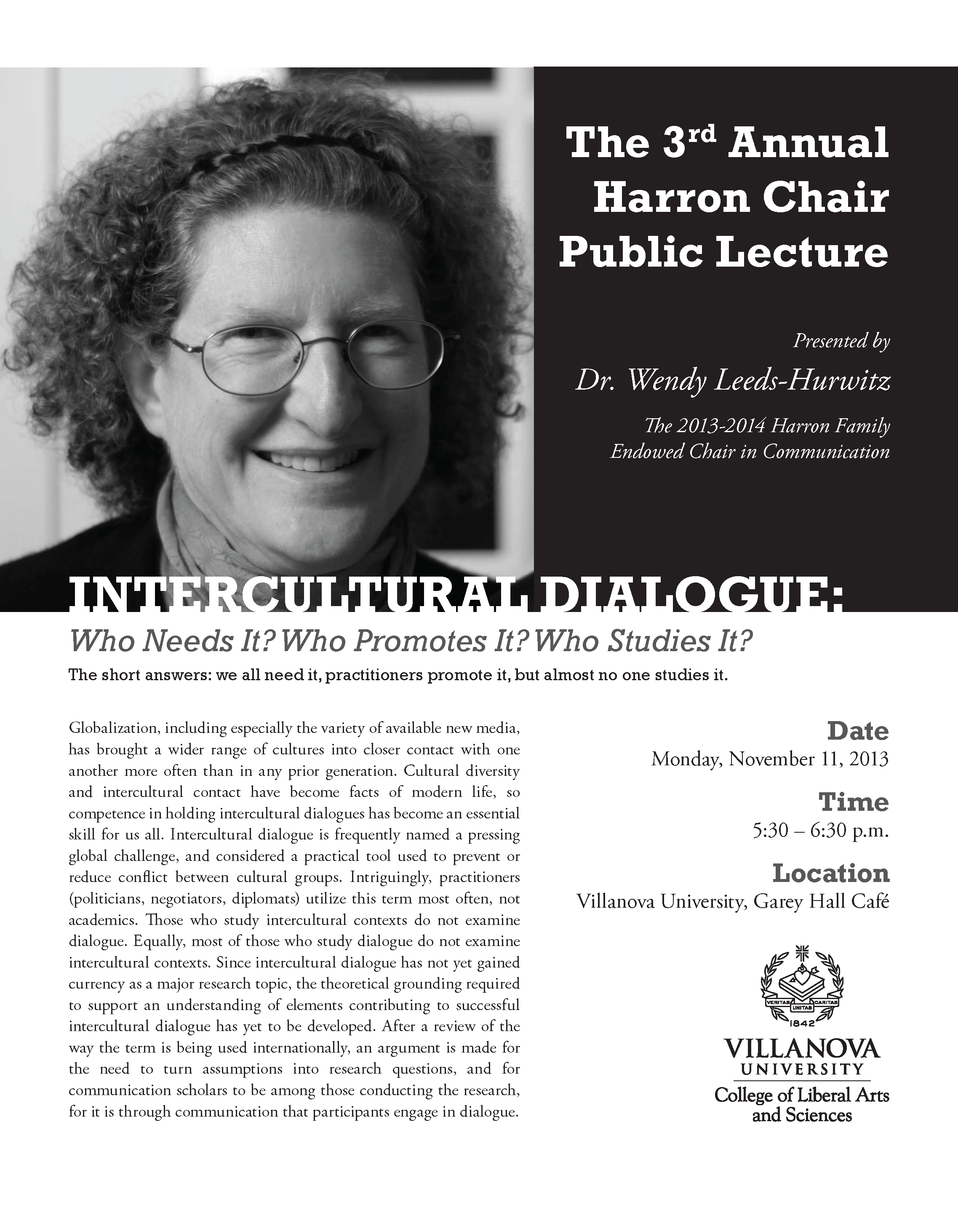
On November 11, 2013, I presented the Harron Family Endowed Chair Lecture entitled “Intercultural Dialogue: Who Needs It? Who Promotes It? Who Studies It?” This is the one public lecture expected of the Harron Chair at Villanova University, and this semester I serve in that position. College of Liberal Arts and Sciences Dean Jean Ann Linney provided a brief history of the Harron Family Endowed Chair for the audience, and Dr. Maurice Hall, Communication Department Chair, introduced me. There was a large crowd (more than expected, about 75 – sorry about the lack of chairs for the last dozen to come!) and good questions from not only faculty members but also students. Thanks to Chad Fahs for videotaping, and Minh Cao who set up a new YouTube channel for the Center (more about that in a separate post), you can see an excerpt of the talk (above).
Wendy Leeds-Hurwitz, Director
Center for Intercultural Dialogue

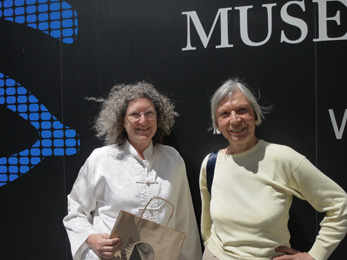 From May 14-17, 2014, I stopped in Turin, Italy to meet Professor Francesca Gobbo, recently retired from the University of Turin. In addition to talking about common interests in intercultural dialogue and classroom ethnography, I was able to connect with a number of her doctoral students. In fact, one of them, Federica Setti had just been awarded her PhD, and was gracious enough to include me and my husband in her celebration party (thanks again, Federica!). Another, Paola Giorgis, was in the process of preparing a post-doctoral fellowship application to EURIAS, and I was able to provide some advice, having served as one of their reviewers in the past. Rebecca Sansoé and Giorgia Peano were also in attendance that evening. Prof. Gobbo was particularly generous with her time, and we were able to fit in quite a bit of sightseeing around Turin during my visit, including their famous Egyptian museum.