NCA 2014 in Chicago

This slideshow requires JavaScript.

The National Communication Association 100th convention was held in Chicago November 20-23, 2014. I organized a panel entitled “Intellectual Genealogy: Documenting Invisible Colleges in the Age of Digital Communication” with Theresa Castor, Robert Craig, Jay Leighter, Jefferson Pooley, Michelle Scollo and Leah Wingard. In addition, I presented two papers. “Taking a (Meta)Communication Perspective to Intercultural Dialogue” (discussing the Key Concepts in Intercultural Dialogue) was part of the panel organized by Richard Buttny resulting from the Macau conference in spring, with Todd Sandel and Sunny Lie (from that event) and the added participation of Don Ellis; Cynthia Gordon was chair. “Bringing Intercultural Dialogue to the Center” was part of a panel of past chairs of the International and Intercultural Communication Division, organized by Alberto Gonzalez, and titled “Past Challenges, Present Victories.” A photo from that event is attached; the participants were (bottom row, from left): Mary Jane Collier, Wendy Leeds-Hurwitz, Young Yun Kim, Yolanta Drzewiecka, and (top row, from left): Benjamin Broome, Carley Dodd, Donal Carbaugh, and Alberto Gonzalez.

In addition, I met with several of the CID advisory board members (Donal Carbaugh, Todd Sandel, and Charles Self). And, as is always the great benefit of large conventions such as this, I caught up with literally dozens of people I know. Far too many to name, this group included not only everyone on any of my panels, but graduate school peers and former colleagues; large numbers of professional colleagues from various contexts, including prior conferences large and small; NCA officers past, present, and future; and even a colleague met in China attending his first NCA. I also caught up with my Villanova University colleagues from  last year, this year’s Harron Chair (Raymie McKerrow), several people considering applying for next year, and a former graduate student who was presenting a paper prepared for my seminar in Social Construction Theory. Perhaps my favorite part of going to such conventions is that I also always meet lots of new people. Unfortunately, only one other photo will have to represent all these connections: the second photo above shows me with Jing Yin  and Yoshitaka Miike.

Wendy Leeds-Hurwitz, Director
Center for Intercultural Dialogue

Intercultural Dialogue Day

The European Federation for Intercultural Learning (the federation of AFS organizations in Europe) sponsors Intercultural Dialogue Day each year on the last Thursday of September. On that day AFS promotes intercultural dialogue and diversity through youth exchanges. It is organised by AFS volunteers across Europe and addresses public audiences in an interactive way
in order to raise awareness. In 2014 the theme is “Diversity Education.”

This year the project is also supported by the European Youth Foundation of the Council of Europe.

Save

Inga Milevica – Micro grant report

This slideshow requires JavaScript.

In Spring 2014, Inga Milevica was awarded a micro grant funded by the Association for Business Communication. The following is her report.


The first and the main scientific-practical task of my project was to participate in an international forum and represent one of the private colleges of Latvia – Alberta College. The international forum “Socio-Cultural and Linguistic Aspects in Educational and Scientific Context” took place in Kyoto (Japan) at Kyoto Sangyo University from September 25-29, 2014. During the forum I presented my paper, “Naive Argumentation of Authority.” Colleagues recognized that they have similar problems (such as plagiarism, lack of knowledge of style, unwillingness to see the limits of text, ignorance of sources of information, glorification of online information sources). Also, I received an invitation from colleagues from the University of Ural publish my research the wider format (as part of a book). I gladly accepted this invitation. Thus, the first phase of the project has been very successful.

As a result of this trip, colleagues from many countries (including Korea, Japan, Kazakhstan, Belarus and Russia) learned about my college. I received multiple invitations for cooperation between my college (Alberta College in Riga, Latvia) and national institutions from many countries on the following topics: foreign language teaching methodology, innovations of linguistic science, bilingual education opportunities and perspective, new paradigm of instructional theory, intercultural aspects of pedagogical activity, information technologies in education, and horizons of literature.

The second goal of my project was methodical planning. The partners in the forum included Kyoto Sangyo University (Kyoto, Japan), Middlebury College (Vermont, USA), University of Bologna (Bologna, Italy), Sangmyung University of South Korea (Cheonan, South Korea), Almaty Institute of Power and Communication (Alamty, Republic of Kazakhstan), International Centre of Scientific-Educational Platform of Interaction of Cultures (Yekaterinburg, Russia), and the Institute of Foreign Languages and Multimedia at University of Greifswald (Greifswald, Federal Republic of Germany). I was able to discuss important issues of cooperation (different forms of cooperation, the uniqueness of cooperation programs, the most successful and unsuccessful programs, etc.) with colleges from Japan, Korea, Kazakhstan, Russia, Germany and USA. The most successful are developing virtual forms of cooperation, many colleagues said.

My third goal in this project was educational enrichment. I teach students in Business in such courses as Communication and Ethics, and Corporate Culture. In these courses, themes of intercultural communication are greatly emphasized (with a focus on making contacts with foreign colleagues, partners, clients). I can say that I was lucky: I saw the careful attitude to the time, I saw the specifics of Japanese design space (at the university, in the hotel, as well as in the cities). Also, I watched the beginning of the Japanese builders‘ working day: they do some exercises and sing a song in a daily ritual that helps establish a working mood. Particularly interesting was listening to Japanese speech because their form of argument is different from that of Europeans.

In conclusion, I want to say thank you to both the Association for Business Communication and the Center for Intercultural Dialogue for this grant, which provided a unique opportunity in terms of work, as well as my personal and professional interests!



Rosanne Teniente-Micro grant report

This slideshow requires JavaScript.

In Spring 2014, Rosanne Teniente was awarded a micro grant funded by the Association for Business Communication. The following is her report.


This past August I was privileged to have the opportunity to attend the Institute for Peace and Dialogue’s Summer Academy on Peacebuilding and Intercultural Dialogue hosted in Baar, Switzerland. IPD is an organization dedicated to conflict resolution, peacebuilding, and intercultural dialogue, and host conferences and trainings for those interested in peacebuilding and cross-cultural communication. I was there for ten days from August 17th through 27th and was partially funded through a microgrant from ABC, awarded through CID.

To say the least, it was a truly inspiring experience that I will cherish for the rest of my life. The experts invited were all very knowledgeable about their speaking topics, ranging from the Middle East conflict, non-violent communication and civil disobedience, to learning how to influence and persuade others, especially in dealing with conflict. Experts included a former French diplomat, the founder of the Pancevo peace movement in Serbia who was also directly involved in the Otpor movement that brought down Milosevic, as well as a former British colonel who worked on the Transnistrian conflict. There were also several experts in communication topics, ranging from cross-cultural communication, persuasive communication for successful negotiation, and non-violent communication. Every day had enthralling lectures, with great exercises and activities to really involve the participants.

Perhaps what really made the conference as special as it was were the other attendees. There were about thirty other participants, attending from all over the world. Everyone’s unique cultural background and experiences lent to amazing discussion and insight. One gentleman hailed from the Democratic Republic of Congo and was able to share his experiences in such a high-conflict country. Another came from Iraq and was able to eloquently explain the issues of ISIS and how his country is faring in the post-Iraq war years. Other participants were active peace practitioners, working for the United Nations, the Carter Center, and Peace Brigades International. At the end of the conference, we all agreed that one of the most rewarding aspects was that we were all blessed to have met and gotten to know each other during the time there, and to have forged such great connections with people from unlikely places.

I feel so fortunate that I was able to participate in such an event. As a graduate student and military spouse, it would have been very difficult to afford to attend the conference without funding from CID. I was also lucky that my university program was also able assist with a supplementary travel grant. While I did have to cover about half of the cost by myself, the microgrant from CID made it possible to attend, and as I said before, this will be an experience that I carry with me for the rest of my life.

Dorm Room Diplomacy

I just ran across an interesting example of applied intercultural dialogue that may be of particular interest either to students taking, or faculty teaching, courses on intercultural topics:

“Founded by students at the University of Pennsylvania in 2009, Dorm Room Diplomacy fosters intercultural dialogue and mutual understanding among an international group of university students. Dorm Room Diplomacy employs videoconference technology to facilitate virtual exchanges that help students to see the individuals behind reductionist cultural stereotypes.

The videoconference program occurs each academic semester, and the same set of 8 students join in a virtual dialogue with a trained facilitator each week. Dorm Room Diplomacy is entirely student-run, encouraging students to take ownership over the dialogue process, establish campus chapters, and empower themselves and their peers. As a non-partisan organization, Dorm Room Diplomacy does not engage in political activities or advocacy, other than the promotion of intercultural dialogue. “

For more information, and for the source of this quote, go to the website for Dorm Room Diplomacy.

Macau Roundtable on Intercultural Dialogue video

A short video documenting the Roundtable on Intercultural Dialogue held at the University of Macau on March 28-30, 2014, is now available. Briefly, the Roundtable was organized by the Departments of Communication and English at the University of Macau as well as by the Center for Intercultural Dialogue, and attended by a dozen participants, representing not only Macao, but also Hong Kong, mainland China, Taiwan, Singapore, Malaysia and Indonesia. The original post describing the Roundtable provides further details.

Euromed Dialogue Award 2014

The Anna Lindh Foundation and the Fondazione Mediterraneo are launching the ninth edition of the Euromed Dialogue Award under the theme of ‘Social Resilience and Creativity’, in the framework of the 10th Anniversary of the Anna Lindh Foundation, to take place in Naples (Italy), next October.

The ALF Euro-Med Award recognises the achievements of individuals and organisations that have been at the forefront of promoting Intercultural Dialogue in the Euro-Mediterranean region. Candidates for the Award can be nominated either as an individual or as an organisation and must be based in one of the member countries of the Euro-Med Partnership. Nominating organisations are requested to submit online their nomination proposals for the Award candidates before 30 June 2014 – midnight (Cairo time).

The winner shall receive a financial contribution of 5,000 euros in recognition of their work for Intercultural Dialogue in the Euro-Med region and a trophy, to be delivered by the Euro-Med Award Jury in a prestigious bestowing ceremony.

The Anna Lindh Foundation for Inter-Cultural Dialogue promotes knowledge, mutual respect and inter-cultural dialogue between the people of the Euro-Mediterranean region, working through a network of more than 3,000 civil society organisations in 43 countries. Its budget is co-funded by the EU and the EU member states.

Bergamo (Italy) visit 2014

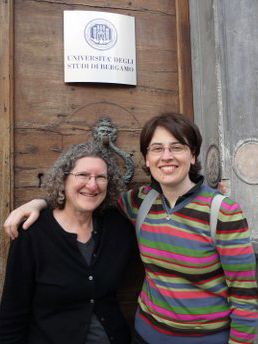
WLH_ManganoOn May 26, 2014, I was able to re-connect with Maria Flora Mangano, one of the participants in the NCA Summer Conference on Intercultural Dialogue, held in Istanbul, in 2009. We have kept in touch, as she has kept in touch with others from that event, but this is the first time we have had the opportunity to meet in person again. It took a bit of travel (I was coming in from Lugano, Switzerland, and she was coming from her home near Rome), but the conversation was worth the effort. Her work will be familiar to regular visitors to this website, as described in her post on A lesson dedicated to the genocide in Burundi: An occasion of dialogue as a space of relationship among cultures.” A chapter of hers is included in Case Studies in Intercultural Dialogue, currently in press with Kendall Hunt, and one of the results of the Istanbul conference.

Although Maria Flora already holds a PhD and has been teaching for many years now, she is currently pursuing further studies at the University of Bergamo, which is why we met there. Much of the University is located in the old city, Bergamo Alta, dating to Roman times, and many of the faculty are housed in historic buildings. This part of the city  is especially impressive, from the funicular ride up the hill on which it rests, to the grand views once you arrive. Many of Maria Flora’s classes are held in a former monastery in the lower city, with a stunning courtyard, also impressive.

Wendy Leeds-Hurwitz, Director
Center for Intercultural Dialogue

University of Turin 2014

WLH_GobboFrom May 14-17, 2014, I stopped in Turin, Italy to meet Professor Francesca Gobbo, recently retired from the University of Turin. In addition to talking about common interests in intercultural dialogue and classroom ethnography, I was able to connect with a number of her doctoral students. In fact, one of them, Federica Setti had just been awarded her PhD, and was gracious enough to include me and my husband in her celebration party (thanks again, Federica!). Another, Paola Giorgis, was in the process of preparing a post-doctoral fellowship application to EURIAS, and I was able to provide some advice, having served as one of their reviewers in the past. Rebecca Sansoé and Giorgia Peano were also in attendance that evening. Prof. Gobbo was particularly generous with her time, and we were able to fit in quite a bit of sightseeing around Turin during my visit, including their famous Egyptian museum.

Over the next few weeks, I will be posting researcher profiles as Prof. Gobbo and her doctoral students have time to send me information.

Wendy Leeds-Hurwitz, Director
Center for Intercultural Dialogue

Belarus book on Intercultural Dialogue

Uladykouskaja book

Любоў Уладыкоўская. Міжкультурны дыялог: амерыканская парадыгма / Л.Уладыкоўская. – Мінск, Установа “Міжкультурны дыялог”, 2014. – 92 с.

The scientific monograph  Intercultural Dialogue: American Paradigm by Liubou Uladykouskaja has just been published. This is the first book in Belarus devoted to intercultural dialogue issues. The book is written in Belarusian, with an introduction and information about the author in English. The book reveals the essence of the American paradigm of intercultural dialogue (including mention of the Center for Intercultural  Dialogue) in its comparing with the European conceptions. Uladykouskaja explains why the American approaches in the field of intercultural dialogue are important for Belarus. She believes that the secret to American success with intercultural dialogue is the precondition for, and has the result of, democracy.

According to Uladykouskaja, the American paradigm of intercultural dialogue includes the following characteristics:
— Universality, inclusiveness, and tolerance;
— Global standards of life of persons;
— Organic interaction of technology, traditions, and nature;
— Unconditional priority of freedom, life, equality, and justice;
— Dialogical thinking;
— Human and national dignity;
— Simplicity, expediency, functionality; and
— Strive for achievements, buoyancy.