CFP Networking East and West

CONFERENCE INVITATION AND CALL FOR PAPERS
Networking East and West: Communications, Commerce, Culture

For many centuries, the East and the West have been entangled in dense networks of communications and commerce. Yet only in our current age of globalization, influenced by a generation of media theorists shaped by the emergence since the 1970s of digital media, has it become customary to interpret these networks as a distinctive social relationship with a pervasive and enduring influence on culture, economics, politics, and international relations. For these theorists, media is more than a representation: in addition, and more fundamentally, it is an institutional practice laden with cultural meaning.

Media scholars in Asia, Europe, Australia, and North America from disciplines that include but are not confined to history, sociology, political science, literature, anthropology, geography, and media studies share a commitment to increasing our understanding of these networks so as to enhance mutual understanding, foster a common research agenda, and nurture an academic community that lowers cultural barriers. To promote this goal, a conference on the theme of “Networking East and West: Communications, Commerce, Culture” will be convened in Renmin University, China, on July 11 -12, 2014. The papers in this conference explore the conflicts, commonalities, and contrasts that have shaped communications networks linking East and West, with a focus on China, the Pacific Rim, and the United States in the period between the mid-nineteenth century and the Second World War.  The call for papers is intended to encourage submissions on a broad range of topics from various disciplinary perspectives. Possible topics include: journalistic ethics, technology transfer, telegraphy, print culture, and media theory.  Papers need not be explicitly comparative, though all should address the conference theme.

Specific details about the conference are as follows:
I.      Conference Title: “Networking East and West: Communications, Commerce, Culture”
II.     Hosts: Confucius Institute Headquarters (Hanban); Confucius Institute at Columbia University
III.    Organizer: School of Journalism and Communication, Renmin University, China
IV.     Co-organizers: Columbia Journalism School, Fudan Journalism School
V.      Theme: the conflicts, commonalities, and contrasts that have shaped communications networks linking East and West
VI.     Venue: Beijing, China
VII.    Date: July 11-12, 2014 (Registration deadline: July 10, 2014)

Participants should send the texts of their proposed papers by June 1 to the organizing committee at mediaculture2014@163.com. Successful proposals will be announced on June 15.  Participants are responsible for their own transportation and accommodation expenses.

Contact (U.S.):
Prof. Richard R. JOHN
Tel: (+1) 212-854-7837

Contact (China):
Dr. CHANG Jiang
Tel: (+86) 139-1151-1157

Further Details:
1.      The proposed paper can be written either in English or Chinese.
2.      The paper’s content shall be relevant to the conference theme.
3.      English-language papers shall be 6,000-10,000 words long; Chinese-language papers shall include 8,000-12,000 characters.
4.      Papers will include: title, name and introduction of the author, abstract, key words, main body, annotations, etc. For the Chinese-language papers, authors are required to supply an English-language title, abstract and keywords. There is no such requirement for English-language papers.
5.      All citations shall be formatted as endnotes in accordance with the conventions described in The Chicago Manual of Style (CMS).
6.      Proposals shall be sent to the organizing committee before June 1, 2014 in Microsoft Word format (.doc/ .docx).

Roundtable on Intercultural Dialogue in Asia (Macau)


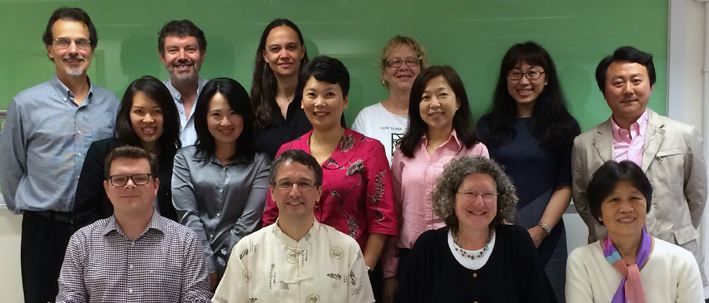
Roundtable portrait
Left to right, front row: Croucher, Sandel, Leeds-Hurwitz, L. Chen; middle row: V. Chen, Dawis, Lijadi, P. Lu, Huang, Jiang; back row: Buttny, Corbett, Witteborn, Young

The Roundtable on Intercultural Dialogue in Asia was held at the University of Macau on March 28-30, 2014. The organizers were Todd Sandel (Communication, University of Macau), John Corbett (English, University of Macau) and Wendy Leeds-Hurwitz (Center for Intercultural Dialogue). By design, this was a small event, designed to answer the question of whether, and in what ways, intercultural dialogue might be a useful term for discussing intercultural interactions in Asia. Sessions focused on such topics as what concepts aid in the study of intercultural dialogue, how intercultural competence fits with intercultural dialogue, and what needs to happen next, and various publication outlets. At least one special journal issue will result.

Martin Montgomery (Dean, Faculty of Arts and Humanities) officially welcomed participants on behalf of the University of Macau. Participants included Saskia Witteborn (Chinese University of Hong Kong), Richard Buttny (Syracuse University, currently doing research in Malaysia), Stephen Croucher (University of Jyväskylä, Finland), Ling Chen (Hong Kong Baptist University), Jiang Fei (Chinese Academy of Social Sciences), Huang Kuo (International Publishing Group, Beijing),  Aimee Dawis (University of Indonesia), Vivian Hsueh Hua Chen (Nanyang Technological University, Singapore, and University of Tasmania-Launceston, Australia), Peih-ying (Peggy) Lu (Kaohsiung Medical University, Taiwan), Melody Lu (Sociology, University of Macau), Priscilla Young (Peking University HSBC Business School, Shenzhen), and Anastasia Aldelina Lijadi (Psychology, University of Macau). Multiple masters and doctoral students in both Communication (Julie Zhong, Fiona Ng, Hazel Wan) and English (Carl, Dai Guangrong and Betty, Liu Suiling) managed some of the logistics, helping international visitors get around the city, picking up lunches, and serving as photographers and videographers. Administrative Staff, Barbara Chin (Communication) and Tina Chao (English) also spent many hours preparing documents and making travel, hotel, and other arrangements.

The highlight of the conference (at least for me) was gaining a sense of intercultural issues across Macau, Hong Kong, Taiwan, mainland China, Singapore, Malaysia and Indonesia, and simultaneously across disciplinary, theoretical and methodological boundaries. Since this was a small group, there were lots of opportunities for participants to connect, and at least one journal special issue and several new research collaborations are being planned, as well as a future conference. Most immediately, researcher profiles for more of the roundtable participants already are being posted to this website, and half a dozen have committed to writing Key Concepts in Intercultural Dialogue, to be posted over the next few weeks and months.

A short highlights video was prepared and is readily available. In addition, Aimee Dawis sent in a photo of coverage about the Roundtable in the International Daily News, a Chinese newspaper with the highest circulation in Indonesia:

International Daily News

Thanks to Aimee for arranging for this article, and to the University of Macau for being such a wonderful host institution for this event.

Wendy Leeds-Hurwitz, Director
Center for Intercultural Dialogue

Save

Save

John Corbett Profile

ProfilesJohn Corbett (PhD, Glasgow University 1992) is a Professor in the English Language and Literature Studies program at BNU-HKBU United International College in Zhuhai, China.

John CorbettHis work on intercultural language education engages with the roles curriculum design and classroom tasks play in the development of intercultural communicative competence, most recently in situations of conflict and extended crisis. He is also interested in the interaction between intercultural language education and professionalism in domains such as medicine and tourism. He is the author of An Intercultural Approach to English Language Teaching (Multilingual Matters, 2003, second edition 2022), Intercultural Language Activities (Cambridge University Press, 2010) and (with Peih-ying Lu) of English in Medicine: An Intercultural Approach to Teaching Language and Values (Multilingual Matters, 2012). He has authored and co-authored numerous articles and book chapters, including (with Wendy Anderson and Alison Phipps) explorations of intercultural language learning and telecollaboration. He was editor of the journal Language and Intercultural Communication between 2004-9. While he works in Asia, he also has strong links with Brazil, where he has been President of the BRAZ-TESOL Special Interest Group on Intercultural Language Education.


Go to his website for further details.


Work for CID:

John Corbett wrote KC9: Communicative Competence, was interviewed on this topic, and has co-authored a guest post on Critical Intercultural Pedagogy for Difficult Times. He also was one of the organizers of the Roundtable on Intercultural Dialogue in Asia, co-sponsored by CID.

Huang Kuo Profile

Profiles

Dr. Huang Kuo is an Associate Professor at English Service of China Radio International (Beijing).

Huang Kuo

Before joining CRI, Dr. Huang worked as Associate Professor at the Center for International Communication Studies, China International Publishing Group (Beijing), Associate Professor at Heilongjiang University (China), Lecturer and Tutor in Macquarie University (Australia), and Lecturer in Beijing Normal University, Zhuhai campus (China).

She has a PhD in Music, Media, Culture and Communication Studies from Macquarie University, Australia, and MA in Communication from Westminster University, UK. Her research interests include international communications, audience studies, and new media. She has published many papers for journals and book chapters, and authored the books Chinese Boxes: Reality TV and Audience Participation (2014) and Multimedia Technology: How It Changes Classroom and Communication (2008).

Representative publications:

Huang, K. (2014). Chinese Boxes: Reality TV and Audience Participation. Lambert Academic Publishing.

Huang, K. (2014). Renewal of International Communication in the Context of Big Data Processing [大数据背景下国际传播的战略思考] in Zhengrong Hu et al (Eds.) Blue Book of International Communication: Annual Report on the Development of China’s International Communication (2014) (pp. 254-260). Beijing: Social Sciences Academic Press.

Huang, K. (2013). Participative Chinese audiences: A Case Study of the Reality Show Switching Spaces. Studies in Communication Sciences, 13(2), 117–128.

Jiang, F., & Huang, K. (2013). Community Media in China: Communication, Digitalization, and Relocation. Journal of International Communication 19(1), 59-68.

Huang, K. (2013). A Functional Approach towards Political Communication in Social Media—A Case Study of 2012 US Election [社交媒体的政治传播功能研究——以2012年美国大选的社交媒体战略为例]. International Communications [对外传播].1, pp.48-50.

Huang, K. (2012). How Family Factors Influence Teenagers in Internet Adoption [家庭因素对青少年互联网使用的影响] in Wenge LI et al (Eds.) Annual Report on the New Media Use by Minors in China 2011-2012, Blue Book of Teenagers [青少年蓝皮书:中国未成年人新媒体运用报2011-2012] (pp. 50-71). Beijing: Social Sciences Academic Press.

Huang, K. (2012). On Strategy Transformation of Western Media in International Communication [西方媒体国际传播战略转型的趋势及启示]. International Communications [对外传播], 7, 35-37.

Huang, K., & Jiang, F. (2012). How New Media Subvert and Reconstruct Chinese ‘Quan-Shi’ Culture [新媒体对中国“权势”文化的颠覆与重构], Exploration and Free Views [探索与争鸣], 7.

Huang, K., & Jiang, F. (2011). Transnational Media Corporations and National Culture as a Security Concern in China. In V. Bajc & W. de Lint (Eds.), Security and Everyday Life (pp. 212-235). New York: Routledge.

Huang, K. (2009). Multimedia Technology: How It Changes Classroom and Communication. VDM Verlag Dr. Müller Aktiengesellschaft & Co. KG.

Huang, K., & Chitty, N. (2009). Selling Participation to Audiences in China. Global Media Journal—Canadian Edition, 2(1), 123-147.

Huang, K., & Jiang, F. (2009). Understanding Diaspora Cultures in the Context of Globalization. International Journal of the Humanities, 7 (10), 115-130.


Work for CID:

Huang Kuo was one of the participants in the Roundtable on Intercultural Dialogue in Asia, co-sponsored by CID.

Jiang Fei Profile

ProfilesDr. Jiang Fei is Dean of the School of International Journalism and Communication at the Beijing Foreign Studies University. He has a Ph.D. from the Department of Literature, Media & Communication studies from Sichuan University (Chengdu, China).

Jiang Fei

Previously he was Professor at the Institute of Journalism and Communication, Chinese Academy of Social Sciences, where he also served as  Director of the Department of Communication Studies, and Director of the Global Media and Communication Research Center. He is also the Secretary General of the Communication Association of China (CAC), and associate editor for the Journal of China Media Report Overseas.

Prof. Jiang has taught at several universities in China and has given invited lectures at the Chinese University of Hong Kong, Taiwan National Chengchi University, and Lugano University (Switzerland). He was visiting scholar at Stockholm University (Sweden), Toronto University (Canada), University of British Columbia (Canada), Royal Roads University (Canada), Macquarie University (Australia) and the Annenberg School for Communications, University of Pennsylvania (USA). His research interests include communication theory, new media and intercultural communication studies, cultural studies, and post-colonial theory. He has published many papers for journals and book chapters, and authored three books on intercultural communication.

Books

Jiang, F. (2011). Communication and Culture [传播与文化]. Beijing: Chinese Communication University Press.

Jiang, F. (2005). Intercultural Communication in the Post-colonial Context [跨文化传播的后殖民语境]. Beijing: China Renmin University Press.

Jiang, F. (Ed.). (2005). Transnational Media in China [海外传媒在中国]. Beijing: CFLACPC (China Federation of Literary and Art Circles Publishing Corporation).

Representative Book Chapters and Journal Articles

Jiang, F. (2013). On the three waves of China’s communication studies: A commemoration of the 30th anniversary of Schramm’s visit to China & China’s communication studies in post-Schramm times. Studies in Communication Sciences, 13(2), 107–116.

Jiang, F. (2013, coauthored), Strategic Studies on International Media Development and the Enlightenment to China [国际主流媒体发展战略研究及其对中国国际传播的启示], Modern Communication [现代传播]. Issue 2.

Jiang, F. (2012). An Intercultural Communication Study from China’s Perspective [跨文化传播研究的中国视角]. In A. Fung (Ed.), The Imagination of Chinese Communication [华人传播想像](pp.137-194). Hong Kong: The Chinese University of Hong Kong Press.

Jiang, F. (2012, coauthored). Reviewing Chinese Communication Studies 2011 [2011年传播学研究综述]. In Tang Xujun (Ed.), China Journalism and Communication Annual [中国新闻与传播年鉴]. Beijing: Social Science Academic Press.

Jiang, F. (2011, coauthored). Transnational Media Corporations and National Culture as a Security Concern in China. In V. Bajc & W. de Lint (Ed.), Security and Everyday Life (pp. 212-235). New York: Routledge.

Jiang, F. (2009, coauthored). Understanding Diaspora Cultures in the Context of Globalization. International Journal of the Humanities, 7(10), 115-130.


Work for CID:

Jiang Fei was one of the participants in the Roundtable on Intercultural Dialogue in Asia, co-sponsored by CID.

CFP ABC Asia-Pacific conference 2014

The 13th ABC Asia-Pacific Conference: Dao of Business Communication
March 27 – 29, 2014
Shanghai, China

ABC logo

The 13th Asia-Pacific Conference of the Association for Business Communication will be held on March 28-30, 2014, in Shanghai, China. ABC Asia-Pacific 2014 aims to provide a high-level international forum as well as a workshop for researchers, teachers, students, and industry practitioners to present and discuss recent advances in the applications of traditional thoughts in modern business communication.

Abstract Deadline:
Please submit a 300-500 word abstract (APA style, Times New Roman 12 point font and double spaced) as an email attachment no later than January 1st, 2014. Authors of accepted abstracts will be notified by February 1, 2014, and will then be invited to submit a full paper ranging from 5000 to 12000 words by March 1st. All submissions will be carefully reviewed. High quality articles will be selected for publication.

In an increasingly globalizing world, international business has developed more and more without national borders and human communication assumes in more complex and technology-oriented ways. The conference hopes to focus on the diversity and complexity of communication in international business across national boundaries.

Conference Chair: Guanglin Wang

Summer internship in Shanghai

2014 Summer Internship Program in Shanghai, China
hosted by the Department of Communication, Villanova University

This program is joined with the summer Internship program at Villanova School of Business (VSB) and the Chinese language summer program (introductory, intermediate, and advanced mandarin classes are all available). So non-COM majors or the students interested in any or all three areas are welcome to apply as well.

Here are some highlights:
1.     Time: 6/21-8/2, 2014
2.     Internship location: Shanghai, China.
3.     6-credit program: 3-credit Internship and 3 credit course Intercultural Communication in China.
a.     5-week internship
b.     No language requirement; English speaking environment
c.     Student specialization-tailored internships placed by a reputable agent that has worked with Villanova for over 10 years.
d.     Full cultural immersion through weekly field trips and 10-day cultural excursion.
e.      Chinese culture-specific and context-focused course design
4.     Joint program with Villanova School of Business and Chinese language program in the Institute of Global and Interdisciplinary Studies:
a.     Mix and match courses/ internships with Business/Economics, and Chinese Language programs
b.     Three faculty members; joint group activities; more fun together!
5.     Estimated cost: $6,950 (final cost will be confirmed by late December, 2013).
Cost includes tuition, shared double room in a hotel affiliated with Shanghai Academy of Social Sciences, Chinese breakfast each morning, orientation, city tour, cultural excursions, internet, student visa, and receptions. Students are required to have a cell phone in China. Some phone companies provide international service. We will assist you if needed. Cost excludes airfare, lunch & dinner, and local transportation.
An optional (highly recommended) group flight will be available for interested students. The program director will work with students to obtain the required Chinese Student Visa.
6.     Application deadline: 3/1/2014
7.   Application form

Please contact Dr. Qi Wang, the Program Director, for any questions or requests. Contact info:
Qi Wang, Ph.D.
Associate Professor, Department of Communication Page Legacy Scholar
2013/2014 President, Association for Chinese Communication Studies
16 Garey Hall, 800 E Lancaster Ave, Villanova, PA 19085

U Macau job ad

Full / Associate Professor of Communication
University of Macau
Reference No.:FSS/DCOM/FAP/10/2014

The University of Macau is a leading higher educational institution in Macao and is making strides towards becoming internationally recognized for its excellence in teaching, research and service to the community. The University is growing rapidly with a number of new strategic initiatives including the relocation to a new campus and the establishment of the largest Residential College system in Asia. The new campus is 20 times larger than the present one with a projected fast growth of student intake and faculty size. English is the University’s working language.

The Department of Communication of the Faculty of Social Sciences invites applications for the position of Full / Associate Professor of Communication from candidates with expertise in one or more of the following areas of communication studies: Advertising, Cinema Studies, Communication Theory, Critical Theory, Cultural Studies, Gender Studies, Inter-cultural Communication, Inter-personal Communication, Journalism, Mass Communication, Media Production, Media Studies, New Media, Organizational Communication, Public Relations and Visual Culture The Department of Communication currently offers broad-based curricula leading to Bachelor’s and Master’s degrees embracing the full range of the field, including Journalism, Public Relations, Advertising, Mass Communication, New Media, Media and Cultural Studies, Cinema, International and Intercultural Communication and Media Production. It also hosts a lively PhD programme. This new position is intended to complement and strengthen existing departmental emphases. For academic enquiries, please contact FSS.Comm@umac.mo. Qualifications Candidates must hold a PhD in a relevant field and should have a distinguished record of research and publication at an international level, as well as a demonstrable record of excellence in teaching, including post-graduate supervision. While candidates must be fluent in English, ability to speak Chinese may be considered an asset, though it is not a prerequisite for the appointment. Appointees with less academic achievement may be considered for Associate Professorship. The selected candidate is expected to assume duty in August 2014. Position and Remuneration Remuneration and appointment rank offered will be competitive and commensurate with the successful applicant’s academic qualification, current position and professional experience. The current local maximum income tax rate is 12% but is effectively around 5% – 7% after various discretionary exemptions.

Application Procedure Applicants should visit the full position description for more details, and apply ONLINE at Jobs@UM (Ref. No.: FSS/DCOM/FAP/10/2014). Review of applications will commence on 31 October 2013 and continue until the position is filled. Applicants may consider their applications not successful if they were not invited for an interview within 3 months of application.

The effective position and salary index are subject to the Personnel Statute of the University of Macau in force. The University of Macau reserves the right not to appoint a candidate. Applicants with less qualification and experience can be offered lower positions under special circumstances.

***Personal data provided by applicants will be kept confidential and used for recruitment purpose only**

Save

CFP China international comm annual

China International/Intercultural Communication Annual 2013

For Greater China (including Mainland China, Hong Kong and Macau, Taiwan, as well as overseas Chinese and elsewhere), working within the scope of the relevant international / intercultural communication research group, construction of the academic publishing field, comprehensive reflection of international / intercultural communication research topics, and frontiers of the latest research results, the Chinese Academy of Social Sciences has developed the innovative project “Intercultural Communication in the Age of Globalization: Academic Research and Application of Achievements.” Specifically, we plan to launch the China International / Intercultural Communication  Annual, in order to publish research on international / intercultural communication each year. The annual will be published each October starting in 2014.

We hope this annual will be an important summit from which to review the past and plan the future. We welcome all scholars who are interested in international / intercultural communication research to submit papers. Please submit your proposed title and abstract, as well as your affiliation, academic rank, telephone number and E-mail address.

Deadlines: Title and abstract by 15 September 2013, full paper by 31 December 2013

For submission or inquiry, please email ciica2013 AT 163.com to contact Ms. XIE Ming

CFP Int’l Conf Intercultural Comm Wuhan

Call for Papers:
7th International Conference of Intercultural Communication
15th–17th November, 2013 at Wuhan University, China

The 7th International Conference of Intercultural Communication (2013 ICIC) will address a range of issues on the theme “Cultural Conflict and Intercultural Communication.” With the advance of globalization, more and people are either brought in the context of dialogue and communication or assimilated into a dominant culture, which facilitates individuals’ cultural competence and enables them to witness cultural changes and manage the cultural diversity more effectively. At the same time, globalization is also splitting the world apart with globalization is also splitting world apart with diversity more effectively. At the same time, globalization is also splitting world apart with capital power, political power and cultural power, and the diversity of cultures prevents people recognizing the common humanity, thus, cultural conflict is all around the world. For example, the French policies of ban on veil Muslim women and repatriation of Roma have brought great trouble. The event of burning Koran by the US pastor Terry Jones and the rally of white supremacist groups have caused unquenchable violence. All these events exposed another horrible scene of globalization: more people tend to emphasize the absolute differences to express themselves, and more people are approaching violence under the oppression of power.

In 2010, the annual United Nations World Culture Report focused on diversity of cultures and intercultural dialogues, striving for the New Humanism in the era of globalization. The core proposition of the report was the inclusiveness and interaction in diversity, which presented an idealistic thinking. However, faced with the cultural conflict and helplessness of communication in reality, it’s not enough to reveal the idealistic flag. We have face the conflicts and predicaments in intercultural communication, and seek the social psychological reasons of cultural adaption so as to innovate the way of communication and construct the possibilities of communication.

The theme of this conference is “Cultural Conflict and Intercultural Communication”, which can be divided into 8 main topics:
1. The fundamental communication theories of cultural diversity and conflict
2. The intercultural case studies on the news report of cultural conflict and its public opinions
3. Cultural adaption and survival of immigrants, marginal groups, minorities sub-cultural groups
4. Integration and differentiation of intercultural communication space in arts (intercultural dramas, movies, paintings, music, clothing, etc.)
5. Intercultural Analysis of cultural creative products (movies, comics, ads, art designs, etc.) that triggered cultural conflicts
6. New intercultural communication problems presented in new-media on cultural conflicts
7. The new tendency of intercultural conflicts and management tactics in multinational firms
8. The innovative theories of new humanism and intercultural communication in the era of globalization

The conference is held by School of Journalism and Communication of Wuhan University and Media Development Research Center of Wuhan University, the co-organizer institutions will include: French Consulate, U.S. Intercultural Communication Research Center, Hubei Daily Media Group, School of Journalism and Communication of Xinjiang University, Xinjiang Normal University, Wuhan Textile University, etc.

The abstract of the paper is expected to be submitted by 30th July, 2013 which may contain the abstract and basic information about the author, with less than 500 words in Chinese or 250 words in English. Full submissions are expected by 30th September, 2013.
Please e-mail to: media.whu AT gmail.com
Languages of Conference: Chinese & English

Convener of 2013 ICIC:
SHAN Bo, Ph.D.
Professor, Vice Dean
School of Journalism and Communication
Wuhan University
shanbo AT whu.edu.cn
http://www.icchina.org/