Inga Milevica – Micro grant award

MilevicaInga Milevica has been awarded a micro grant for international travel, funded by the Association for Business Communication through the Center for Intercultural Dialogue. The following is her description of herself and the project. You can also read the main article describing all award winners.


Dr. Inga Milevica is a researcher and teacher in Latvia, author of more than 90 scientific papers. Her main research interests are: gender communication, business communication, mass communication and translation problems, in particular, problems of translation in films. Milevica has been working at Alberta College since 2008 in all its fields of study: Legal foundation of the business, Entertainment management and production, Cultural tourism management, Marketing and marketings innovations, Staff work organization, Business accountancy and taxes, Information technology, Game development, Economics and organization of small companies and Public relations. She teaches the following courses: Rhetoric and Presentation Skills, Introduction into Communication Theory, Corporate Culture, Business Communication and professional Ethics, Stylistics and Culture of Latvian Language.

The first and the main scientific-practical task of the project is to participate in the international forum and represent one of the private colleges of Latvia – Alberta College. The international forum “Socio-Cultural and Linguistic Aspects in Educational and Scientific Context” will take place in Kyoto (Japan) in Kyoto Sangyo University, September 25-29, 2014. The paper “Naive Argumentation of Authority” is being prepared for the section Intercultural Aspects in Pedagogical Activity. There will be basic peculiarities of the argumentation and especially of an argument authority discussed in the paper, based on the verbal and written discourse of the students.

The second task deals with methodical planning. The partners of the forum are such famous and respected educational institutions of the world as Kyoto Sangyo University (Kyoto, Japan), Middlebury College (Vermont, USA), University of Bologna (Bologna, Italy), Sangmyung University of South Korea (Cheonan, South Korea), Almaty Institute of Power and Communication (Alamty, Republic of Kazakhstan), International Centre of Scientific-Educational Platform of Interaction of Cultures (Yekaterinburg, Russia), Institute of Foreign Languages and Multimedia at University of Greifswald (Greifswald, Federal Republic of Germany). The author intends to discuss with the representatives of the universities possibilities of the programme Erasmus+, which starting from 2014 will expand both geography of the trips and scientific and educational profiles, both for the students and teaching staff.

In addition, this project will help to perfect practical knowledge about the distinctive culture of Japan. For example, such important categories for successful communication and overcoming potential barriers as time (monochrome or polychrome perception) and place (public or private – and to what extent) should be felt already on the airplane, in the hotel, on the streets, at the university, etc., and such a category as argumentation (linear or holistic) also can and must be experienced in real communication.

ABC Micro Grants Awarded

Three scholars have been awarded micro grants for international travel related to research, funded by the Association for Business Communication, in spring 2014. Brief descriptions of the award winners and their projects are below; click on the name of the grant winners for further details. After each project is completed, a link to a report will be posted to the CID website as well.


MilevicaInga Milevica, who teaches at Alberta College in Latvia, will travel to Kyoto, Japan, to connect with colleagues from the Ukraine as well as Japan, working on the topic of the naive argument of authority.

October 2014: Milevica’s report of her activities is now available.


Olena ZelikovskaOlena Zelikovska, who teaches at the National University of Life and Environmental Sciences of Ukraine, will travel to California State University of Los Angeles, working on the topic of intercultural competence.


TenienteRosanne Teniente, a graduate student at Northeastern University, will travel to participate in the Institute for Peace and Dialogue, in Switzerland.

September 2014: Teniente’s report of her activities is now available.


Olena Zelikovska Micro Grant Award

Olena ZelikovskaOlena Zelikovska has been awarded a micro grant for international travel, funded by the Association for Business Communication through the Center for Intercultural Dialogue. The following is her description of herself and the project. You can also read the main article describing all award winners.


Dr. Olena Zelikovska is an Associate Professor in the Department of English for Economic Specialties at the National University of Life and Environmental Sciences of Ukraine (NULESU). For the last 10 years she has been working as a focal point in developing curriculum of “Business English” and ‘Translation of Commercial Correspondence and Business Communication’ for undergraduate and graduate students majoring in Economics, Management of International Affairs and Linguistics as well as in supervising students’ research projects with the focus on intercultural communication issues.

In 2010, Zelikovska defended the thesis: ‘Developing intercultural competence in the students of higher economic educational institutions’ (adopted by the Ministry of Education and Science of Ukraine). She has been chairing the Student’s Research Group “Business Environment and Intercultural Communication” since 2011.

Zelikovska has been constantly seeking for international cooperation to provide the students with valuable practical experience. She is interested in project-based programs designed to connect American and Ukrainian students in a distance learning opportunity that is grounded in intercultural dialogue and exchange.

Project background: The growing importance of English as an instrument of international communication on the global scale and its increased use in Ukraine has triggered research about improved methods to develop university students’ intercultural competence (ICC). This has promoted changes in both the teaching and learning process. However lack of students’ cross-cultural communication experience has resulted in low sensitivity of intercultural issues. The initial discussion has shown that the NULESU students majoring in Management of International Affairs or in Linguistics have very little idea about intercultural communication (IC). For instance, they are unaware of the privacy zone character of the American culture and can easily use the patterns of direct language imposing their ideas and feelings on the interlocutor as they commonly do in Ukrainian culture with higher power distance and no privacy space. Moreover English classroom communicative behavior of the majority of faculty staff unfortunately does not often correlate with such behavior of their American colleagues. That is why the traditional teaching practice does not achieve the expected results on developing ICC.

The key to the solution may be the application of the 3-component intercultural development model that provides knowledge (cognitive element of the model), foster awareness (affective element of the model) and develop skills (behavioral element of the model). The proposed project seeks to assess the interrelated issues: How to fill each component of the model with the intercultural communication content tailored to the particular needs of the individual student? How do these components correlate with each other? What issues should be submitted for Student’s Research Group? How to launch distant projects between American and Ukrainian students to enrich each other with learning by experience? The development of classroom communicative behavior of the department staff is the issue of special importance. The project will provide the unique opportunity for the grant holder to study all these processes as a system at the Californian State University by classroom observation, students and faculty staff surveying and discussions with further analysis of the data collected. The ultimate goal of the research is to empower Ukrainian students with intercultural awareness enabling them to develop empathy, tolerance and mutual understanding with their American peers.

The Netherlands 2014

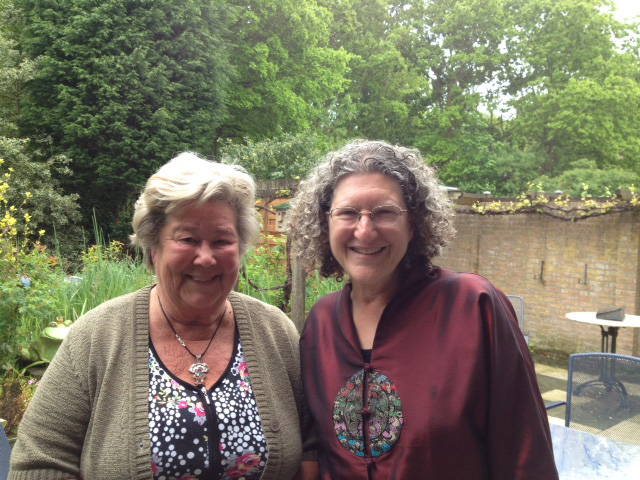
Marieke de Mooij, Wendy Leeds-HurwitzOne of the great pleasures of directing the Center for Intercultural Dialogue is meeting people in person who I have only “met” previously online. A few days ago, I had the opportunity to meet Marieke de Mooij in person, at her home in The Netherlands. She graciously invited me and my 3 traveling companions to visit, fed us an excellent traditional lunch including a wide variety of smoked fishes and other seafood, and recommended which small towns to visit on the drive to and from Amsterdam.

A long-time consultant in cross-cultural communication, Marieke’s books on global marketing and advertising are used around the world. We talked generally about overlaps in our research interests, and especially about her newest book,  Human and Mediated Communication around the World: A Comprehensive Review and Analysis (Springer, 2014). One of her goals in the book is to recombine interaction and media as parts of the study of communication; another is to take a truly global perspective.

My thanks to Yoshi Miike for introducing us last fall!

Belarus book on Intercultural Dialogue

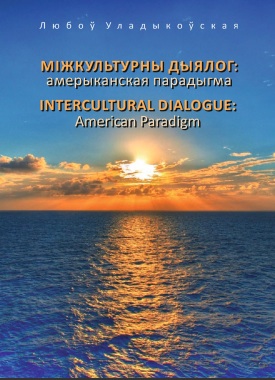
Uladykouskaja book

Любоў Уладыкоўская. Міжкультурны дыялог: амерыканская парадыгма / Л.Уладыкоўская. – Мінск, Установа “Міжкультурны дыялог”, 2014. – 92 с.

The scientific monograph  Intercultural Dialogue: American Paradigm by Liubou Uladykouskaja has just been published. This is the first book in Belarus devoted to intercultural dialogue issues. The book is written in Belarusian, with an introduction and information about the author in English. The book reveals the essence of the American paradigm of intercultural dialogue (including mention of the Center for Intercultural  Dialogue) in its comparing with the European conceptions. Uladykouskaja explains why the American approaches in the field of intercultural dialogue are important for Belarus. She believes that the secret to American success with intercultural dialogue is the precondition for, and has the result of, democracy.

According to Uladykouskaja, the American paradigm of intercultural dialogue includes the following characteristics:
— Universality, inclusiveness, and tolerance;
— Global standards of life of persons;
— Organic interaction of technology, traditions, and nature;
— Unconditional priority of freedom, life, equality, and justice;
— Dialogical thinking;
— Human and national dignity;
— Simplicity, expediency, functionality; and
— Strive for achievements, buoyancy.

CFP Asian Cultural and Media Studies (Australia)

Asian Cultural & Media Studies Research Cluster
6-7 November 2014
Monash Asia Institute, Monash University, Melbourne, Australia

The Asian Cultural & Media Studies Research Cluster of the Monash Asia Institute, Monash University will host an international conference, ‘Asian Cultural and Media Studies Now’ at Monash University, Caulfield campus in Melbourne on 6 – 7 November 2014.

The conference aims to critically revisit some of the key issues in the study of Asian culture, media and communications, which have been developed rapidly over the last twenty years, to discuss what kinds of new approaches and scholarly frameworks are required in the current socio-historical context. The conference will focus on four key areas of investigation, whose historical significance and transgressive potential requires reassessment in light of the advancement of market-driven processes of globalization and intensifying socio-economic disparity:
1) Alternative modernities and de-Westernization
2) Trans-Asian connections, dialogue and unevenness
3) Cultural convergence, citizenship and socio-cultural diversity
4) Mobility, imagined communities and cosmopolitanism

We are inviting proposals for paper presentations on these issues, although proposals that are in other ways relevant to the topic of Asian Cultural and Media Studies Now will also be considered.

The conference format will be discussion-oriented and all speakers will give a concise talk of the main points for 10-15 minutes. Speakers are not expected to present complete papers but to raise key theoretical questions with related empirical examination where relevant.

Please send your paper proposals (less than 300 words) with your affiliation details and e-mail address no later than 12 May. Please clearly put “Paper proposal for Asian Cultural and Media Studies Now” in the subject line. Acceptance of proposals will be notified in mid-June.

Please kindly be advised that we will not be able to offer financial support for participants’ travel costs. There will be no registration fees for the conference.

St Cloud State U job ad

Assistant Professor in Intercultural Communication, fixed term, non-probationary Position at St. Cloud State University

Salary:  Depends on qualifications
Date of appointment:  Fall semester, August 20, 2014.
Description:  One 1-year fixed term non-probationary position (with possibility of renewal) in the Department of Communication Studies.

Responsibilities:  To teach the introductory intercultural communication course and the hybrid communication studies course.  Other responsibilities could include public speaking, small group communication, interpersonal communication or intercultural communication related courses.   Additional responsibilities, such as committee work, will be assigned.

Qualifications: Required:
M.A/M.S. in Communication Studies/Speech Communication Coursework in teaching experience in intercultural communication Coursework or teaching experience in the hybrid communication course or its components (interpersonal, small group, public speaking) Evidence of demonstrated ability to teach and work with persons from culturally diverse backgrounds.

Preferred:
Ph.D. Preferred
College teaching experience in an undergraduate program Evidence of effective working relationships with peers and students

Application Instructions:
To apply for this position, please continue the process by going directly to the website.

For best consideration, application materials must be received by May 21, 2014; position is open until filled.  Only complete applications will be considered.  A complete application will include the following:
1. Application letter and curriculum vitae
2. Evidence of effective teaching.  At minimum representative samples of teaching  evaluations and course syllabi
3. All graduate transcripts (copies permitted for initial evaluation)
4. Evidence of commitment to incorporating diversity issues and perspectives.  At  minimum include a narrative describing how the candidate has or will incorporate these perspectives in teaching and professional activities

Contact Information:
Dr. Eddah Mutua, Search Committee Chair
Department of Communication Studies

St. Cloud State University is committed to excellence and actively supports cultural diversity. To promote this endeavor, we invite individuals who contribute to such diversity to apply, including minorities, women, LGBT, persons with disabilities and veterans. St. Cloud State University is a member of Minnesota State Colleges and
Universities System.

Post-doc position Karlstad U (Sweden)

Career opportunities in media and communication studies, Karlstad University
Research in media and communication studies at Karlstad University is pursued at the Department of Geography, Media and Communication (GMK) in the Faculty of Arts and Social Sciences. Media and communication studies at Karlstad University is an attractive education and research environment with interdisciplinary contacts and global perspectives as integral parts of our activities.

Undergraduate studies are offered in the two degree programmes Information & PR and Media and Communication, the latter with the options Communication and Global Media and Visual Communication and Design. The overarching research perspective is global media studies, including global media industries and journalism as well as the daily media routines in a multifaceted mediascape. The research pursued under this umbrella has an emphasis on two areas: (1) Communication, culture and identity, and (2) Media, democracy and citizenship. Researchers in the department are used to publishing internationally and attracting research funding. The environment is internationally orientated and in an expansive phase. We are recent recipients of a major research funding from the Ander Foundation to institute The Ander Centre for Research on News and Opinion in the Digital Era (NODE), which means that we now need to recruit a number of new academic staff to strengthen the research and teaching capacity in our two profile areas, including: a postdoc position (2 years) in media and communication studies: news, public opinion, and digital media (linked to NODE).

Duties for the postdoc position in media and communication studies with emphasis news, public opinion, and digital media.
This postdoc position offers the opportunity to work for two years on a research project of relevance to one or both of the NODE research projects, i.e. (1) how audiences access political information (in a wide sense of the word) in a media landscape where journalism no longer necessarily has a given role, and (2) how organisations, businesses, and public authorities act and think in relation to the gradual weakening or even outright disappearance of investigative journalism; to what extent alternative forces such as citizen journalists, activists and public authorities are perceived to fulfil similar functions to investigative journalism; and what communication strategies are used by businesses and public authorities (and other organizations with an interest in public opinion formation) when many citizens cannot be reached via traditional mass media. The postdoc is also expected to contribute to the NODE research environment and to departmental research activities generally by participating in seminars, conferences, meetings, etc. Postdoc duties are mainly linked to research. Partly, but not exceeding 20%, duties may include teaching, supervision, examination, course responsibility and development.

Eligibility
A PhD in media and communication studies/related field or equivalent qualifications from abroad is required for this postdoc position. The doctoral degree must have been earned within three years before the application deadline. An applicant holding a degree older than three years may still be considered if there are special reasons e.g. parental leave och sick leave.

Assessment criteria
Beyond the eligibility requirements, the following qualifications and skills will be considered: 
Special weight is given to the innovativeness and feasibility of the project proposal, and its international relevance.
Special weight is given to the project’s relevance to one of the following themes:
*1) how audiences access political information (in a wide sense of the word) in a media landscape where journalism no longer necessarily has a given role,
*2a) how organisations, businesses, and public authorities act and think in relation to the gradual weakening or even outright disappearance of investigative journalism; to what extent alternative forces such as citizen journalists, activists and public authorities are perceived to fulfil similar functions to investigative journalism,
*2b) what communication strategies are used by businesses and public authorities (and other organizations with an interest in public opinion formation) when many citizens cannot be reached via traditional mass media.
Considerable weight is given to the considered and realistic publication plan submitted (preferably with specification of substudies, planned publication channels/journals etc)
Considerable weight is given to documented research skills in one of the following areas: journalism, news media, media consumption, public opinion, political communication, strategic communication.
Weight is given to the fact that research skills are primarily documented through peer reviewed journal publications – at least one such international journal publication is required.
Weight is given to the high degree of research skills demonstrated in respect to problem formulation, theory and methodological awareness, and analytical capacity.

In addition, the following are useful qualifications:
*besides academic qualifications, experience of practical communication work (journalism, information etc)
*experience of developing and leading projects and activities
*international experience and experience of teaching in English
*experience of course development and web-based teaching
*experience of external cooperation

Terms of employment
This is a two-year fixed-term employment full-time. Expected starting date in the autumn of 2014.

Application should include the following items:
*A project plan (2,000 words) presenting the applicant’s ideas of how the postdoc project fits into the research field of news, public opinion, and digital media as well as into the applicant’s own research profile.
*Publication plan
*CV (with verified copies of certificates, references, degrees etc.)
*Submitted academic publications – doctoral thesis,
*Research articles or books/book chapters –  displaying the applicant’s research skills.
*An account of practical experiences of relevance to the position
*A brief (1,000 words) personal letter with background, reasons for applying, and view on research.
*Two letters of recommendation and contact information to  two references.

Application should be made electronically via the university’s web-based recruitment tool MyNetwork. Documents that cannot be sent electronically, such as books, publications, software, should be delivered in two copies to:
Karlstads universitet
Personalavdelningen
651 88 Karlstad Sweden
Referensnumber REK2013/101

For information on all the vacancies, please contact
Solveig Nilsson Lindberg, Head of Department
Christer Clerwall, Director of Studies
Professor André Jansson
Professor Henrik Örnebring.

Last day of application: 23 May 2014

Karlstad University has around 16 000 students and a staff of over 1 200 members. Democratic principles, equality and diversity are cornerstones of the University. We value the enriching presence of diverse backgrounds and competencies among students and staff.


Shirley Saenz Profile

ProfilesShirley Saenz is a cross-cultural trainer and business partner at ICEBERG Cultural Intelligence, the leading intercultural consulting firm in Latin America, and president of SIETAR Argentina.

Shirley Saenz

She has been actively working in the cross-cultural field training and counseling global teams, international business managers and professionals with international exposure in several industries. During the last years, Shirley has been living and working overseas throughout Colombia, France, China, Brazil, Argentina and the United States, which allowed her to gain a deep understanding of these cultures. Shirley’s primary research interests have been the cultural differences among Latin American countries, the impact of language on culture, and intercultural communication in multicultural and virtual teams.


Work for CID:

Shirley Saenz translated KC3: Intercultural Competence, KC5: Intercultural CommunicationKC10: Cross-Cultural Dialogue, and KC55: Stereotypes into Spanish. She has also reviewed translations into Spanish.

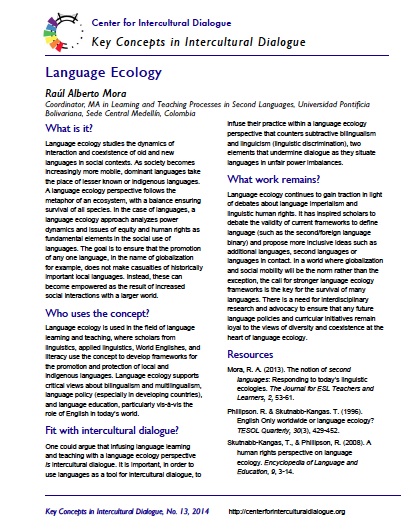
Key Concepts #13: Language Ecology by Raúl Alberto Mora

Key Concepts in ICDThe next issue of Key Concepts in intercultural Dialogue is now available. This is KC13: Language Ecology by Raúl Alberto Mora. As always, all Key Concepts are available as free PDFs; just click on the thumbnail to download.Lists organized  chronologically by publication date and numberalphabetically by concept in English, and by languages into which they have been translated, are available, as is a page of acknowledgments with the names of all authors, translators, and reviewers.

kc13-sm

Mora, R. A. (2014). Language ecology. Key Concepts in Intercultural Dialogue, 13. Available from:
https://centerforinterculturaldialogue.org/wp-content/uploads/2014/05/key-concept-language-ecology.pdf

The Center for Intercultural Dialogue publishes a series of short briefs describing Key Concepts in intercultural Dialogue. Different people, working in different countries and disciplines, use different vocabulary to describe their interests, yet these terms overlap. Our goal is to provide some of the assumptions and history attached to each concept for those unfamiliar with it. As there are other concepts you would like to see included, send an email to the series editor, Wendy Leeds-Hurwitz. If there are concepts you would like to prepare, provide a brief explanation of why you think the concept is central to the study of intercultural dialogue, and why you are the obvious person to write up that concept.


Creative Commons License
This work is licensed under a Creative Commons Attribution-NonCommercial-NoDerivatives 4.0 International License.