University of South Carolina Upstate job ad

Assistant Professor of Communication Studies
University of South Carolina Upstate
Requisition 007369

Nine-month tenure-track Assistant Professor position beginning August 16, 2014 to teach on the Spartanburg and/or Greenville campuses.  Seeking a faculty member who has a strong background in organizational and/or interpersonal communication with an emphasis on critically engaging issues of difference, especially within the areas of race and/or transnationalism. Ideal candidate would be equipped to teach critical approaches to Small Group Communication, Organizational Communication, Research Methods, Intercultural Communication, and Interpersonal Communication at the undergraduate level.

Required: PhD in Communication Studies; ABD in Communication Studies will be considered with degree completion required before August 15, 2014; demonstrated commitment to student-centered learning and evidence of excellence in teaching. Prefer: Three years of teaching experience at the university level and a clear, focused research agenda.

Applicants must apply online. Review of applications will begin immediately and continue until position is filled.

Contact: Dr. Benjamin Myers, Chair, Fine Arts & Communication Studies

CFP Modernity and Telephones in the non-west

Call for Papers: History of Modernity and Telephony in the non-West
CyberOrient: Online Journal of the Virtual Middle East
Guest Editor: Burçe Çelik
Submission deadline: April 30th, 2014 (Full Papers)

Aim
For the past few decades, history of modernization began to be written by focusing on how technologies as components of modernization processes change the lives of humans, their daily practices and imaginations, and the ways in which they construct and express their identities. Telephony, which functions in both public and private spheres and witnesses social and political changes in private as well as professional relations, is regarded as especially important for historical analysis. Functioning on multiple levels, social history of telephony can unearth the ways in which technologies obtain meanings and values in changing cultural contexts and the dynamics of social, political and cultural transformations. The history of modernization in the non-western societies is often studied by focusing on the projects of the rulers and on the discourses of the ruling parties that aim a social/political change in accordance with a particular Occidentalism where modernity is imagined with a model of the western modernization processes. Yet, the question of how people of these landscapes contributed to the modernization processes and how they produced their own modern practices in daily organizations, relations and experiences, did not receive enough scholarly attention.

This special issue of CyberOrient invites articles that focus on the history of modernity and telephony in the non-west that take the user perspective to the center. Topics could include the daily practices of users with telephone technology, the meaning and values that have been attributed to this technology by users, the role of telephony within
the social, cultural and political struggles of users, and the effect of the ownership or non-ownership of telephony in social, cultural and political lives of individuals and collectives. We welcome submissions from across disciplines and methodological approaches that are empirically and critically grounded.

About CyberOrient
CyberOrient is a peer-reviewed journal published by the American Anthropological Association, in collaboration with the Faculty of Arts of Charles University in Prague. The aim of the journal is to provide research and theoretical considerations on the representation of Islam and the Middle East, the very areas that used to be styled as an “Orient”, in cyberspace, as well as the impact of the internet and new media in Muslim and Middle Eastern contexts.

Submission
Articles should be submitted directly to Burçe Çelik and Vit Sisler. Articles should be between 6,000 and 8,000 words (including references), and follow the AAA style in referencing and citations. Upon acceptance, articles will be published online with free access in autumn 2014. More information can be found in the full call for papers.

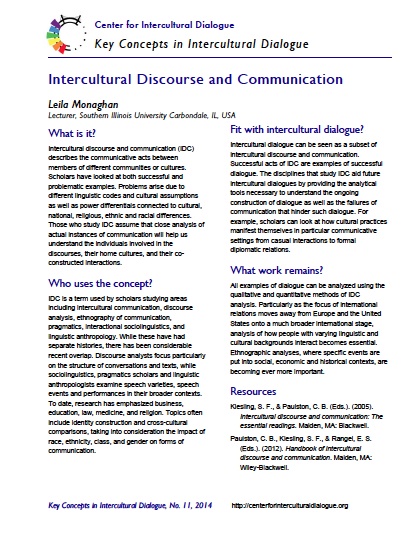
Key Concepts #11: Intercultural Discourse & Communication by Leila Monaghan

Key Concepts in ICDThe next issue of Key Concepts in intercultural Dialogue is now available. This is KC11: Intercultural Discourse & Communication by Leila Monaghan. As always, all Key Concepts are available as free PDFs; just click on the thumbnail to download.Lists organized  chronologically by publication date and numberalphabetically by concept in English, and by languages into which they have been translated, are available, as is a page of acknowledgments with the names of all authors, translators, and reviewers.

kc11-smMonaghan, L. (2014). Intercultural discourse and communication. Key Concepts in Intercultural Dialogue, 11. Available from:
https://centerforinterculturaldialogue.org/wp-content/uploads/2014/04/key-concept-intercult-discourse-comm.pdf

The Center for Intercultural Dialogue publishes a series of short briefs describing Key Concepts in intercultural Dialogue. Different people, working in different countries and disciplines, use different vocabulary to describe their interests, yet these terms overlap. Our goal is to provide some of the assumptions and history attached to each concept for those unfamiliar with it. As there are other concepts you would like to see included, send an email to the series editor, Wendy Leeds-Hurwitz. If there are concepts you would like to prepare, provide a brief explanation of why you think the concept is central to the study of intercultural dialogue, and why you are the obvious person to write up that concept.


Creative Commons License
This work is licensed under a Creative Commons Attribution-NonCommercial-NoDerivatives 4.0 International License.

John Stewart Profile

Profiles

John Stewart serves as Special Assistant to the President at the University of Dubuque in Dubuque, Iowa.

John Stewart

He was Vice President for Academic Affairs at UD from 2001-2010, and on the Communication faculty at the University of Washington in Seattle from 1969-2001. He also taught full-time at the University of Wisconsin-Stout and filled visiting professor/ lecturer positions at a number of institutions, including the University of Hawaii-Manoa, Texas A&M, Gonzaga, California State University-Fresno, Wake Forest, Hebrew University, and the Universities of Tel Aviv and Haifa.

John’s primary research interests have been the philosophy of language, the philosophy and practice of dialogue, and the philosophy and practice of interpretive research. He articulated a relational view of language in Language as Articulate Contact: Toward a Post-Semiotic Philosophy of Communication (1995) and the edited volume, Beyond the Symbol Model: Reflections on the Representational Nature of Language (1996), both published by SUNY Press. His approach to dialogue has been developed in several articles and chapters, including “Foundations of Dialogic Communication,” Quarterly Journal of Speech, 65 (1978), 183-201; “Dialogue as Tensional, Ethical Practice,” with Karen Zediker, Southern Communication Journal, 65 (2000), 224-242; and “Relationships Among Philosophies of dialogue,” with K. E. Zediker and L. L. Black, in Dialogic Approaches to Communication, R. Anderson, L. A. Baxter, & K. N. Cissna (Eds.) (Sage, 2003).

John’s edited textbook, Bridges Not Walls: A Book About Interpersonal Communication is currently in its 11th edition with McGraw Hill, and his co-authored Together: Communicating Interpersonally is in its 6th edition with Oxford.

He is currently focused on revising his communication self-help book, U&ME: Communicating in Moments that Matter (Taos Institute Publications, 2013), which is available in print and e-book versions. Excerpts from, and news about U&ME are available on its Facebook site, and John’s biography, interpersonal communication blog, and information about his other publications are can be found at www.johnstewart.org.


Work for CID:
John Stewart wrote KC14: Dialogue.

CFP European Institutes for Advanced Study Fellowships

The European Institutes for Advanced Study (EURIAS) Fellowship Programme is an international researcher mobility programme offering 10-month residencies in one of the 16 participating Institutes: Berlin, Bologna, Budapest, Cambridge, Delmenhorst, Edinburgh, Freiburg, Helsinki, Jerusalem, Lyon, Marseille, Paris, Uppsala, Vienna, Wassenaar, Zürich. The Institutes for Advanced Study support the focused, self-directed work of outstanding researchers. The fellows benefit from the finest intellectual and research conditions and from the stimulating environment of a multi-disciplinary and international community of first-rate scholars.

EURIAS Fellowships are mainly offered in the fields of the humanities and social sciences but may also be granted to scholars in life and exact sciences, provided that their proposed research project does not require laboratory facilities and that it interfaces with humanities and social sciences. The diversity of the 16 participating IAS offers a wide range of possible research contexts in Europe for worldwide scholars. Applicants may select up to three IAS outside their country of nationality or residence as possible host institutions.

The Programme welcomes applications worldwide from promising young scholars as well as from leading senior researchers. The EURIAS selection process has proven to be highly competitive. To match the Programme standards, applicants have to submit a solid and innovative research proposal, to demonstrate the ability to forge beyond disciplinary specialisation, to show an international commitment as well as quality publications in high-impact venues.

For the 2015-2016 academic year, EURIAS offers 44 fellowships (22 junior and 22 senior positions).

All IAS have agreed on common standards, including the provision of a living allowance (in the range of € 26,000 for a junior fellow and € 38,000 for a senior fellow), accommodation (or a mobility allowance), a research budget, plus coverage of travel expenses.

APPLICATION
– Applications are submitted online via www.eurias-fp.eu, where, you will find detailed information regarding the content of the application, eligibility criteria, selection procedure.
The deadline for applications is June 5th, 2014, 12 PM (noon) GMT. Late applications will not be considered.

SELECTION PROCEDURE
– Scientific assessment by two international referees
– Pre-selection by the EURIAS international Scientific Committee
– Final selection by the IAS Academic Boards
– Publication of results: January 2015

For further information on the Programme, please consult our website: www.eurias-fp.eu
For further information on the IAS and their specific working conditions: www.eurias-fp.eu/ias

EIUC (Italy) 2 job ads

EIUC jobs
The European Inter-University Centre for Human Rights and Democratisation (EIUC) is advertising two job opportunities:
1) E.MA Fellow in International Relations for the academic year 2014/2015
2) Event Manager for the research project “FRAME” – 2014

1) E.MA Fellow in International Relations for the academic year 2014/2015

The European Inter-University Centre for Human Rights and Democratisation (EIUC) is looking to appoint a highly qualified individual as E.MA Fellow in International Relations for the academic year 2014/2015 in Venice-Lido, Italy.

The E.MA Fellow in International Relations will work as a member of the academic and administrative unit of the E.MA Programme in cooperation with the E.MA Fellow in International Human Rights Law and under the supervision of the E.MA Programme Director. The position involves a combination of academic and administrative responsibilities connected with the E.MA Programme.

The closing date for receipt of applications is Saturday 3 May 2014 at 6 pm (CET).

Read full vacancy here.

2) Event Manager for the research project “FRAME” – 2014

With reference to its research activities, European Inter-University Centre for Human Rights and Democratisation (EIUC) is looking to appoint a highly qualified individual to participate in the unique large scale FP7 research project “FRAME” involving 20 universities in the EU and worldwide on the topic of human rights in EU external relations and internal policies.

The FRAME Event Manager will work as a member of the academic and administrative unit dedicated by EIUC to the FRAME project. He/she will work under the direction and supervision of the EIUC Secretary General, and coordinate its work with the Leuven Centre for Global Governance Studies (coordinator of the project) as well as with other key partners.

The closing date for receipt of applications is Friday 9 May 2014 at 6 pm (CET).

Read full vacancy here.

CFP History, the Press and Diaspora (Ireland)

Conference 2014 – Call for Papers
The theme for the seventh annual Newspaper and Periodical History Forum of Ireland (NPHFI) Conference, to be held at University College Cork on Friday and Saturday, 21-22 November 2014, is: Home thoughts from abroad: History, the Press and Diaspora

Proposals are welcome for papers that address the relationship between the press and diaspora in Irish and other historical contexts. The focus of the papers should be print journalism, and topics that might be addressed include:
· Biographical sketches of individual journalists who lived / worked abroad
· Press and empire(s)
· Journalism, migration and migrant identity
· Transnational journalism in a historical context
· Technological and transnational influence on print journalism
· Case studies of key diaspora publications / diaspora press owners

Abstracts should be no longer than 500 words. Abstracts must contain a clear title and present clearly the main thesis / argument proposed. Each abstract must also include name(s), affiliation, institutional address and email address(es) of the author(s).

To submit a proposal, please email a 500-word summary of your paper and a brief biographical note to the NPHFI secretary, Oliver O’Hanlon.

The closing date for submission of proposals is 27 June 2014.

Giovanna Dell’Orto Profile

Profiles

Giovanna Dell’Orto is an Associate Professor in the School of Journalism and Mass Communication of the University of Minnesota.

Giovanna Dell'Orto

Her research focuses on international mass communication, particularly the role of the media and mediated discourses in international affairs, historically and currently. Her latest book, “AP Foreign Correspondents in Action: World War II to the Present” (Cambridge University Press, 2015), reveals for the first time the story behind the stories that have brought the world home to America, focusing on changing journalistic practices. In 2013, she published two books: “American Journalism and International Relations” (Cambridge University Press), a monograph on the interplay between US foreign correspondence and foreign policy over 160 years, and “Reporting at the Southern Borders” (Routledge), an edited volume on journalism and immigration at the southern frontiers of the US and the EU.

Dr. Dell’Orto received her Ph.D. in Mass Communication from the University of Minnesota in 2004. She has also worked as reporter and editor for The Associated Press, most recently in the capacity of immigration reporter. She is the author of two monographs (“Giving Meanings to the World”, 2002, and “The Hidden Power of the American Dream”, 2008), which dealt with international journalism and its ability to construct images across national borders. Together with Professor Emerita Hazel Dicken-Garcia, she has also authored a book about journalists’ understanding of First Amendment rights, “Hated Ideas and the American Civil War Press” (2007).


Work for CID:

Giovanna Dell’Orto served on the CID Advisory Board 2014-20, and has reviewed translations into French.

CFP Networking East and West

CONFERENCE INVITATION AND CALL FOR PAPERS
Networking East and West: Communications, Commerce, Culture

For many centuries, the East and the West have been entangled in dense networks of communications and commerce. Yet only in our current age of globalization, influenced by a generation of media theorists shaped by the emergence since the 1970s of digital media, has it become customary to interpret these networks as a distinctive social relationship with a pervasive and enduring influence on culture, economics, politics, and international relations. For these theorists, media is more than a representation: in addition, and more fundamentally, it is an institutional practice laden with cultural meaning.

Media scholars in Asia, Europe, Australia, and North America from disciplines that include but are not confined to history, sociology, political science, literature, anthropology, geography, and media studies share a commitment to increasing our understanding of these networks so as to enhance mutual understanding, foster a common research agenda, and nurture an academic community that lowers cultural barriers. To promote this goal, a conference on the theme of “Networking East and West: Communications, Commerce, Culture” will be convened in Renmin University, China, on July 11 -12, 2014. The papers in this conference explore the conflicts, commonalities, and contrasts that have shaped communications networks linking East and West, with a focus on China, the Pacific Rim, and the United States in the period between the mid-nineteenth century and the Second World War.  The call for papers is intended to encourage submissions on a broad range of topics from various disciplinary perspectives. Possible topics include: journalistic ethics, technology transfer, telegraphy, print culture, and media theory.  Papers need not be explicitly comparative, though all should address the conference theme.

Specific details about the conference are as follows:
I.      Conference Title: “Networking East and West: Communications, Commerce, Culture”
II.     Hosts: Confucius Institute Headquarters (Hanban); Confucius Institute at Columbia University
III.    Organizer: School of Journalism and Communication, Renmin University, China
IV.     Co-organizers: Columbia Journalism School, Fudan Journalism School
V.      Theme: the conflicts, commonalities, and contrasts that have shaped communications networks linking East and West
VI.     Venue: Beijing, China
VII.    Date: July 11-12, 2014 (Registration deadline: July 10, 2014)

Participants should send the texts of their proposed papers by June 1 to the organizing committee at mediaculture2014@163.com. Successful proposals will be announced on June 15.  Participants are responsible for their own transportation and accommodation expenses.

Contact (U.S.):
Prof. Richard R. JOHN
Tel: (+1) 212-854-7837

Contact (China):
Dr. CHANG Jiang
Tel: (+86) 139-1151-1157

Further Details:
1.      The proposed paper can be written either in English or Chinese.
2.      The paper’s content shall be relevant to the conference theme.
3.      English-language papers shall be 6,000-10,000 words long; Chinese-language papers shall include 8,000-12,000 characters.
4.      Papers will include: title, name and introduction of the author, abstract, key words, main body, annotations, etc. For the Chinese-language papers, authors are required to supply an English-language title, abstract and keywords. There is no such requirement for English-language papers.
5.      All citations shall be formatted as endnotes in accordance with the conventions described in The Chicago Manual of Style (CMS).
6.      Proposals shall be sent to the organizing committee before June 1, 2014 in Microsoft Word format (.doc/ .docx).

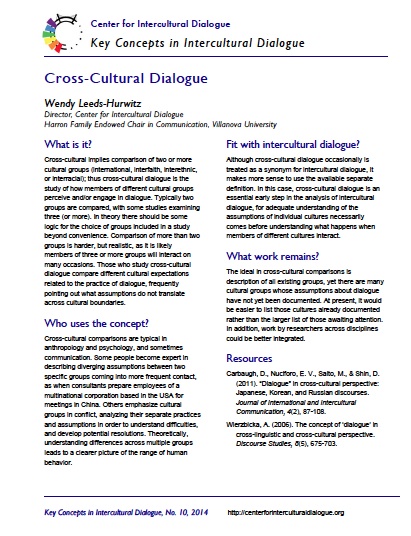
Key Concepts #10: Cross-Cultural Dialogue by Wendy Leeds-Hurwitz

Key Concepts in ICDThe next issue of Key Concepts in intercultural Dialogue is now available. This is KC10: Cross-Cultural Dialogue by Wendy Leeds-Hurwitz. As always, all Key Concepts are available as free PDFs; just click on the thumbnail to download.Lists organized  chronologically by publication date and numberalphabetically by concept in English, and by languages into which they have been translated, are available, as is a page of acknowledgments with the names of all authors, translators, and reviewers.

KC10-sm

Leeds-Hurwitz, W. (2014). Cross-cultural dialogue. Key Concepts in Intercultural Dialogue, 10. Available from:
https://centerforinterculturaldialogue.org/wp-content/uploads/2014/04/key-concept-cross-cultural-dialogue.pdf

The Center for Intercultural Dialogue publishes a series of short briefs describing Key Concepts in intercultural Dialogue. Different people, working in different countries and disciplines, use different vocabulary to describe their interests, yet these terms overlap. Our goal is to provide some of the assumptions and history attached to each concept for those unfamiliar with it. As there are other concepts you would like to see included, send an email to the series editor, Wendy Leeds-Hurwitz. If there are concepts you would like to prepare, provide a brief explanation of why you think the concept is central to the study of intercultural dialogue, and why you are the obvious person to write up that concept.


Creative Commons License
This work is licensed under a Creative Commons Attribution-NonCommercial-NoDerivatives 4.0 International License.