
Nanyang Technological U Job Ad: Language & Communication (Singapore)

Job adsLecturer (Language and Communication Centre)
Nanyang Technological University – School of Humanities (Singapore)

Young and research-intensive, Nanyang Technological University (NTU Singapore) is ranked 13th globally. It is also placed 1st amongst the world’s best young universities.

The Language and Communication Centre (LCC) offers courses in communication skills to students across the university, particularly in the disciplines of engineering, the humanities, science, and social sciences. The Centre is especially interested in employing teaching staff with a background in English for science and technology, web-based learning programmes, and the teaching of English research writing to postgraduate students across a range of disciplines.

Candidates who have the following qualifications are encouraged to apply:

  • PhD Degree in English linguistics, Applied Linguistics or Technical Communication
  • Experience in course design for discipline-specific English
  • Interest in new media and digital literacy
  • An active research agenda

Successful candidates will be expected to teach communication skills, English for academic purposes, and/or technical communication and to conduct research on related areas of inquiry. This position will be in an academic centre which is rapidly developing a strong research trajectory, and which will welcome candidates with a strong interest in research in such fields as English for Academic Purposes, Applied English Linguistics, English for Specific Purposes, multimodal education, web-based learning or a related field of English linguistics. This position may suit newly-qualified PhDs with a passion for interdisciplinary English teaching and research.   

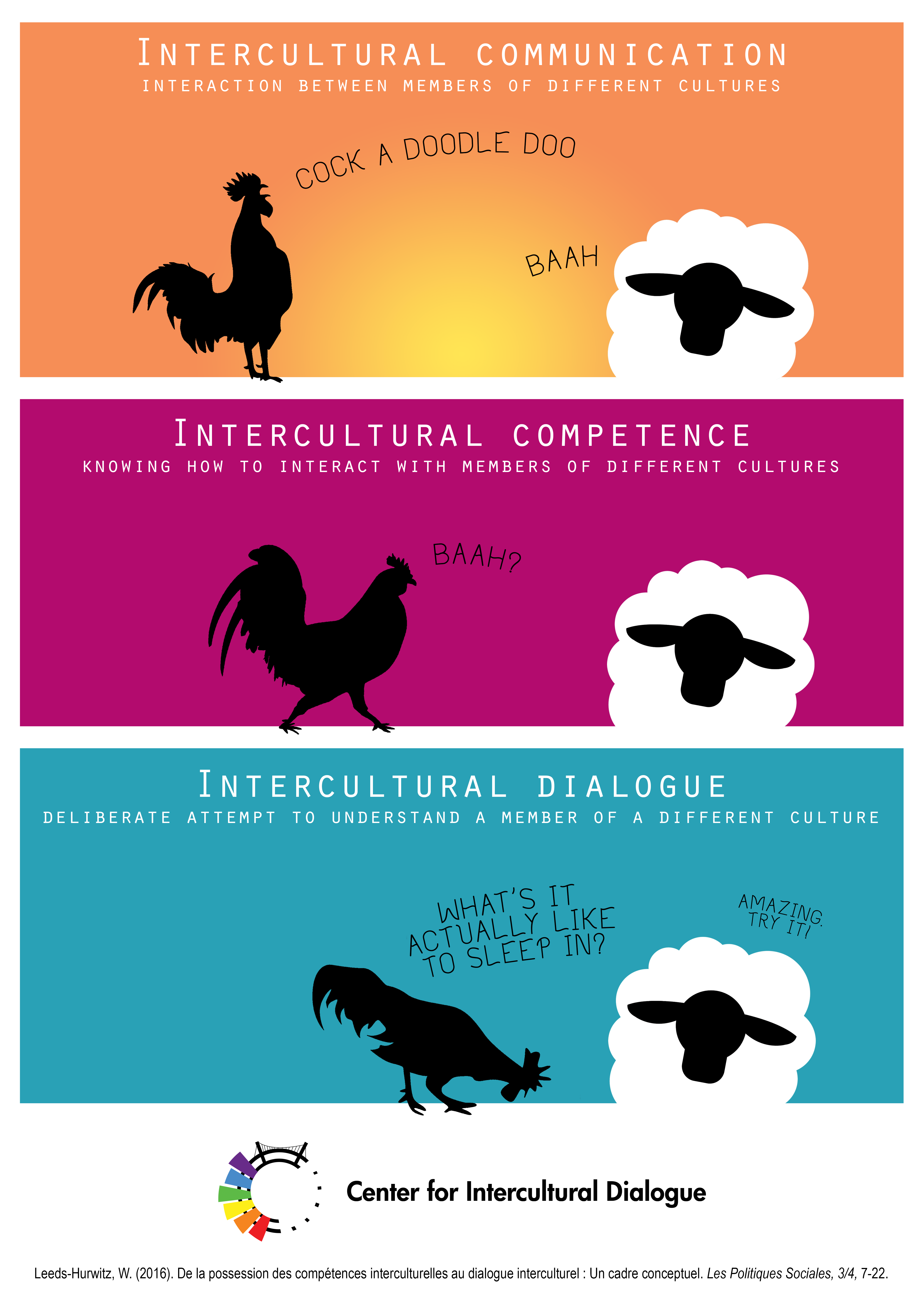
CID Poster #1: Intercultural Communication/Competence/Dialogue

CID PostersThis is the first of the posters designed by Linda J. de Wit, in her role as CID intern. This one provides a quick and easy way to understand, and differentiate between, the concepts of “intercultural communication,” “intercultural competence,” and “intercultural dialogue,” using a rooster and a sheep to represent members of different cultures (and she notes that the animals are vector designs by vecteezy.com). The article where these explanations of these concepts (as well as lots of other concepts) were published is:

Leeds-Hurwitz, W. (2016). De la possession des compétences interculturelles au dialogue interculturel: Un cadre conceptuel [Moving from having intercultural competencies to constructing intercultural dialogues: A conceptual framework]. Les Politiques Sociales, 3/4, 7-22.

Intercultural communication/competence/dialogue

Just in case anyone wants to cite this poster, the following would be the recommended format:

Center for Intercultural Dialogue. (2017). Intercultural communication, intercultural competence, intercultural dialogue. CID Posters, 1. Available from:
https://centerforinterculturaldialogue.org/2017/06/28/cid-poster-1/

As with other series, CID Posters are available for free on the site; just click on the thumbnail to download a printable PDF. They may be downloaded, printed, and shared as is, without changes, without cost, so long as there is acknowledgment of the source.

Now that the first poster is available as a model, the series is open to submissions. If you wish to contribute an original design, please send an email before starting any work to receive approval, to minimize inadvertent duplication, and to learn about technical requirements. As is the case with other CID Publications, posters should be created initially in English. Given that translations of the Key Concepts in Intercultural Dialogue have received so many views, where specific quotes are provided, anyone who wishes to translate their own poster into another language (or two) is invited to design that as well. If you want to volunteer to translate someone else’s poster into a language in which you are fluent, send in a note before starting, to receive approval and to confirm no one else is working on the same one.

Wendy Leeds-Hurwitz
Director, Center for Intercultural Dialogue
intercult.dialogue AT gmail.com


Creative Commons License
This work is licensed under a Creative Commons Attribution-NonCommercial-NoDerivatives 4.0 International License.

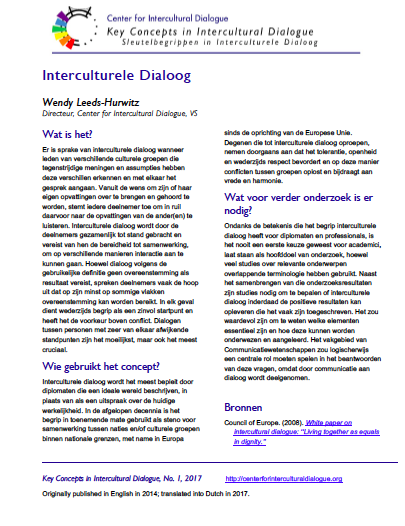
Key Concepts #1: Intercultural Dialogue Translated into Dutch

Key Concepts in ICDContinuing translations of Key Concepts in Intercultural Dialogue, today I am posting KC#1: Intercultural Dialogue, which I wrote for publication in English in 2014, and which Linda J. de Wit has now translated into Dutch.

As always, all Key Concepts are available as free PDFs; just click on the thumbnail to download. Lists of Key Concepts organized chronologically by publication date and number, alphabetically by concept, and by languages into which they have been translated, are available, as is a page of acknowledgments with the names of all authors, translators, and reviewers.

KC1 ICD_DutchLeeds-Hurwitz, W. (2017). Interculturele dialoog. (L. J. de Wit, Trans). Key Concepts in Intercultural Dialogue, 1. Available from:
https://centerforinterculturaldialogue.org/wp-content/uploads/2017/06/kc1-icd_dutch.pdf

If you are interested in translating one of the Key Concepts, please contact me for approval first because dozens are currently in process. As always, if there is a concept you think should be written up as one of the Key Concepts, whether in English or any other language, propose it. If you are new to CID, please provide a brief resume. This opportunity is open to masters students and above, on the assumption that some familiarity with academic conventions generally, and discussion of intercultural dialogue specifically, are useful.

Wendy Leeds-Hurwitz, Director
Center for Intercultural Dialogue


Creative Commons License
This work is licensed under a Creative Commons Attribution-NonCommercial-NoDerivatives 4.0 International License.

Save

Save

CFP: Culture and Communication in Negotiation and Conflict Management

Publication OpportunitiesSpecial Issue Call for Papers: Culture and Communication in Negotiation and Conflict Management, for Negotiation and Conflict Management Research. Submission Deadline: January 15, 2018. Special Issue Editor: Wendi Adair, University of Waterloo.

Culture is defined broadly as a social group with shared values and norms that are reinforced and perpetuated through the group’s institutions. Culture defined by national borders is one conceptualization; culture defined by gender, religion, lifestyles, careers, and generations are also predictors of what, how, and when someone communicates, as well as interprets, and responds. What refers to communication content: meaning the speaker conveys and meaning the listener interprets. How refers to linguistic style, nonverbal cues, context dependence, and communication medium. When refers to temporal patterns such as timing, pacing, and temporal horizons.

We invite empirical and conceptual submissions addressing culture and communication in diverse negotiation and conflict management contexts including topics such as:
–     Case studies or comparative culture analyses of negotiators’ or mediators’ communication repertoires in understudied populations (e.g., Africa, South America, religious groups);
–   Communication adjustment/adaptation, cultural interpreters, and role of language in cross-cultural negotiation and conflict resolution;
–       Qualitative analyses of linguistic or communication tools used to aid conflict resolution and negotiation in distinct cultural populations (e.g., metaphor in high context cultures, sharing circles, story-telling in hierarchical cultures);
–       Content analyses of public accounts of negotiation or conflict resolution (e.g., media coverage of land dispute, international trade, and political negotiations across culture);
–       Identification, interpretation, and management of miscommunication and misinterpretation in cross-cultural negotiation or dispute resolution;
–     Conflict management and negotiation in close relationships across cultures.

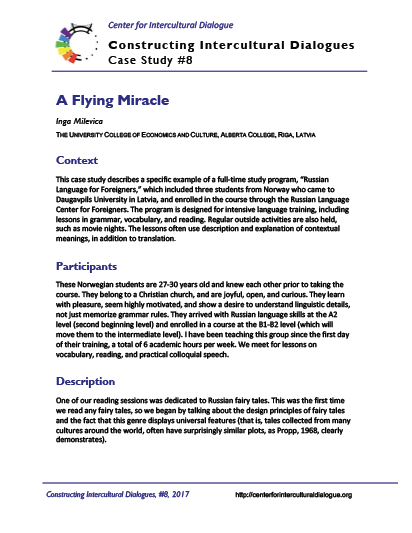
Constructing Intercultural Dialogue #8: A Flying Miracle

Constructing ICD

The next issue of Constructing intercultural Dialogues is now available, “A Flying Miracle” by Inga Milēviča.

As a reminder, the goal of this series is to provide concrete examples of how actual people have managed to organize and hold intercultural dialogues, so that others may be inspired to do the same. As with other CID series, these may be downloaded for free. Click on the thumbnail to download the PDF.

Constructing ICD #8Milevica, I. (2017). A flying miracle. Constructing Intercultural Dialogues, 8. Available from:
https://centerforinterculturaldialogue.org/wp-content/uploads/2017/06/constructing-icd-8.pdf

If you have a case study you would like to share, send an email to the series editor, Wendy Leeds-Hurwitz.


Creative Commons License
This work is licensed under a Creative Commons Attribution-NonCommercial-NoDerivatives 4.0 International License.

Key Concept #55: Stereotypes Translated into Russian

Key Concepts in ICDContinuing translations of Key Concepts in Intercultural Dialogue, today I am posting KC#55: Stereotypes, which Anastacia Kurylo wrote for publication in English in 2015, and which Inga Milēviča has now translated into Russian.

As always, all Key Concepts are available as free PDFs; just click on the thumbnail to download. Lists of Key Concepts organized chronologically by publication date and number, alphabetically by concept, and by languages into which they have been translated, are available, as is a page of acknowledgments with the names of all authors, translators, and reviewers.

KC55 Stereotypes_RussianKurylo, A. (2017). Stereotypes [Russian]. (Inga Milēviča Trans). Key Concepts in Intercultural Dialogue, 55. Available from:
https://centerforinterculturaldialogue.org/wp-content/uploads/2017/06/kc55-stereotypes_russian.pdf

If you are interested in translating one of the Key Concepts, please contact me for approval first because dozens are currently in process. As always, if there is a concept you think should be written up as one of the Key Concepts, whether in English or any other language, propose it. If you are new to CID, please provide a brief resume. This opportunity is open to masters students and above, on the assumption that some familiarity with academic conventions generally, and discussion of intercultural dialogue specifically, are useful.

Wendy Leeds-Hurwitz, Director
Center for Intercultural Dialogue


Creative Commons License
This work is licensed under a Creative Commons Attribution-NonCommercial-NoDerivatives 4.0 International License.

Save

Save

Save

Save

PHD Studentships & Research Fellow Linköping U (Sweden)

FellowshipsPhD student in Language and Culture within the research project ”Vocal Practices of Coordinating Human Action” in the Department of Culture and Communication (IKK), at the Graduate School of Language and Culture in Europe, Linköping University.

Research fellow in Language and Culture, within the project “Vocal Practices of Coordinating Human Action” for the duration of one year, with possible extension up to 4 years in total, formally based at the Department of Culture and Communication (IKK), Linköping University. The duties of the research fellow include fieldwork (video ethnography), transcription, analysis, and research output towards the goals of the project, with possible participation in PhD supervision.

Starting date 
By agreement (during the fall 2017).

PhD student in Language and Culture focused on the field literature, media and ecology. The position is linked both to the research group Literature, Media History and Information Cultures (LMI) and the research program The Seed Box. A Mistra-Formas Environmental Humanities Collaboratory, and is formally placed at the Department of Culture and Communication (IKK), at the Graduate School of Language and Culture in Europe, Linköping University.

British Academy Postdoctoral Fellowships

FellowshipsThe British Academy Postdoctoral Fellowships are three-year Fellowship awards made to an annual cohort of outstanding Early Career Scholars. The aim is to offer opportunities for outstanding early career researchers to strengthen their experience of research and teaching in a university environment which will develop their curriculum vitae and improve their prospects of obtaining permanent lecturing posts by the end of the Fellowship. The primary emphasis is on completion of a significant piece of publishable research, which will be assisted by full membership of an academic community of established scholars working in similar fields.

[Many universities participate – but this notice in particular, from the Department of English, Linguistics and Cultural Studies, has come to our attention.] The University of Westminster is committed to supporting postdoctoral and early career fellowships. We are keen to consider eligible applications from suitable PhD students and early career researchers of postdoctoral standing, whether or not they have a current affiliation with the University.
All potential applicants for this scheme must first submit an application to the University.
To apply, eligible applicants will need to complete a short proforma describing their research and why they have selected the University of Westminster as their host institution. Please email the proforma to us for selection. Successful candidates will be supported by Westminster through the British Academy Post-Doctoral Fellowship application process.
All applications will be considered on the basis of research excellence: the scholarly importance of the project; your ability to carry out the research successfully; the feasibility of the proposed research programme, especially the proposed methodology and timescale; and your publication record to date. Successful candidates will need to demonstrate in their CV a clear research trajectory and some standing in the field.
All applicants will need to identify a mentor prior to submitting their application. You should discuss your application with your mentor. We will not be able to consider an application submitted without a mentor.
Before writing an application, we recommend that you check the British Academy Postdoctoral Fellowship Guidance Notes, FAQs and guidance on how the British Academy reviews and evaluates applications for funding
All applicants must complete the proforma and submit it by email to bidsupport@westminster.ac.uk, along with a CV of no more than four pages, by 23:59 on 19 July 2017. Successful applicants will receive feedback by Friday 11 August 2017.

Key Concept #17: Multilingualism Translated into Chinese

Key Concepts in ICDContinuing translations of Key Concepts in Intercultural Dialogue, today I am posting KC#17: Multilingualism, which Josep Soler-Carbonell first published in English in 2014, and which Yan Qiu has now translated into Simplified Chinese.

As always, all Key Concepts are available as free PDFs; just click on the thumbnail to download. Lists of Key Concepts organized chronologically by publication date and number, alphabetically by concept, and by languages into which they have been translated, are available, as is a page of acknowledgments with the names of all authors, translators, and reviewers.

KC17 Multilingualism_Chinese-simSoler-Carbonell, J. (2017). Multilingualism [Simplified Chinese]. (Y. Qiu, Trans). Key Concepts in Intercultural Dialogue, 17. Available from: https://centerforinterculturaldialogue.org/wp-content/uploads/2017/06/kc17-multilingualism_chinese-sim.pdf

If you are interested in translating one of the Key Concepts, please contact me for approval first because dozens are currently in process. As always, if there is a concept you think should be written up as one of the Key Concepts, whether in English or any other language, propose it. If you are new to CID, please provide a brief resume. This opportunity is open to masters students and above, on the assumption that some familiarity with academic conventions generally, and discussion of intercultural dialogue specifically, are useful.

Wendy Leeds-Hurwitz, Director
Center for Intercultural Dialogue


Creative Commons License
This work is licensed under a Creative Commons Attribution-NonCommercial-NoDerivatives 4.0 International License.

Yan Qiu Profile

ProfilesYan Qiu holds an M.A. in Intercultural and International Communication from Royal Roads University, and is currently a Ph.D. student in the Department of Sociology and Legal Studies at the University of Waterloo, both in Canada. She has a solid academic foundation in intercultural communication, media studies, and cultural theory.

Currently, Yan applies her expertise as a Graphic Design Consultant, creating visual content for academic dissemination. In addition, she works as an AI Writing Expert, providing linguistic and cultural insights to help develop AI language models.

Yan utilizes social media to craft engaging narratives that foster audience connection and enhance brand visibility, using digital platforms as a tool for meaningful interaction and community building. Yan is also a member of the Certified Management Accountant Association, leveraging her knowledge in financial management and analysis to bring an interdisciplinary perspective to her academic and professional work.

Previously, as a research assistant at Royal Roads University, Yan worked on projects related to Chinese media history, literature, and industry practices, her research has been integrated into academic course materials.

Yan has travelled extensively, exploring numerous countries and cities, and immersing herself in diverse cultures, languages, and cuisines. These journeys have enriched her academic research and helped her develop a deeper understanding of how media and communication intersect with cultural identities.


Work for CID:

Yan Qiu has translated KC1: Intercultural Dialogue, KC5: Intercultural Communication, KC10: Cross-Cultural Dialogue, KC11: Intercultural Discourse and Communication, KC17: Multilingualism, KC19: Multiculturalism, KC22: Cultural Identity, KC25: Metacommunication, KC95: Transnational Media, KC99: Translanguaging, and KC100: Transcultural Communication into Simplified Chinese. Starting in 2024, she took on a role as the Center’s graphic design consultant, and has done the necessary work to revise the original designs for the Catalan, French, German, Italian, and Spanish translations of the CID Posters.