
Akari Takenishi Profile

ProfilesAkari Takenishi has recently completed a Master’s degree in International and Intercultural Communication at Royal Roads University in Canada.

Akari Takanishi photoShe earned her Bachelor’s degree in Geography, focusing on the cultural and social aspects of Geography at the University of Victoria. She is interested in studying multiculturalism in Canada. Examining her personal experiences as an international student from Japan, she wrote about the influences of multiculturalism on self-representation of identity in society. While completing her Master’s, she also served as research assistant for a study examining the impacts of social media on higher education.

Akari has served as an interpreter and translator, believing that the power of knowledge is limitless and translation is one of the most influential ways to make knowledge reach a greater audience. She has translated several TED talks into Japanese, including:

  • “You don’t need an app for that” By Toby Shapshak
  • “Don’t insist on English” By Patricia Ryan
  • “How to air-condition outdoor spaces” By Wolfgang Kessling
  • “Learning from Sherman the shark” by Jim Toomey
  • “The economic injustice of plastic” by Van Jones

Having grown up in a small village in Japan, she appreciates nature and enjoys growing plants. She became involved in her family tea farm as a distributor dealing with a local tea shop in Canada. Her life has brought her unexpected opportunities and excitement and she feels fortunate to be surrounded by friends, family and mentors who support her personal life as well as academic pursuits. Her academic interests include:

  • Designing a platform where small farmers around the world can share their knowledge and experience with sustainable farming methods, resource management, and reliable market building.
  • Investigating the role of eco-politics in international relations and how it challenges international relations theory in global environmental conflicts.
  • Investigating the academic language proficiency of international graduate students studying in North America and the accuracy of scores of English proficiency tests in portraying academic language skills.

Akari is currently increasing her translation skills, focusing on articles and journals related to intercultural communication and competence. She would like to connect with any individuals or groups who share similar academic interests to discuss future projects and opportunities. As a recent graduate, she is excited to share her knowledge and skills, and learn more from others, hoping that she can be a part of a positive change for a socially and environmentally sustainable future.


Work for CID:
Akari Takenishi wrote KC92: Kintsugi, and also translated it into Japanese.

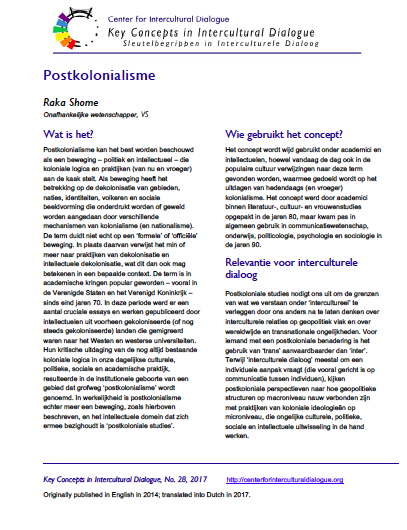
Key Concept #28: Postcolonialism Translated into Dutch

Key Concepts in ICDContinuing translations of Key Concepts in Intercultural Dialogue, today I am posting KC#28: Postcolonialism, originally prepared by Raka Shome for publication in English in 2014, and which Linda J. de Wit has now translated into Dutch.

As always, all Key Concepts are available as free PDFs; just click on the thumbnail to download. Lists of Key Concepts organized chronologically by publication date and number, alphabetically by concept, and by languages into which they have been translated, are available, as is a page of acknowledgments with the names of all authors, translators, and reviewers.

KC28 Postcolonialism_DutchShome, R. (2017). Postkolonialisme. (L. J. de Wit, Trans). Key Concepts in Intercultural Dialogue, 28. Available from:
https://centerforinterculturaldialogue.org/wp-content/uploads/2017/07/kc28-postcolonialism_dutch.pdf

If you are interested in translating one of the Key Concepts, please contact me for approval first because dozens are currently in process. As always, if there is a concept you think should be written up as one of the Key Concepts, whether in English or any other language, propose it. If you are new to CID, please provide a brief resume. This opportunity is open to masters students and above, on the assumption that some familiarity with academic conventions generally, and discussion of intercultural dialogue specifically, are useful.

Wendy Leeds-Hurwitz, Director
Center for Intercultural Dialogue


Creative Commons License
This work is licensed under a Creative Commons Attribution-NonCommercial-NoDerivatives 4.0 International License.

U Jyväskylä Job Ad: Intercultural & Digital Communication (Finland)

Associate Professor, Intercultural and Digital Communication, University of Jyväskylä

The University of Jyväskylä is a nationally and internationally significant research university and an expert on education that focuses on human and natural sciences. The University is Finland’s leading expert in teacher education and adult education, as well as the major exporter of education. The Faculty of Sport and Health Sciences is the only one in the country. The University of Jyväskylä is known for its dynamic operating culture and strong commitment to social responsibility.

Department of Language and Communication Studies is currently seeking to recruit an Associate Professor (tenure track), Intercultural and Digital Communication, starting January 1st 2018 for a fixed-term period of five years. The Associate Professor’s position is allocated to Department of Language and Communication Studies in the discipline of Intercultural communication. The position supports the profiling of the department at the two core fields of the University strategy (Languages, Culture and Communities in Global Change Processes, and Information Technology and the Human in the Knowledge Society) and the profiling measure Language in Changing Society.

The duties of the associate professor include active international research and publication activity, initiating and leading research projects, acquiring external research funding, active participation in national and international networks, teaching and supervision in undergraduate and postgraduate training, and leading the international master’s programme. The duty of the associate professor is in particular to develop future oriented research and teaching in the field of intercultural and digital communication.

The successful applicant needs to have strong evidence of research and teaching in intercultural communication. Research in the areas of digital communication and communication technologies is considered an asset. Success in acquiring external funding, supervision of theses, and administrative experience are also considered an asset. The emphasis in the evaluation is based on strong international research profile and on experience in teaching and supervision. In addition, the successful applicant is expected to have broad theoretical and methodological expertise.

Please submit your application at the latest on Monday, August 14th 2017 using the online application form.

U Melbourne Job Ad: ESL (Australia)

Job adsLecturer in ESL, University of Melbourne – School of Languages and Linguistics (Australia)

The School of Languages and Linguistics teaches a broad suite of undergraduate and graduate courses, maintains a vigorous research higher degree culture, and has an internationally-recognised research profile.  The School now seeks to appoint a Lecturer (Level B) continuing, to consolidate and further develop the School’s teaching and research programs.

The position is located in Linguistics & Applied Linguistics, which offers an undergraduate major and minor in Linguistics & Applied Linguistics, as well as a graduate Master of Applied Linguistics, in addition to an Honours program and a large PhD program. The School also offer an ESL program which includes a suite of credit-bearing subjects at undergraduate and graduate level.  The Lecturer will contribute to research in teaching in ESL as well as Applied Linguistics. A specialization in an area such as intercultural communication, second language writing, English language research and global Englishes will be preferred.

The Lecturer will contribute to teaching excellence in the ESL program and Applied Linguistics including the coordination of subjects, preparation and conduct of lectures and tutorials and related assessment, and consultations with students.

Employment Type: Full-time continuing position available from 1 January 2018           

Close date: 16 July 2017

CID Poster #2: Key Concepts as the World

CID PostersThis is the second of the posters designed by Linda J. de Wit, in her role as CID intern. This poster names all of the 81 Key Concepts in Intercultural Dialogue already published to the site, bringing them together into a representation of the world.

Key Concepts poster

Just in case anyone wants to cite this poster, the following would be the recommended format:

Center for Intercultural Dialogue. (2017). Key Concepts in Intercultural Dialogue. CID Posters, 2. Available from:
https://centerforinterculturaldialogue.org/2017/07/07/cid-poster-2-key…pts-as-the-world/

As with other series, CID Posters are available for free on the site; just click on the thumbnail to download a printable PDF. They may be downloaded, printed, and shared as is, without changes, without cost, so long as there is acknowledgment of the source.

As with other series, if you wish to contribute an original contribution, please send an email before starting any work to receive approval, to minimize inadvertent duplication, and to learn about technical requirements. As is the case with other CID Publications, posters should be created initially in English. Given that translations of the Key Concepts in Intercultural Dialogue have received so many views, anyone who wishes to translate their own poster into another language (or two) is invited to provide that as well. If you want to volunteer to translate someone else’s poster into a language in which you are fluent, send in a note before starting, to receive approval and to confirm no one else is working on the same one.

Wendy Leeds-Hurwitz
Director, Center for Intercultural Dialogue
intercult.dialogue AT gmail.com


Creative Commons License
This work is licensed under a Creative Commons Attribution-NonCommercial-NoDerivatives 4.0 International License.

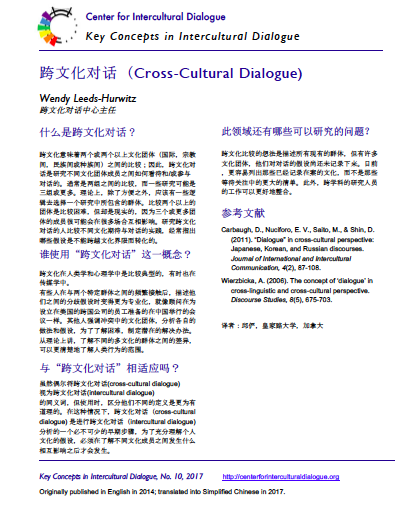
Key Concept #10: Cross-Cultural Dialogue Translated into Simplified Chinese

Key Concepts in ICDContinuing translations of Key Concepts in Intercultural Dialogue, today I am posting KC#10: Cross-Cultural Dialogue, which I first published in English in 2014, and which Yan Qiu has now translated into Simplified Chinese.

As always, all Key Concepts are available as free PDFs; just click on the thumbnail to download. Lists of Key Concepts organized chronologically by publication date and number, alphabetically by concept, and by languages into which they have been translated, are available, as is a page of acknowledgments with the names of all authors, translators, and reviewers.

KC10 Cross-Cultural Dialogue_Chinese-simLeeds-Hurwitz, W. (2017). Cross-cultural dialogue [Simplified Chinese]. (Y. Qiu, Trans). Key Concepts in Intercultural Dialogue, 10. Available from:
https://centerforinterculturaldialogue.org/wp-content/uploads/2019/10/kc10-cross-cultural-dialogue_chinese-simplified.pdf

If you are interested in translating one of the Key Concepts, please contact me for approval first because dozens are currently in process. As always, if there is a concept you think should be written up as one of the Key Concepts, whether in English or any other language, propose it. If you are new to CID, please provide a brief resume. This opportunity is open to masters students and above, on the assumption that some familiarity with academic conventions generally, and discussion of intercultural dialogue specifically, are useful.

Wendy Leeds-Hurwitz, Director
Center for Intercultural Dialogue


Creative Commons License
This work is licensed under a Creative Commons Attribution-NonCommercial-NoDerivatives 4.0 International License.

Save

William Zard Abou Jaoude Award 2017 (Film Competition)

AwardsThe William Zard Abou Jaoude International Award is an annual award granted by the Lebanon Dialogue Initiative (LDI). It seeks to recognize promising young (18-35) non-professional creators/directors committed to exploring conflict/dispute, dialogue, peace-building, reconciliation, identity, territory, citizenship, and the like.

A distinguished jury panel will review submissions, and the winner will be invited to screen his or her short film during the 2017 LDI Forum Gala Dinner, which will take place on November 4, 2017, in Lebanon. Screenings will be attended by a diverse audience, comprising of LDI members, local and international speakers, government officials, academics, journalists, diplomats, and civil society activists as well as the general public.

The winning short film will subsequently be screened at prominent LDI events and gatherings around the world and will be used as part of the LDI communication tool.

Deadline: August 31, 2017
Entry fee: Gratis
Award: $5,000 USD

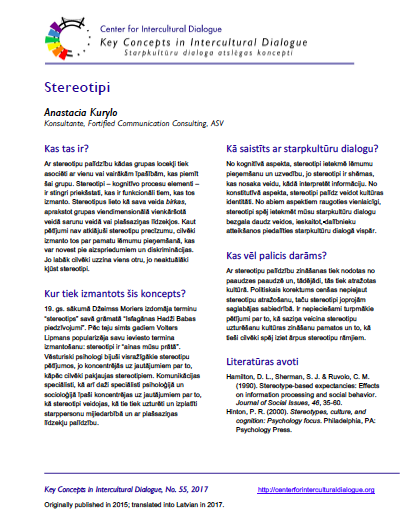
Key Concept #55: Stereotypes Translated into Latvian

Key Concepts in ICDContinuing translations of Key Concepts in Intercultural Dialogue, today I am posting KC#55: Stereotypes, which Anastacia Kurylo wrote and first published in English in 2015, and which Inga Milēviča has now translated into Latvian. As always, all Key Concepts are available as free PDFs; just click on the thumbnail to download. Lists of Key Concepts organized chronologically by publication date and number, alphabetically by concept, and by languages into which they have been translated, are available, as is a page of acknowledgments with the names of all authors, translators, and reviewers.

KC55 Stereotypes_LatvianKurylo, A. (2017). Stereotipi. (I. Milēviča Trans). Key Concepts in Intercultural Dialogue, 55. Available from:
https://centerforinterculturaldialogue.org/wp-content/uploads/2017/06/kc55-stereotypes_latvian.pdf

If you are interested in translating one of the Key Concepts, please contact me for approval first because dozens are currently in process. As always, if there is a concept you think should be written up as one of the Key Concepts, whether in English or any other language, propose it. If you are new to CID, please provide a brief resume. This opportunity is open to masters students and above, on the assumption that some familiarity with academic conventions generally, and discussion of intercultural dialogue specifically, are useful.

Wendy Leeds-Hurwitz, Director
Center for Intercultural Dialogue


Creative Commons License
This work is licensed under a Creative Commons Attribution-NonCommercial-NoDerivatives 4.0 International License.

Save

U College London Job Ad: Global Politics (UK)

Teaching Fellow in Global Politics, University College London – UCL School of European Languages, Culture and Society – Centre for Multidisciplinary and Intercultural Inquiry (UK)

The UCL Centre for Multidisciplinary and Intercultural Inquiry invites applications for the post of Teaching Fellow in Global Politics. The successful candidate will be expected to take up the position on 1 September 2017, or as soon as possible thereafter. The post is fixed-term for 12 months.

The post holder will teach four courses or equivalent – an approximate total of 80 contact hours of teaching – at graduate level. He or she will be required to mark and assess work completed for these and, at the discretion of the Chair of CMII, other courses, assist in the preparation of timed examination papers to be taken in the summer term, supervise MA dissertations, participate in CMII PhD and MA dissertation presentations, hold office hours, attend meetings concerning the courses that he or she teaches, and complete mandatory training requirements that he or she may, in accordance with UCL policy, need to take.

The post holder will have a Postgraduate qualification or equivalent within the area of Global Politics, Comparative Politics, or International Relations.

Closing Date: 7 July 2017
Part-Time: 18.25 hours per week (50% FTE)


CFP Who Belongs? Immigrants, Refugees, Migrants

Publication OpportunitiesCall for Papers: Journal of Critical Thought and Praxis (Special Issue): Who Belongs? Immigrants, Refugees, Migrants, and Actions Towards Justice

Over the past year, both in the U.S. and Europe, far-right nationalist and white supremacist organizations have led a massive assault on the human rights of immigrants, refugees, and migrants, resulting in multiple acts of violence against individuals and communities and a general climate of fear. Notably, this assault has been supported by the most mainstream of political actors, ranging from elected officials in the U.S. who advocate for travel bans targeted at people who are Muslim and deportation raids targeted at the Latinx community to the racist and xenophobic political platforms of leading candidates for the highest of political offices in France and Austria. In this issue, we seek to engage this political landscape by asking the question: Who belongs? This question raises significant abstract issues, including: the legitimacy and construction of nationstates; theories of democratic governance and legal systems; notions of citizenship; intersections between racialized, gendered, and classed social identities; and, processes of imperialism and colonization. The question also raises significant issues that are more concrete, including: access to public resources (such as education, housing, and health care); policies and processes of “legal” documentation; activist and community mobilization; sanctuary cities; U.S. and European military intervention; the militarization of law enforcement in the U.S. and abroad; neoliberal economic policies; and, ongoing anti- and post- colonial struggles across the globe. We thus invite scholars and activists from a range of disciplinary and professional positions to submit work (research articles, conceptual essays, book reviews, and poems) that illuminates these and other issues that are central to political struggle for the rights of immigrants, refugees, and migrants.

Submission Timeline Deadline: Friday, September 1, 2017
Anticipated Publication: January 2018