Bridging Cultural Gap Between Morocco, Japan

Applied ICD

Kawano, G. (2021, April 25). Morocconia, Nipponia: Bridging cultural gap between Morocco, Japan. Morocco World News.

“The greatest strength I gained through this project is cultural awareness. I’m better equipped with skills to work in [a] multicultural environment.”

This article documents the ways in which Hafsa Rifki, of Morocco, who first became interested in Japanese anime, then began studying the Japanese language, and later Japanese culture, became part of a cultural circle of like-minded peers, which turned into the group Nipponia. Later she moved to Japan for a PhD in Media and Governance at Keio University. While in Japan, she developed a similar group of people interested in Morocco, named Morocconia. She now manages both groups.

KC3 Intercultural Competence Translated into French

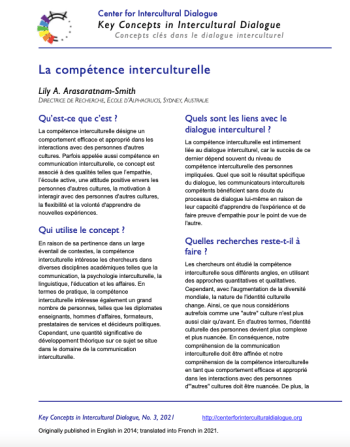
Key Concepts in ICDContinuing translations of Key Concepts in Intercultural Dialogue, today I am posting KC#3: Intercultural Competence, which Lily Arasaratnam-Smith wrote for publication in English in 2014, and which Mohammed Guamguami has now translated into French.

As always, all Key Concepts are available as free PDFs; just click on the thumbnail to download. Lists of Key Concepts organized alphabetically by conceptchronologically by publication date and number, and by languages into which they have been translated, are available, as is a page of acknowledgments with the names of all authors, translators, and reviewers.


KC3 Intercultural Competence_FrenchArasaratnam-Smith, L. A. (2021). La compétence interculturelle. (M. Guamguami, Trans.). Key Concepts in Intercultural Dialogue, 3. Retrieved from:  https://centerforinterculturaldialogue.org/wp-content/uploads/2022/01/kc3-intercultural-competence_french-v2.pdf

If you are interested in translating one of the Key Concepts, please contact me for approval first because dozens are currently in process. As always, if there is a concept you think should be written up as one of the Key Concepts, whether in English or any other language, propose it. If you are new to CID, please provide a brief resume. This opportunity is open to masters students and above, on the assumption that some familiarity with academic conventions generally, and discussion of intercultural dialogue specifically, are useful.

Wendy Leeds-Hurwitz, Director
Center for Intercultural Dialogue


Creative Commons License
This work is licensed under a Creative Commons Attribution-NonCommercial-NoDerivatives 4.0 International License.

CFP Contemporary Developments on Media, Culture and Society: Argentina and Latin America (Argentina but hybrid)

EventsCall for papers: Contemporary Developments on Media, Culture and Society: Argentina and Latin America, Center for the Study on Media and Society in Argentina (MESO), Universidad de San Andrés, Buenos Aires, Argentina, November 26-27, 2021 (hybrid meeting). Deadline: August 31, 2021.

This will be the seventh annual conference organized by MESO on the interactions between media, culture and society. For more information about previous events, please visit our website. This Annual Conference is sponsored by the Center for Global Culture and Communication and the Center for Latinx Digital Media at Northwestern University.

Submissions should contribute to ongoing conversations about media, culture, and society in empirical, theoretical or methodological ways. They might also broaden our knowledge about the relationship between media, culture, and society at the national and regional level. Articles may refer to different aspects of communication, media, and cultural goods and services in the areas of journalism, entertainment -cinema, theater, television, music, etc. – advertising and marketing, public relations, social media, and video games, among others.

KC12 Third Culture Kids Translated into French

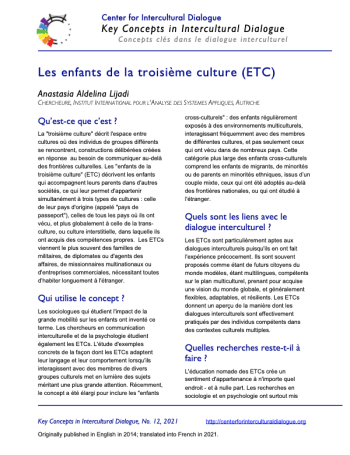
Key Concepts in ICDContinuing translations of Key Concepts in Intercultural Dialogue, today I am posting KC#12: Third Culture Kids, which Anastasia Lijadi published in English in 2014, and which Mohammed Guamguami has now translated into French.

As always, all Key Concepts are available as free PDFs; just click on the thumbnail to download the PDF. Lists organized chronologically by publication date and numberalphabetically by concept in English, and by languages into which they have been translated, are available, as is a page of acknowledgments with the names of all authors, translators, and reviewers.

KC12 TCKs_FrenchLijadi, A. A. (2021). Les enfants de la troisième culture (ETC). (M. Guamguami, trans.) Key Concepts in Intercultural Dialogue, 12. Available from: https://centerforinterculturaldialogue.org/wp-content/uploads/2021/06/kc12-tcks_french.pdf

The Center for Intercultural Dialogue publishes a series of short briefs describing Key Concepts in Intercultural Dialogue. Different people, working in different countries and disciplines, use different vocabulary to describe their interests, yet these terms overlap. Our goal is to provide some of the assumptions and history attached to each concept for those unfamiliar with it. As there are other concepts you would like to see included, send an email to the series editor, Wendy Leeds-Hurwitz. If there are concepts you would like to prepare, provide a brief explanation of why you think the concept is central to the study of intercultural dialogue, and why you are the obvious person to write up that concept.


Creative Commons License
This work is licensed under a Creative Commons Attribution-NonCommercial-NoDerivatives 4.0 International License.

Giovanna Carloni Profile

ProfilesGiovanna Carloni, PhD, is a lecturer at the University of Urbino, Italy.

Her fields of expertise are applied linguistics, foreign language education, teaching Italian as a second and foreign language, intercultural and global competence, educational technology, virtual exchange, teacher training, corpus linguistics, English linguistics, EAP (English for Academic Purposes) and ESP (English for Specific Purposes),  CLIL (Content and Language Integrated Learning), and internationalization in higher education. She worked as project coordinator for the CLIL Internationalization project at the University of Urbino, Italy, where she was also responsible for providing the content instructors engaged in the project with CLIL methodological support. As project coordinator, she devised the digitally-enhanced theoretical and methodological CLIL framework that the University of Urbino has adopted. Furthermore, she has been responsible for the design and implementation of virtual exchange from an intercultural perspective with universities in the USA, Australia, and South Africa for about a decade. Among her publications:

Books and edited volumes

Carloni, G. (2020). Digitally-enhanced practices and open pedagogy in English-taught programs: Flexible learning for local and global settings in higher education. Milan: Franco Angeli.

Carloni, G. (2016). Corpus linguistics and English teaching materials. Milan: Franco Angeli.

Carloni, G. (2015). CLIL in higher education and the role of corpora: A blended model of consultation services and learning environments. Venice: Edizioni Ca’ Foscari.

Carloni, G. (Ed.). (2015). Insegnare italiano a stranieri. Percorsi operativi. Milano: Franco Angeli.

Selected Articles

Carloni, G. (2021). Using a Community of Inquiry framework to foster students’ active learning. In K. Enomoto, R. Warner, & C. Nygaard (Eds.), Teaching and learning innovations in higher education (pp. 195-208).  Oxfordshire, UK: Libri Publishing.

Carloni G., & Zuccala B. (2020). Blending Italian through Skype: A diachronic and comparative account of a telecollaborative project. In J. Fornasiero, S. M. A. Reed, R. Amery, E. Bouvet, K. Enomoto, H. L. Xu (Eds.), Intersections in language planning and policy: Establishing connections in languages and cultures (pp. 279-298). Dordrecht: Springer Nature.

Carloni G., Grassi S., Virga A., & Zuccala B. (2018). Exploring the transnational connections between blended learning spaces, trans-institutional collaboration, and intercultural awareness in transformative telecollaborative projects. LEA – Lingue e letterature d’Oriente e d’Occidente, 7, 393-403. DOI:  http://dx.doi.org/10.13128/LEA-1824-484x-24403

Carloni G., & Zuccala B. (2018). Blending Italian ‘down-under’: Toward a theoretical framework and pragmatic guide for blending tertiary Italian language and culture courses through Skype-enhanced, pre-service teacher-centred telecollaboration. LEA – Lingue e letterature d’Oriente e d’Occidente, 7, 405-445. DOI: http://dx.doi.org/10.13128/LEA-1824-484x-24408

Carloni G., & Zuccala B. (2017). Blending Italian at Monash University through an Italian-Australian digital project: An analysis of students’ perceptions. LEA – Lingue e Letterature d’Oriente e d’Occidente, 6, 115-139. https://doi.org/10.13128/LEA-1824-484x-22333


Work for CID:
Giovanna Carloni participated in a CID/UNESCO focus group for the Futures of Education Initiative, and then provided an exercises for the addendum.

ICN Business School: Organizational Behavior & Intercultural Management (France)

“Job

Assistant/Associate Professor in Organizational Behavior & Intercultural Management, ICN Business School, Paris, France. Deadline: 19 July 2021.

The ideal candidate for this position in ICN’s Human Resources and Organisational Behaviour Department will have teaching experience and strong research interests in such fields as organisational behaviour, intercultural management and team management. Networking experience with the corporate world would be an asset. The candidate is expected to pursue research excellence, preferably connecting to the school’s main research themes (Unesco Chair – ICN Business School)(icn-artem.com) and to teach to multiple audiences (Bachelor, Master, Executive Education) in English, on the different campuses and teaching sites of the school. The ability to teach in French will be an asset. Candidates are expected to demonstrate their willingness to innovate in the design of courses, teaching material and teaching methods.

Key Concept #4: Coordinated Management of Meaning Translated into French

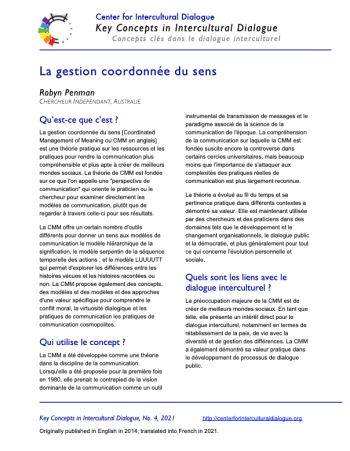
Key Concepts in ICDContinuing translations of Key Concepts in Intercultural Dialogue, today I am posting KC4: Coordinated Management of Meaning, which Robyn Penman wrote and first published in English in 2014, which Mohammed Guamguami has now translated into French.

As always, all Key Concepts are available as free PDFs; just click on the thumbnail to download. Lists of Key Concepts organized chronologically by publication date and number, alphabetically by concept, and by languages into which they have been translated, are available, as is a page of acknowledgments with the names of all authors, translators, and reviewers.

KC4 CMM_FrenchPenman, R. (2021). La gestion coordonnée du sens. (M. Guamguami, Trans). Key Concepts in Intercultural Dialogue, 4. Available from: https://centerforinterculturaldialogue.org/wp-content/uploads/2021/06/kc4-cmm_french.pdf

If you are interested in translating one of the Key Concepts, please contact me for approval first because dozens are currently in process. As always, if there is a concept you think should be written up as one of the Key Concepts, whether in English or any other language, propose it. If you are new to CID, please provide a brief resume. This opportunity is open to masters students and above, on the assumption that some familiarity with academic conventions generally, and discussion of intercultural dialogue specifically, are useful.

Wendy Leeds-Hurwitz, Director
Center for Intercultural Dialogue


Creative Commons License
This work is licensed under a Creative Commons Attribution-NonCommercial-NoDerivatives 4.0 International License.

CFP Media Research on South Asia & Diaspora Worldwide 2021 (Online)

ConferencesCall for submissions: Turning the Page: Media Research on South Asia and Its Diaspora Worldwide, South Asia Communication Association virtual session at AEJMC, Aug 4-7, 2021. Deadline: June 29, 2021.

Organizers invite you to present your research at the South Asia​ Communication Association (SACA)’s refereed-r​esearch session at the 104th annual conference of the ​Association for Education in Journalism and Mass Communication (AEJMC), virtual conference, August 4-7, 2021 (#AEJMC21). AEJMC 2021 promises to be an innovative, interactive and exciting conference.

SACA will host an interactive paper session. A committee of renowned scholars will review submissions. Since SACA is an institutional initiative of AEJMC, this session will be featured in the official program of the AEJMC annual conference.

SACA represents a joint effort of media and communication scholars and practitioners in South Asia and the South Asian diaspora worldwide.

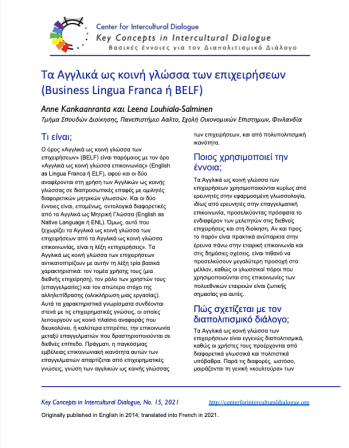
Key Concept #58 BELF Translated into Greek

Key Concepts in ICDContinuing translations of Key Concepts in Intercultural Dialogue, today I am posting the translation of KC58: English as Business Lingua Franca (BELF). Anne Kankaanranta and Leena Louhiala-Salminen wrote this in English in 2015 and Anastasia Karakitsou has now translated it into Greek.

As always, all Key Concepts are available as free PDFs; just click on the thumbnail to download. Lists of Key Concepts organized chronologically by publication date and number, alphabetically by concept, and by languages into which they have been translated, are available, as is a page of acknowledgments with the names of all authors, translators, and reviewers.

KC58 BELF_GreekKankaanranta, A., & Louhiala-Salminen, L. (2021). English as Business Lingua Franca (BELF) [Greek]. Key Concepts in Intercultural Dialogue, 58. Available from: https://centerforinterculturaldialogue.org/wp-content/uploads/2021/06/ce9ac58-belf_greek.pdf

If you are interested in translating one of the Key Concepts, please contact me for approval first because dozens are currently in process. As always, if there is a concept you think should be written up as one of the Key Concepts, whether in English or any other language, propose it. If you are new to CID, please provide a brief resume. This opportunity is open to masters students and above, on the assumption that some familiarity with academic conventions generally, and discussion of intercultural dialogue specifically, are useful.

Wendy Leeds-Hurwitz, Director
Center for Intercultural Dialogue


Creative Commons License
This work is licensed under a Creative Commons Attribution-NonCommercial-NoDerivatives 4.0 International License.

French Institutes for Advanced Study: Fellowships 2022-23 (France)

Fellowships

Fellowships in 2022-2023, French Institutes for Advanced Study, Paris / Lyon / Montpellier / Marseille / Nantes, France. Deadline: 6 July 2021.

The French Institutes for Advanced Study Fellowship Programme offers 10-month fellowships in the five Institutes of Paris, Lyon, Marseille, Montpellier and Nantes. It welcomes applications from high-level international scholars and scientists primarily in the fields of the social sciences and the humanities (SSH). For the 2022-23 academic year, FIAS offers 28 fellowship positions: 17 in Paris, 4 in Marseille, 3 in Montpellier, and 4 in Nantes. The call is open to all disciplines in the SSH and all research fields. Research projects from other sciences that propose a transversal dialogue with SSH are also eligible. Some of the four IAS have scientific priorities they will focus on more specifically.

The Fellows will benefit from the support and conducive scientific environment offered by the IAS, in an interdisciplinary cohort of fellows and in close relation to the local research potential. The fellows will be free to organize their work and conduct research as they wish.