Maryam Ahmadi Profile

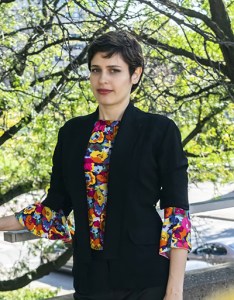
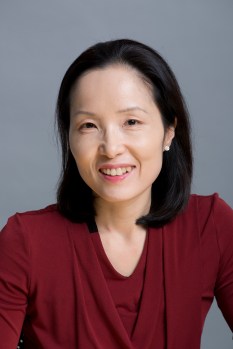
ProfilesMaryam Ahmadi is a Ph.D. candidate in the Rhetoric, Politics, & Culture program in the Department of Communication Arts at the University of Wisconsin-Madison.

Maryam Ahmadi

She holds a BA in English Literature and an MA in Political Sociology from the University of Tehran, and a second MA in Communication Arts from the University of Wisconsin-Madison. Her research interests lie at the intersection of rhetorical theory and history, the study of colonialism and empire, and global/non-Western rhetorics. In her current work, she focuses on the suasive discourse of “occidentosis” (gharbzadegi) within the context of Iran’s encounter with colonial modernity to consider how Persian rhetorical practices and theories emerge from a semicolonial locus of enunciation.


Work for CID:

Maryam Ahmadi translated KC23: Afrocentric and KC24: Asiacentricity into Persian.

CFP Communication of Culture and Islamic Fundamentalism

“PublicationCall for Abstracts: Special Issue of Frontiers in Communication: Communication of Culture and Islamic Fundamentalism Deadline: 31 January 2022.

This Research Topic is planned to coincide with the ongoing political developments in Afghanistan, and the emergence and re-emergence of Islamic fundamentalism throughout the world. Editors of the special issue (Diyako Rahmani, Jiyar Aghapouri, & Soumia Bardhan) invite submissions on a broad range of topics related to the communication of Islamic fundamentalism. They encourage submissions and commentary from multiple disciplinary perspectives including cultural and media/communication studies, sociology, political science, human rights, and other relevant fields. While this Research Topic is open to the studies of Islamic fundamentalism broadly, it will put particular emphasis on the Taliban takeover of Afghanistan as a case to illuminate the theoretical and empirical caveats concerning the socio-cultural and socio-political impacts of fundamentalist ideologies.

KC27 Globalization Translated into Turkish

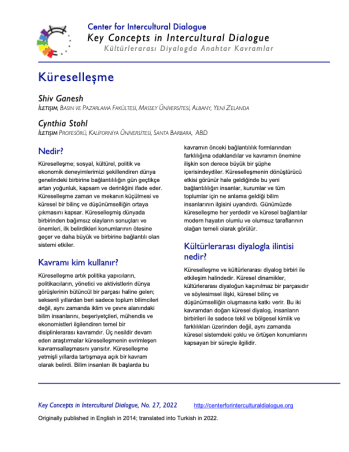
Key Concepts in ICDContinuing translations of Key Concepts in Intercultural Dialogue, today I am posting KC 27: Globalization, which Shiv Ganesh and Cynthia Stohl wrote for publication in English in 2014, and which Candost Aydın has now translated into Turkish.

As always, all Key Concepts are available as free PDFs; just click on the thumbnail to download. Lists of Key Concepts organized chronologically by publication date and number, alphabetically by concept, and by languages into which they have been translated, are available, as is a page of acknowledgments with the names of all authors, translators, and reviewers.

KC27 Globalization_TurkishGanesh, S., & Stohl, C. (2022). Globalization [Turkish]. (C. Aydın, Trans.). Key Concepts in Intercultural Dialogue, 27. Retrieved from: https://centerforinterculturaldialogue.org/wp-content/uploads/2021/12/kc27-globalization_turkish.pdf

If you are interested in translating one of the Key Concepts, please contact me for approval first because dozens are currently in process. As always, if there is a concept you think should be written up as one of the Key Concepts, whether in English or any other language, propose it. If you are new to CID, please provide a brief resume. This opportunity is open to masters students and above, on the assumption that some familiarity with academic conventions generally, and discussion of intercultural dialogue specifically, are useful.

Wendy Leeds-Hurwitz, Director
Center for Intercultural Dialogue


Creative Commons License
This work is licensed under a Creative Commons Attribution-NonCommercial-NoDerivatives 4.0 International License.

U South Carolina: Intercultural & Media Studies (USA)

“JobAssistant Professor of Intercultural Communication and Media Studies, Communication and Emerging Media, University of South Carolina-Aiken, SC, USA. Deadline: screening begins January 10, 2022.

The Department of Communication and Emerging Media at the University of South Carolina Aiken (UofSC Aiken) invites applications for a tenure-track Assistant Professor to start August 16, 2022. USC Aiken is a growing and forward-thinking liberal arts university consistently ranked a top public college in the South. They seek an individual with:

  • Demonstrated excellence in teaching intercultural communication and media studies.

  • Ability, as needed, to support the core communication courses for the majors and the general education curriculum.

  • Experience teaching online courses.

  • Commitment to personal and professional growth of students, including communication competence, written and oral skills, and problem-solving abilities.

  • Ability to provide conscientious academic advisement, work well with colleagues and community members, engage in scholarly activity, and provide service to the university, community and/or profession.

Happy New Year 2022

About CIDHappy New Year 2022 from the Center for Intercultural Dialogue. Wishing peace, happiness, and especially good health to all our followers in the coming year.

woods

Thank you to all those who have supported CID over the past year, and the past 12 years. Our work would not be possible without the considerable contributions of scholars and practitioners around the world. See the acknowledgments for specific names, but you know who you are. Your time and effort are much appreciated.

Wendy Leeds-Hurwitz, Director
Center for Intercultural Dialogue

Photo taken in Shelburne, Vermont, in November 2021, by Wendy Leeds-Hurwitz.

One Small Step: Moving Towards Dialogue

Applied ICDRengers, Carrie. (2021, November 21. “It’s hard to hate up close”: How Wichita’s are taking One Small Step to bridge the political divideThe Wichita Eagle.

It’s hard to hate up close. (Dave Isey, founder of both StoryCorps and One Small Step)

“Wichita is a test market for One Small Step, which brings together pairs of people with differing beliefs for approximately 40-minute recorded discussions aimed at conquering dehumanization across political lines. The point is to search for common ground – not in politics, but in humanity.

Like StoryCorps’ vignettes, One Small Step’s conversations will be stored at the Library of Congress.

…’We’re all socialized to move immediately into debate, and debate is a game to win,’ [Peter T.] Coleman said. He said One Small Step isn’t about debate but dialogue.” (emphasis added)


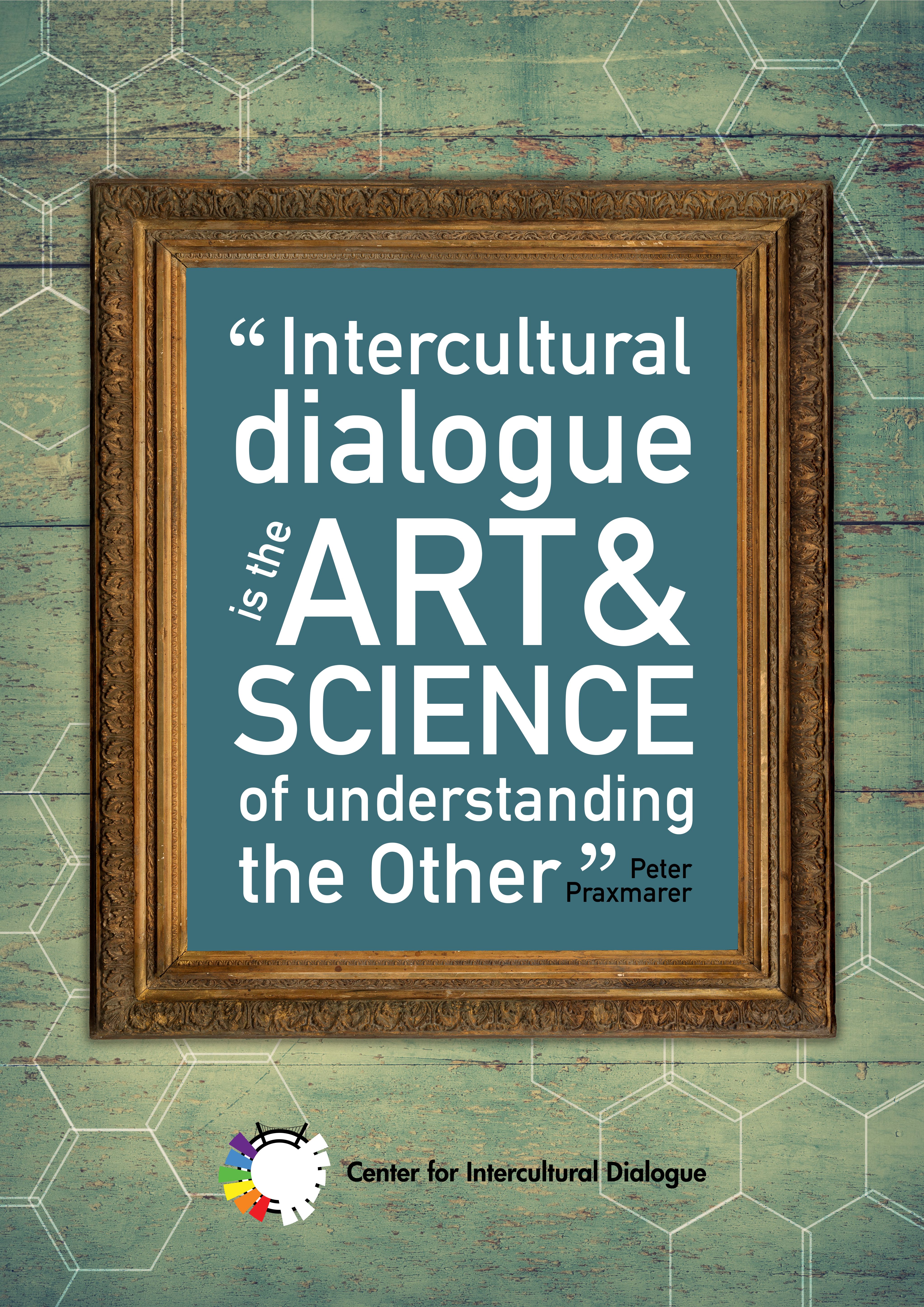
CID Poster #3: Intercultural Dialogue (reprise)

CID Posters(We are reprising the series of posters, because it has been several years since they were originally created, and they are much too wonderful to let them not be noticed by newcomers to the site!)

This is the third of the posters designed by Linda J. de Wit, then in her role as CID intern. The quote by Peter Praxmarer does not come from a publication, but from a Skype conversation we had on April 25, 2017. I was struck by what he said, and how nicely it summed up the concept of intercultural dialogue, and requested permission to turn the definition into a poster, and he graciously agreed. In terms of visual design, Linda indicated “art” by the picture frame, and “science” by the design in the background. Hopefully this definition will find a wide audience, because I think it does a better and more concise job of explaining intercultural dialogue than other definitions I’ve seen.
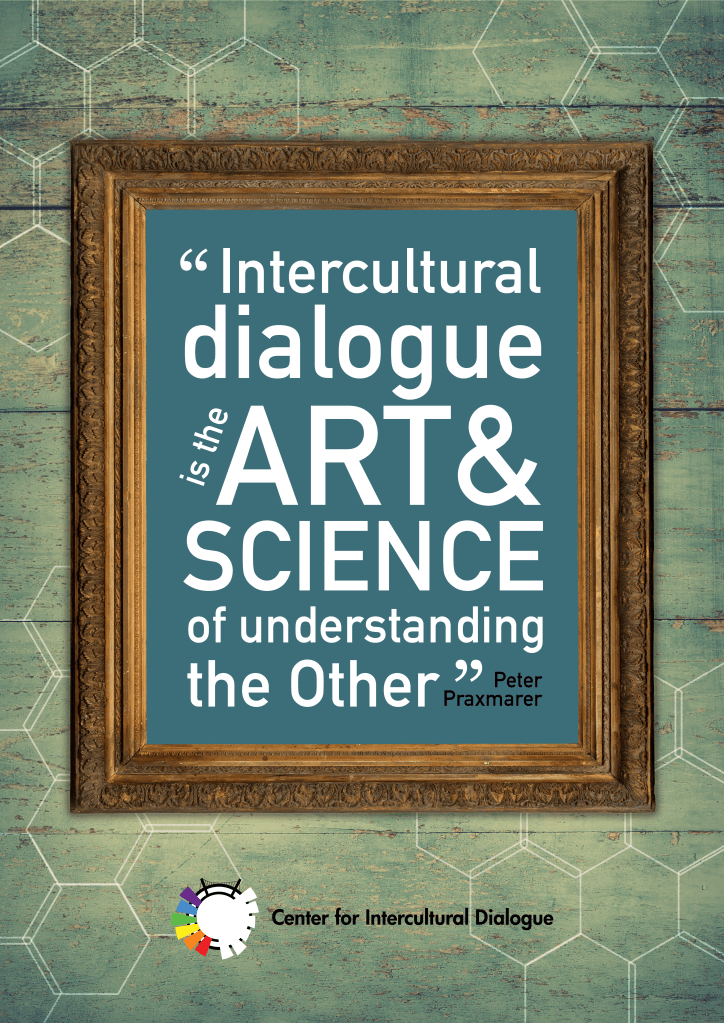
Intercultural Dialogue definition

Just in case anyone wants to cite this poster, the following would be the recommended format:

Center for Intercultural Dialogue. (2017). Intercultural Dialogue. CID Posters, 3. Available from:
https://centerforinterculturaldialogue.org/wp-content/uploads/2017/07/art-and-science.png

As with other series, CID Posters are available for free on the site; just click on the thumbnail to download a printable PDF. They may be downloaded, printed, and shared as is, without changes, without cost, so long as there is acknowledgment of the source.

As with other series, if you wish to contribute an original contribution, please send an email before starting any work to receive approval, to minimize inadvertent duplication, and to learn about technical requirements. As is the case with other CID Publications, posters should be created initially in English. Given that translations of the Key Concepts in Intercultural Dialogue have received so many views, anyone who wishes to translate their own poster into another language (or two) is invited to provide that as well. If you want to volunteer to translate someone else’s poster into a language in which you are fluent, send in a note before starting, to receive approval and to confirm no one else is working on the same one.

Wendy Leeds-Hurwitz
Director, Center for Intercultural Dialogue
intercult.dialogue AT gmail.com


Creative Commons License
This work is licensed under a Creative Commons Attribution-NonCommercial-NoDerivatives 4.0 International License.


U Penn: Global Communication Postdoc 2022 (USA)

PostdocsPostdoctoral fellowship, Center for Advanced Research in Global Communication, Annenberg School for Communication, University of Pennsylvania, Philadelphia, PA. Deadline extended: February 15, 2022.

The Center for Advanced Research in Global Communication (CARGC) produces and promotes scholarly research on global communication and public life. As an institute for advanced study dedicated to global media studies, they revisit enduring questions and engage pressing matters in geopolitics and communication. Our vision of “inclusive globalization” recognizes plurality and inequality in global media, politics, and culture. Their translocal approach fuses multidisciplinary “area studies” knowledge with theory and methodology in the humanities and social sciences. This synthesis of deep expertise and interdisciplinary inquiry stimulates critical conversations about entrenched and emerging communicative structures, practices, flows, and struggles. They explore new ways of understanding and explaining the world, including public scholarship, algorithmic culture, the arts, multi-modal scholarship, and digital archives. With a core commitment to the development of early career scholars worldwide, CARGC hosts postdoctoral, doctoral, undergraduate, and faculty fellows who collaborate in research groups, author CARGC Press publications, and organize talks, lectures, symposia, conferences, and summer institutes.

CFP ECREA 2022: Rethink Impact (Denmark)

ConferencesCall for papers:  9th European Communication Conference: Rethink Impact, 19-22 October 2022, Aarhus University, Aarhus, Denmark. Deadline: 17 January 2022.

The European Communication Research and Education Association (ECREA), the Department of Media and Journalism Studies at Aarhus University (AU) and the Danish School of Media and Journalism (DMJX) are happy to announce that the theme for the 9th European Communication Conference (ECC) will be “Rethink Impact.”

Impact raises fundamental questions on whether – or to what extent – university research and education should directly contribute to social, economic and political demands and be driven by agendas external to the academy. Is it possible to conduct critical research that is publicly funded? Are there models of academic collaboration with society that are not adequately described by current impact assessments? Are funders determining what impact research ought to have? Is there another way of doing impact, as impact ‘from below’, serving the needs of common spaces and grassroots communities? What is the impact of scholars working in the field of communication and external stakeholders, historically and in the present? Why is the long-term contribution of higher education often overlooked in impact discussions? What would an adequate assessment of impact look like in the field of media and communication research, respecting different work cultures, disciplinary orientations and methodologies?

By inviting researchers to ‘rethink impact’ the organisers are wishing to further discussions about both the more traditional ways of thinking about impact as well as some of the more subtle and long-term ways in which researchers and educators in media and communication make a difference contribute to society. Discussions about impact draw on different cultural, social and political histories and ambitions, dealing with contemporary funding and employment structures and incentives, as much as they relate to the place and recognition of scholarship in wider societal and global developments. Rethinking Impact raises fundamental questions about the identity and autonomy of media and communications researchers as an interdisciplinary field of research at the centre of current debates of societal transformation.

Jinhyun Cho Profile

ProfilesJinhyun Cho (Ph.D. Macquarie University, 2016) is a Senior Lecturer in the Department of Linguistics at Macquarie University in Sydney, Australia.

Jinhyun specializes in translation and interpreting and sociolinguistics with a focus on gender, intercultural communication, and language ideologies. Jinhyun’s research brings together interpreting and sociolinguistics to examine hitherto taken-for-granted cultural and linguistic phenomena through the unique prism of interpreters as social agents. By focusing on a shift in understanding away from the traditional mechanical view of interpreters as “translation machines” to a perspective which sees interpreters as social actors, she has been able to capture significant insights into the dynamics of dominant ideologies and societal power structures and their influences on linguistic and cultural practices in diverse socio-historical contexts.

Jinhyun has a particular passion for social justice, diversity and inclusion and currently serves on the editorial board of Multilingua.

Selected publications

Cho, J. (2022). Intercultural communication in interpreting: Power and choices. London, UK: Routledge, Taylor and Francis Group.

Cho, J. (2021). Constructing a white mask through English: The misrecognized self in Orientalism. International Journal of the Sociology of Language, 271, 17-34. https://doi.org/10.1515/ijsl-2020-0037

Cho, J. (2021). “That’s not how we speak”: Interpreting monolingual ideologies in courtrooms. Griffith Law Review, 1-21. https://doi.org/10.1080/10383441.2021.1932234

Cho, J. (2017). English language ideologies in Korea: Interpreting the past and present. Cham, Switzerland: Springer Nature.

Cho, J. (2017). Why do interpreters need to be beautiful? Aesthetic labour of language workers. Gender and Language, 11(4), 482-506. https://doi.org/10.1558/genl.31618


Work for CID:

Jinhyun Cho wrote the guest post Intercultural communication in interpreting: Power and choices.