CFP In Other Words: Otherness

“PublicationCall for proposals: In Other Words (IOW), an online dictionary of contextualized keywords that focuses on how words (re)produce different forms of Otherness.

There is a recent increase of online dictionaries. So, what is IOW’s specificity?

  • The first is precisely its focus: how does a specific word, in a specific context, (re)produce Otherness? And how can discriminating narratives be contested, destablized, subverted?
  • The second is its structure: the discussion of the keywords is highly interdisciplinary, critical, and creative, using different elements from different fields – visual arts, literature, videos, media texts, etc.
  • The third is its addresses: the dictionary does not speak to academics only, but it is a resource to be used for free to favor discussions and appropriations in/by different educational and social contexts.
  • The fourth is its co-construction: it is a collaborative, ongoing project that welcomes the participation of scholars, teachers, practitioners, professionals, educators, activists, artists, individuals from different various fields, formations and experiences.

We invite you to have a tour of IOW dictionary. Submissions are welcome and peer-reviewed year round. For further info, please contact the Editorial Board. Looking forward to receiving your proposals!

Paola Giorgis for IOW Editorial Board

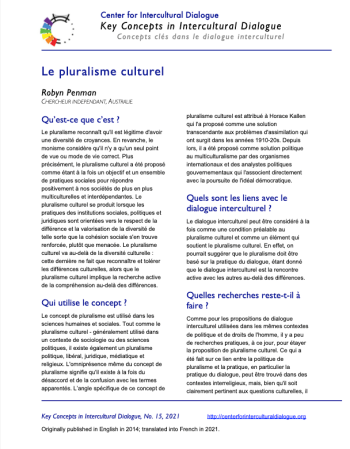
KC15 Cultural Pluralism Translated into French

Key Concepts in ICDContinuing translations of Key Concepts in Intercultural Dialogue, today I am posting KC#15: Cultural Pluralism, which which Robyn Penman wrote in English for publication in 2014, and  which Mohammed Guamguami has now translated into French.

As always, all Key Concepts are available as free PDFs; just click on the thumbnail to download. Lists of Key Concepts organized alphabetically by conceptchronologically by publication date and number, and by languages into which they have been translated, are available, as is a page of acknowledgments with the names of all authors, translators, and reviewers.

KC15 Cultural pluralism_FrenchPenman, R. (2021). Le pluralisme culturel. (M. Guamguami, trans). Key Concepts in Intercultural Dialogue, 15. Available from: https://centerforinterculturaldialogue.org/wp-content/uploads/2021/06/kc15-cultural-pluralism_french.pdf

If you are interested in translating one of the Key Concepts, please contact me for approval first because dozens are currently in process. As always, if there is a concept you think should be written up as one of the Key Concepts, whether in English or any other language, propose it. If you are new to CID, please provide a brief resume. This opportunity is open to masters students and above, on the assumption that some familiarity with academic conventions generally, and discussion of intercultural dialogue specifically, are useful.

Wendy Leeds-Hurwitz, Director
Center for Intercultural Dialogue


Creative Commons License
This work is licensed under a Creative Commons Attribution-NonCommercial-NoDerivatives 4.0 International License.

Constance Mbassi Manga Profile

ProfilesConstance Mbassi Manga earned her Ph.D. from Lancaster University, UK, and wrote her thesis on Camfranglais in use by diasporic Cameroonians living in Western cities, from a sociolinguistic and ethnographic perspective.

Constance Mbassi Manga
Photo credit: Ewane Nja Kwa

A French native of Cameroonian origin, she was raised multilingual and has been working in the field of language for 30+ years, in various capacities (from working as a freelance translator and interpreter, then heading her own translation agency, and later as a Team Lead/an Account Director in Marketing Communications). Moreover, she spent her childhood in a highly multilingual country (Cameroon, where over 250 languages are spoken), speaking 4 languages (2 African languages, English, French) from birth, learning a 5th (German) from the age of 10. She has always been fascinated by language practices and by the unique and powerful link that people draw between the language(s) they speak and who they are.

In terms of academic study, she was introduced to the study of multilingualism and sociolinguistics during her Masters at Kings College London; her Masters thesis focused on ‘Language Practices of Francophone Cameroonians in London.’ Since that time, she has been interested in language practices of non-European background adults in diasporic contexts, and how these tie in with ideologies of language, home and ‘belonging’.

Selected Publications:

Mbassi Manga, C. (2025). Language, home and belonging in migratory contexts: The case of Camfranglais. London: Routledge. (To be published June 10th, 2025)

Mbassi Manga, C. (2019). A case study of Camfranglais in superdiverse contexts: France, the UK and the USA. In R. Siebetcheu & S. Machetti (Eds.), Le camfranglais dans le monde global Contextes migratoires et perspectives sociolinguistiques (175-191). Paris, France: L’Harmattan.


Work for CID:
Constance Mbassi Manga is the author of KC108: Superdiversity, has translated that into French, translated KC23: Afrocentricity into French, and also has served as a reviewer for French.

Utrecht U: Media, Arts & Society (The Netherlands)

“JobAssistant Professor in Media, Arts & Society, Department of Media and Culture Studies, Faculty of Humanities, Utrecht University, the Netherlands. Deadline: 15 August 2021.

The Department of Media and Culture Studies invites applications for an Assistant Professorship in Media, Arts & Society, starting January 1, 2022 (earlier is negotiable). The appointment includes 30 percent research time. The candidate is expected to actively contribute to the research agenda of Media and Culture Studies and to participate in research collaboration within the department and beyond.

For this position, the Department is looking for candidates who contribute to research into the role of media, art and technology in contemporary culture, questions about the impact of the algorithmic turn on various cultural, artistic and social practices, and forms of knowledge production, and into the role of the humanities in responding to contemporary cultural transformations and societal challenges. Of specific interest to the Department are candidates who will contribute to trans- and interdisciplinary research agendas around participatory practices and civic engagement, and/or critical perspectives for fostering diversity and justice in our mediatized society.

U Aberdeen: Director for Social Inclusion & Cultural Diversity (UK)

“Job

Director, Interdisciplinary Centre for Social Inclusion and Cultural Diversity, University of Aberdeen,  Aberdeen, UK. Deadline: 6 August 2021.

The University of Aberdeen wishes to appoint, at Professorial level, a Director to lead its interdisciplinary Centre for Social Inclusion and Cultural Diversity.  The ideal candidate should have extensive internationally-renowned academic expertise in an underpinning discipline within Social Inclusion and Cultural Diversity, with a proven track record of interdisciplinary research, as well as success in meeting or exceeding challenging targets. For this role candidates will be an experienced academic leader with outstanding leadership, human resources, financial accountability and negotiating skills. You will also have an in-depth knowledge of high-level Government policy and business as well as a strong understanding of government and other funding streams.

Peace Direct Free Course on Conflict

Intercultural PedagogyConflict Transformation: Your Practical Toolkit for Peacebuilding, Peace Direct, Online course. Deadline: Free until August 31, 2021, available at a cost after that.

Peace Direct has launched a new course for people wanting to learn more about peacebuilding. The course is available online and is free until the end of August during the test phase. The course is self paced, and takes on average between two hours and two weeks to complete. The course can be used by peacebuilders or anyone working in conflict situations, as a practical toolkit for peacebuilding. It is relevant to people working in fields such as: human rights, development, democracy, healing and environmental sustainability as well as other areas of work related to peace. Upon completion, participants should have a greater knowledge of the practical skills and techniques required to resolve conflict and build peace successfully at a local level.

The course consists of eight modules:

  • Perspectives and values
  • Self-awareness and learning
  • Influencing through relationships: conflict and power
  • Violence, peace and healing
  • Participative conflict analysis
  • Strategy and nonviolence
  • Exploring options from ourselves to building a movement
  • Being the change

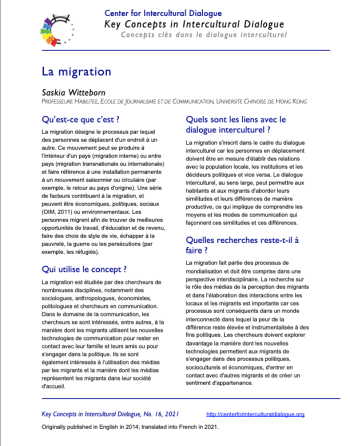
KC16: Migration Translated into French

Key Concepts in ICDContinuing translations of Key Concepts in Intercultural Dialogue, today I am posting KC#16: Migration, which Saskia Witteborn wrote for publication in English in 2014, and which Mohammed Guamguami has now translated into French.

As always, all Key Concepts are available as free PDFs; just click on the thumbnail to download. Lists of Key Concepts organized chronologically by publication date and number, alphabetically by concept, and by languages into which they have been translated, are available, as is a page of acknowledgments with the names of all authors, translators, and reviewers.

KC16 Migration_French

Witteborn, S. (2021). La migration. (M. Guamguami, Trans.). Key Concepts in Intercultural Dialogue, 16. Available from: https://centerforinterculturaldialogue.org/wp-content/uploads/2021/06/kc16-migration_french.pdf

If you are interested in translating one of the Key Concepts, please contact me for approval first because dozens are currently in process. As always, if there is a concept you think should be written up as one of the Key Concepts, whether in English or any other language, propose it. If you are new to CID, please provide a brief resume. This opportunity is open to masters students and above, on the assumption that some familiarity with academic conventions generally, and discussion of intercultural dialogue specifically, are useful.

Wendy Leeds-Hurwitz, Director
Center for Intercultural Dialogue


Creative Commons License
This work is licensed under a Creative Commons Attribution-NonCommercial-NoDerivatives 4.0 International License.

Identity, Digital Storytelling & Linguistic Citizenship (UK but Online)

Events

Identity, Digital Storytelling and Linguistic Citizenship, Hub for Education & Language Diversity, King’s College, London, UK, 22 July 2021, 15:00 BST.

This event is part of the Hub for Education & Language Diversity (HELD) summer school, July 21-23, 2021, but is open to everyone.

What is the relationship between identity, digital storytelling and linguistic citizenship? Due to advances in digital technology, there are new relations of power at micro and macro levels, and digital literacy has become essential in “claiming the right to speak.” As language learners navigate these changing times, they need to negotiate new identities, investments, and imagined futures.

In this presentation, Dr Bonny Norton demonstrates that while there are social structures that may constrain a language learner’s linguistic citizenship, digital stories in multiple languages can help these learners claim the right to be heard. Drawing on her recent research on digital storytelling in both wealthy and poorly resourced communities worldwide, she discusses how freely available digital stories in multiple languages can harness the linguistic capital of language learners in homes and schools, with exciting implications for the promotion of linguistic citizenship in communities worldwide.

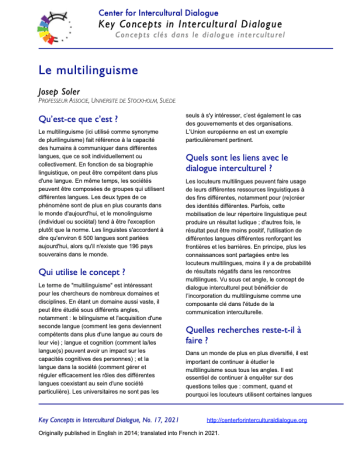
KC17 Multilingualism Translated into French

Key Concepts in ICDContinuing translations of Key Concepts in Intercultural Dialogue, today I am posting KC#17: Multilingualism, which Josep Soler wrote for publication in English in 2014, and which Mohammed Guamguami has now translated into French.

As always, all Key Concepts are available as free PDFs; just click on the thumbnail to download. Lists of Key Concepts organized alphabetically by conceptchronologically by publication date and number, and by languages into which they have been translated, are available, as is a page of acknowledgments with the names of all authors, translators, and reviewers.

KC17 Multilingualism_FrenchSoler, J. (2021). Le multilinguisme. (M. Guamguami, Trans.). Key Concepts in Intercultural Dialogue, 17. Available from: https://centerforinterculturaldialogue.org/wp-content/uploads/2021/06/kc17-multilingualism_french.pdf

If you are interested in translating one of the Key Concepts, please contact me for approval first because dozens are currently in process. As always, if there is a concept you think should be written up as one of the Key Concepts, whether in English or any other language, propose it. If you are new to CID, please provide a brief resume. This opportunity is open to masters students and above, on the assumption that some familiarity with academic conventions generally, and discussion of intercultural dialogue specifically, are useful.

Wendy Leeds-Hurwitz, Director
Center for Intercultural Dialogue


Creative Commons License
This work is licensed under a Creative Commons Attribution-NonCommercial-NoDerivatives 4.0 International License.

KC33: Moral Conflict Translated into French

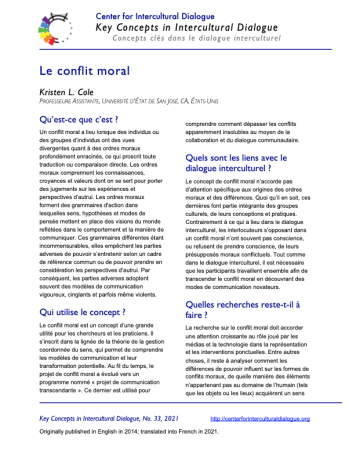
Key Concepts in ICDContinuing translations of Key Concepts in Intercultural Dialogue, today I am posting KC#33: Moral Conflict, which Kristen L. Cole wrote for publication in English in 2014, and which Suzie Suriam Wordofa has now translated into French.

As always, all Key Concepts are available as free PDFs; just click on the thumbnail to download. Lists of Key Concepts organized chronologically by publication date and number, alphabetically by concept, and by languages into which they have been translated, are available, as is a page of acknowledgments with the names of all authors, translators, and reviewers.

KC33 Moral conflict_FrenchCole, K. L. (2021). Le conflit moral. (S. S. Wordofa, Trans.). Key Concepts in Intercultural Dialogue, 33. Retrieved from: https://centerforinterculturaldialogue.org/wp-content/uploads/2021/07/kc33-moral-conflict_french.pdf

If you are interested in translating one of the Key Concepts, please contact me for approval first because dozens are currently in process. As always, if there is a concept you think should be written up as one of the Key Concepts, whether in English or any other language, propose it. If you are new to CID, please provide a brief resume. This opportunity is open to masters students and above, on the assumption that some familiarity with academic conventions generally, and discussion of intercultural dialogue specifically, are useful.

Wendy Leeds-Hurwitz, Director
Center for Intercultural Dialogue


Creative Commons License
This work is licensed under a Creative Commons Attribution-NonCommercial-NoDerivatives 4.0 International License.