Erasmus Mundus: Intercultural Mediation 2014-15

Call for scholars scholarship open until 7th of July 2014

Master Erasmus Mundus “Intercultural Mediation: Identities, Mobilities, Conflicts” offers interdisciplinary training for excellence in 4 semesters, Federated by joint research programs within a consortium: Université de Lille (France), Katholieke Universiteit Leuven (Belgique), University College Cork (Irlande), Université « Babes-Bolyai » (Roumanie), Université de Wroclaw (Pologne), Université Cheikh Anta Diop de Dakar (Sénégal), Universidad Nacional Autónoma de México (Mexique) and Université Fédérale de Rio de Janeiro (Brésil). Des professionnels et des institutions publiques et privées (Professionals and public and private institutions associated with them).

Located in territories shaped by migration, these institutions have been led to question the social changes, cultural and resulting policies and now extend to the global society. It therefore became necessary to train experts of migration, integration, management of cultural and linguistic diversity, with particular expertise in ethics.

Save

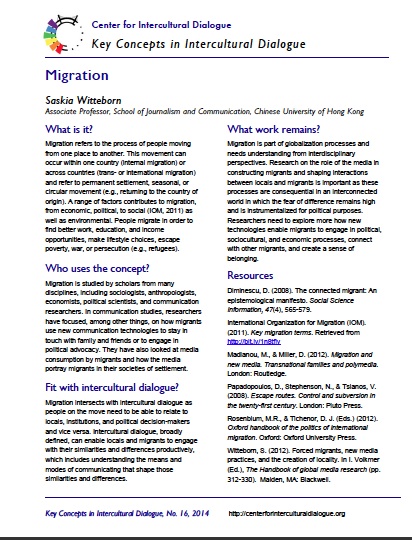
Key Concept #16: Migration by Saskia Witteborn

Key Concepts in ICDThe next issue of Key Concepts in intercultural Dialogue is now available. This is KC16: Migration by Saskia Witteborn. As always, all Key Concepts are available as free PDFs; just click on the thumbnail to download.Lists organized  chronologically by publication date and numberalphabetically by concept in English, and by languages into which they have been translated, are available, as is a page of acknowledgments with the names of all authors, translators, and reviewers.

KC16 Migration


Witteborn, S. (2014). Migration. Key Concepts in Intercultural Dialogue, 16. Available from:
https://centerforinterculturaldialogue.org/wp-content/uploads/2014/05/key-concept-migration.pdf

The Center for Intercultural Dialogue publishes a series of short briefs describing Key Concepts in intercultural Dialogue. Different people, working in different countries and disciplines, use different vocabulary to describe their interests, yet these terms overlap. Our goal is to provide some of the assumptions and history attached to each concept for those unfamiliar with it. As there are other concepts you would like to see included, send an email to the series editor, Wendy Leeds-Hurwitz. If there are concepts you would like to prepare, provide a brief explanation of why you think the concept is central to the study of intercultural dialogue, and why you are the obvious person to write up that concept.


Creative Commons License
This work is licensed under a Creative Commons Attribution-NonCommercial-NoDerivatives 4.0 International License.

9th Congress IAIR Bergen (Norway) 2015

The 9th Biennial Congress of the International Academy for Intercultural Research

Realizing the potential of Cultural Diversity in the society and at the workplace

There is hardly any large society that is presently ethnically homogenous as a result of domestic and international migration. The foreign-populations of many societies are increasing at unprecedented rates. For instance, it has been estimated that by 2050, 85% of Australia‘s population growth will be either from overseas migration or from native born Australians who have at least one foreign-born parent. Europe will need 80 million immigrants by 2030, while the US, Japan and Canada will need 35 million, 17 million, and 11 million immigrants by 2030, respectively (Saunders, 2010).

The aging population of the world, particularly in Western industrialized countries, and unemployment and economic stagnation in many countries, will put pressure on the economies of Western industrialized countries in the form of increased migration, bringing people of different ethnic and cultural backgrounds together in ways that have never been seen before.

These demographic changes have wide range of implications for the governance of nation-building including employment, health, education, housing, economics, politics, culture, intergroup relationships and so forth.  Depending on which angle one takes, the results can be either positive or negative.  Unfortunately, events such as the terror attacks in major European cities including Madrid (2004), in London (2005) and in Oslo/Utøya (Norway, 2011) together with the Danish cartoon drawings of Mohammed are some negative instances of intercultural relations.  European leaders have not fared any better when they incite skepticism by suggesting that multiculturalism has been a failure. These pessimistic statements undermine and diminish the positive aspects of cultural diversity.

It is within this context that this conference is organized, with the theme – Realizing the potential of cultural diversity.

Realizing the potential of cultural diversity in the workplace and society will challenge societies politically, economically, socially, legally and culturally. This challenge will require a parallel effort to achieve equity and full participation of all cultural communities in the larger society. Any discussion around the topics will require a multi-disciplinary approach.  Hence the planned conference will attract scholars from psychology, and many related fields and disciplines. Indeed the ultimate goal of this conference will be to bring to Bergen the leading scholars of the world to share research findings, engage in dialogue on how to tap into the positive sides of cultural diversity, and how employers, institutions, and governments can realize its potential. The conference will include Keynote presentations by leading scholars, symposia, individual papers, posters and round table discussions, including debates. During the past three conferences, the Academy has also devoted a whole day to a workshop – Fellows’ Day – just before the opening of the conference where the Fellows of the Academy engage in a series of discussions regarding the conference theme.

The Conference is hosted by:
Society and Workplace Diversity Research Group, Department of Psychosocial Science, University of Bergen

Administratively, the Department of Psychosocial Science is responsible for the running of the conference, but the practical activities regarding the conference will be coordinated by the Society and Workplace Diversity Research group in close collaboration with the Congress Bureau (Kongress og Kultur – KK-Bergen). While the Research Group will be responsible for the scientific side of the conference, the all practical organization will be taken care of by the Congress Bureau.

Venue:  Most of the congress program will be held at the Bjørn Christiansen Building, Christiesgate 12

SOME IMPORTANT DATES TO REMEMBER
Submission of proposals opens: March 1, 2014
1st proposal  Deadline: November 1, 2014
Accepted Decision: December 15, 2014
2nd proposal deadline: December 31, 2014
Accepted decision: February 15, 2015

Sample of thematic topics
*Cultural diversity in the society
*Cultural diversity at the work place
*Migration, Acculturation, and Adjustment
*Intercultural competence and training
*Intercultural communication

CFP History, the Press and Diaspora (Ireland)

Conference 2014 – Call for Papers
The theme for the seventh annual Newspaper and Periodical History Forum of Ireland (NPHFI) Conference, to be held at University College Cork on Friday and Saturday, 21-22 November 2014, is: Home thoughts from abroad: History, the Press and Diaspora

Proposals are welcome for papers that address the relationship between the press and diaspora in Irish and other historical contexts. The focus of the papers should be print journalism, and topics that might be addressed include:
· Biographical sketches of individual journalists who lived / worked abroad
· Press and empire(s)
· Journalism, migration and migrant identity
· Transnational journalism in a historical context
· Technological and transnational influence on print journalism
· Case studies of key diaspora publications / diaspora press owners

Abstracts should be no longer than 500 words. Abstracts must contain a clear title and present clearly the main thesis / argument proposed. Each abstract must also include name(s), affiliation, institutional address and email address(es) of the author(s).

To submit a proposal, please email a 500-word summary of your paper and a brief biographical note to the NPHFI secretary, Oliver O’Hanlon.

The closing date for submission of proposals is 27 June 2014.

Migration Post-doc UNU-GCM (Barcelona)

Visiting Researchers Programme

UNU-GCM is currently offering THREE places of three months each to post-doctoral researchers in the Humanities and Social Sciences with expertise in the area of statelessness and transcontinental migration. Their Visiting Researchers Programme gives qualified researchers an opportunity to research topics related to the ongoing research programme on Statelessness and Transcontinental Migration, and to participate in UNU-GCM activities. Visiting Researchers will be expected to reside in Barcelona and work from our office in the Sant Pau Art Nouveau Site in Barcelona.

Download the full details here:  icon Visiting Researchers Programme (UNU – GCM) (135.92 kB)

CFP Globalization: Texts, Performances, Practices

Call for Papers

Globalization: Texts, Performances, Practices
Type: Cross-Disciplinary International Conference
Institution: Department of Communication, Saint Louis University
Location: Madrid (Spain)
Date: 24.–26.4.2014
Deadline: 16.12.2013

__________________________________________________

The depth and breadth of what we regularly reference as globalization is still expanding. At the same time, in most moments, we as subjects are situated in palpable, immediate, super-organic localities. This and other paradoxes demonstrate that, however much “globalization” has become a widely circulated buzzword, we are still probing what it means for subjects in everyday terms.

Across three days, participants from all over the globe will reflect on the many registers in which the “structuring structures” of globalization play out as the conference assays to unpack “what’s going on.” While the event will be hosted by a Communication department, the organizers welcome cross-disciplinary effort.

Some specific areas of interest to the Organizing Committee include:

Globalization, on Screens Everywhere:
– Media, Technology, and Society
– The Practice of International Journalism
– Digital Journalism
– New Media: New Subjects?
– Film & Television as International Couriers
– International Political Economy of Media

Critical Intercultural Communication:
– Globalization and Subjectivity
– Culture, Identity & Mobility
– Tourism in Practice
– Glocalization and Cultural Heterogeneity
– Fluidity and Hybridity
– Performing Globalization
– Post-Colonial & Diaspora Studies
– New Cartographies

Global Organizations:
– Nations/TransNations
– The Confrontation with Neoliberalism
– The Corporation
– Human Rights & NGOs
– Modes of Protest

To be considered as a presenter, please email the following by 16 December 2013:
(1) Your name and title
(2) Institutional affiliation
(3) A title and abstract of your work (200-400 words)
(4) four “key words”

The conference’s designated language will be English in all its variants.

Keynote Addresses:
– Radha S. Hegde, New York University: “Migrant Bodies and the Politics of Recognition”
– Natalie Fenton, Goldsmiths/University of London: “Mediated Public Spheres: The Problem of Politics and Dream of Democracy”

Contact:
Department of Communication
Saint Louis University – Madrid Campus
Avenida del Valle 34
E-28003 Madrid
Spain
Email: madrid.comm.conference2014@gmail.com

CFP Superdiversity conference Birmingham

CALL FOR PAPERS
Superdiversity: theory, method and practice in an era of change
International Conference, Birmingham 23-24 June 2014

(DEADLINE FOR SUBMISSION: 10th DECEMBER 2013)

Keynote Speakers include:
*Professor Jan Blommaert, Babylon Centre for the study of Superdiversity, University of Tilberg, The Netherlands.
*Professor Peggy Levitt, Wellesey College, USA.
*Professor James Nazroo, The Cathie Marsh Centre for Census and Survey Research, University of Manchester, UK.
*Professor Gill Valentine, University of Sheffield, UK
*Professor Steven Vertovec, Max Planck Institute for the Study of Religious and Ethnic Diversity, Gottingen, Germany

With the unprecedented speed, scale and spread of global migration, academics have an important role in developing new methods, advancing theoretical understanding and producing empirically informed knowledge about the emergence of superdiversity.

Invitation to submit
The Institute for Research into Superdiversity (IRiS) at the University of Birmingham are organising the first international interdisciplinary conference on superdiversity. The conference will be held at University of Birmingham on the 23rd and 24th June 2014. It will feature invited plenaries, academic panels and a policy roundtable on topics at the forefront of the superdiversity research agenda. The aim of the conference is to map the state of the art in knowledge on superdiversity and to draw an agenda for future research.

We welcome academics from a broad range of disciplines, including anthropology, sociology, social policy, geography, linguistics, history, psychology, economics, medicine, demography, politics, and development studies, policy makers and practitioners to submit innovative papers, panel proposals or posters on any aspect related to superdiversity. Doctoral researchers are welcome to submit their work. The conference will be an opportunity for meeting fellow PhD students and senior academics working on superdiversity.

The conference will include parallel sessions on:
*Migration processes, transnational practices, and globalization
*Patterns and experiences of space and place
*Interchanges, interactions and encounters
*Immigration regimes, rights and belonging
*Discrimination, segregation and inclusion
*Hybridity, representations and belonging
*Communication, language and media
*Policy, planning and service delivery
*Research methods and approaches
*Markets, finance and opportunity
*Art, culture and history
*Faith, religion and spirituality
*Health and healthcare
*New demographies

Submission Guidelines
Abstracts should be submitted electronically, using the on-line submission link – http://www.birmingham.ac.uk/research/activity/superdiversity-institute/events/2014/06/call-for-papers.aspx – by 10th December 2013.
*Submissions for presentations should include an abstract of a maximum of 250 words.
*Submissions for panels should include the names of three speakers and a Chair, an overview abstract of 250 words and an abstract for each associated paper of 250 words.
*Poster submissions can describe in 250 words or less key themes and approaches to be included in the poster.

Acceptance decisions will be communicated week beginning the 24th February 2014.

Presentation Format: The selected papers will be grouped by themes. There will be parallel sessions, with three presentations in each session. Each presentation will last 20 minutes and followed by 10 minutes discussion.

Deadline for papers: Panel speakers are expected to submit full papers (pdf files) by 30th May 2014.

Conference publications: delegates will be offered the opportunity after the conference to submit their papers for consideration to be included in an edited book and/or journal special edition.

Other: Travel and accommodation expenses should be covered by the participants. However, there will be a limited number of registration fee bursaries for participants under exceptional circumstances.

Save

CFP Migration, Media and Intercultural Dialogue

Call for Papers
Migration, Media and Intercultural Dialogue
Conference 25th and 26th November 2013
Institute on Globalization, Culture and Mobility, Barcelona, Spain

While migration often poses the question of cultural difference, diverse forms of media play a key role in enabling representation, thus forging modes of communication. Through a focus on the role of media, this conference will explore the extent to which the latter bridges cultural differences in contexts of migration and facilitates intercultural dialogue.

Keynote speakers:
Iain Chambers, Professor of Cultural and Postcolonial Studies, Oriental University of Naples, Italy
Kevin Robins, Professor of Sociology, City University, London, UK

Further abstracts are sought which focus on a range of issues, both theoretical and empirical, which relate to: cultural diversity and difference, how media can mobilize societies and cultures, and the role of media in triggering migration, and connecting migrants to their homelands. This is an interdisciplinary conference. Contributions are welcomed from anthropologists, cultural theorists, economists, linguists, political theorists, sociologists, and anyone examining relevant questions.

Two events will follow the conference in which participants are welcome to participate:
– Roundtable discussion with Immigrant Press Journalists in Barcelona, organized in collaboration with Casa Asia on November 25, 2013
– Training workshop on PhD research methods organized in collaboration with CIDOB on November 27, 2013

The conference will take place at the offices of UNU-GCM, located at:
Sant Manuel Pavilion, Sant Pau Art Nouveau Site, c/ Sant Antoni Maria Claret, 167, 08025-Barcelona, Spain.
Please note that there is no financial assistance available for travel or accommodation.

Submission information:
Abstracts for papers should be of maximum 500 words, and sent along with a biographical note of maximum 150 words to: Tendayi Bloom.
Abstracts for panels should be of maximum 500 words. Prospective conveners should include a biographical note of maximum 150 words for each convener and should provide a list of questions the panel will address, with a short sentence about each panel member, where known. This should be sent to: Valeria Bello.
The deadline is 5pm CET Friday 18th October 2013 (response by 24th October).

Save

U Denver postdocs

Lecturer-Postdoctoral Teaching Fellow

The Department of Communication Studies at the University of Denver invites applications for a three year, annually renewable, Lecturer-Postdoctoral Teaching Fellow with a specific focus on migration and/or diaspora studies, to begin September 1, 2012.

The Department of Communication Studies grants the B.A., M.A., and Ph.D. degrees. The graduate program is focused on three areas of inquiry: Culture and Communication, Interpersonal and Family Communication, and Rhetoric and Communication Ethics. Given faculty research and teaching foci we are particularly interested in applicants who have teaching and research interests in Communication, transnationalism, diaspora, and/or migration. Scholars with research and teaching foci in the areas of African diaspora studies, citizenship studies, and diaspora studies, and/or queer diaspora studies are particularly welcome. We seek to participate in the process of preparing recent Ph.D. recipients for tenure track positions and careers in academia. A central component of this position is mentoring; thus, a faculty mentor will be assigned to our new colleague. Eligible applicants are individuals who have received the Ph.D. in Communication no earlier than May 2009. The person hired will be expected to teach six courses over three quarters (two courses a quarter).

The Postdoctoral Fellow will contribute to the University’s Common Curriculum and the major of the department of Communication Studies. Given these needs, in consultation with the Dean’s Office, the following courses are likely possibilities.
•       First Year Seminar  (1) : Special topic course and advising for first year students. (Title and content to be determined by the Fellow the Department, and the Dean’s Office.)
•       Ways of Knowing Class (2 or3): For undergraduates, for instance, COMN 2220, Race and Popular Culture and COMN 2210, Gender and Communication. (Title and content to be determined by the Fellow the Department, and the Dean’s Office.)
•       Advanced Seminar (2 or 3 Classes): For advanced undergraduates, for instance ASEM 2509, Communication and the Production of Culture, or a new ASEM focused o the candidates specific interest. (Title and content to be determined by the Fellow the Department, and the Dean’s Office.)

Review of applications will begin April 9, 2012 and will continue until the position is filled. Applicants who wish to apply must complete an online application at www.dujobs.org. Attach letter of application and vitae. Please mail evidence of teaching effectiveness (syllabi and sample evaluations), three letters of recommendation, and other materials to:

Dr. Roy Wood, Chair Search Committee
Department of Communication Studies
2000 E. Asbury Ave.
Sturm 200
University of Denver
Denver, CO 80208

The University of Denver is committed to enhancing the diversity of its faculty and staff and encourages applications from women, minorities, people with disabilities and veterans. DU is an EEO/AA employer.

Postdoctoral fellow-University of Denver

Postdoctoral Lecturer, University of Denver

The Department of Communication Studies grants the B.A., M.A., and Ph.D. degrees. The graduate program is focused on three areas of inquiry: Culture and Communication, Interpersonal and Family Communication, and Rhetoric and Communication Ethics. The area of Culture and Communication investigates the communicative constitution and intersection of difference in its various codifications as culture, race, class, religion, ethnicity, nationality, gender and sexual orientation. Its vision is to promote an ethic of inclusivity, racial and social justice, reciprocity, and mutual transformation in the encounter of difference. Courses reflect this emphasis, focusing on the social and performative construction of identity, the politics of representation, performances of affect, identity, and community and vernacular and embodied rhetorics, all informed by, critical, feminist and queer perspectives on cultural communication.

Given faculty research and teaching foci we are particularly interested in applicants who have teaching and research interests in Communication, transnationalism, diaspora, and/or migration. Scholars with research and teaching foci in the areas of African diaspora studies, citizenship studies, and diaspora studies, and/or queer diaspora studies are particularly welcome. We seek to participate in the process of preparing recent Ph.D. recipients for tenure track positions and careers in academia. A central component of this position is mentoring; thus, a faculty mentor will be assigned to our new colleague. Eligible applicants are individuals who have received the Ph.D. in Communication no earlier than May 2008. The person hired will be expected to teach six courses over three quarters (two courses a quarter).

The Postdoctoral Fellow will contribute to the University’s Common Curriculum and the major of the department of Communication Studies. Given these needs, in consultation with the Dean’s Office, the following courses are likely possibilities.

Teaching Description:
* First Year Seminar  (1) : Special topic course and advising for first year students. (Title and content to be determined by the Fellow the Department, and the Dean’s Office.)
* Ways of Knowing Class (2 or 3): For undergraduates, for instance, COMN 2220, Race and Popular Culture and COMN 2210, Gender and Communication. (Title and content to be determined by the Fellow the Department, and the Dean’s Office.)
* Advanced Seminar (2 or 3 Classes): For advanced undergraduates, for instance ASEM 2509, Communication and the Production of Culture, or a new ASEM focused o the candidates specific interest. (Title and content to be determined by the Fellow the Department, and the Dean’s Office.)

Ph.D. in Communication no earlier than May 2008.
Experience teaching at a College or University level desired.

To be considered an applicant, you must submit your application, C.V., cover letter. list of references, and scholarly publications online. Please also send three letters of recommendation:

Bernadette Calafell
University of Denver
2000 E. Asbury Ave.
Sturm Hall, Suite 200
Denver, CO 80208

Review of applications will begin March 15th, 2011 and continue until the position is filled.

The University of Denver is committed to enhancing the diversity of its faculty and staff and encourages applications from women, minorities, people with disabilities and veterans. DU is an EEO/AA employer.

Please see our extensive benefit package at www.du.edu/hr/benefits