Key Concept #1: Intercultural Dialogue Translated into Chinese

Key Concepts in ICDContinuing translations of Key Concepts in Intercultural Dialogue, today I am posting KC#1: Intercultural Dialogue, which I wrote and first published in English in 2014, and which Yan Qiu has now translated into Simplified Chinese.

As always, all Key Concepts are available as free PDFs; just click on the thumbnail to download. Lists of Key Concepts organized chronologically by publication date and number, alphabetically by concept, and by languages into which they have been translated, are available, as is a page of acknowledgments with the names of all authors, translators, and reviewers.
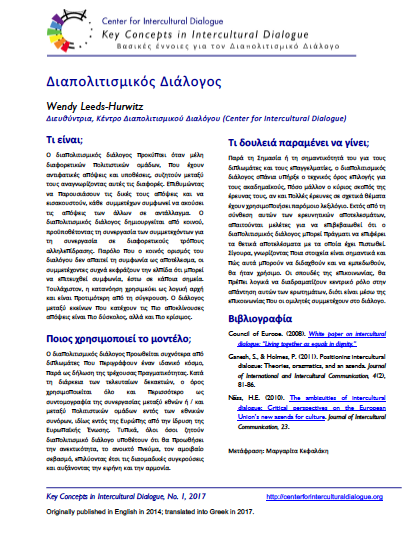
KC1 ICD_Chinese-simLeeds-Hurwitz, W. (2017). Intercultural dialogue [Simplified Chinese]. (Y. Qiu, Trans). Key Concepts in Intercultural Dialogue, 1. Available from: https://centerforinterculturaldialogue.org/wp-content/uploads/2017/05/kc1-icd_chinese-sim.pdf

If you are interested in translating one of the Key Concepts, please contact me for approval first because dozens are currently in process. As always, if there is a concept you think should be written up as one of the Key Concepts, whether in English or any other language, propose it. If you are new to CID, please provide a brief resume. This opportunity is open to masters students and above, on the assumption that some familiarity with academic conventions generally, and discussion of intercultural dialogue specifically, are useful.

Wendy Leeds-Hurwitz, Director
Center for Intercultural Dialogue


Creative Commons License
This work is licensed under a Creative Commons Attribution-NonCommercial-NoDerivatives 4.0 International License.

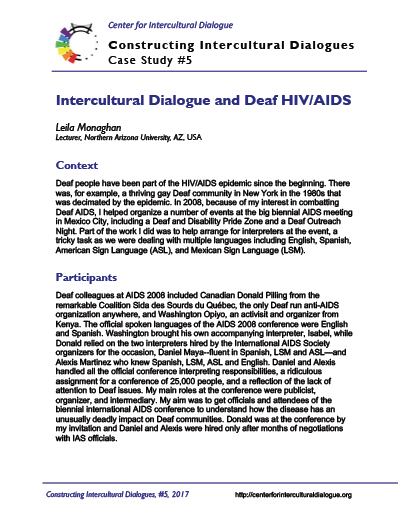
Constructing Intercultural Dialogues #5: Intercultural Dialogue and Deaf HIV/AIDS

Constructing ICD

The fifth issue of Constructing intercultural Dialogues is now available, “Intercultural Dialogue and Deaf HIV/AIDS,” by Leila Monaghan.

As a reminder, the goal of this series is to provide concrete examples of how actual people have managed to organize and hold intercultural dialogues, so that others may be inspired to do the same. As with Key Concepts in Intercultural Dialogue, these may be downloaded for free. Click on the thumbnail to download the PDF.
CICD 5 MonaghanMonaghan, L. (2017). Intercultural dialogue and Deaf HIV/AIDS. Constructing Intercultural Dialogues, 5. Available from: https://centerforinterculturaldialogue.org/wp-content/uploads/2017/04/constructing-icd-5.pdf

If you have a case study you would like to share, send an email to the series editor, Wendy Leeds-Hurwitz.


Creative Commons License
This work is licensed under a Creative Commons Attribution-NonCommercial-NoDerivatives 4.0 International License.
MOOC: Media & Information Literacy & Intercultural Dialogue

UNESCO and Athabasca University jointly offer a MOOC on Media and Information Literacy and Intercultural Dialogue (MILID), in partnership with the International Media and Information Literacy and Intercultural Dialogue University Network.

In the evolving knowledge societies of today, some people are overloaded with information; others are starved for information. Everywhere, people are yearning to express themselves freely and to participate actively in governance processes and cultural exchange. Universally, there is a deep thirst to understand the complex world around us.

Media and Information Literacy and Intercultural Dialogue (MILID) is a basis for enhancing access to information and knowledge, freedom of expression, gender equality, and a high standard of education in an intercultural framework. It describes skills and attitudes that are needed to understand the functions of media and other information providers in society across a variety of media formats, including those of the Internet. It encourages the value of accepting and sharing diverse cultural and religious standpoints. The course does these things in order to enable people to share knowledge and experience, learn from one another and find, evaluate, and produce information and media content on their own. In other words, MILID covers the competencies that are vital for people to engage effectively in all aspects of development.

More and more countries recognize the importance of MILID. Over 70 countries are implementing MILID-related activities in varying degrees and reach. Yet, this takes time. At present, only a handful of states have put in place national MILID-related policies and elaborated the strategies that are needed to sustain their efforts. Meanwhile, research has shown that countries with national MILID policies and strategies have more far-reaching and sustained programmes.

This open access course in MILID, which has been designed, written and offered as a partnership between UNESCO and Athabasca University, introduces the concepts of media and information literacy and intercultural dialogue along with important issues that relate to this new set of competencies for global citizenship.

The course is open to anyone who wishes to sign in. There are 10 units addressing such concepts as media and information literacy, intercultural dialogue, freedom of expression, the multiple roles of media and advertising in contemporary life, gender representation and stereotyping in the media, challenges and opportunities for youth, and ways of engaging with new technologies for social change. If you wish to receive a certificate for taking this course, you need to achieve a grade of at least 65% overall.

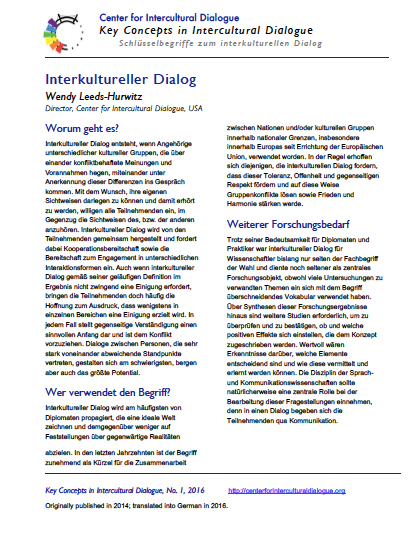
Key Concept #1: Intercultural Dialogue Translated into German

Key Concepts in ICDContinuing translations of Key Concepts in Intercultural Dialogue, today I am posting KC1: Intercultural Dialogue, which I published in English in 2014 as the first in the series, and which Dominic Busch has now translated into German.

As always, all Key Concepts are available as free PDFs; just click on the thumbnail to download. Lists of Key Concepts organized chronologically by publication date and number, alphabetically by concept, and by languages into which they have been translated, are available, as is a page of acknowledgments with the names of all authors, translators, and reviewers.

KC1 Interkultureller dialog_GermanLeeds-Hurwitz, W. (2016). Interkultureller dialog. (D. Busch, trans). Key Concepts in Intercultural Dialogue, 1. Available from:
https://centerforinterculturaldialogue.org/wp-content/uploads/2016/09/kc1-icd_german.pdf

If you are interested in translating one of the Key Concepts, please contact me for approval first because dozens are currently in process. As always, if there is a concept you think should be written up as one of the Key Concepts, whether in English or any other language, propose it. If you are new to CID, please provide a brief resume. This opportunity is open to masters students and above, on the assumption that some familiarity with academic conventions generally, and discussion of intercultural dialogue specifically, are useful.

Wendy Leeds-Hurwitz, Director
Center for Intercultural Dialogue


Creative Commons License
This work is licensed under a Creative Commons Attribution-NonCommercial-NoDerivatives 4.0 International License.
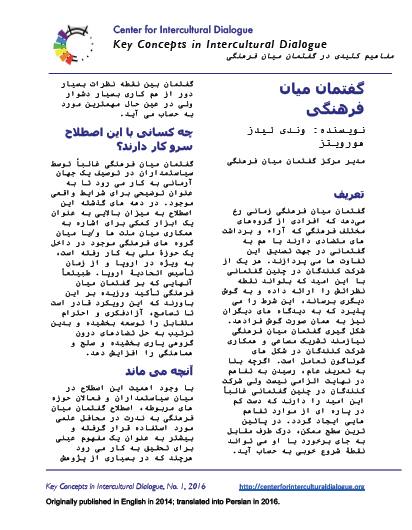
Key Concept #1: Intercultural Dialogue Translated into Persian

Key Concepts in ICDContinuing translations of Key Concepts in Intercultural Dialogue, today I am posting KC#1: Intercultural Dialogue, which I published in English in 2014 as the first in the series, and which Ramin Hajianfard has now translated into Persian.

As always, all Key Concepts are available as free PDFs; just click on the thumbnail to download. Lists of Key Concepts organized chronologically by publication date and number, alphabetically by concept, and by languages into which they have been translated, are available, as is a page of acknowledgments with the names of all authors, translators, and reviewers.

KC1 Intercultural Dialogue_PersianLeeds-Hurwitz, W. (2016). Intercultural dialogue [Persian]. (R. Hajianfard, trans). Key Concepts in Intercultural Dialogue, 1. Available from:
https://centerforinterculturaldialogue.org/wp-content/uploads/2018/08/kc1-intercultural-dialogue_persian.pdf

If you are interested in translating one of the Key Concepts, please contact me for approval first because dozens are currently in process. As always, if there is a concept you think should be written up as one of the Key Concepts, whether in English or any other language, propose it. If you are new to CID, please provide a brief resume. This opportunity is open to masters students and above, on the assumption that some familiarity with academic conventions generally, and discussion of intercultural dialogue specifically, are useful.

Wendy Leeds-Hurwitz, Director
Center for Intercultural Dialogue


Creative Commons License
This work is licensed under a Creative Commons Attribution-NonCommercial-NoDerivatives 4.0 International License.
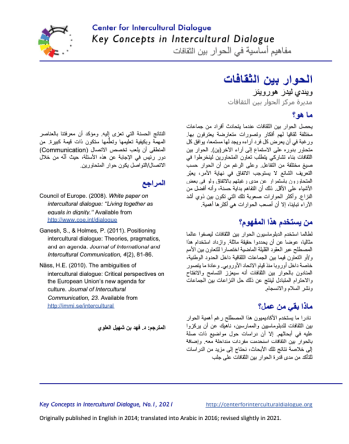
Key Concept #1 Intercultural Dialogue Translated into Arabic

Key Concepts in ICDContinuing translations of Key Concepts in Intercultural Dialogue, today I am posting KC1: Intercultural Dialogue, which I wrote in English to start the series 2 years ago, now translated into Arabic by Fahd Alalwi, of the Prince Sattam Bin Abdulaziz University, in Saudi Arabia.

As always, all Key Concepts are available as free PDFs; just click on the thumbnail of the translation to read it. Lists of Key Concepts organized chronologically by publication date and number, alphabetically by concept, and by languages into which they have been translated, are available, as is a page of acknowledgments with the names of all authors, translators, and reviewers.

KC1 ICD_Arabic v2Leeds-Hurwitz, W. (2021). Intercultural dialogue [Arabic]. Key Concepts in Intercultural Dialogue, 1.  (F. Alalwi, Trans.). Available from: https://centerforinterculturaldialogue.org/wp-content/uploads/2021/06/kc1-icd_arabic-v2.pdf

If you are interested in translating one of the Key Concepts, please contact me for approval first because dozens are currently in process. As always, if there is a concept you think should be written up as one of the Key Concepts, whether in English or any other language, propose it. If you are new to CID, please provide a brief resume. This opportunity is open to masters students and above, on the assumption that some familiarity with academic conventions generally, and discussion of intercultural dialogue specifically, are useful.

Wendy Leeds-Hurwitz, Director
Center for Intercultural Dialogue


Creative Commons License
This work is licensed under a Creative Commons Attribution-NonCommercial-NoDerivatives 4.0 International License.
Key Concept #1: Intercultural Dialogue Translated into Turkish

Key Concepts in ICDContinuing translations of Key Concepts in Intercultural Dialogue, today I am posting KC1: Intercultural Dialogue, which I wrote in English to start the series 2 years ago, now translated into Turkish by Kenan Çetinkaya.

As always, all Key Concepts are available as free PDFs; just click on the thumbnail of the translation to read it. Lists of Key Concepts organized chronologically by publication date and number, alphabetically by concept, and by languages into which they have been translated, are available, as is a page of acknowledgments with the names of all authors, translators, and reviewers.

KC1 ICD TurkishLeeds-Hurwitz, W. (2016). Kültürlerarası diyalog. Key Concepts in Intercultural Dialogue, 1 (K. Çetinkaya, Trans.). Available from:
https://centerforinterculturaldialogue.org/wp-content/uploads/2017/09/kc1-icd-turkish.pdf

If you are interested in translating one of the Key Concepts, please contact me for approval first because dozens are currently in process. As always, if there is a concept you think should be written up as one of the Key Concepts, whether in English or any other language, propose it. If you are new to CID, please provide a brief resume. This opportunity is open to masters students and above, on the assumption that some familiarity with academic conventions generally, and discussion of intercultural dialogue specifically, are useful.

Wendy Leeds-Hurwitz, Director
Center for Intercultural Dialogue


Creative Commons License
This work is licensed under a Creative Commons Attribution-NonCommercial-NoDerivatives 4.0 International License.
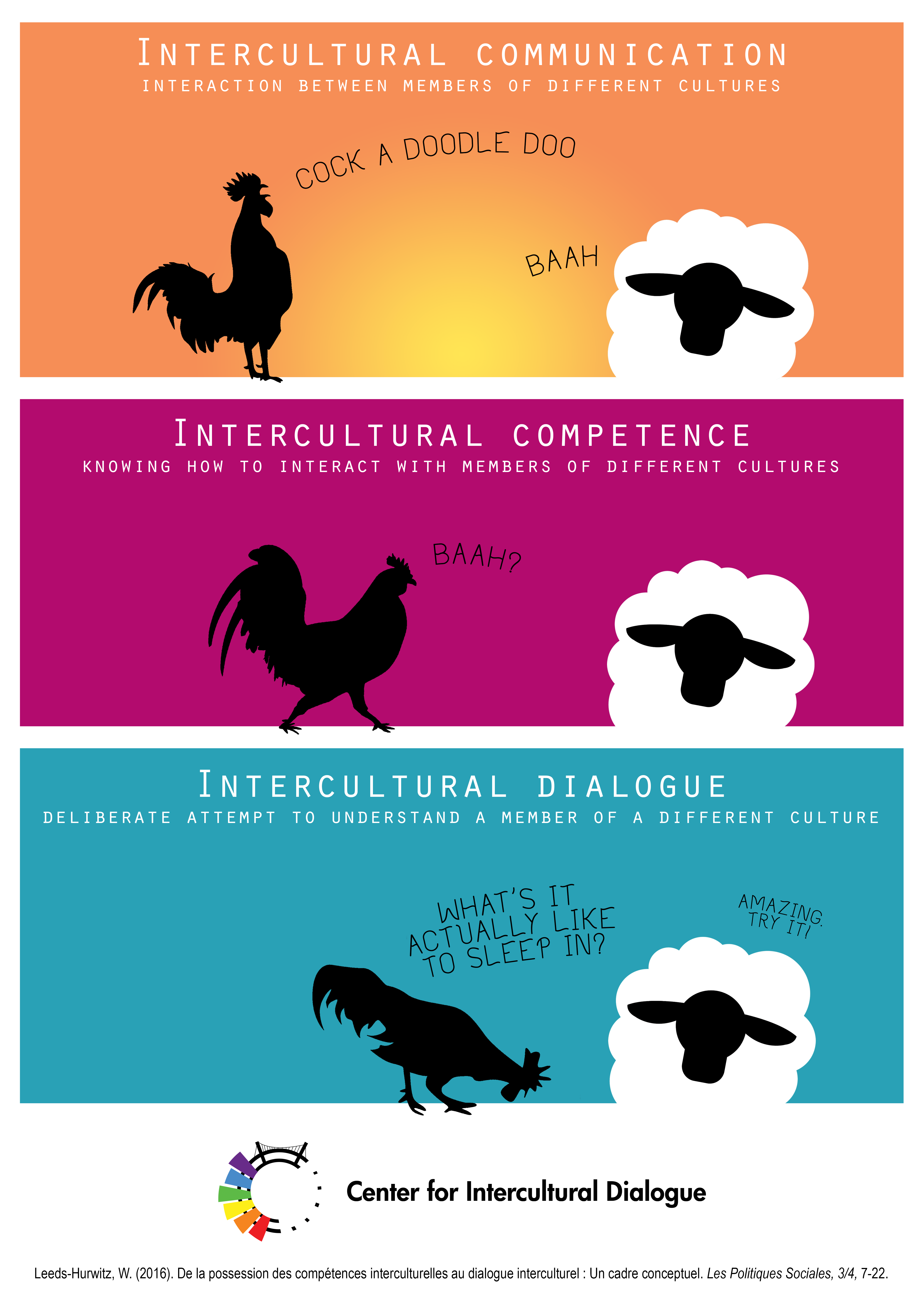
Quote of the Day: Culture, Sustainability, Intercultural Dialogue

Intercultural Dialogue QuotesOccasionally when I read, a quote related to intercultural dialogue strikes me as particularly noteworthy for being insightful, concise, beautifully written, and/or original. One example is provided below. If you have quotes you would like to see posted, submit them for consideration to intercult.dialogue@[at]gmail.com

“Participation in cultural activities fosters young people to be more imaginative and innovative: the processes of creation and cultural participation provide knowledge and techniques to imagine and expand horizons, integrate diverse elements, and create something new. Cultural experiences can be important platforms for the development of capacities that expand self-knowledge, self-expression, self-determination, and life satisfaction and well-being.”

“Educational systems at all levels should include the acquisition of cultural skills and knowledge pertaining to intercultural dialogue; the recognition and valuing of diversity, creativity, tangible and intangible heritage; and the development of skills using digital tools for cultural transmission, innovative expression, and bridging of cultures.” (p. 30)

Duxbury, N., Hosagrahar, J., & Pascual, J. (2016). Why must culture be at the heart of sustainable urban development? Barcelona, Spain: United Cities and Local Governments.

Wendy Leeds-Hurwitz, Director
Center for Intercultural Dialogue

Intercultural Dialogue Described

Several years ago I was invited to describe intercultural dialogue for an entry in the International Encyclopedia of Language and Social Interaction; the volume has now appeared. The citation is:

Leeds-Hurwitz, W. (2015). Intercultural dialogue. In K. Tracy, C. Ilie & T. Sandel (Eds.), International encyclopedia of language and social interaction (vol. 2, pp. 860-868). Boston: John Wiley & Sons. DOI: 10.1002/9781118611463/wbielsi061

Excerpts:
“Intercultural dialogue (ICD) stands at the nexus of language and social interaction (LSI) and intercultural communication (ICC). Unlike other forms of interaction, ICD assumes participants come from different cultural (ethnic, linguistic, religious) contexts, implying that they will have divergent assumptions about, and rules for, interaction. ICD has been used as a technical term having several quite different meanings. First, ICD may refer to any interaction in which participants have different cultural backgrounds. Encompassing virtually all of ICC, this use may be discarded as too broad and thus not especially helpful. Second, ICD may refer to specific types of intercultural interactions, those in which dialogue serves as a specific goal. That narrower use will be taken as the focus here. Unlike other intercultural interactions, which may include nonverbal and unconscious elements, in this usage ICD typically requires both language and intent, being a deliberate verbal exchange of views. ICDs are designed to achieve understanding of cultural others as an immediate goal, taking the more advanced steps of achieving agreement and cooperation as potential later goals. Given existing cultural diversity, not only within political alliances (such as the European Union) but even within individual countries, today ICD typically is granted considerable value as a practical tool used to prevent or reduce conflict between cultural groups, instead fostering respect and tolerance.Thus it is treated as a potential technique for building or maintaining peace. . . The term ICD has been widely used since the 1980s but less often
directly studied than its significance warrants, thus, it is a concept that is not only available
but that calls out for further research. . . Like all dialogue, ICD is an active, co-constructed creation, requiring the cooperation of participants to engage in potentially new ways of interacting.”

Liubou Uladykouskaja Profile

Profiles
Liubou Uladykouskaja
is the Founder and Director General of the Institution “Intercultural Dialogue” in Minsk, Belarus.

Liubou Uladykouskaja

In spring 2015 she is also a Fulbright Scholar at the University of Florida, in Gainesville. She earned her PhD in Belarusian Studies in 1993. She is the author of 320 publications on the problems of intercultural dialogue, nation building, identity, preservation of  cultural originality, democratic transformation, globalization, and the USA, including six books: Spiritual Ideals in the Modern Belarusian Culture and Values of Globalism (2009), How to Preserve Cultural Originality (2010), Discovery of My America, Or Why do the Belarusians Need the USA? (2012), and Intercultural Dialogue: American Paradigm (2014).

She established the Center for Intercultural Dialogue (2010), the Inter-Cultural Dialogue Department of the Academy of Sciences of Belarus (2011), NG Institution “Intercultural Dialogue” (2012), the Laboratory for Intercultural Communication at Belarusian State University (2013). She also has initiated and successfully implemented multiple civic society activities (organization and running of constantly working exhibitions, libraries, art galleries, clubs, ex. the Terminological Commission at the Ministry of Education, the American Club in Minsk, the Belarusian Club of Christian Intellectuals, the Discussion Club “Disputant” at the scientific magazine Higher Education) and international projects, including 190 international conferences, seminars, round tables and presentations. She has participated in joint civic and scientific projects in Poland, Great Britain, Germany, Luxembourg, France, USA, Sweden, Norway, Italy, Lithuania, Latvia, and Ukraine. She’s worked as a Chief of the Research Laboratory for Intercultural Communication (Belarusian State University), as Department Chair, Institute of Sociology, as a Director of the Center for Multicultural Education and Deputy Director, a Chief Administrative Unit for Science (Belarusian State University), as a Director of the F. Skaryna National Scientific and Educational Center, in the Ministry of Education and Science of Belarus (supervising social science and humanities curricula at universities), as a Lecturer in Belarusian Studies. Uladykouskaja also worked as a journalist, including radio and TV performances.


Work for CID:

Liubou Uladykouskaja wrote KC61: ВЫХАВАННЕ and then translated it into Belarusian and Russian.