Identity, Culture, and Communication among Italian Americans
Call for book chapter proposals on Italian American identity, for edited book.
This book aims to explore how Italian Americans communicate their identities in specific locations around the United States. While there has been some research conducted on migration patterns, sociology, and folklore of Italian Americans, there is very little documentation of their communication experience and of regional differences in those experiences. This is a unique opportunity for communication scholars to contribute to the area of intercultural communication, and to begin an interdisciplinary conversation between the two fields. We invite proposals that reveal the multiple and complex cultural constructions of Italian American identity represented in local communities. This volume will approach topics from a number of critical and theoretical perspectives.
Essays may explore, but are not limited to, the following themes:
How Italian Americans form and sustain identities through language, speech acts, rituals, cultural artifacts, media, or networks.
What Italian Americans make of their own communication practices.
The cultural contexts of Italian American communication.
Italian American interpersonal communication.
Local forms of communication in Italian American communities.
How Italian Americans construct or share cultural spaces in their communities.
Symbolic meanings in Italian American communication practices.
Italian American self-representation versus media representation.
Italian Americans communication with other ethnic groups.
Please submit proposals of 300-500 words (as word file) or inquiries to Denise Scannell, Assistant Professor, New York City College of Technology, no later than October 15, 2013.
Andreas Pöllmann (Ph.D., 2008, M.A., 2004, Department of Sociology, University of Essex, UK) is a full time researcher and lecturer in intercultural education at Paderborn University in Germany.
He is a member of the International Sociology Association (i.e., Racism, Nationalism and Ethnic Relations, Sociology of Education, and Sociology of Migration Research Committees). His works have appeared in Compare: A Journal of Comparative and International Education, Educational Studies, European Societies, and SAGE Open – focusing on feelings of national and supranational attachment, inclusive forms of national identity, intercultural education, and the notion of intercultural capital. He is currently conducting conceptual and empirical research on sociocultural inequalities in the realization of intercultural capital, with a particular interest in the (unfulfilled) potential of schooling and school management. Further regularly updated information will be available on academia.edu
I applied for one of the Center for Intercultural Dialogue‘s microgrants funded by the National Communication Association to explore the possibilities of meeting with researchers in London. Currently, I am looking at using communication methods to better implement and evaluate the roll out, implementation and uptake of HIV biomedical interventions among gay and bisexual men in the United States. Because of the disproportionate impact of HIV in the United States on certain groups, my work focuses on African American, Latino and HIV-positive gay men – all populations that experience persistent structural barriers in the healthcare system.
Matching funds The Hofstra University School of Communication supported this project with a faculty research support grant. The matching funds covered the costs of housing and food while at the host institution.
Local host The Global Forum on Men who have Sex with Men (MSM) hosted a Pre-Conference focused on gay and bisexual men at the International AIDS Conference 2012 in Washington, DC. I chaired the panel on HIV, community mobilization and immigrant MSM. On the panel, Ibidun Fakoya, Research Fellow at University College London presented her formative assessment of African gay men living with HIV in London. Ibidun Fakoya works with Dr. Fiona Burns on the advancing Migrant Access to health Services in Europe (aMASE). aMASE uses a multi-site Community Advisory Group to assess clinical and health care access for migrants in Europe with some focus on MSM and substance users. As such, aMASE is constructing a framework for effectively working with mobile and marginalized populations in assessing healthcare. In follow up conversations and through social media, a relationship emerged on common research interests. Through these conversations, the project emerged and additional meetings were made through Ibidun Fakoya and social media. In the past few years, I have developed a network of other advocates and researchers who are active on twitter and whose specialty is health disparities and the gay, lesbian, bisexual and transgender communities.
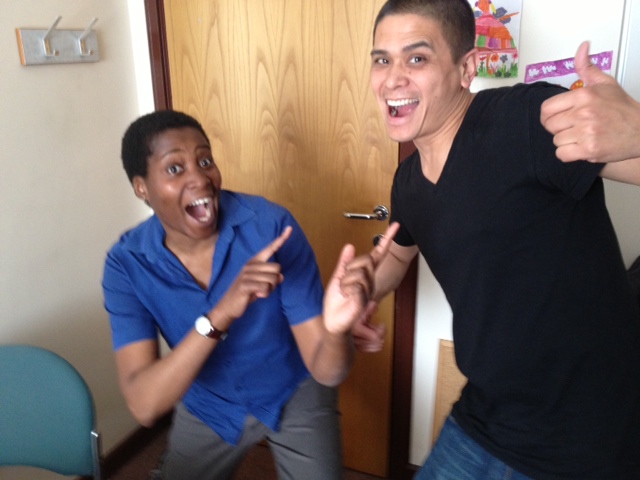
Ibidun Fakoya, Andrew Spieldenner
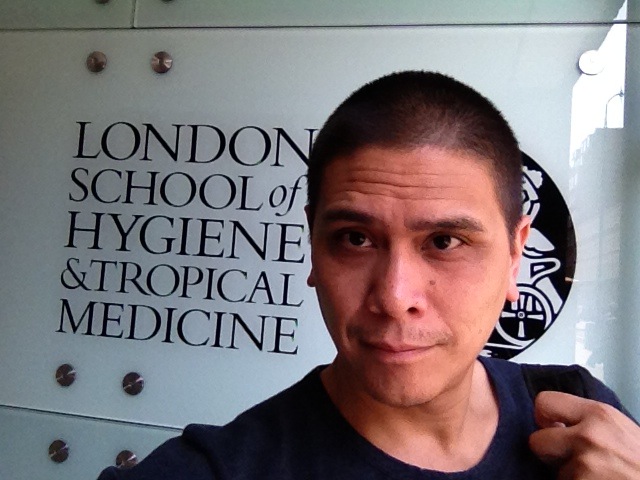
Trip itinerary My colleagues were generous with their time. I visited University College London, Birkbeck College and the London School of Hygiene and Tropical Medicine. Each meeting opened up other doors to consider – with other researchers, community groups, medical providers, and health policy institutions.
Ibidun “Ibi” Fakoya and Dr. Fiona Burns of University of College London aMASE project were my primary hosts. Ibi and I met with the Community Mobilization Coordinator to discuss the Community Advisory Group and the implementation of the research survey in multiple countries in clinic and community settings. We brainstormed on possible community partners to achieve the target survey populations in the United Kingdom (UK), Germany, Spain and Italy. I was able to review the processes that aMASE has implemented to get a shared research tool and protocols across all partner sites. In addition, Ibi and I reviewed social marketing and health messaging in order to develop marketing materials. Ibi was instrumental in coordinating with the other researchers for my trip.
At the University College London, I met with Professor Graham Hart on HIV and gay men in the London and New York City, focusing on the vastly different healthcare systems in the two countries. Professor Hart is Dean of the School, and he has extensively researched HIV and gay men. Professor Hart was interested in how the differing healthcare systems and social attitudes about health impact the treatment and service environment for gay men of varied racial/ethnic and socioeconomic backgrounds. He gave several referrals to visit community groups and health policy institutions.
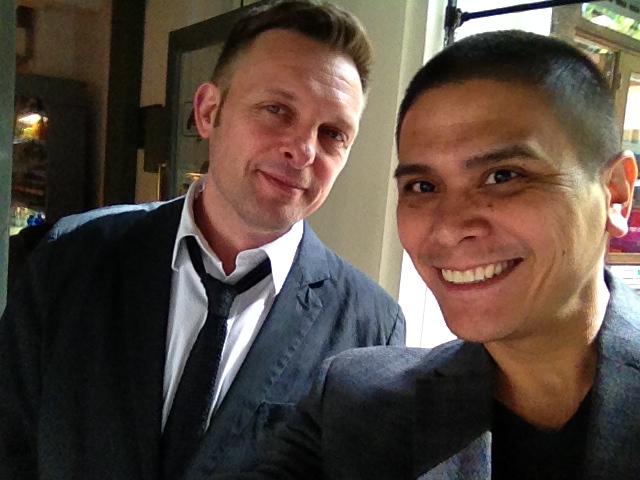
Professor Matthew Weait of Birkbeck College is an expert on HIV criminalization laws. We discussed the ways that HIV criminalization laws operate in various countries, and how cultural views frame the laws. We also examined the concurrent passage of gay marriage legislation in Maryland alongside an enhancement of the state’s HIV criminalization law. We discussed the importance of translating research and policy into accessible language in order to mobilize community members.
Matt Weait, Andrew Spieldenner
Dr. Catherine Dodds and Dr. Ford Hickson of the Sigma Research Group are currently housed at the London School of Hygiene and Tropical Medicine. The Sigma Research Group has been on the forefront of research in the UK on gay men and HIV. They have conducted surveys at gay prides in the UK for over a decade, and have implemented several Community-Based Participatory Research (CBPR) projects alongside community partners. We had an intense discussion about harm reduction in HIV, the limits to current public health discourse on gay men and HIV, methods of conducting CBPR projects (including the use of Skype), and how communication – as a field – can be used in public health research.
Further activities There are several future activities possible in the future. Many of these involve future correspondence and research support. We acknowledged that there were several meetings about HIV and our respective fields that may be of interest to the others. Dr. Hickson, Dr. Dodds and Professor Weait committed to ongoing communication about projects and possible next dates for meetings when we happened to be in the same event (such as the International AIDS Conference 2014).
Ibidun Fakoya and I sketched out two different research projects to advance, and we are looking to collaborate over the next two years on these projects.
Finally, I plan to return to Europe summer of 2014 on another project, where I will be renewing my relationships with these researchers.
[NOTE: Andrew Spieldenner’s original project proposal is available here.]
HOW DO I KNOW IF IT’S WORKPLACE BULLYING? CULTURE MATTERS
Project Description
The National Communication Association micro grant provided through the Center for Intercultural Dialogue allowed me to begin a very productive conversation and collaboration with renowned European workplace bullying researcher, Dr. Denise Salin (Hanken School of Economics, Finland). I first connect Dr. Salin after reading her extensive research on workplace bullying and the organization from the European perspective. Dr. Salin and I, along with our project partner, Dr. Suzy Fox (Professor, Loyola University, Chicago) are in the planning stage of a large multi-national research study on conceptions of workplace bullying. Our conversations allowed me to better understand workplace bullying from a European perspective and helped shed light on pertinent issues when investigating bullying from a culture perspective. In order to begin this effort, I needed to raise research funds to allow attendance at the planning meeting in Helsinki, Finland.
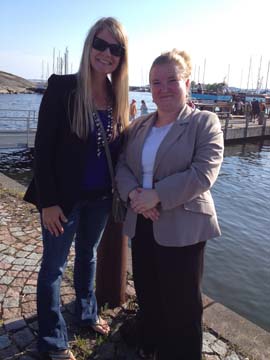
Renee Cowan, Denise Salin
Raising Funds for the Trip To fund this international collaboration trip, I estimated I would need $2,400 for airfare and hotel arrangements. I was granted $900 from the National Communication Association through the Center for Intercultural Dialogue and $1200 in a Faculty Research Grant from the University of Texas at San Antonio. This covered the majority of costs associated with the trip and I personally supplemented the remaining sum. Our meeting was highly successful and because of the trip we are advancing through Phase 1 of the project.
The Project During our meeting we discussed and finalized a three-phase international workplace bullying project. From a U.S. human resources perspective, workplace bullying (WB) is defined as “Actions and practices that a ‘reasonable person’ would find abusive, occur repeatedly or persistently, harm or are intended to harm the target, and result in economic, psychological, or physical harm to the target and/or create a hostile work environment” (Fox, Cowan & Lykkebak, 2012, p. 10). While WB is a universal phenomenon, there are institutional, legal, organizational, and cultural factors that necessitate different approaches to bullying in different parts of the world. We determined our guiding research question: based on the assumption that the violation of national, gendered, or other cultural norms will be perceived as rude, crude, or bullying behavior, to what extent will national differences in cultural values and communication norms be associated with differences in behaviors perceived to constitute workplace bullying?
The Center for Intercultural Dialogue grant allowed me to meet with Drs. Salin and Fox to discuss and refine our three-phase intercultural bullying research project. We held this meeting during the week of June 1-8, 2013. During this week-long meeting we were able to discuss important logistics of our international project including securing grants, our project schedule, securing country partners, and specifics of data collection. The meeting was very productive and we are now able to move forward with data collection for Phase 1 in Summer 2013. We hope to complete the full project by Fall 2015. We have secured collaboration from country partners in Argentina, Poland, Bahrain, Turkey, India, Australia, Austria, China, Greece, Mexico, the Caribbean, Puerto Rico and we have collaborators who have expressed interest in the United Kingdom and Israel. What follows are more details on the project:
Phase 1. In this phase we have determined the participating countries and collaborators, gained commitment and alignment of the team members, developed the collaboration protocols and project guidelines, and began creating the interview and survey measures. The two main clusters of materials will be common measures of cultural characteristics and communication norms, an initial set of bullying items based on popular Workplace Bullying measures and semi-structured interview protocols. Focus groups in the U.S. and Finland will be conducted. We have largely completed Phase one and plan to conduct most focus groups by the end of Summer 2013.
Phase 2. Focus group, interview and survey materials will be translated and back-translated, supplemented by culture-specific questions contributed by our country researchers. Each collaborator will conduct interviews with a minimum of 15 respondents, and will include Human Resource professionals, managers who have handled bullying incidents, and union leaders or other employee representatives.
The focus groups and interviews will seek to uncover underlying cultural assumptions, values, norms, and perceptions that contribute to judgments of workplace bullying behaviors. For each culture, we will work with the collaborators to develop a comprehensive and specific set of behaviors that employees in that culture would consider to be workplace bullying. This will be the starting point for the next phase, the survey.
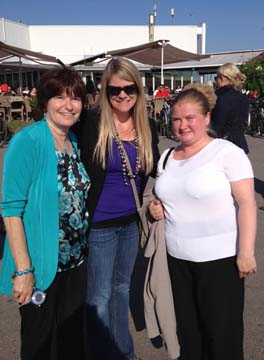
Suzy Fox, Renee Cowan, Denise Salin
The project will produce strong intellectual significance by attending to the question: To what extent are national differences in cultural values, communication norms and gender roles associated with differences in a) behaviors perceived to constitute workplace bullying, b) how individuals and organizations respond to perceived workplace bullying, and c) preferences for organizational and public policies, including specific roles assigned to HR professionals in efforts to counter workplace bullying?
This research will result in several direct outputs that will be beneficial for both U.S.-based and global HR departments: 1) specific guidelines for what should be effective practice in addressing WB from a training standpoint, 2) specific guidelines for anti-bullying policy for global and U.S.-based organizations, 3) guidelines for identifying and addressing WB in both local and multicultural contexts, 4) dispute resolution guidelines and procedures and 5) suggestions for incorporating anti-bullying considerations into organizations’ formal performance management and disciplinary systems. The project’s potential broader impacts are to offer guidance to Human Resource Professionals (HRPs) and managers in defining, recognizing and responding to workplace bullying complaints and situations, and to help multinational corporations develop guidelines that enable people from diverse national backgrounds to work together.
REFERENCE
Fox, S., Cowan, R. & Lykkebak, K. (2012). Revision of the workplace bullying-checklist: workplace bullying policy survey for HR professionals. Proceedings, Academy of Business Research, New Orleans, March 15, 2012.
[NOTE: Renee Cowan’s original project proposal is available here.]
On June 17, 2013, I was one of three co-authors of a paper entitled “Robert E. Park’s contribution to the history of intercultural communication” for the New Histories of Communication Study Preconference, at the International Communication Association convention in London. My co-authors were Filipa Subtil and José Luis Garcia, who I met last year while in Portugal. Dave Park, Peter Simonson and Philip Lodge did a great job of organizing the preconference. A group photo of 60 of the 80 participants is available here.
And after the preconference came the conference proper. ICA has really worked on becoming a more truly international organization (it’s now up to about 45% international members). As a result, this conference was the perfect ending for the last six months of travel because I connected again with other scholars I had last met in the countries where they live and work: China (Jiang Fei and Kuo Huang), Saila Poutiainen (Finland), John Wilson (Northern Ireland), Saskia Witteborn and Ling Chen (Hong Kong), Todd Sandel (Macau), Tamar Katriel, Esther Schely-Newman and Ifat Maoz (Israel), Cindy Gallois and Jeff Pittam (Australia). And Casey Lum, who I last met in Hong Kong, though he lives in the US. Of course, I also met a variety of friends and colleagues, both international and from the US (Richard Buttny, Theresa Castor, Don Ellis, Larry Gross, Beth Haslett, Evelyn Ho, Klaus Krippendorff, Dave Park, Jeff Pooley, Jeff Robinson, Karen Tracy and Bob Craig, Steve Wilson, Cynthia Stohl, Bill Eadie, Natasha Shrikant, François Cooren (Canada), Akiba Cohen (Israel), Olga Ivanovna Matyash (Russia), among many others – sorry not to be able to name everyone!), as well as several directly connected with this Center or the Council that is its parent organization (Linda Steiner, Brenda Berkelaar, Michael Haley). And I was glad to discover new international colleagues (Sheila Lodge, UK; Marion Wrenn, now at Princeton, but shortly to be in Abu Dhabi; John Laprise, Qatar; Zrinjka Peruško, Croatia; Boguslawa Dobek-Ostrowska, Poland; Raul Fuentes Navarro, Mexico; Peter Putnis, Australia, among others). As a result, some new researcher profiles and guest posts will be appearing on this site over the next month or so. Some of the conversations were about the possibilities permitted by social media and new publishing choices, so stay tuned for additions to this site as a result.
Wendy Leeds-Hurwitz, Director
Center for Intercultural Dialogue
A general call is being circulated – feel free to respond directly, as described below.
“We would like to hear from you – what role should culture play in EU external relations?
In 2012 a consortium consisting of eight members, led by the Goethe Institute, Brussels, was tasked by the European Commission to carry out the preparatory action ’Culture in EU external relations” launched by the European Commission and approved by the European Parliament.
The purpose of the action is to facilitate an on-going process of research, exchange of knowledge and support policy reflection in strengthening the role of culture in external relations.
In particular, the preparatory action will contribute to formulating recommendations for a strategy on culture in EU’s external relations on basis of the comprehensive mapping exercise and consultation process involving 54 countries worldwide. Watch and hear Professor of Cultural Policy Studies Yudhishthir Raj Isar, team leader, shortly explaining the aim and purpose of the Preparatory Action.
The Preparatory Action is running until mid-2014 along with the online discussion. To sum up the process, we converge the results into a final conference in April 2014 where future recommendations for policy makers are made and the strategic approach towards mobilising action on culture in external relations is presented.
It is our goal to raise awareness of the project and make the debate on Culture in EU external relations as strong as possible by involving wider public, civil society, culture institutions, artists, public bodies and individuals who have knowledge to add and comments to share. So, please tell us what do you think?
Please visit our website/blog and join the discussion, or post a video, picture or comment #CultExtRel on Facebook, Twitter or LinkedIn. And subscribe to our Newsletter to be on top on the latest research in the field – and add your perspective and knowledge to it.
We are looking forward to passing on your recommendations to the policy makers, the European Parliament and interested parties.”
The Department of Communications and New Media at the National University of Singapore (NUS) has posted ads and seeks to hire for three positions, one at the Assistant Professor level and two at the Associate Professor level. For application info, please visit this website.
1) A tenure track Assistant Professor in Health Communication for July 2014. Candidates must have a Ph.D. in Communication or a closely related field. ABDs are encouraged to apply, but a Ph.D. degree is required by date of appointment. The successful candidate should demonstrate a clear promise of research excellence in health communication. We are interested in candidates who explore health communication using participatory and culture-centered methodologies or approaches. The successful candidate will teach a range of courses in Health Communication and Communication Management/Public Relations, and work closely with the Center for Culture-Centered Approach to Research and Evaluation (CARE) at NUS. CARE is a global hub for health communication research that uses participatory and culture-centered methodologies to develop community-driven health communication solutions. Application deadline for this position is: September 30, 2013.
2. Associate Professor in Health Communication and/or Communication Management. Candidates must have a Ph.D. in Communication or a closely related field, and demonstrated excellence in teaching and research. We are interested in scholars who approach communication through new and emergent media perspectives and value diverse research methods. The successful candidate will be expected to teach a range of courses in health communication and communication management/public relations, and play active roles in developing the Department’s graduate program and mentoring graduate students.
3. Associate Professor in Media Studies/New Media. The successful candidate should have a Ph.D. in Communication or a closely related field, who has demonstrated excellence in teaching and research. We seek a colleague to conduct teaching and research in one or more of the following specializations in New Media: (a) Freedom of Speech, Regulation, and Control, and (b) Public Discourse and Public Participation. We are interested in scholars with a record of research or a research interest in Asian contexts.
Application deadline for positions two and three: August 31, 2013.
I am currently preparing an entry on intercultural dialogue for the International Encyclopedia of Language and Social Interaction. This is a general call for anyone who has published on the topic to send me an email (intercult.dialogue@gmail.com) with a citation you propose for potential mention in the entry. It needs to be a specific discussion of intercultural dialogue, not of intercultural communication more generally. And it needs to be about language and/or interaction, not media, not even social media, given the publication context.
If you want to know what I have already read and am currently considering for inclusion in the discussion, see the list of publications on intercultural dialogue posted to this site (although this includes far more sources than can be mentioned). As a thank you for the time you take in sending in suggestions, I will add all relevant citations received to this publications list, so that others may learn about them.
Thanks!
Wendy Leeds-Hurwitz, Director
Center for Intercultural Dialogue
Soliya is an entrepreneurial non-profit organization with offices in New York and Cairo dedicated to improving relations between Western & predominantly Muslim societies by combining best practices from conflict resolution and cross-cultural education with innovative application of new communication and media technologies.
Since its founding in 2002, Soliya has developed a groundbreaking online cross-cultural education program, the Connect Program, that has been integrated into curriculum at over 80 universities in 25 countries across the Middle East, North Africa, Asia, Europe & North America. In 2009, Soliya launched a new initiative called The Network, where young adults use the latest in media and communication technologies to expose people in the general public to alternative perspectives and enable them to interact in a constructive, respectful way about the issues currently dividing Western & predominantly Muslim societies. Thousands of young adults from extraordinarily diverse backgrounds have engaged in intensive facilitated dialogue and/or received extensive online training in facilitation or media production through Soliya’s programs resulting in a vibrant and active global volunteer community.
Exchange 2.0 is the primary way we are doing that, based on the belief that, in the 21st Century, it should become the norm for students to have a profound cross-cultural experience as part of their education, whether it is in person or online. We have established an Exchange 2.0 Coalition with key partners to collaboratively make that vision a reality.
The Connect Program is our flagship program that demonstrates the potential of Exchange 2.0. It is an online cross-cultural education program that has been implemented in over 100 universities in 27 countries across the Middle East, North Africa, South Asia, Europe and North America since 2003.
To provide ongoing engagement opportunities to alumni from these programs and to ensure we have dependable pool of high-quality facilitators for them, we also offer Advanced Training programs.
Finally, Civil Media, is the term we use to describe a new strategic model we are developing, which empowers the emerging community of young adults from our programs to amplify voices from civil society that are not commonly heard and catalyze constructive and respectful discourse across divisions about important socio-political issues.
Special issue connexions • international professional communication journal
December 2014
Today, information and communication technologies (ICTs) allow individuals located in different nations to collaborate almost as easily as if they were located in the same physical office. As a result, globally distributed virtual teams now support the work of organizations across the spectrum of products and services. Such teams are used by a range of for-profit and non-profit organizations including businesses, government organizations, the military, and educational institutions. These organizations are increasingly employing individuals located in different nations to engage in various types of collaborative work via ICTs.
As a result of such factors, much of the modern workforce is now migrating toward a virtual model of work, and forces associated with globalization are changing the nature of competitiveness in the new economy. Individuals, in turn, must often adapt rapidly to virtual environments and do so with little or no formal preparation in the types of professional communication practices essential to success in such contexts. As a result, individuals working in internationally distributed teams must generally learn from their mistakes, an effective but often costly approach. Moreover, individuals must also often adapt to working in an environment in which they are regularly paired with new colleagues and clients from different nations, cultures, and language groups.
Thus, the modern distributed workplace requires employees to account for and address three central factors—technology, culture, and language—in order to succeed in most work-related tasks.
An all-important question arising from this situation is, “How can we better prepare these individuals for this international, online context?”
A 2012 IEEE Transactions on Professional Communication special issue on global training reveals, however, that very little information on training—particularly global virtual communication training—has been published in the major professional communication journals in the last ten years. Such a gap needs to be closed if educators and trainers alike wish to prepare adult learners to be successful participants in current (and future) business practices and processes.
This special issue on education and training for globally distributed virtual teams seeks to address this topic through articles on how best to prepare individuals to succeed in this new workplace.
In particular, the editors are interested in articles that answer questions such as:
*What types of education and training are most desired by managers and participants of global virtual teams?
*How can organizations best prepare virtual team members for working across boundaries of language? What issues affect translation and terminology? What do team members most need to know about World Englishes, English as a Second Language, or English for Specific Purposes?
*How can organizations better prepare employees to collaborate and cooperate online and across cultural boundaries?
*How can social media be used to prepare individuals for working in intercultural online contexts?
*What legal issues can affect or should be included in global virtual team training? What should participants in global virtual teams know about proprietary information and privacy?
In addition, the editors of this special issue welcome articles such as:
*Critical analyses of the many published task/technology models that support global virtual teams.
*Critical analyses of virtual team studies in areas such as technical training, adult education, human resources development, educational technology, human performance technology, technical communication, and user experience design.
The guest editors are also interested in discussing other prospective topics with potential contributors.
Types of articles connexions publishes four types of articles:
*Original research articles of 5,000 to 7,000 words in length
*Review articles of 3,000 to 5,000 words in length
*Focused commentary and industry perspectives articles of 500 to 3,000 words in length
*Teaching cases of 3,000 to 5,000 words in length
Submission Guidelines Interested individuals should send a 150-200 word proposal to connexionsspecialissue@gmail.com Proposals should be sent as a .docx, .doc, or .rtf file attached to an email message with the subject line:
“Proposal for Special Issue on Globally Distributed Virtual Teams.”
All proposals should include the submitter’s name, affiliation, and email address as well as a working title for the proposed article.
Production Schedule The schedule for the special issue is as follows:
15 Jan. 2014 –Proposals due
15 Feb. 2014 – Decisions on proposals sent to proposal submitters
15 June 2014 – Manuscripts due
15 Aug. 2014 – Reviewer comments to authors
15 Oct. 2014 – Final manuscripts due to editors
Dec. 2014 – Publication of special issue
Contact Information Completed proposals or questions about either proposal topics or this special issue should be sent to Pam Estes Brewer and Kirk St. Amant at connexionsspecialissue AT gmail.com




 Center for Intercultural Dialogue