CID and Social Media

About CIDIn addition to the Facebook group page developed several years ago, the Center for Intercultural Dialogue now has a social media presence that includes LinkedIn, Twitter, Pinterest, YouTube, and Google+.

social media logos

Nearly all of this activity is due to the efforts of Minh Cao, Assistant to the Director.  Minh also learned the required format to post on Wikipedia – an entry on CID is currently under review and will be described in a post once it is public. [UPDATE: CID is now on Wikipedia as well!]

Several colleagues have asked why a broad social media presence is valuable (and whether it is worth the considerable time it takes). The short answer is that social media permit CID to meet interculturalists on whatever platform they choose to spend their time. A further question might be: are so many people really using social media today? The answer to that comes from the Pew Internet and American Life Project which just posted their Social Media Update for 2013. They conclude:

Some 73% of online adults now use a social networking site of some kind. Facebook is the dominant social networking platform in the number of users, but a striking number of users are now diversifying onto other platforms. Some 42% of online adults now use multiple social networking sites.

Substantial thanks are due to Minh for making the CID accessible across multiple platforms in 2013. The goal for 2014 will be to determine what content best fits each of these contexts, and to expand the impact of the CID as a result.

Wendy Leeds-Hurwitz, Director
Center for Intercultural Dialogue

Miike reflection on international/cultural communication

Guest PostsOn Inheriting the Fields of International and Intercultural Communication: A Personal Reflection*
Guest post by Yoshitaka Miike

To inherit is to receive as legacy, place adequate value on and make a part of one’s life. But to be a custodian of a great legacy is to guard, preserve, expand and promote it. It is to honor it by building on and expanding it and, in turn, leaving it as an enriched legacy for future generations.

– Maulana Karenga (1996, p. 551)

The International and Intercultural Communication Division (IICD) of the National Communication Association (NCA) was founded as a commission in 1971 and later formed as a division in 1984. I am thus the 42nd incoming chair of this flourishing division. When I think about the history of the IICD and its critical role in advocating diversity and advancing internationalization within the NCA, I feel the heavy weight of the gavel that Dr. S. Lily Mendoza at Oakland University passed to me in Washington, D.C. With an eye on the 100th Anniversary of the NCA next year, I would like to offer a personal year-end reflection on how we may inherit the fields of international and intercultural communication. More specifically, I wish to suggest that we (1) “create a community of a larger memory” of our fields (to borrow Dr. Ronald Takaki’s [1998] words), (2) clarify our theoretical ideas  and practical issues without sacrificing their complexities, and (3) generate knowledge that bridges differences especially from non-U.S. and non-elite perspectives.

*Source: Miike, Y. (2013, December). On inheriting the fields of international and intercultural communication: A personal reflection. National Communication Association’s International and Intercultural Communication Division Newsletter, pp. 4-7.

Download the entire post as a PDF.

CID has Pinterest Account

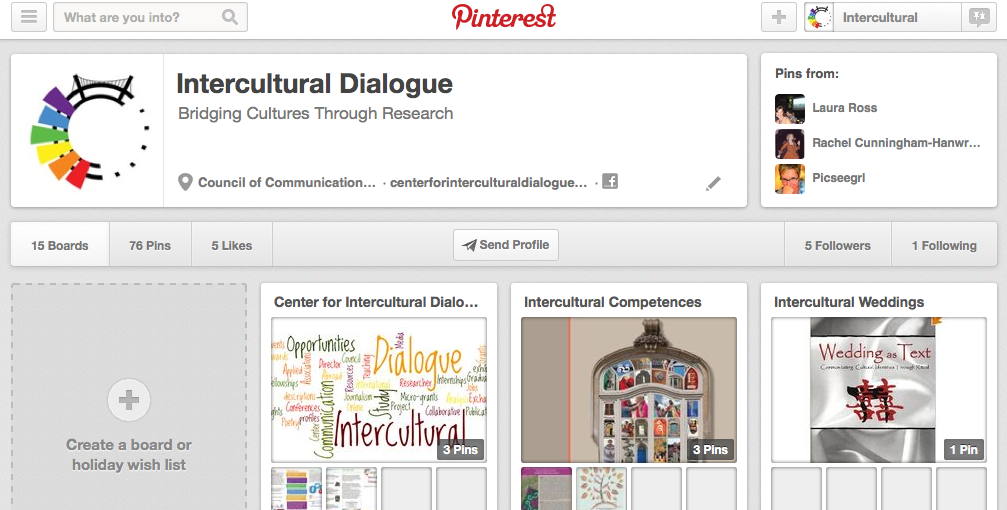
About CIDPinterest-CIDThe Center for Intercultural Dialogue recently started a Pinterest account, thanks to the efforts of Minh Cao, Assistant to the Director.

For those who prefer to access information through visual rather than verbal content, this will be a place to go to see images related to intercultural dialogue that have originally been posted to this website, or on other similar sites (such as UNESCO, UNAOC or ACIDI). Current content includes photographs, images from our publications, and word clouds used on the site. It’s also a good way to see what websites we’ve been surfing.

Language culture & mind conference Lublin 2014

Sixth International Conference on *Language, Culture and Mind*
June 24-26, 2014 Lublin, Poland

Contact: info@lcm6.umcs.lublin.pl

Deadline for *abstract submission* of individual papers and posters: *Jan 20, 2014*

The Sixth International Conference on Language, Culture and Mind (LCM VI) will be held on *24-26 June 2014* at the Maria Curie-Sklodowska University in Lublin, Poland. It will be preceded by a *Young Researchers Workshop* on 23 June 2014 (same venue), where young researchers will present their ongoing dissertation projects and other work.

The goals of LCM conferences are to contribute to situating the study of language in a contemporary interdisciplinary dialogue (involving philosophy, linguistics, psychology, anthropology, semiotics and related fields), and to promote a better integration of cognitive and cultural perspectives in empirical and theoretical studies of language.

Confirmed plenary speakers:
Nancy Budwig (Clark University, Psychology)
Henryk Kardela (Maria Curie-Sklodowska University, Linguistics)
Alan Rumsey (Australian National University, School of Culture, History & Language)
Farzad Sharifian (Monash University, Language and Society Centre)
Beata Stawarska (University of Oregon, Philosophy)

The theme for LCM VI is: *Inside/Out: Practice and Representation*
While some focus on the representational nature of language and mind, others regard them as socially embedded and embodied practices. We encourage submissions that further investigate the dynamic between practice and representation and critically examine stereotypical or mainstream conceptions of representations as internal and practices as external.

We invite abstract submissions for oral presentations, posters and symposia. (Please clearly indicate your chosen format with your submission.)

Submission guidelines and formats:
• Oral presentations
Title, name, affiliation, 400 word abstract
20 min presentation + 10 minute discussion

• Posters
Title, name, affiliation, 100 word abstract
1 minute oral presentation in the main lecture hall, preceding the poster session

• Symposia (submissions closed)
Symposium title, name and affiliation of symposium convener, an
introduction of up to 400 words explaining the theme, all symposium
abstracts, in suitable order. 90-minute symposia of 3 papers, allowing time for discussion. Up to two 90-minute symposia may be merged for proposals with 5-6 participants. Papers in each symposium should be thematically linked.

Symposium proposers should indicate whether, if a symposium is not accepted as a whole, they wish the individual abstracts to be considered as individual presentations (oral or poster)

Deadline for abstract submission of symposia: Nov 30, 2013 (closed). Deadline for abstract submission of individual papers and posters: *Jan 20, 2014. Abstracts should be submitted as .rtf, .odt or .doc attachments using EasyChair. In order to submit an abstract you have to use your existing EasyChair account or register using the link above. Detailed instructions can be found on the Language Culture and Mind VI conference website.

Important dates:
• Deadline for abstract submission (symposia): 30 Nov 2013 (*closed*)
• Deadline for abstract submission (papers, posters): *20 Jan 2014*
• Notification of acceptance (symposia): 15 Jan 2014
• Notification of acceptance (papers, posters): *28 Feb 2014*
• Last date for early registration: 30 Mar 2014
• Last date for participant registration: 1 May 2014
• Final program publication: 31 May 2014

****Young Researchers Workshop****
The LCM VI Young Researchers Workshop is a satellite event of the LCM VI conference, aimed at graduate students and junior scholars conducting theoretical or empirical research in language and communication including, but not limited to cognitive, social, affective, embodied and/or cultural perspectives. The workshop aims at providing a forum for presenting results and foster interaction and debate in the context of interdisciplinary collaboration.

Young researchers in anthropology, biology, linguistics, philosophy, psychology, semiotics, semantics, discourse analysis, cognitive and neuroscience are invited to share, and thereby enrich, their study of human natural language and communication. A specialist’s comment on each accepted
contribution makes the workshop a unique opportunity to receive expert feedback.

Contact: Roberto Bottini

Abstract specifications:
1 page, 400 words, single-spaced, font size 12 pt, Times New Roman, 2.5 cm margins on all sides. Diagrams must fit in the page.
Heading should include:
– Title of the paper
– Author(s) name
– Author(s) affiliation
– E-mail address of principal author

Abstracts for the Young Researchers Workshop presentations should be submitted as .rtf, .pdf or .doc attachments using EasyChair. A special track for YRW has been created within LCM6 EasyChair account.

Recommended UNESCO Documents for Interculturalists

UNESCO sees intercultural dialogue as a central topic, and publishes frequently on related issues. In addition to the Intercultural Competences booklet that I worked on last year, which has had hundreds and hundreds of downloads from this site alone, several other publications may be of interest to intercultural scholars.

A Common Framework for the Ethics of the 21st Century

A New Cultural Policy Agenda for Development and Mutual Understanding

Asian-Arab Philosophical Dialogues on Globalization, Democracy and Human Rights

Cultural Diversity and Transversal Values: East-West Dialogue on Spiritual and Secular Dynamics

Exploring Synergies between Faith Values and Education for Sustainable Development

What UNESCO for the Future? Forum of Reflexion

World Social Science Report 2010: Knowledge Divides

My thanks to Yoshitaka Miike for these suggestions!

Wendy Leeds-Hurwitz, Director
Center for Intercultural Dialogue

Save

Public Dialogue and Deliberation

A message from Rebecca Townsend, on behalf of a group of scholars named below:

“We welcome members of the National Communication Association (NCA) to consider supporting the creation of a Public Dialogue and Deliberation Division. Should you support , please attach your name to this petition. A full rationale for this proposed division is available, but a brief version follows.

The discipline of communication is poised to become more than a de facto leader in scholarship on dialogue and deliberation. Creating the NCA Public Dialogue and Deliberation division would significantly advance that effort and not only bring together communication scholars but also attract others toward our discipline. We identify three principal reasons for forming the division.

(1) Many dialogue and deliberation scholars who belong to NCA produce innovative work that spans the different sub-fields within our discipline but doesn’t fit well in any single division. A new division would welcome all such scholarship and better feature the best scholarship on dialogue and deliberation in the conference program, jointly sponsoring panels with other divisions as appropriate.

(2) The lack of a division substantially reduces the opportunity for cross-pollination and collaboration among the diverse scholars who study dialogue and deliberation. Within this new division, those with a more pedagogical focus and those engaged in community interventions, in particular, may find more opportunities to meet and interact with those doing humanistic and social scientific research.

(3) Many of those who study dialogue and deliberation seek a qualitatively different style of conference session. The conventional presentation of papers, with a respondent and brief Q&A, rarely permits dialogic exchange or deliberative analysis, but the new division would offer the freedom to explore alternative ways of meeting together.

Thank you for your consideration and possible support!”

Rebecca M. Townsend, Manchester Community College, on behalf of proposal drafting committee, including:

Laura Black, Ohio University
Martín Carcasson, Colorado State University
John Gastil, Penn State University
William Keith, University of Wisconsin-Milwaukee
Windy Lawrence, University of Houston
Leah Sprain, University of Colorado Boulder
Tim Steffensmeier, Kansas State University

CFP ABC Asia-Pacific conference 2014

The 13th ABC Asia-Pacific Conference: Dao of Business Communication
March 27 – 29, 2014
Shanghai, China

ABC logo

The 13th Asia-Pacific Conference of the Association for Business Communication will be held on March 28-30, 2014, in Shanghai, China. ABC Asia-Pacific 2014 aims to provide a high-level international forum as well as a workshop for researchers, teachers, students, and industry practitioners to present and discuss recent advances in the applications of traditional thoughts in modern business communication.

Abstract Deadline:
Please submit a 300-500 word abstract (APA style, Times New Roman 12 point font and double spaced) as an email attachment no later than January 1st, 2014. Authors of accepted abstracts will be notified by February 1, 2014, and will then be invited to submit a full paper ranging from 5000 to 12000 words by March 1st. All submissions will be carefully reviewed. High quality articles will be selected for publication.

In an increasingly globalizing world, international business has developed more and more without national borders and human communication assumes in more complex and technology-oriented ways. The conference hopes to focus on the diversity and complexity of communication in international business across national boundaries.

Conference Chair: Guanglin Wang

CID has a LinkedIn Group

About CIDThe Center for Intercultural Dialogue recently started a LinkedIn group, thanks to the efforts of Minh Cao, Assistant to the Director.

CID LinkedIn group

The purpose of this group is to permit conversations among those who share interests in intercultural dialogue. It is open to conversations among members not only on intercultural dialogue as a narrow focus, but also on a broad range of topics related to international or intercultural communication, dialogue, or international collaborative research more generally. This website is not a convenient place to hold conversations, so the LinkedIn group is designed to fill that gap.

Examples of appropriate topics:
* Asking for help in locating resources on a subject
* Asking for contacts in a particular country
* Questioning how others respond to particular intercultural problems
* Asking opinions about a topic of general interest
* Posting an academic job, so long as it has to do with intercultural or dialogue topics, or if it is outside the US (if it meets the latter requirements but is non-academic, it may still be fine; if you post it and we don’t think it fits, we’ll delete it) – but post jobs under the job tab or they will be moved there

CFP ABC discourse conference Italy 2014

ABC International Symposium on the Ins and Outs of Professional Discourse Research
March 6 – 7, 2014; Modena, Italy

ABC logo

Conference scope
Researching professional discourse is an exciting multi-faceted enterprise, from gaining access and collecting data  to feeding these results back in the form of recommendations to practitioners. This two-day symposium invites contributions which explore these two extreme ends of the scholarly process , investigating written, oral, non-verbal and digital communication in professional settings as both input and output or: the “ins and outs” of business discourse research.

Day  One –  6 March: THE INS (Dipartimento di Studi Linguistici e Culturali – Modena) focuses on issues of access and data collection: how can we convince practitioners to let us observe, record, interview, survey etc? And what counts as data? How much do we need ? In what shape and form? And how does our research interfere with what we study?

Day Two  – 7 March: THE OUTS (Dipartimento di Comunicazione ed Economia – Reggio Emilia) looks at how results can be fed back to the field in the form of recommendations: how can business discourse research be applied to help shape practice? How do we translate our methods and concepts for the communities that we investigate, including industry, government and non – profit organizations?

The symposium offers an all-plenary format, with ample time for discussion. On both days we welcome data- and case-based, empirical talks, presenting best practices, self-reflections or meta-analyses, drawing on a wide range of qualitative, quantitative and critical perspectives on  professional and business discourse, from ethnography, corpus studies and sociolinguistics to interaction analysis, genre studies and document design.

The symposium language is English.

Symposium contact:: abceuropesymposium AT unimore.it or glenmichael.alessi AT unimore.it

Registration
ABC Members and students: 75 Euros (Late registration: 100 Euros)
Non-members: 100 Euros (Late registration: 150 Euros)

CFP Case Studies Diverse Organizational Settings

Call for Case Study Chapters

“Cases in Organizational and Managerial Communication: Stretching Boundaries” (Routledge, 2016)

Edited by:
Jeremy P. Fyke, Marquette University
Jeralyn Faris, Purdue University
Patrice M. Buzzanell, Purdue University

About the Edited Volume:
Given the interest in engaged scholarship and more flexible and virtual forms within communication, and organizational communication in particular, cases in this volume will cross over different areas within our field and related disciplines. We encourage contributors to cover topics and populations that have been largely underresearched in organizational communication literature (e.g., Twitter, transnational organizations, faith-based organizations, blogging, cybervetting, women in the informal work sector in India), but that play an important role
in today’s global economy. Thus, contributions might delve into organizing structures, relationships, and visions for global not-for-profits, hybrid, creative industry, and entrepreneurial organizations. Cases can be more “positive” in orientation to display exemplars of organizations that have qualities to emulate. However, cases might also display “destructive” elements and processes (e.g., dysfunctional leadership, workplace bullying). Furthermore, the chapters in this volume could reflect an awareness of the necessity of intercultural communication competencies, emphasizing communication in multicultural contexts (e.g., China, India, Africa, Turkey). Overall, regardless of topic, we encourage submissions that explore intercultural/cross-cultural communication issues.

Possible Case Study Topics:
Identity(ies)/Identifications * Technology/Technological Processes * Cybervetting * Diversity/Difference * Engaged Scholarship * Social Change * Leadership * Global Labor Force/Labor Trends * Professionalism/Careerism * Volunteerism * Popular Culture * Career Lifecycles/Meanings of Work * Constructive/Destructive Processes * Social Networks

Submission Details:
To contribute, send a 1 page (~300 word) proposal that highlights the case study topic area by January 31, 2014. Potential authors will then be contacted by the end of February. The deadline for full case submissions is May 1, 2014.

Final cases should be between 2,500-3,000 words (10-12 double spaced pages total) and should be accompanied by discussion questions for students and suggested further readings. Additionally, contributors will be asked to provide a 150-word case synopsis that can be used for in-class exercises.

Jeremy Fyke, Ph.D.
Assistant Professor
Communication Studies & Strategic Communication Diederich College of Communication, Marquette University