Bergamo (Italy) visit 2014

WLH_ManganoOn May 26, 2014, I was able to re-connect with Maria Flora Mangano, one of the participants in the NCA Summer Conference on Intercultural Dialogue, held in Istanbul, in 2009. We have kept in touch, as she has kept in touch with others from that event, but this is the first time we have had the opportunity to meet in person again. It took a bit of travel (I was coming in from Lugano, Switzerland, and she was coming from her home near Rome), but the conversation was worth the effort. Her work will be familiar to regular visitors to this website, as described in her post on A lesson dedicated to the genocide in Burundi: An occasion of dialogue as a space of relationship among cultures.” A chapter of hers is included in Case Studies in Intercultural Dialogue, currently in press with Kendall Hunt, and one of the results of the Istanbul conference.

Although Maria Flora already holds a PhD and has been teaching for many years now, she is currently pursuing further studies at the University of Bergamo, which is why we met there. Much of the University is located in the old city, Bergamo Alta, dating to Roman times, and many of the faculty are housed in historic buildings. This part of the city  is especially impressive, from the funicular ride up the hill on which it rests, to the grand views once you arrive. Many of Maria Flora’s classes are held in a former monastery in the lower city, with a stunning courtyard, also impressive.

Wendy Leeds-Hurwitz, Director
Center for Intercultural Dialogue

Communication in Emerging Democracies – Grants

Call for Proposals
Grants from the Dale Leathers Fund to Promote Communication Studies in Emerging Democracies
National Communication Association

NCA seeks proposals for activities that promote scholarship and teaching of Communication Studies to benefit emerging democracies and their peoples. Such activities may include (but are not limited to) the following:
*International travel for residents of emerging democracies to attend conferences or advanced training in Communication Studies
*International travel for U.S. residents to disseminate Communication scholarship or to conduct training in Communication Studies in emerging democracies
*Procuring and disseminating scholarly and instructional materials in Communication Studies for use by institutions within emerging democracies
*Research about various topics in communication conducted by residents of emerging democracies who would otherwise lack adequate support for such research
*Research about communication phenomena in emerging democracies, which may be conducted by U.S. scholars or by others, and which promises to directly or indirectly promote effective communication practices

General Procedures for Proposals
Proposals should not exceed 10 pages and shall include the following information:
(1)      a rationale for considering the target nation an emerging democracy;
(2)      a clear statement of methods or listing of activities, depending on the nature of the proposal;
(3)      a clear statement of expected outcomes and their relationship to the purpose of the grant;
(4)      a clear statement of the intended use of monies provided by the grant;
(5)      an abbreviated, 3 page CV of applicant or principal investigator.

Deadline to submit proposal is October 1, 2014.

Visit www.natcom.org/LeathersFund for application materials and additional information.

CFP Africa, Media, Globalization special issue

Call for Abstracts – Communication, Culture & Critique
Deadline: August 15, 2014
Special issue on Africa, Media and Globalization
Guest editor: H. Leslie Steeves, University of Oregon, USA
Consulting editors: Herman Wasserman, University of Cape Town, South Africa; Audrey Gadzekpo, University of Ghana, Ghana; John Hanson, Indiana University, USA

Globalization is not new to Africa, as histories of global conquest and colonial/postcolonial intervention have shaped the continent in recent centuries: the exploits of European explorers, traders and missionaries leading to the so-called ‘scramble for Africa’ and the division of the continent at the Berlin conference of 1884-85; post-independence alignments during the Cold War; and post-Cold War colonization via ideological and political economic processes and structures. However, to the extent that globalization is a process of neoliberal integration of economies and cultures, sub-Saharan Africa has lagged behind other regions of the world and the overwhelming majority of Africans have not benefited from the spread of the global economy. Scholars today argue that Africa’s continued marginalization and exploitation are sustained by new hegemonic powers in Asia that benefit from Africa’s resources. China’s emergence as an economic superpower and its enormous and escalating investment in Africa must be included in analyses of Africa and globalization, as Africa’s global integration is no longer determined predominantly by Western interests. In her popular TED talk Nigerian novelist Chimamanda Adichie speaks eloquently of Africa’s ‘single story’ of victimization, a narrative that contributes to Africa’s enduring erasure in Western media via homogenization, denial of agency, and economic dependence. At the same time, an overarching ‘single story’ discourse overshadows the production and distribution of media content by and for Africans. Further, the historic global movements of African peoples and cultures suggests many untold and under-told stories of globalization, stories unfolding at a rapid pace with growing technology and internet access. The spread of technology raises many questions, such as: in what ways do technologies impose alien values on African communities and/or extend indigenous values?

This special issue of CCC on Africa seeks diverse studies that critically address and illuminate 21st century stories about media and globalization relevant to Africa at multiple levels of observation and analysis. CCC is primarily a qualitative journal of the International Communication Association that publishes critical and interpretive research in media, communication, and cultural studies. Articles may focus primarily on phenomena relevant to one country, group or region, or may be comparative (one example might be the media’s contemporary role in evangelism and homosexuality legislation). Articles may address any aspect of media and globalization, including discourses, practices and structures of: journalism; popular culture (film, television, music, celebrity philanthropy, tourism promotion, beauty pageants, etc.); information and communication technologies (ICTs); foreign aid; and/or infrastructure investment, particularly in telecommunications.

Theoretical and methodological approaches may vary consistent with the guidelines of the journal as long as they contribute to our knowledge and conceptual understanding of media and globalization and relate directly to Africa.

Authors should email an abstract (500 words) to Leslie Steeves by August 15, 2014. The editor and consulting editors will review all submissions and successful authors will be invited to submit a full manuscript. Abstracts and manuscripts must be in English. Authors of selected abstracts will be notified of acceptance by October 15, 2014. Full papers will be subject to anonymous peer review, and full papers are due by February 15, 2015.

Leonarda Garcia-Jimenez Profile

Profiles

Leonarda Garcia-Jimenez, Ph.D. in Communication, is Associate Professor at the University of Murcia (Spain) and Affiliate Faculty at Colorado State University (USA).

Leonarda García-Jiménez

Throughout her career, she has also taught and researched in other US, Swiss, Mexican, Colombian and Spanish universities. Dr. García-Jiménez has published more than forty works in communication theory, media culture and intercultural communication. Her H Index in Google Scholar Citations is 10. She loves spending time by the Mediterranean Sea. .

Garcia-Jimenez has done more than forty works (articles, books, chapters, as well as conference papers) on her specialist field of study: communication theory, culture and media. Her works have been published in Communication Monographs, European Journal of Communication, Estudios del Mensaje Periodistico, ZER, Razon y Palabra, Catalan Journal of Communication and Cultural Studies among others. Her book about communication theory published in one of the most important publishing companies of Latin America and Spain (Tecnos, 2007) sold out the first edition (1500 books). She has participated in some of the most important conferences in communication (WAPOR, ICA, NCA, IAMCR, ECREA, Bienal de Comunicacion, IBERCOM, ISA, etc.).

Her most recent publications focus on communication as a constitutive phenomenon that transforms the world. This approach has been developed in  epistemological and practical (cross cultural comparison) ways like “Some Foundational Conceptions of Communication: Revising and Expanding the Traditions of Thought” (Empedocles: European Journal for the Philosophy of Communication, 2012) or “The Pragmatic Metamodel of Communication: A Cultural Approach to Interaction” (Studies in Communication Sciences, 2014). She is also developing with her research group from Universitat Pompeu Fabra (Barcelona) the analysis of discourses about interculturality (intercultural interaction) in television news as a way of promoting a more dialogical/conciliatory world.

Leonarda thinks that education in the understanding of communication (in epistemological, interpersonal, media or socio-cultural ways) would promote a better and more peaceful world.

Key Concept #16: Migration by Saskia Witteborn

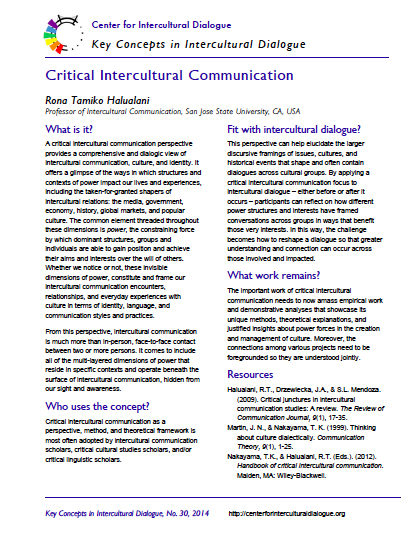
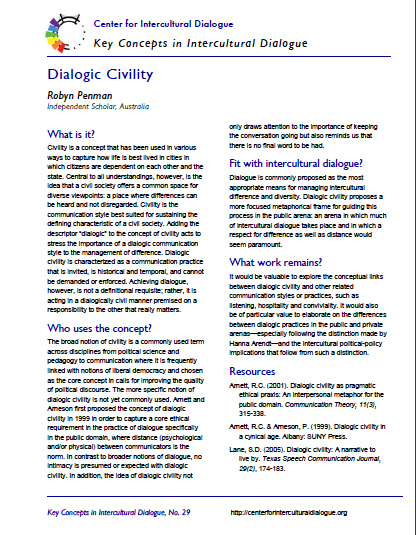
Key Concepts in ICDThe next issue of Key Concepts in intercultural Dialogue is now available. This is KC16: Migration by Saskia Witteborn. As always, all Key Concepts are available as free PDFs; just click on the thumbnail to download.Lists organized  chronologically by publication date and numberalphabetically by concept in English, and by languages into which they have been translated, are available, as is a page of acknowledgments with the names of all authors, translators, and reviewers.

KC16 Migration


Witteborn, S. (2014). Migration. Key Concepts in Intercultural Dialogue, 16. Available from:
https://centerforinterculturaldialogue.org/wp-content/uploads/2014/05/key-concept-migration.pdf

The Center for Intercultural Dialogue publishes a series of short briefs describing Key Concepts in intercultural Dialogue. Different people, working in different countries and disciplines, use different vocabulary to describe their interests, yet these terms overlap. Our goal is to provide some of the assumptions and history attached to each concept for those unfamiliar with it. As there are other concepts you would like to see included, send an email to the series editor, Wendy Leeds-Hurwitz. If there are concepts you would like to prepare, provide a brief explanation of why you think the concept is central to the study of intercultural dialogue, and why you are the obvious person to write up that concept.


Creative Commons License
This work is licensed under a Creative Commons Attribution-NonCommercial-NoDerivatives 4.0 International License.

Federica Setti Profile

Profiles

Federica Setti holds a PhD in Anthropology and Education at the University of Turin.

Federica Setti


As part of her PhD she has carried out an ethnographic study of education and relationships between Roma and non-Roma among a Sinti family network and in a middle school attended by their teenager children in Trento. She was visiting scholar at the University of Edinburgh, based at STEP (Scottish Traveller Education Programme). She carried out ethnographic research among a Dassikané Roma family network and in a primary school attended by their children in Turin as part of her MA in Cultural Anthropology and Ethnology.

Her research interests include Romani studies; Cultural and Medical Anthropology; Migration studies and Anthropology of Death. She carried out ethnographic research into Moroccan peoples’ migration experiences between Italy and Morocco and an ethnography of mourning processes, related to relatives of patients attended by a palliative care centre in Trento, for her BA degree in Cultural Anthropology and Ethnology. The latter is published in the The Italian Journal of Palliative Care under the title “Processes of Mourning: Ethnography and Life histories in Trentino.” She also concentrated on the history of relationships between majority societies and minorities, particularly through an archival research on the special classes ‘Lacio Drom’ activated in Italy only for those called ‘Gypsies’, with an exonym, published in the article “‘You, Gadže, see school in one way. We, Sinti, see it in another way’: An ethnography of education and school pathways of Sinti and non-Sinti in Trento,” in Trentino’s Archive Journal.

The monograph about her PhD research, titled “In A Matter of Perspectives: Ethnography of Education and of Relationships between Roma and non-Roma” is in publication, in Italian, with the publisher CISU (Rome). Furthermore, the journal articles she wrote related to her PhD ethnography are forthcoming, including “The implications of ‘naming’ on Roma and Sinti right to education and social inclusion: an ethnography of education among a Sinti family network,” prepared for the Special Issue “On the education of Roma, Travelers and ‘occupational nomads’. Research findings and questions that interrogate researchers and educators,” to be published in Intercultural Education Journal.

She was Teaching Fellow, Lecturer and Exam committee member in Anthropology of Education, Intercultural Education and Educational Processes in Multicultural Societies (chair: Professor Francesca Gobbo) at the University of Turin, for four years. She is in the Teachers of Italian as Foreign language’s Province of Trento’s register and taught for three years Italian as foreign language to migrant and Roma students in middle schools. She is a member of the European Academic Network on Romani Studies, the Gypsy Lore Society and the URBA-ROM Network. She is also co-founder and member of wom.an.ed – women’s studies in anthropology and/of education. She is reachable via email.

University of Turin 2014

WLH_GobboFrom May 14-17, 2014, I stopped in Turin, Italy to meet Professor Francesca Gobbo, recently retired from the University of Turin. In addition to talking about common interests in intercultural dialogue and classroom ethnography, I was able to connect with a number of her doctoral students. In fact, one of them, Federica Setti had just been awarded her PhD, and was gracious enough to include me and my husband in her celebration party (thanks again, Federica!). Another, Paola Giorgis, was in the process of preparing a post-doctoral fellowship application to EURIAS, and I was able to provide some advice, having served as one of their reviewers in the past. Rebecca Sansoé and Giorgia Peano were also in attendance that evening. Prof. Gobbo was particularly generous with her time, and we were able to fit in quite a bit of sightseeing around Turin during my visit, including their famous Egyptian museum.

Over the next few weeks, I will be posting researcher profiles as Prof. Gobbo and her doctoral students have time to send me information.

Wendy Leeds-Hurwitz, Director
Center for Intercultural Dialogue

African American expatriate survey

Collaboration request from Alyssa Hislop:

Research participants wanted! If you are African-American and have lived more than one year of your adult life either working, studying or living abroad, you can contribute to better comprehension of the life of the African American Expatriate and possible implications for racial identity by completing this online survey. The survey can take anywhere from 30 minutes to 1 hour. If there are any questions you may contact Alyssa Hislop, Principal Investigator.

Alyssa Hislop is a Master’s student at Andrews University in Michigan whose research paper is on African American Expatriates and how their racial identity may be affected while living abroad. She is asking that the CID help locate appropriate people to complete her survey.

PLURAL+ Youth Video Festival

Call for Video Entries
PLURAL+ Youth Video Festival on Migration, Diversity and Social Inclusion

The United Nations Alliance of Civilizations ( UNAOC) and International Organization for Migration ( IOM) invite youth to submit original and creative videos focusing on Migration, Diversity and Social inclusion by 27 June 2014 for consideration in the 2014 PLURAL+ Youth Video Festival.

Recognizing youth as powerful agents of social change in a world often characterized by intolerance, and cultural and religious divisions, PLURAL+ invites youth to address key challenges and opportunities related to social inclusion and cohesion, migrant integration, respect for identity, diversity, and human rights, both at local and global levels. Young people up to 25 years old are invited to submit short videos of five minutes maximum in length.

PLURAL+ supports young people’s expression of their opinions by providing them with a variety of media platforms and distribution networks, including broadcasts, video festivals, conferences and events around the world. PLURAL+ not only provides young people with an effective platform to express themselves on key migration and diversity issues, but also reinforces the firm belief of IOM and UNAOC that youth are powerful and creative agents of social change.

A prestigious international jury will select three winners in each age category (9-12, 13-17, 18-25). International Jury winners will be invited to New York, all travel expenses paid, to present their work at the PLURAL + 2014 Awards Ceremony at the Paley Center for Media in December 2014.

PLURAL+ partner organizations will also award other prizes and professional opportunities, such as winning participants presenting their work at film and video festivals, conferences and events around the world.

The PLURAL+ 2014 deadline for video submission is 27 June, 2014. Further information, including guidelines, regulations, awards, and the entry form can be downloaded here and is also available on the PLURAL+ website.

You can watch PLURAL+ 2013 award winning videos here

PLURAL+ is organized by the United Nations Alliance of Civilizations and the International Organization for Migration with the collaboration of many international partners.

Key Concepts #15: Cultural Pluralism by Robyn Penman

Key Concepts in ICDThe next issue of Key Concepts in intercultural Dialogue is now available. This is KC15: Cultural Pluralism by Robyn Penman. As always, all Key Concepts are available as free PDFs; just click on the thumbnail to download.Lists organized  chronologically by publication date and numberalphabetically by concept in English, and by languages into which they have been translated, are available, as is a page of acknowledgments with the names of all authors, translators, and reviewers.

kc15-sm

Penman, R. (2014). Cultural pluralism. Key Concepts in Intercultural Dialogue, 15. Available from:
https://centerforinterculturaldialogue.org/wp-content/uploads/2014/05/key-concept-cultural-pluralism.pdf

The Center for Intercultural Dialogue publishes a series of short briefs describing Key Concepts in intercultural Dialogue. Different people, working in different countries and disciplines, use different vocabulary to describe their interests, yet these terms overlap. Our goal is to provide some of the assumptions and history attached to each concept for those unfamiliar with it. As there are other concepts you would like to see included, send an email to the series editor, Wendy Leeds-Hurwitz. If there are concepts you would like to prepare, provide a brief explanation of why you think the concept is central to the study of intercultural dialogue, and why you are the obvious person to write up that concept.


Creative Commons License
This work is licensed under a Creative Commons Attribution-NonCommercial-NoDerivatives 4.0 International License.