Hui-Ching Chang Profile

ProfilesAs Dean of the Honors College and Professor of Communication at the University at Albany, Dr. Hui-Ching Chang sees knowledge as intimately connected with everyday practices. After completing her law degree from National Taiwan University, she pursued advanced degrees in speech communication from the University of Illinois at Urbana-Champaign.

Hui-Ching Chang

Dr. Chang has studied Chinese language patterns, specifically Taiwanese national identity as constituted through discursive practices. Her book, Clever, Creative, Modest: The Chinese Language Practice (2010), examines Chinese language behavior from three distinctive yet overlapping dimensions: the manipulative speaker, the artistic speaker, and the humble speaker. Her most recent book, Language, Politics and Identity in Taiwan: Naming China (2015), explores how Taiwanese fashion their identities in the shifting and intertwined paths of five names Taiwan used to name China: “Communist bandits”; “Chinese Communists”; “mainland”; “opposite shore”; and the “People’s Republic of China.”

Prof. Chang has received many grants and top paper awards for her research and has been an invited keynote speaker at numerous international conferences. Her publications have appeared in Journal of Language and Politics; Discourse Studies; Research on Language and Social Interaction; Journal of Language and Social Psychology; Nationalism and Ethnic Studies; and Journal of Asian Pacific Communication, among others. Very recently she was principal editor of the special issue, “Explored but not Assumed: Revisiting Commonalities in Asian Pacific Communication” (2015), in the Journal of Asian Pacific Communication.

Prof. Chang enjoys putting theories into practice: “I firmly believe that it is adventure and personal engagement that brings intercultural communication to life, an inspiring perspective I learned while on ‘Semester at Sea’.” She was a Fulbright Scholar, Ukraine (2010-2011, 2012); Chair Professor of the College of Journalism at Xiamen University, China (2009-2012); Visiting Scholar to Hong Kong Baptist University (2007) and Visiting Scholar to National Taiwan University (2003-2004).

Prior to coming to UAlbany, Prof. Chang was Associate Dean for Academic Affairs of the Honors College, the University of Illinois at Chicago, and Faculty-in-Residence, where she pioneered innovative programs like “Cutie’s Office Hours” to promote a vibrant living-learning community. She served as Director of Undergraduate Studies and Director of Graduate Studies in her department, and was also a trained mediator for UIC’s Dispute Resolution Service. For her, being an Honors College administrator requires the same curiosity and urge to learn as it does for research and teaching—it is exciting, energizing, and fulfilling.


Work for CID:

Hui-Ching Chang wrote KC41: Yuan, and translated it into Chinese (both Simplified and Traditional).

CFP Critical Thinking in Multilingual/Intercultural Education

Call for chapters
Abstracts by 15th Dec. 2014
Demystifying Critical Thinking in Multilingual and Intercultural Education

Edited by Fred Dervin (University of Helsinki, Finland) & Julie Byrd Clark (Western University, Canada)
To be published by Info Age Publishing in 2016
BOOK SERIES: Contemporary Language Education

Following a very successful volume on reflexivity in multilingual and intercultural language education (Routledge, 2014), the editors of this new volume wish to tackle the burning issue of Critical Thinking (CT). CT is often said to be a key skill of 21st century education and is very much used as a mantra by educational institutions without always defining it. The literature contains hundreds of definitions of CT but there is no consensus on a single definition. Thus ‘my CT’ does not always correspond to ‘your CT’.

One of the most basic definitions of CT could be: “The ability to interpret, analyse and evaluate ideas and arguments” (Fisher, 2011). In a study on views held by academics about CT, T. Moore (2013) found six definitional strands: CT (i) as judgment; (ii) as skepticism; (iii) as a simple originality; (iv) as sensitive readings; (v) as rationality; (vi) as an activist engagement with knowledge; and (vii) as self-reflexivity. One thing is for sure: CT involves developing certain dispositions (probing), skills (cognitive and meta-cognitive) and habits of mind (Costa & Kallick, 2009). Some scholars are interested in the reasoning process behind CT, others the outcomes. Yet again there is no agreement in global scholarship and practice about its components or simply its definition.

Recently the idea of CT has been criticized for at least two reasons. First CT can feel too negative for some, leading to equating CT with mere adversely criticizing others. According to Fisher (2011) some scholars have thus proposed to call it ‘critico-creative thinking’ to insist on its positive, imaginative aspects. Second CT has often been criticized for being too Western, to contain too many Western norms. In their 2011 article entitled Critical thinking and Chinese university students: a review of the evidence, Jing Tian and Graham David Low discuss the apparent lack of Chinese students’ CT skills. They question the usual argument that Chinese culture does not allow ‘criticality’ and show that the students’ previous learning experiences have an influence on their level of CT. CT is often used as a way of comparing educational ‘cultures’ – some have more of it than others – thus leading to unfair ethnocentric and homogenizing judgments (Holliday, 2010).

How do we then define this contested disposition, skill and habit of mind in order to make it useful? Is it possible? Can we work from definitions of CT that avoid creating hierarchies between learners and their ‘cultures’? Whose conceptions of critical thinking could we use to do so? Can we once and for all avoid falling into the trap of giving the privilege of CT to the ‘Western world’? In other words can CT be demystified?

This volume concentrates on the context of multilingual and intercultural education. Potential authors are welcome to consider the following questions:
–       What constitutes a critical thinker in multilingual and intercultural education in the 2010s? What dispositions, skills and habits of mind are needed? (Students, teachers, teacher educators and researchers)
–       How can CT contribute to renewing multilingual and intercultural education? What alternative models of CT can be used to enrich multilingual and intercultural education?
–       Can CT be taught and learnt? If so, how and in what ways and under what kinds of conditions?
–       If CT exists then what is uncritical thinking in multilingual and intercultural education?
–       Can digital technologies help to promote CT in multilingual and intercultural education?
–       The issue of assessing CT is problematic. Yet can CT be assessed summatively or formatively in multilingual and intercultural education?

Interested authors please send a 300-word abstract to the editors Fred Dervin & Julie Byrd Clark by 15th Dec. 2014. Full chapters should be ready by 1st Sept. 2015.

CFP 8th Central/Eastern European Media & Communication Conference

CEECOM2015
The Digital Media Challenge
8th Central and Eastern European Media and Communication Conference
Zagreb, 12-14 June 2015

Conference organized by the University of Zagreb in cooperation with the ECREA CEE Network and cosponsored by ICA

The transition of communication media to digital is a worldwide phenomenon. In Central and Eastern Europe the term “transition” is naturally assumed to mean democratic transition in the postsocialist period starting in 1990. For the past 25 years, many in these countries struggled to establish independent media industries with new democratic expectations and in a capitalist market environment. The focus was very much on the political and economic postsocialist transition, including in research in media and communication studies.

In this years’ CEECOM we wish to refocus on the challenges to media industries, media audiences, and media regulators posed by the digital transition in the Central and Eastern European region and beyond. Since today’s media have an increasingly global dimension that is manifesting together with the digital technology, we aim to discuss the manifestations of these global developments and their challenges in a regional setting.

The journalistic profession is having a hard time facing the challenges of the digital revolution and global economy, but also the pressures of commercial interests and the need for new competences of young journalists. As a result of that process, the trust citizens have in state institutions and mass media has been significantly declining. Some warn that the corruption of basic journalistic values – through infotainment, the imperative of speed and the use of digital technologies to raise the popularity instead of quality – has been undermining the very foundations of democracy. The citizens, paradoxically, are surrounded with media offer that has never been wider, while they have never been less involved. New possibilities for participation in the digital public sphere are being used in different ways by different people, are there patterns here that we can uncover?

While digital technology defines today’s media, the key to their understanding is beyond a technological utopia or dystopia, in the new social practices that media afford – in media production and use, in changing public communication, media organization and production, journalism practice and the role of audiences. Social media, user-generated content, crowdsourcing, rise of alternative media, networked distribution and promotion of content and participatory agenda setting characterize today’s media landscapes that comprise both the legacy and the digital media. Today’s mediatized cultures can no longer be observed outside of the media that facilitate them, but need to be investigated in their articulations of everyday lifeworlds.

In our attempt to understand the present manifestations of digital mediascapes, we might also examine how the socialist economic and political settings and normative assumptions of the role of media influence contemporary post-socialist institutional settings and the development of digital media cultures.

Some of the topics for which we invite contributions include, but are not limited to:
*Mediatized cultures – production, audiences and social practices
*Self-construction and self-expression, identity performance and experimentation
*Education, knowledge and learning, play and entertainment
*Sociality – social spaces created around and through use of communication technology, belonging – foundation of social bonds and social integration, communities they create, how they engage in politics or civic activities
*Privacy, security, control and surveillance (interveillance)
*Digital democracy – mediatized political communication, digital citizenship, participation and the digital public sphere
*Redefining the legacy journalism paradigm
*At the organizational level: the role of newsroom in digital media environment; newsroom adjustments to media convergence.
*At the professional level: changing practice of journalists; multi-platform reporting; role of social media in daily reporting, especially in stories and sources identification and interaction; new relations with audiences, participatory and collaborative journalism.
*At the media output level: pluralism and quality of content, its availability and usability and, in general, public interest
*Digital Skills for the New Approach to Journalism Education
*Development of the new digital skills and the basis for the new journalism education curricula – new forms of reporting, new genres in digital media, data analysis and storytelling
*Children in the mediatized world
*media literacy – privacy and young media consumers,
*role of family in media literacy & media use
*digital generation and media
*Media and information literacy – libraries, copyright issues and open access, education for media and information literacy, regulation for media and information literacy, media literacy and social inclusion
*The past and present of media and communication studies in CEE – comparing socialist and post-socialist disciplinary developments

The conference will work in plenary (keynote and special panels) and parallel/paper sessions. Abstracts will be double blind reviewed by members of the Scientific Committee.

Conference Participants
The conference aims to promote academic cooperation in the field of media and communication studies, broadly defined in a way to include trans-disciplinary and inter-disciplinary approaches to media and communication, within the Central and Eastern European region and beyond. While the primary focus of the conference is on sharing and discussing new research, the conference takes a multi-stakeholder approach to underline the importance of dialogue between scholars of media, political science, sociology, regulators and policy makers, international and national experts, practitioners, as well as representatives of regulatory authorities and civil society organizations.

Co-authored proposals are accepted, including those written by master students and their academic supervisors. The participants are invited to register and to submit original papers and panels. No more than two submissions by one author can be accepted (including combinations of panels and individual papers).

Participants do not need to be members of any of the sponsoring academic associations. The event is also open to participants who do not plan to submit research proposals. All accepted attendees are asked to register for the Conference.

Submission, Registration and Important Dates
Conference language: English. Individual paper proposals addressed to one of the proposed topics should mention this in the proposal (other topics on CEE issues are welcome as well). Abstracts (of max. 300 words) will be evaluated by at least two members of the Scientific Committee. Panel proposals of 300 – 500 words should include the rationale and title of proposed panel, and name & affiliation of the Chair/Moderator and up to five members of the panel, and brief abstracts (150 words) for each participant’s contribution. Abstract & panel submission site will open on November 20, and individual paper and panel proposal can be uploaded until 20 December, 23:59 CET. The reviews will be completed and notifications sent by 31 January 2015.

Please contact the conference organizers if you have any questions!
Conference registration will open on 1 February 2015. Early bird registration ends 1 April 2015.

Summary of important dates:
20 November 2014: Abstract Submission Site Opens
20 December 2014: Deadline for submissions of abstracts and panel proposals
31 January 2015: Notification of acceptance
1 February 2015: Registration & fee site opens
1 April 2015: Early bird registration ends
1 May 2015: Deadline for full papers to be delivered to Chair of the working group
12 June 2015: Opening ceremony of CEECOM 2015 conference

Conference Book
Full papers should be sent to the panel chairs by 1 May 2015. An edited collection of the most successful papers will be published with an international publisher.

Conference Fee
150 EUR conference participants
100 EUR doctoral students
Early bird: until 1 April 2015
100 EUR conference participants
75 EUR doctoral students
The fee covers lunches & coffe & refreshments breakes, and conference materials.

Conference Organizers
CONFERENCE CHAIR: Zrinjka Peruško, University of Zagreb, Croatia

SCIENTIFIC COMMITTEE (MEMBERS OF CEECOM CONSORTIUM):
Auks? Bal?ytien? (Vytautas Magnus University in Kaunas, Lithuania)
Boguslawa Dobek-Ostrowska (University of Wroclaw, Poland)
Micha? G?owacki (University of Warsaw, Poland)
Epp Lauk (University of Jyväskylä, Finland)
Zrinjka Peruško (University of Zagreb, Croatia)
Irena Reifova (Charles University in Prague, Czech Republic)
Ilija Tomani?-Trivundža (Ljubljana University, Slovenia)
Tomáš Trampota (Charles University in Prague, Czech Republic)

LOCAL ORGANIZING COMMITTEE
Mihaela Banek Zorica (University of Zagreb, Croatia)
Domagoj Bebi? (University of Zagreb, Croatia)
Antonija ?uvalo (University of Zagreb, Croatia)
Hrvoje Jakopovi? (University of Zagreb, Croatia) Iva Nenadi? (University of J.J. Strossmayer, Osijek, Croatia)
Krešimir Pavlina (University of Zagreb, Croatia)
Tena Perišin (University of Zagreb, Croatia)
Sonja Špiranec (University of Zagreb, Croatia)
Dina Vozab (University of Zagreb, Croatia)
Nada Zagrablji? Rotar (University of Zagreb, Croatia)

CONTACT/CONFERENCE SECRETARIAT:
Centre for Media and Communication Research
Faculty of Political Science
University of Zagreb
Lepuši?eva 6, 10 000 Zagreb, Croatia
www.cim.fpzg.unizg.hr
E-mail: ceecom2015@gmail.com
Website: www.ceecom.org
Facebook: http://www.facebook.com/ceecom2015
Twitter: @ceecom2015 #ceecom2015

Indian Institute of Management job ad (India)

Assistant, Associate and Full Professor at Indian Institute of Management, Ahmedabad

The Department of Communication at the Indian Institute of Management, Ahmedabad (IIM-A) seeks communication scholars for a full time faculty position (equivalent to tenure track) in the area of organizational communication. Depending on the applicant’s qualifications, he or she would be appointed as a professor, associate professor or assistant professor.

This position requires a commitment to a strong research agenda and excellence in graduate-level teaching which will enable the applicant to meet the institute’s criteria for confirmation of appointment at the appropriate time.

Applicants should have a Ph.D. degree in Communication or a closely related discipline by the start of appointment. Candidates who are close to completing their PhD (all but dissertation) and demonstrate sound record of teaching and research, may be considered for the position of assistant professor. Interested applicants are requested to send their CV and recent publications/conference papers in electronic form to: dean-facATiimahd.ernet.in

We are also happy to entertain applications for a visiting position.

We would be happy meet applicants attending the forthcoming National Communication Association Annual Convention in Chicago. Those interested may write to Prof Vaibhavi Kulkarni to schedule a meeting.

About IIM-A:
The Indian Institute of Management, Ahmedabad (IIMA) is an autonomous School of Management in India. Set up in 1961, with initial academic support from the Harvard Business School, IIM-A assumed leadership in management education in India. It has maintained this stature over the past 50 years and has broken into the top 20s in international ratings. Its flagship Post Graduate Programme (PGP) in Management was set up in 1964. IIMA also offers a highly rated one year Pos Graduate Program in Management for Executives (PGPX), a top ranked program in Agri Business Management, and a Doctoral Programme in Management. IIMA promotes high quality research, providing the best in class support to facilitate the same. Faculty are encouraged to build international collaborations. IIMA enjoys a strong connect with the industry and Government in India, offering a rich repertoire of relevant management problems and policy issues for research.

About Ahmedabad:
Ahmedabad is a lively city of more than five million, located in the Western region of India. Just an hour’s flight from Mumbai and Delhi, Ahmedabad is also well connected by air to other cities in India and abroad. It has direct rail and road connections to practically all the major cities in the country.

CFP SIETAR Europa (Spain)

SIETAR EUROPA CONGRESS 21-23 May 2015

This congress welcomes all those whose life and work puts them at the interface of cultures, from the perspectives of economy, society, and education with the aim of reshaping intercultural discourse, questioning our current cultural paradigms and exploring new thinking to help us navigate complexity in our emerging global world. Thus our congress title mirrors this need.

With an aim to re-examine our cultural dimensions, understandings and paradigms, we invite submissions that question, critique, explore and refresh our cultural paradigms and theories, share new methods and best practices. We invite those engaged in business, training and research (including independent consultants, education, organisations) shaping European public sphere (NGO’s, governmental organisations and institutions) as well as media and arts to participate and share contributions from all disciplines and fields that deal with intercultural issues.

The location, Valencia, Spain, has been chosen as a strong, visible example of the mixing of the cultural heritage and modern technology. Its exposure to the Mediterranean shores and its historical mixture represents the potential of cultural synergies.

This is an exciting opportunity for researchers, practitioners and individuals at the interface of cultures in media, the arts, government and NGO’s, particularly in the European context, to exchange ideas shaping our intercultural world.

Click on one of the links below to jump to the corresponding contents:
Topics
Presentation formats
Instructions for submission
Language

SIETAR Europa Conference covers the cutting-edge of cross-cultural management and communication. All presentation proposals from this field of knowledge are welcome, although preference will be given to contributions connected to the Congress theme and topics.

Save

Study Abroad with St. Petersburg College: Halifax (Canada) 2015

Blended delivery: Study abroad + Online: Mass Media and Popular Culture

St. Petersburg College is offering a new study abroad program in Nova Scotia, Canada next May, 2015. The courses offered will begin with the Study Abroad component in Halifax (May 15-25) and then continue online after the return to the U.S. This program will combine the study of two courses, world literature and mass media and pop culture. Some of the sites on the schedule for visits include: the Titanic Museum, the Bay of Fundy; Lunenburg; Peggy’s Cove; the CBC; the Global television network; and many other sites relevant to the exciting night life and pop culture of Nova Scotia.

To learn more about Nova Scotia, Canada click here.
*Apply early – space is limited! Application, all forms, payments, visa (if necessary), etc. must be processed and completed by the deadline of Feb 14, 2015.

Courses offered:
LIT 2120  World Literature II   Dr. Martha Campbell
MMC 2700 Mass Media and Popular Culture  Dr. Shirley Oakley

Trip details:   http://www.spcollege.edu/canada/

Summer International/Intercultural and Backpack Journalism Program

Summer International/Intercultural and Backpack Journalism Program

For the eleventh summer Gonzaga University Master’s in Communication and Leadership Program is offering its Summer International/Intercultural and Backpack Journalism Program. Open to all graduate students or graduating seniors, the program begins in Florence and then moves into the Apennine Mountain medieval city of Cagli, where students in the Cagli Project are assigned to develop multi-media storytelling projects. Time is spent in class, in the field researching and producing stories, and in the lab completing assignments and coordinating the elements of each story. This year there are five specific course modules: Intercultural Communication, Italian language and culture (these modules include Journaling), Profile Writing, Photography, and Digital Design. The program also includes a day-trip to Urbino and free weekend-travel.   Because of the setting of this program, students will have a unique opportunity to learn how to access a foreign culture and to acquire practical language skills rapidly by using an immersion technique. The ability to assimilate quickly and to hone in on another culture¹s values are indispensable tools for anyone preparing for a career in a field where globalization and intercultural communication are becoming increasingly important. At the micro level, students will learn how “to read” another culture on its own terms — thereby eliminating cultural bias.  At the macro level, students will be ready to become facilitators in the intercultural dialogue that the modern world requires.This program is open to graduating seniors and graduate students.  The Program costs include 6 graduate credits, hotels and apartments, in county transportation, some meals, technology, and closing exhibition.   The summer session is June 8June 24, 2015, with online content pre and post Italy. For more information contact Dr. John Caputo. To see the work of former students and years go to:
http://www.gonzagaincagli.com  For details of the MA and descriptions of the program along with an application go to the main webpage.

Webster University job ad: International Communication

Assistant Professor in International Communication & Media Studies at Webster University

The School of Communications at Webster University invites applications for a tenure track Assistant Professor position in International Communication and Media Studies, in our Communications & Journalism Department.  We are seeking a teacher-scholar with the experience and creativity to help us build curriculum in international and comparative communication, media, and culture.  Other areas of interest could include intercultural communication, political communication, communication and development, or other areas of the candidate’s expertise.

The successful candidate will teach in Media Communications or other programs in the Department, including advertising, public relations, or journalism, as well as advising students, and engaging in faculty service and professional development, including scholarship and creative activity.

A record of teaching success, developing track record of successful scholarship, Ph.D., and international experience are required (ABD candidates may be considered). Applicants should send: (1) a letter of interest that addresses qualifications and fit to the Department and School, (2) a curriculum vitae, and (3) contact information for three references; additional materials may be requested at a later date.  Review of applications will begin immediately and continue until the position is filled; for priority consideration, applications should be received by December 5. Interested candidates may submit electronic applications to socfacsearchATwebster.edu using the subject line “International Communication.”

The School of Communications at Webster University prepares students to excel as skilled professionals in the global field of communications.  We provide theory and practice in media courses framed within a liberal arts-based curriculum, augmented by personalized mentorship, and professional development opportunities.  Fifteen distinct majors are available at the undergraduate level and master’s degrees in five diverse fields of communications. We offer BA and MA programs on the Webster campuses in Geneva, Vienna, London, Leiden, Thailand, and Ghana, as well as in Saint Louis and online.

Webster University, founded in 1915 with its home campus in Saint Louis, Missouri, USA, is the only Tier 1, private, nonprofit university with campus locations around the world including metropolitan, military, online and corporate, as well as American-style traditional campuses in North America, Africa, Europe, and Asia.

Webster University is an Equal Opportunity/Affirmative Action educator and employer. We are committed to maintaining a culturally and academically diverse faculty of the highest caliber. We strongly encourage applications from those who identify as diverse in terms of gender, race, ethnicity and/or sexual orientation.

CFP Middle East Dialogue 2015 by PSO

The Policy Studies Organization (PSO), in cooperation with the Digest of the Middle East Studies (DOMES), announces its official call for papers for the upcoming Middle East Dialogue 2015: Glorious Past, Uncertain Future. The fifth annual conference will take place February 26, 2015 at the historic Whittemore House in Washington D.C.

The Middle East Dialogue is a gathering of policy makers, scholars, business and social leaders, with a common interest on inter-connected issues in the Middle East. The purpose of the conference is to promote a productive and continuous dialogue surrounding current policy concerns, while providing a civil space for discussion across the political and religious spectrum. Proposals are sought from individuals or groups on topics relating to education initiatives, social, economic and political reforms, nuclear proliferation, interfaith dialogue, women’s gains and challenges, peace initiatives, and potential areas of conflict. Other topics are welcomed for submission.

Proposals of one to two pages should be sent as email attachments by or before our early deadline of December 30, 2014, to PSO Executive Director, Daniel Gutierrez. Papers presented at MED15 will have the opportunity to be published in a volume of conference proceedings.

Please visit the conference website for further information regarding proposal submission, registration, and other details about the Middle East Dialogue 2015.

The Policy Studies Organization publishes 19 journals, which includes the Digest of the Middle East Studies, and 3 book series. Our mission is to encourage discussion surrounding policy issues, and promote further research and dissemination of policy scholarship.

Key Concept #40: English as a Lingua Franca by Beyza Björkman

Key Concepts in ICDThe next issue of Key Concepts in intercultural Dialogue is now available. This is KC40: English as a Lingua Franca by Beyza Björkman. As always, all Key Concepts are available as free PDFs; just click on the thumbnail to download. Lists organized  chronologically by publication date and numberalphabetically by concept in English, and by languages into which they have been translated, are available, as is a page of acknowledgments with the names of all authors, translators, and reviewers.
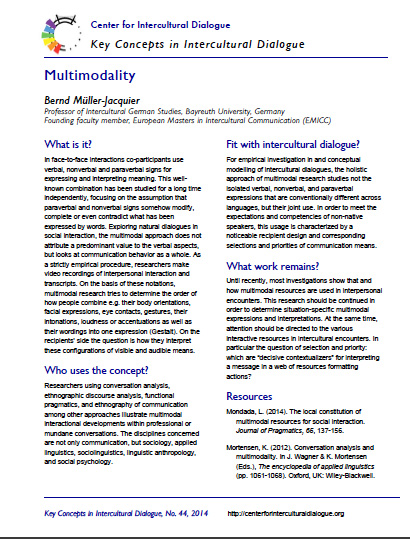
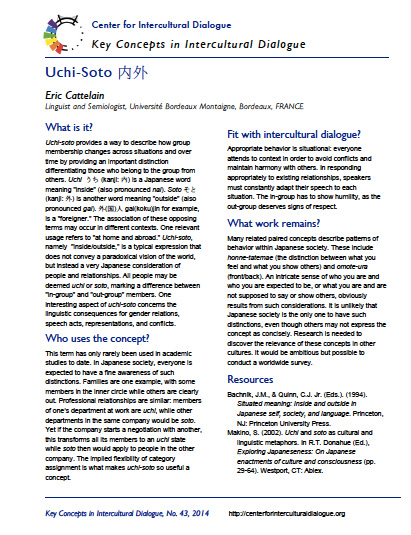
kc40-sm Björkman, B. (2014). English as a lingua franca. Key Concepts in Intercultural Dialogue, 40. Available from: https://centerforinterculturaldialogue.org/wp-content/uploads/2014/11/key-concept-elf.pdf

The Center for Intercultural Dialogue publishes a series of short briefs describing Key Concepts in Intercultural Dialogue. Different people, working in different countries and disciplines, use different vocabulary to describe their interests, yet these terms overlap. Our goal is to provide some of the assumptions and history attached to each concept for those unfamiliar with it. As there are other concepts you would like to see included, send an email to the series editor, Wendy Leeds-Hurwitz. If there are concepts you would like to prepare, provide a brief explanation of why you think the concept is central to the study of intercultural dialogue, and why you are the obvious person to write up that concept.


Creative Commons License
This work is licensed under a Creative Commons Attribution-NonCommercial-NoDerivatives 4.0 International License.
