CFP Linguistic Diversity & Asylum (Germany)

Conferences

Linguistic diversity and asylum
October 26-27, 2017

Conference at the Max Planck Institute for the Study of Religious and Ethnic Diversity, Department of Socio-Cultural Diversity, Göttingen, Germany

The exponential increase of refugees arriving in Europe
has added a new linguistic dimension to the social diversity
within European societies. The workshop engages with
how and where linguistic diversity is observable in the
asylum process and how institutions react in situations of
non-deniable and more and more complex linguistic diversity.

Amritsar: Conflict & Harmony

Guest PostsAmritsar: Conflict and Harmony
Guest Post by Linda J. de Wit

Amritsar is a medium-sized city in India serving as a tourist destination for two main reasons. First, it is the location of the holiest temple of the Sikh religion; second, it is the closest city to the Wagah border crossing with Pakistan where thousands of visitors assemble to watch the ceremonial closing of the gates every day.

The city and its surroundings have great significance in the history of Partition and the border ceremony is probably the most tangible example of the persistent tensions between the countries separated in 1947. In a remarkably aligned military drill, soldiers on both sides parade up and down, accompanied by hostile looks, aggressive hand gestures, and kicks so high they are basically standing splits. The audiences cheer every move in what almost looks like a dance-off.

When the two flags simultaneously are lowered, a single brief handshake takes place before the border gates are violently slammed shut in the neighbor’s face. The crowds applaud and shout patriotic slogans. The ceremony is a joyful event with music and dancing, having the atmosphere of a sports game. The souvenirs on the Indian side signal that the subject matter is more serious, as they boast about the “world’s largest border guarding force.” Most visitors have probably never been, and will never go, to the other side.

Back in the city, one can visit the Partition museum, the only one in the country. It recounts how the division of British India along religious lines caused millions of people to leave their homes. Amritsar’s train station saw refugees leaving in both directions, as well as packed trains arriving with no one alive, attacked because they were Muslims or Hindus.

A stone’s throw from the museum is a walled garden, Jallianwala Bagh, where a massacre took place by British forces among peaceful protesters in 1919. Gatherings had been forbidden and, without providing a warning, soldiers opened fire on the crowd for ten minutes, killing hundreds. This was one of the events that nourished the independence movement in India.

The city’s main attraction, however, is a different place, drawing more visitors than the Taj Mahal: the Golden Temple. It is the spiritual center of Sikhism because it is where the original version of the religion’s holy book lies. The Temple’s four doors symbolize that people from east, west, north and south can enter the place, irrespective of caste, creed and sex: Sikhism’s fundamental values include absolute equality and the unity of humankind.

The free information booklets distributed around the Temple describe how Sikhism holds that, in essence, all religions are an expression of the same fundamental truth. The founder of Sikhism, Guru Nanak (1469-1539), strove to bring Hindus and Muslims together: “his life and teachings were a symbol of the harmony between the two communities.”[1]

The peaceful ambience of the Temple complex is a heartening change from the city’s gloomier connotations. Tears may spring to the visitor’s eyes, due to mountains of onions being peeled by countless volunteers: every Sikh place of worship has a common kitchen distributing free meals. At the Golden Temple some 75,000 people per day share the same food, sitting together in a row on the floor.

For the moment, such harmony is, on a larger scale, still something to strive for. Last December, the Heart of Asia peace summit took place in Amritsar, but India and Pakistan did not successfully initiate a dialogue process.[2]

The significance of Amritsar in history, as in the present, remains ambiguous. The city is the backdrop of some of the most intense examples of failing intercultural and interreligious dialogue and the consequences thereof. At the same time, as the capital of Sikhism, the city is imbued with the inclusive philosophy of tolerance and unity. For all its contrasts, Amritsar ultimately is a symbol of hope of a better future.

[1] Dr. Sir Radhkrishnan, as cited in: Singh Shan, H. (2015). Sri Guru Granth Sahib. The Unique and Universal Scripture. Dharam Parchar Committee.

[2] http://www.atimes.com/inod-pak-dialogue-process-fails-launch-amritsar/

Download the entire essay as a PDF.

Save

KC3: Intercultural Competence Translated into Romanian

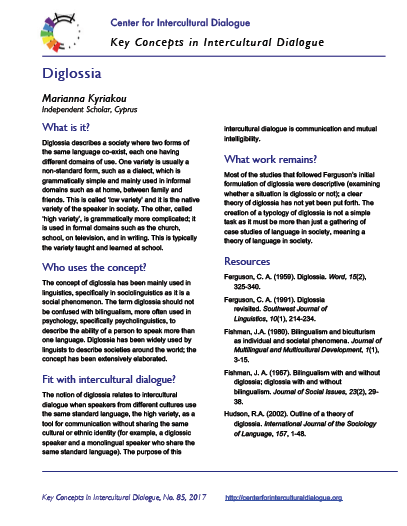
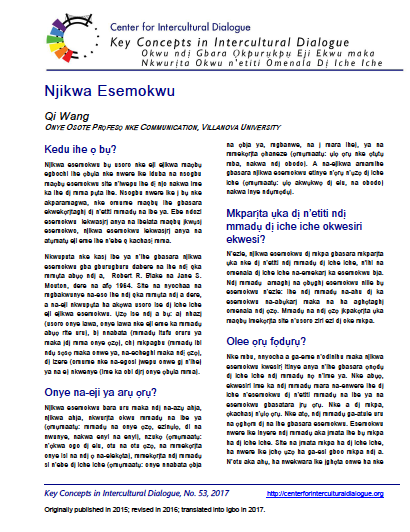
Key Concepts in ICDContinuing translations of Key Concepts in Intercultural Dialogue, today I am posting KC3: Intercultural Competence, first published in English in 2014 by Lily A. Arasaratnam which Gabriel Furmuzachi has now translated into Romanian.

As always, all Key Concepts are available as free PDFs; just click on the thumbnail to download. Lists of Key Concepts organized chronologically by publication date and number, alphabetically by concept, and by languages into which they have been translated, are available, as is a page of acknowledgments with the names of all authors, translators, and reviewers.
KC3 Intercultural Competence_RomanianArasaratnam, L. A. (2017). Competenţa Interculturală (G. Furmuzachi, Trans.). Key Concepts in Intercultural Dialogue, 3. Available from: https://centerforinterculturaldialogue.org/wp-content/uploads/2017/05/kc3-intercultural-competence_romanian.pdf

If you are interested in translating one of the Key Concepts, please contact me for approval first because dozens are currently in process. As always, if there is a concept you think should be written up as one of the Key Concepts, whether in English or any other language, propose it. If you are new to CID, please provide a brief resume. This opportunity is open to masters students and above, on the assumption that some familiarity with academic conventions generally, and discussion of intercultural dialogue specifically, are useful.

Wendy Leeds-Hurwitz, Director
Center for Intercultural Dialogue


Creative Commons License
This work is licensed under a Creative Commons Attribution-NonCommercial-NoDerivatives 4.0 International License.

Gabriel Furmuzachi Profile

ProfilesGabriel Furmuzachi has a Ph.D. in philosophy from the University of Vienna (Austria).

Gabriel Furmuzachi

His academic work deals with issues such as multiculturalism and cosmopolitanism, language learning, communication and narrative identity. His present research interests gravitate around the idea of dialogue as a means of bringing cultures closer and of cosmopolitanism (both in its guise as identity and responsibility and as moral and institutional cosmopolitanism). He also has written essays about metaphors and emotions, the accommodationist use of reason in Canadian philosophy, the relationship between reason and nature, aesthetics and more.His non-academic work consists in surveying the international fine art trade (with emphasis on Eastern European art), buying and selling nineteenth and twentieth century paintings.

He is also involved in a series of projects spread on a wide cultural spectrum including, for example, Space and Place (a non-profit group based in Vienna, Austria, focused on urbanism and social interventions aiming at promoting cultural and social diversity in the city), Liternautica (a Romanian literature portal where he is part of the editorial team, encouraging young and established Romanian writers and building bridges between literary traditions) and Revista Timpul (where he is contributing with interviews and essays on various themes).


Work for CID:

Gabriel Furmuzachi wrote a guest post, Migration, Language and Dialogue, and conducted an interview: Vienna Coffeehouse Conversations: An interview with Eugene Quinn. He also translated KC1: Intercultural Dialogue, KC3: Intercultural Competence, and KC16: Migration into Romanian.

PLURAL+ 2017 Youth Video Festival

Applied ICDDo you have something to say about the themes of diversity, migration, social inclusion, and xenophobia? Submit videos less than 5 minutes in length to the PLURAL+ 2017 Youth Video Festival. Deadline: June 4, 2017

PLURAL+ is a joint initiative of the United Nations Alliance of Civilizations (UNAOC) and the International Organization for Migration (IOM) with the support of a wide network of international partners.

View winning videos from past and present PLURAL+ Youth Video Festivals, chosen by an international jury and partners from thousands of submissions from around the globe.

Save

Key Concept #1: Intercultural Dialogue Translated into Chinese

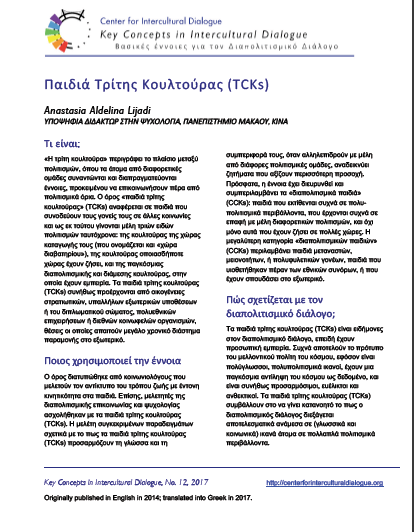
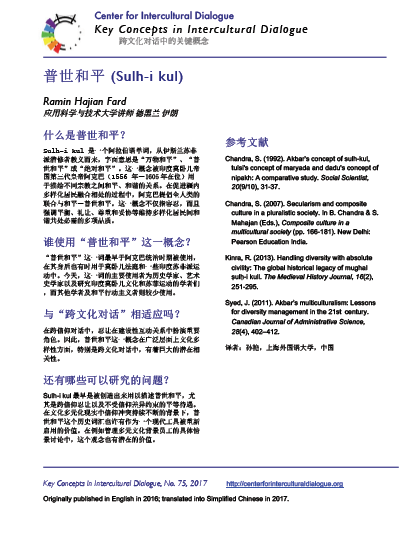
Key Concepts in ICDContinuing translations of Key Concepts in Intercultural Dialogue, today I am posting KC#1: Intercultural Dialogue, which I wrote and first published in English in 2014, and which Yan Qiu has now translated into Simplified Chinese.

As always, all Key Concepts are available as free PDFs; just click on the thumbnail to download. Lists of Key Concepts organized chronologically by publication date and number, alphabetically by concept, and by languages into which they have been translated, are available, as is a page of acknowledgments with the names of all authors, translators, and reviewers.

KC1 ICD_Chinese-simLeeds-Hurwitz, W. (2017). Intercultural dialogue [Simplified Chinese]. (Y. Qiu, Trans). Key Concepts in Intercultural Dialogue, 1. Available from: https://centerforinterculturaldialogue.org/wp-content/uploads/2017/05/kc1-icd_chinese-sim.pdf

If you are interested in translating one of the Key Concepts, please contact me for approval first because dozens are currently in process. As always, if there is a concept you think should be written up as one of the Key Concepts, whether in English or any other language, propose it. If you are new to CID, please provide a brief resume. This opportunity is open to masters students and above, on the assumption that some familiarity with academic conventions generally, and discussion of intercultural dialogue specifically, are useful.

Wendy Leeds-Hurwitz, Director
Center for Intercultural Dialogue


Creative Commons License
This work is licensed under a Creative Commons Attribution-NonCommercial-NoDerivatives 4.0 International License.

Goldsmiths Job Ad: Media & Communications (UK)

Lecturer in Media and Communications
Goldsmiths, University of London – Department of Media and Communications

The Department of Media and Communications seeks a temporary appointment to teach across our UG and MA curriculum. The appointed person will teach convene the BA Anthropology and Media, teach two modules on social theory and media rituals and deliver undergraduate learning and dissertation support.

Please note this post is fixed term from 1 September 2017 to 30 June 2018.

World Day for Cultural Diversity for Dialogue and Development

EventsSince 2002, May 21 has been chosen by the United Nations as World Day for Cultural Diversity for Dialogue and Development. As the UN page for the event points out: “Three-quarters of the world’s major conflicts have a cultural dimension. Bridging the gap between cultures is urgent and necessary for peace, stability and development.”

Here is their recommended list of Ten simple things YOU can do to celebrate the Day

  1. Visit an art exhibit or a museum dedicated to other cultures.
  2. Invite a family or people in the neighborhood from another culture or religion to share a meal with you and exchange views on life.
  3. Rent a movie or read a book from another country or religion than your own.
  4. Invite people from a different culture to share your customs.
  5. Read about the great thinkers of other cultures than yours (e.g. Confucius, Socrates, Avicenna, Ibn Khaldun, Aristotle, Ganesh, Rumi).
  6. Go next week-end to visit a place of worship different than yours and participate in the celebration.
  7. Play the “stereotypes game.” Stick a post-it on your forehead with the name of a country. Ask people to tell you stereotypes associated with people from that country. You win if you find out where you are from.
  8. Learn about traditional celebrations from other cultures; learn more about Hanukkah or Ramadan or about amazing celebrations of New Year’s Eve in Spain or Qingming festival in China.
  9. Spread your own culture around the world through our Facebook page and learn about other cultures.
  10. Explore music of a different culture.

City, University of London Job Ad: Media & Communications (UK)

Lecturer in Media and Communications (Digital Media)
City, University of London – School of Arts and Social Sciences – Department of Sociology

City, University of London is a global university committed to academic excellence with a focus on business and the professions and an enviable central London location.

City is in the UK’s top twenty (Guardian University Guide) and the world’s top four per cent (Times Higher Education World University Rankings). City attracts around 19,500 students (35% postgraduate), is well above the sector average for graduate employability in most subjects, and is eleventh in the UK for starting salaries and second in London for student satisfaction. City joined the University of London in 2016.

In the last REF, City doubled the proportion of its total academic staff producing world-leading or internationally excellent research.

The Department of Sociology is a leading centre for research and education. The REF confirmed the high quality of its research and the Department rose in the GPA rankings to equal-16th in the UK. 74% of its submitted research was graded as world-leading or internationally excellent, increasing from 45% in the 2008 RAE.

Person Specification
We are seeking to appoint an outstanding academic to a Lectureship in Media & Communications (Digital Media) to further enhance research and education in this area.

The appointed individual will demonstrate emerging strengths in research and publication and the ability to educate and supervise at undergraduate and postgraduate levels. The successful candidate will play a key role in developing a growing and dynamic research-driven Department.

Additional Information
City offers a sector-leading salary, pension scheme and benefits including a comprehensive package of staff training and development.

The role is available from autumn 2017.

Closing date: 11.59pm on 30th May 2017.

Interview date: 19th June 2017.

City, University of London is a global university committed to academic excellence with a focus on business and the professions and an enviable central London location.

City is in the UK’s top twenty (Guardian University Guide) and the world’s top four per cent (Times Higher Education World University Rankings). City attracts around 19,500 students (35% postgraduate), is well above the sector average for graduate employability in most subjects, and is eleventh in the UK for starting salaries and second in London for student satisfaction. City joined the University of London in 2016.

In the last REF, City doubled the proportion of its total academic staff producing world-leading or internationally excellent research.

The Department of Sociology is a leading centre for research and education. The REF confirmed the high quality of its research and the Department rose in the GPA rankings to equal-16th in the UK. 74% of its submitted research was graded as world-leading or internationally excellent, increasing from 45% in the 2008 RAE.

Person Specification
We are seeking to appoint an outstanding academic to a Lectureship in Media & Communications (Digital Media) to further enhance research and education in this area.

The appointed individual will demonstrate emerging strengths in research and publication and the ability to educate and supervise at undergraduate and postgraduate levels. The successful candidate will play a key role in developing a growing and dynamic research-driven Department.

Additional Information
City offers a sector-leading salary, pension scheme and benefits including a comprehensive package of staff training and development.

The role is available from autumn 2017.
Closing date: 11.59pm on 30th May 2017.
Interview date: 19th June 2017.

Linda J. de Wit Profile

CID People

Linda J. de Wit holds a BSc in Political Science, a BA in Philosophy, and an MA in Global Studies.


She is connected to CID as a graphic design consultant since 2020. In 2017 she completed an internship working on projects related to CID’s publications and visual identity.

Linda has worked in development, education, and graphic design, and enjoys photography and language learning. Having lived across four continents, though most of the time in the Middle East, she developed a broad interest in intercultural communication and dialogue.

She wrote her master’s thesis about the Egyptian community in Dubai – one of the most international places in the world – from the frameworks of transnationalism and social identity theory.

You can find her design work, photography, and articles she has written on her website LindaJW.com.


Work for CID:

Linda de Wit produced 13 of the 14 CID Posters, the poster for the 2018 video competition, the current CID brochure, CID letterhead, and prepared the layout and design for In Dialogue: CID Occasional Papers. She also designed the CID Report for the UNESCO Futures of Education initiative.

In addition, she wrote two guest posts, Andalusia’s ambivalence: Between convivencia and Islamophobia, and Amritsar: Conflict and harmony, and translated KC1: Intercultural Dialogue and KC28: Postcolonialism into Dutch.