KC77: Negotiation Translated into Simplified Chinese

Key Concepts in ICDContinuing translations of Key Concepts in Intercultural Dialogue, today I am posting KC#77: Negotiation, which Beth Fisher-Yoshida wrote for publication in English in 2015, and which Yan Sun has now translated into Simplified Chinese.

As always, all Key Concepts are available as free PDFs; just click on the thumbnail to download. Lists of Key Concepts organized chronologically by publication date and number, alphabetically by concept, and by languages into which they have been translated, are available, as is a page of acknowledgments with the names of all authors, translators, and reviewers.

KC77 Negotiation_Chinese-simFisher-Yoshida, B. (2017). Negotiation [Simplified Chinese]. (Y. Sun, trans). Key Concepts in Intercultural Dialogue, 77. Available from:
https://centerforinterculturaldialogue.org/wp-content/uploads/2017/09/kc77-negotiation_chinese-sim.pdf

If you are interested in translating one of the Key Concepts, please contact me for approval first because dozens are currently in process. As always, if there is a concept you think should be written up as one of the Key Concepts, whether in English or any other language, propose it. If you are new to CID, please provide a brief resume. This opportunity is open to masters students and above, on the assumption that some familiarity with academic conventions generally, and discussion of intercultural dialogue specifically, are useful.

Wendy Leeds-Hurwitz, Director
Center for Intercultural Dialogue


Creative Commons License
This work is licensed under a Creative Commons Attribution-NonCommercial-NoDerivatives 4.0 International License.

Lisa Hanasono Profile

ProfilesLisa Hanasono (Ph.D., Purdue University) is an associate professor in the School of Media and Communication at Bowling Green State University (BGSU).

As a researcher, she examines how people engage in communication to reduce prejudice, shatter stigma, engage in allyship, and make institutions of higher education more equitable, diverse, and inclusive. She is currently a Co-PI of a nearly million dollar National Science Foundation (NSF) ADVANCE Adaptation grant that investigates how faculty allyship, bystander intervention, and inclusive leadership can (a) remove structural barriers, (b) reduce social biases, and (c) promote the career advancement of women faculty, nonbinary faculty, and faculty of color in STEM and social behavioral sciences.

While pursuing her Ph.D. at Purdue University, she worked with a team of administrators, faculty, staff, and students to establish an Asian American Studies Program. At BGSU, she teaches undergraduate and graduate courses related to race and communication, persuasion, interpersonal communication, research methods, interviewing, and communication theory.  She has won several awards for her teaching, including the 2019 Organization for the Study of Communication, Language, and Gender’s Feminist Teacher/Mentor Award, Central States Communication Association’s Outstanding New Teacher Award, The Elliott L. Blinn Award for Faculty-Undergraduate Research, BGSU Graduate Student Senate’s Outstanding Contributor to Graduate Education Award, and the David Hoch Memorial Award for Excellence in Service.

Dr. Hanasono is strongly committed to diversity, equity, and inclusion. As a Certified Campus Workshop Facilitator and Faculty Success Program Coach for the National Center for Faculty Development and Diversity (NCFDD), she works diligently to empower faculty members with key skills, knowledge, and opportunities to advance their careers, enjoy sustainable success, and thrive in academia. She has served on the President’s Advisory Committee on Diversity and Inclusion, worked with a team of faculty members and administrators to establish an inclusive mentoring program for new faculty at BGSU, chaired the National Communication Association’s (NCA) Asian/Pacific American Caucus and Asian/Pacific American Communication Studies Division, and served as the Publications Officer of NCA’s International and Intercultural Communication Studies Division.

Select publications:

Hanasono, L. K., Matuga, J., & Yacobucci, M. M. (2019). Breaking the bamboo and glass ceilings: Challenges and opportunities for Asian and Asian American women faculty leaders. In C. C. Chao & L. Ha (Eds.), Asian women leadership: A cross-national and cross-sector comparison (pp. 28-45). London: Routledge.

Hanasono, L. K., & Yang, F. (2016). Computer-mediated coping: Exploring the quality of supportive communication in an online discussion forum for individuals who are coping with racial discrimination. Communication Quarterly, 64(4), 369-389. doi: 10.1080/01463373.2015.1103292

Chen, L., & Hanasono L. K. (2016). The effect of acculturation on Chinese international students’ usage of Facebook and Renren. Chinese Media Research, 12, 46-59.

Hanasono, L. K., Chen, L., & Wilson, S. R. (2014). Identifying communities in need: Examining the impact of acculturation on perceived discrimination, social support, and coping amongst racial minority members. Journal of International and Intercultural Communication, 7, 216-237. doi: 10.1080/17513057.2014.929201

Hanasono, L. K. (2013). Sticks and stones: Dealing with discrimination. In S. L. Faulkner (Ed.), Inside relationships: A creative case book on relational communication (pp. 225-231). Walnut Creek, CA: Left Coast Press.

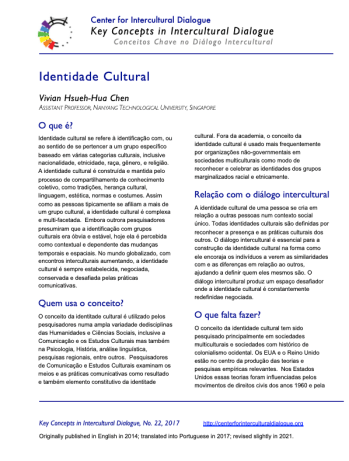
KC22: Cultural Identity Translated into Portuguese

Key Concepts in ICDContinuing translations of Key Concepts in Intercultural Dialogue, today I am posting KC#22: Cultural Identity, which Vivian Hsueh-Hua Chen wrote for publication in English in 2014, and which John R. Baldwin and Lûiz Fêrnando da Silva have now translated into Portuguese.

As always, all Key Concepts are available as free PDFs; just click on the thumbnail to download. Lists of Key Concepts organized chronologically by publication date and number, alphabetically by concept, and by languages into which they have been translated, are available, as is a page of acknowledgments with the names of all authors, translators, and reviewers.

KC22 Cultural identity_PortugueseChen, V. H-H. (2017). Identidade cultural. (J. R. Baldwin & F. Silva, trans). Key Concepts in Intercultural Dialogue, 22. Available from:
https://centerforinterculturaldialogue.org/wp-content/uploads/2021/05/kc22-cultural-identity_portuguese-v2.pdf

If you are interested in translating one of the Key Concepts, please contact me for approval first because dozens are currently in process. As always, if there is a concept you think should be written up as one of the Key Concepts, whether in English or any other language, propose it. If you are new to CID, please provide a brief resume. This opportunity is open to masters students and above, on the assumption that some familiarity with academic conventions generally, and discussion of intercultural dialogue specifically, are useful.

Wendy Leeds-Hurwitz, Director
Center for Intercultural Dialogue


Creative Commons License
This work is licensed under a Creative Commons Attribution-NonCommercial-NoDerivatives 4.0 International License.

SOAS U of London Job Ad: Engaged Humanities

Job adsAdministrator, Engaged Humanities Project, SOAS University of London – Linguistics
Closes: 7th September 2017

Part-time (18 hours per week – 0.5 FTE). This post is fixed-term until 31/12/18. The successful applicant will be required to start as soon as possible.

The role and its responsibilities

We are looking for a Project Administrator for the Engaged Humanities in Europe: Capacity building for participatory research in linguistic-cultural heritage Project (ENGHUM) within the School of Linguistics, Cultures and Languages at SOAS, University of London.

The postholder will provide administrative support, including:

  • organising meetings, workshops, etc.;
  • helping to prepare reports and deliverables;
  • financial management;
  • liaising with counterparts and team members at collaborating universities, as well as SOAS colleagues in academic and support departments.

Continue reading “SOAS U of London Job Ad: Engaged Humanities”

Carleton U Job Ad: Communication, Politics & Policy (Canada)

Job adsThe School of Journalism and Communication at Carleton University invites applications from qualified candidates for a preliminary (tenure track) appointment at the rank of Assistant Professor, to begin July 1, 2018. Deadline for the receipt of applications is Friday, October 27, 2017.

Candidates should demonstrate strong potential to become leading researchers in the area of communication, politics, and policy. Candidates may work in a variety of sub-fields, draw on a range of theoretical and methodological approaches, and focus on Canadian or global/international issues. We are particularly interested in applications from scholars whose research activity and teaching interests engages critically with one or more of the following:

  • Media technologies and election campaigns
  • Communication and public/civic engagement
  • Media, gender and politics
  • Communications policy
  • Cultural policy
  • Political rhetoric
  • Propaganda and populism
  • Political activism/advocacy
  • Digital diplomacy
  • Media and development

Continue reading “Carleton U Job Ad: Communication, Politics & Policy (Canada)”

CFP Communication in the Multilingual City (UK)

ConferencesOpen for submissions
An international conference, Communication in the multilingual cityto be held at University of Birmingham, UK, 28/29 March 2018

TLANG is delighted to invite proposals for its final two day international cross disciplinary conference focused on the theme of communication in the city. We will create conversations which transcend disciplinary boundaries, and assist in thinking creatively about communication in metropolitan settings. We aim to promote discussion of research findings and methodologies between a range of stakeholders including academics, professionals, policy-makers, and practitioners.  British Sign Language and International Sign interpretation will be organised for all main sessions and at least one of the parallel sessions.

Continue reading “CFP Communication in the Multilingual City (UK)”

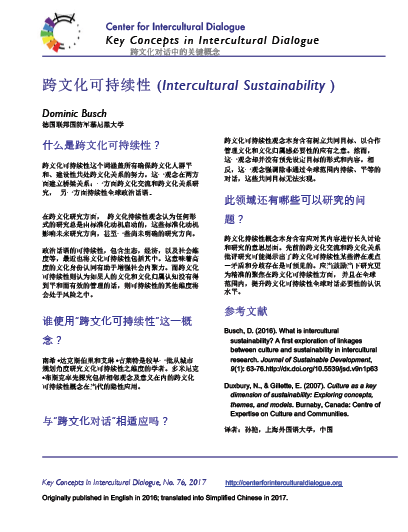
KC76: Intercultural Sustainability Translated into Simplified Chinese

Key Concepts in ICDContinuing translations of Key Concepts in Intercultural Dialogue, today I am posting KC#76: Intercultural Sustainability, which Dominic Busch wrote for publication in English in 2016, and which Yan Sun has now translated into Simplified Chinese.
\As always, all Key Concepts are available as free PDFs; just click on the thumbnail to download. Lists of Key Concepts organized chronologically by publication date and number, alphabetically by concept, and by languages into which they have been translated, are available, as is a page of acknowledgments with the names of all authors, translators, and reviewers.

KC76 Intercultural Sustainability_Chinese-simBusch, D. (2017). Intercultural sustainability [Simplified Chinese]. (Y. Sun, trans). Key Concepts in Intercultural Dialogue, 76. Available from:
https://centerforinterculturaldialogue.org/wp-content/uploads/2017/08/kc76-intercultural-sustainability_chinese-sim1.pdf

If you are interested in translating one of the Key Concepts, please contact me for approval first because dozens are currently in process. As always, if there is a concept you think should be written up as one of the Key Concepts, whether in English or any other language, propose it. If you are new to CID, please provide a brief resume. This opportunity is open to masters students and above, on the assumption that some familiarity with academic conventions generally, and discussion of intercultural dialogue specifically, are useful.

Wendy Leeds-Hurwitz, Director
Center for Intercultural Dialogue


Creative Commons License
This work is licensed under a Creative Commons Attribution-NonCommercial-NoDerivatives 4.0 International License.

Andalusia’s Ambivalence: Between Convivencia and Islamophobia

Guest PostsGuest post by Linda J. de Wit about Andalusia, a region that has often been described by means of “paradoxes, contradictions, syntheses or contrasts. Andalusia can at the same time be regarded as a unique case – not unusual for a frontier region – and as challenging contemporary understandings and expectations about concepts like multiculturalism and social cohesion.” 

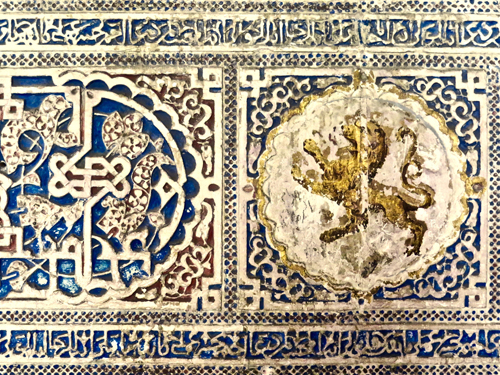
Lion of Spain
The lion of Spain’s coat of arms as part of Islamic-style wall decoration in the royal palace in Seville. Photo by Linda J. de Wit.

Andalusia’s Ambivalence: Between Convivencia and Islamophobia
by Linda J. de Wit

The southern Spanish province of Andalusia is a much-invaded corner of Europe. Its history and culture have been shaped by peoples as distinctive as Iberians, Phoenicians, Celts, Greeks, Carthaginians, Romans, Visigoths, Moors and Castilians. In the context of intercultural communication, the region is sometimes invoked by referring to the seven centuries from which it inherited its name: between 711 and 1492 it was the heartland of Spain under Islamic (Moorish) rule, Al-Andalus. This period is today often associated with the concept of convivencia: the peaceful coexistence and cultural interaction of Muslims, Christians and Jews. In this light, both Andalusia’s past and its present make interesting case studies of multiculturalism.

Download the entire essay as a PDF.

Irene Maria F. Blayer Profile

ProfilesIrene Maria F. Blayer holds a PhD in Romance linguistics from the University of Toronto, and is a Full Professor at Brock University, Ontario, Canada, where she  is affiliated with the department of Modern Languages as well as the Interdisciplinary PhD in Humanities.

Irene Blayer

Trained as a historical linguist, her interests evolved into larger cross-linguistics and interdisciplinary teaching and research projects. In a broader context, current research includes the study of diasporic and insular-narratives, and how these narratives express  the inter-cultural complex and diachronic interplay of identity, language and culture. She has been part of research projects with colleagues in Asia, Brazil, Canada, Europe and the United States. She is the co-founder with Dulce Scott (Anderson Univ, USA) of the InterDISCIPLINARY Journal of Portuguese Diaspora Studies (launched in 2012) and Co-executive editor of the book series Interdisciplinary Studies in Diasporas (launched in 2016) with Peter Lang.

Some recent publications include: Intersecting Diaspora Boundaries: Portuguese Contexts (2016), Portugal pelo mundo disperso (2013), Narrating the Portuguese Diaspora: Piecing Things Together (2011),  Narrativas em Metamorfose: Abordagens Interdisciplinares (2009); Oral and Written Narratives and Cultural Identity: Interdisciplinary Approaches (2007​)​.


Work for CID:
Irene Maria Blayer has served as a reviewer for Portuguese translations.

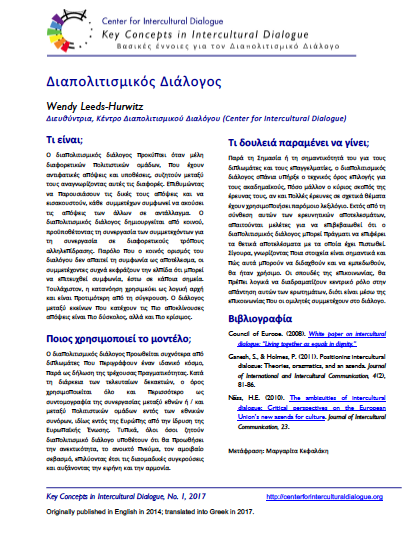
KC1 Intercultural Dialogue Translated into Greek

Key Concepts in ICDContinuing translations of Key Concepts in Intercultural Dialogue, today I am posting KC#1: Intercultural Dialogue, which I wrote for publication in English in 2014, and which Margarita Kefalaki has now translated into Greek.

As always, all Key Concepts are available as free PDFs; just click on the thumbnail to download. Lists of Key Concepts organized chronologically by publication date and number, alphabetically by concept, and by languages into which they have been translated, are available, as is a page of acknowledgments with the names of all authors, translators, and reviewers.

KC1 ICD_GreekLeeds-Hurwitz, W. (2017). Intercultural dialogue [Greek]. (M. Kefalaki, trans). Key Concepts in Intercultural Dialogue, 1. Available from: https://centerforinterculturaldialogue.org/wp-content/uploads/2017/08/kc1-icd_greek.pdf

If you are interested in translating one of the Key Concepts, please contact me for approval first because dozens are currently in process. As always, if there is a concept you think should be written up as one of the Key Concepts, whether in English or any other language, propose it. If you are new to CID, please provide a brief resume. This opportunity is open to masters students and above, on the assumption that some familiarity with academic conventions generally, and discussion of intercultural dialogue specifically, are useful.

Wendy Leeds-Hurwitz, Director
Center for Intercultural Dialogue


Creative Commons License
This work is licensed under a Creative Commons Attribution-NonCommercial-NoDerivatives 4.0 International License.