KC78: Language & Intercultural Communication Translated into Simplified Chinese

Key Concepts in ICDContinuing translations of Key Concepts in Intercultural Dialogue, today I am posting KC#78: Language and Intercultural Communication, which Jane Jackson wrote for publication in English in 2016, and which Yan Sun has now translated into Simplified Chinese.

As always, all Key Concepts are available as free PDFs; just click on the thumbnail to download. Lists of Key Concepts organized chronologically by publication date and number, alphabetically by concept, and by languages into which they have been translated, are available, as is a page of acknowledgments with the names of all authors, translators, and reviewers.
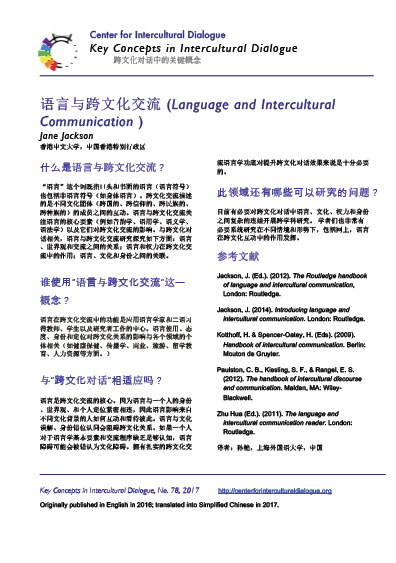
KC78 LIC_Chinese-simJackson, J. (2017). Language and intercultural communication [Simplified Chinese]. (Y. Sun, trans). Key Concepts in Intercultural Dialogue, 78. Available from:
https://centerforinterculturaldialogue.org/wp-content/uploads/2017/09/kc78-lic_chinese-sim.pdf

If you are interested in translating one of the Key Concepts, please contact me for approval first because dozens are currently in process. As always, if there is a concept you think should be written up as one of the Key Concepts, whether in English or any other language, propose it. If you are new to CID, please provide a brief resume. This opportunity is open to masters students and above, on the assumption that some familiarity with academic conventions generally, and discussion of intercultural dialogue specifically, are useful.

Wendy Leeds-Hurwitz, Director
Center for Intercultural Dialogue


Creative Commons License
This work is licensed under a Creative Commons Attribution-NonCommercial-NoDerivatives 4.0 International License.


Natasha Shrikant Profile

Profiles

Natasha Shrikant is an assistant professor in the Department of Communication at the University of Colorado, Boulder.

Natasha Shrikant

She uses ethnographic and discourse analytic approaches to analyze relationships between communication and identity. She focuses mostly on how participants’ interactions explicitly or implicitly construct social identities such as race, ethnicity, gender, and sexuality as relevant to interactional contexts. Most recently, she worked on a project examining how institutional members construct racial and ethnic identities as constitutive of professional identities in various institutional speech events, such as meetings, public speeches, and informal workplace conversations. She is also interested in how institutional members build interethnic or cross cultural relationships in an effort to meet institutional goals.

Sample Publications:

Shrikant, N. (2015).  The discursive construction of race as a professional identity category in two Texas chambers of commerce. International Journal of Business Communication, 1-24. doi: 10.1177/2329488415594156.

Shrikant, N. (2015). “Yo, it’s IST yo”: The discursive construction of an Indian-American youth identity in a South Asian Student Club. Discourse and Society, 26(4), 480-501.

Shrikant, N. (2014). “It’s like, ‘I’ve never met a lesbian before!’”: Personal narratives and the construction of diverse female identities in a lesbian counterpublic. IPrA Pragmatics, 24(4), 799-818. 

Key Concept #83: Intercultural Aesthetics

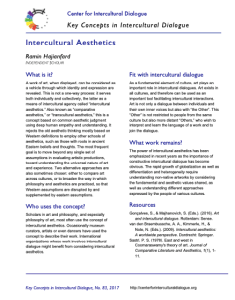
Key Concepts in ICDThe next issue of Key Concepts in intercultural Dialogue is now available. This is KC#83: Intercultural Aesthetics, by Ramin Hajianfard. Click on the thumbnail to download the PDF. Lists organized chronologically by publication date and numberalphabetically by concept in English, and by languages into which they have been translated, are available, as is a page of acknowledgments with the names of all authors, translators, and reviewers.

KC83 Intercultural aesthetics

Hajianfard, R. (2017). Intercultural aesthetics. Key Concepts in Intercultural Dialogue, 83. Available from:
https://centerforinterculturaldialogue.org/wp-content/uploads/2019/11/kc83-intercultural-aesthetics.pdf

The Center for Intercultural Dialogue publishes a series of short briefs describing Key Concepts in Intercultural Dialogue. Different people, working in different countries and disciplines, use different vocabulary to describe their interests, yet these terms overlap. Our goal is to provide some of the assumptions and history attached to each concept for those unfamiliar with it. As there are other concepts you would like to see included, send an email to the series editor, Wendy Leeds-Hurwitz. If there are concepts you would like to prepare, provide a brief explanation of why you think the concept is central to the study of intercultural dialogue, and why you are the obvious person to write up that concept.


Creative Commons License
This work is licensed under a Creative Commons Attribution-NonCommercial-NoDerivatives 4.0 International License.
Euro-Mediterranean Award for Dialogue between Cultures 2017

AwardsThe Anna Lindh Euro-Mediterranean Foundation for Dialogue between Cultures (ALF) and Fondazione Mediterraneo (FM), are launching the 11th Edition of the Euro-Mediterranean Award for Dialogue Between Cultures. This annual Award, which is bestowed by the 42 ALF National Networks, recognises the achievements of individuals and organisations that have been at the forefront of promoting Dialogue in the Euro-Mediterranean region.

Candidates for the Award can be proposed either as an individual or as an organisation, and must bear the nationality of/ be registered in one of the 42 member countries of the Euro-Med Partnership. As youth,  women and minorities are the key target groups of the Foundation’s work, special attention will be given to candidates who have actively worked or implemented projects with these groups.

The selection of the winner of the Euro-Med Award is a participatory process which involves the Heads of the Networks, Network members and non-members. The shortlist of the three (3) finalists for the Award is carried out by the Jury, while the final selection of the winner of the award is carried out by the EuroMed Award Committee.

Colorado State U Job Ad: Race, Ethnicity, Dialogue

Job adsThe Department of Communication Studies at Colorado State University seeks an assistant professor who specializes in race, ethnicity, and dialogue to collaborate with faculty and students in the study and practice of engaged communication within our nationally-recognized Center for Public Deliberation. Candidates may employ either critical or social scientific research methods grounded in the Communication Studies discipline. This is an entry-level, tenure-track, nine-month appointment which starts August 16, 2018.

References will be contacted immediately upon submission of application and will receive an email with a link to submit their letter. Department tenured and tenure track faculty will have access to semi-finalist files, including letters of recommendation. For full consideration, application should be submitted by September 25, 2017. For full consideration, applications must be complete including three letters of reference by October 2, 2017.

Study Abroad: Intercultural Communication in France/Spain

Study AbroadIntercultural Communication: Jan. 2018 Faculty-Led Travel Course in France and Spain. December 31, 2017 – January 13, 2018 (Paris, Aix-en-Provence, Marseille, Granada, Seville, Cordoba, and Madrid). Admission is competitive, deadline for registration is Oct. 1, 2017.

This slideshow requires JavaScript.

The department of communication studies at Kansas State University is offering a two-week, faculty-led, travel course in France and Spain for undergraduates and graduate students in all majors interested in an academic and intercultural experience in a foreign culture.

The course, directed by Professor Soumia Bardhan, may be taken as COMM 480: Intercultural/International Communication, three credits, or COMM 799: Problems in Intercultural/International Communication, three to six credits, independent study. The program kicks off with a welcome reception in Paris on Jan. 1, 2018, and concludes in Madrid on Jan. 13, 2018. It features field trips to Aix-en-Provence and Marseille in southern France, and Granada, Seville and Cordoba in southern Spain.

Continue reading “Study Abroad: Intercultural Communication in France/Spain”

Colorado U Denver Job Ad: Media Learning Lab/Instructor (Beijing)

Job adsCommunication Instructor and Media Learning Lab Director at CU Denver–International College of Beijing

The CU Denver Department of Communication invites applications for a full-time, non-tenure-track teaching position at the International College Beijing (ICB). The job will commence in February, 2018. Depending on the performance of the individual hired, multi-year renewals are possible. Depending on departmental needs, this position may also have the opportunity to teach a semester at the Denver campus, thus rotating semesters between teaching in Beijing and teaching in Denver. We seek to hire a colleague who can direct the ICB’s Media Learning Laboratory while teaching courses that touch upon the analysis and production of New Media and Strategic Communication. The ideal candidate would also be able to teach courses in our general communication curriculum. Review of applications will begin on September 22, 2017 and will continue until a hire is made.

For more information, follow this link, and then search for Job ID # 10926.

Continue reading “Colorado U Denver Job Ad: Media Learning Lab/Instructor (Beijing)”

KC62: Diaspora Translated into Turkish

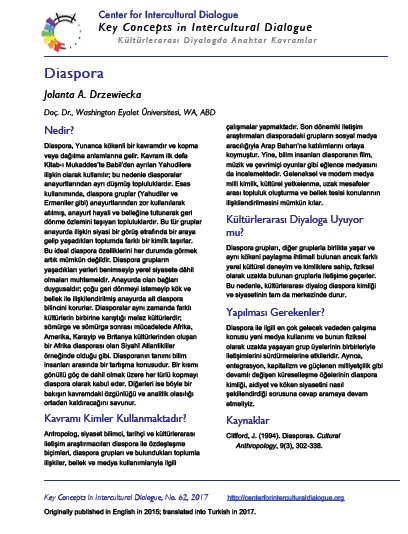
Key Concepts in ICDContinuing translations of Key Concepts in Intercultural Dialogue, today I am posting KC62: Diaspora, first published in English in 2015 by Jolanta Drzewiecka, which Kenan Çetinkaya has now translated into Turkish.

As always, all Key Concepts are available as free PDFs; just click on the thumbnail to download. Lists of Key Concepts organized chronologically by publication date and number, alphabetically by concept, and by languages into which they have been translated, are available, as is a page of acknowledgments with the names of all authors, translators, and reviewers.

KC62 Diaspora-TurkishDrzewiecka, J. (2017). Diaspora [Turkish]. (K. Çetinkaya, trans.). Key Concepts in Intercultural Dialogue, 62. Available from: https://centerforinterculturaldialogue.org/wp-content/uploads/2017/09/kc62-diaspora-turkish.pdf

If you are interested in translating one of the Key Concepts, please contact me for approval first because dozens are currently in process. As always, if there is a concept you think should be written up as one of the Key Concepts, whether in English or any other language, propose it. If you are new to CID, please provide a brief resume. This opportunity is open to masters students and above, on the assumption that some familiarity with academic conventions generally, and discussion of intercultural dialogue specifically, are useful.

Wendy Leeds-Hurwitz, Director
Center for Intercultural Dialogue


Creative Commons License
This work is licensed under a Creative Commons Attribution-NonCommercial-NoDerivatives 4.0 International License.

Digital Storytelling for Intercultural Dialogue

Applied ICDTraining Course: Once Upon a Story – Digital Storytelling for Intercultural Dialogue. 5-14 November 2017, Evora, Portugal

Eligible are 24 participants coming from: Germany, Italy, Netherlands, Poland, Portugal, Spain

Application deadline: 17th September 2017

Erasmus+ training course addressed to youth workers and young leaders interested in exploring the method of digital storytelling and its usage for working with young people with diverse cultural background. Follow the link above for details.

CFP 6th International Conference on Multicultural Discourses (Netherlands)

ConferencesTHE 6TH INTERNATIONAL CONFERENCE ON Multicultural DiscoursesOctober 23-25, 2018, Tilburg, the Netherlands

Following the past and recent successes of the International Conference on Multicultural Discourses, with the latest held in Sao Paulo, Brazil, in 2016, we have now decided to hold the event once every two years instead of three.

This means that the 6th International Conference on Multicultural Discourses will be held from Oct 23-Oct 25, 2018 at the Department of Culture Studies – School of Humanities at Tilburg University, the Netherlands. The event will be co-organized by the Babylon – Centre for the Study of Superdiversity affiliated to the same institution – and the Centre for Contemporary Chinese Discourse Studies, Hangzhou Normal University, and hosted by the former.

Taking cultural discourse studies (CDS) as the central frame of reference, the aim of this international conference is to investigate the affordances, shortcomings, as well as unexplored potentials offered by the multicultural discourses as an intellectual movement when engaged with recent conceptual developments and areas of interest across the social sciences and the humanities.

The conference is therefore intended to provide the wide scholarly community with a forum that explores cultural forms of and approaches to the following issues.