IMéRA Institute for Advanced Study 2020 (France)

“Fellowships“Call for applications: Chair, Agence universitaire de la Francophonie (AUF)- Institute for Advanced Study (IMéRA), 2019-20, Aix-Marseille University, France. Deadline: 19 April 2019.

2019-20 theme: “Transformations structurelles et dynamiques institutionnelles en Francophonie” [Structural transformations and institutional dynamics in the Francophone world].

This call for applications to host a researcher in residence in Marseille is aimed at senior French-speaking academics and researchers from all disciplines who have acquired international scientific recognition (awards, publications, international expertise, etc.). The Chairholder will be hosted in residence in Marseille for a period of 10 months to conduct research work in connection with teams and laboratories of the university, as well as with partner organizations.

CFP Transnational Perspectives on Spanish in Society (UK)

ConferencesCall for Papers: Transnational Perspectives on the Study of Spanish in Society, The University of Edinburgh, 5-6 September 2019. Deadline: April 15, 2019.

Transnational Perspectives on the Study of Spanish in Society marks the the 9th International Conference of Hispanic Linguistics and 7th Biennial Meeting of the International Association for the Study of Spanish in Society. Languages travel and adapt to the new circumstances faced by their speakers. The growth of the Spanish language has always been transnational in nature, insofar as any expansion has been grounded in cultural and economic exchange. Therefore, at this conference, organizers wish to bring together those with scholarly interests in the situation of the Spanish language in the contemporary world. Almost twenty years into the new millennium, it is time reflect on how Spanish speakers, be they in their countries of origin or in the diaspora, construct and negotiate concepts of community. How is this achieved by recourse to ideas of borders, migration and contact? How do speakers move beyond notions of physical space, and push social, political, cultural and commercial boundaries, in order to break through the limits imposed on them by nations and continents?

Abstracts may be submitted in English or in Spanish.

CID Video Competition Resources

Job adsThe following resources discussing intercultural dialogue as a concept may be of help to those preparing entries for the Center for Intercultural Dialogue 2019 Video Competition.

Reminder: the question to answer in 2019 is: How do social media influence intercultural dialogue?

Short, basic definitions for the two concepts that must be addressed by any video:

1) Intercultural dialogue is the term for what happens when people from different cultural backgrounds attempt to understand one other’s assumptions. Culture is a general term that includes all sorts of learned behavioral patterns. Intercultural communication is generally accepted as including international, interracial, interethnic, and interfaith. Intercultural dialogue is deliberate, active rather than passive. It is NOT the same as cultural analysis (understanding how one culture does things), or cross-cultural analysis (comparing how two different cultures do things).

2) Social media refers to any tool using the internet to help people communicate, especially when they are not in the same place at the same time. It includes such applications as Facebook, Twitter, Instagram, WeChat, WhatsApp, and Tumblr, among others. You can limit your consideration to any one of these, or consider several. But don’t just describe the social media by themselves! The question you must answer is how the social media you choose to address influence intercultural dialogue. That means, what changes when people of different cultural backgrounds try to understand one another when they are not even face-to-face? What gets harder? What becomes easier?

Any of the winning videos from the 2018 CID Video Competition should be helpful in providing models of what last year’s judges deemed the most worthy entries. Remember that those participants were answering a different question (What does intercultural dialogue look like?).

CID issues a number of publications that are designed to expand understanding of intercultural dialogue at greater length than the sort explanations above, but still only in 1 or 2 pages. A few that may be of particular help to newcomers to the topic are these:

Key Concepts in Intercultural Dialogue
#1:    Intercultural dialogue
#8:   Public dialogue
#10: Cross-cultural dialogue
#14: Dialogue
#81: Dialogue as a Space of Relationship
#84: Double Intercultural Dialogue

CID Posters
#3: Intercultural dialogue
#6: Dialogue defined
#8: Intercultural competence/intercultural dialogue

If you have further questions, see previously published competition rules, and FAQ. See the reflection by one winning team on creating their video. Or send an email with a question. When you’re ready to submit an entry, click here.

U Colorado: TESOL Instructor (USA)

“JobInstructor in TESOL Theory and Practice, University of Colorado, Boulder, CO. Deadline: April 12, 2019.

The candidate selected for this 1 FTE appointment (.5 FTE Linguistics; .5 FTE International English Center) will report to both the Department of Linguistics and the International English Center. The salary is $55,000. This is a multi-year contract that can be renewed infinitely. Responsibilities divided as follows:

Department of Linguistics:
  • Teaching a 2/1 per academic year course load of split graduate/ undergraduate courses in LING-TESOL methods, theory, and practice.

  • Directing and developing the Department of BA TESOL Certificate program.

  • Advising students seeking the MA-level TESOL with Technology Certificate.

International English Center
  • Teaching 2 courses per each IEC eight-week session; four sessions per year.

  • [and more relating to teaching, curriculum development, service activities – see original ad for details]

Princeton U: Postdoc in Linguistics (USA)

“JobPostdoctoral Research Associate, Program in Linguistics, Princeton University, NJ, USA. Deadline: April 1, 2019 (for first review, with rolling deadline).

The Program in Linguistics at Princeton University invites applications for a post-doctoral (or more senior) research position in linguistics. The ideal candidate will have a strong background in formal semantics/pragmatics or prosody/intonation, and an interest in exploring the relationship between the two, experimentally and theoretically. The candidate may be invited to teach one course for Linguistics per semester, pending sufficient enrollments and with the approval of the Office of the Dean of the Faculty, and may engage in a small amount of undergraduate independent work advising. When teaching or advising, the successful candidate will carry a secondary rank of Lecturer. In addition, they will be expected to participate in the intellectual life of the Program in Linguistics. PhD in Linguistics or relevant discipline, preferably within the past five years but no later than September 1, 2019. This is a one-year term position starting September 1, 2019 with the possibility of renewal for a second year, based on continued satisfactory performance.


Erasmus+ Virtual Exchanges

Applied ICDErasmus+ Virtual Exchange is part of the Erasmus+ programme, providing an accessible, ground-breaking way for young people to engage in intercultural learning.

Working with Youth Organisations and Universities, Erasmus+ Virtual Exchange is open to any young person aged 18-30 residing in Europe and the Southern Mediterranean. Through a range of activities, Erasmus+ Virtual Exchange aims to expand the reach and scope of the Erasmus+ programme through Virtual Exchanges, which are technology-enabled people-to-people dialogues sustained over a period of time.

Specific programs include:

  • Professional development for youth workers and university educators to learn how to develop a Transnational Erasmus+ Virtual Exchange Project (TEP) in order to enrich and expand existing programmes.

  • Advocacy training bringing young people from different backgrounds together to develop parliamentary debate skills with the support of a network of trained debate team leaders, fostering listening and understanding through advocacy training.

  • Interactive Open Online Courses across cultural contexts and national boundaries to learn with peers from diverse backgrounds using bite-sized video lectures, supported by skill building activities and facilitated intercultural discussions.


EIUC Summer School: Cinema Human Rights & Advocacy 2019 (Italy)

Study AbroadEIUC Summer School in Cinema Human Rights and Advocacy, August 26-Sept 4, 2019, Venice, Italy. Deadline: 30 April 2019.

The 14th edition of the Summer School in Cinema Human Rights and Advocacy is a training initiative jointly developed by the European Inter-University Centre for Human Rights and Democratisation (EIUC) and Picture People. The 10-day intense training is aimed at young professionals wishing to broaden their understanding on the connections between human rights, films, digital media and video advocacy, to share ideas and foster participatory and critical thinking on urgent human rights issues, debate with experts and filmmakers from all over the world during the 76thVenice international Film Festival and learn how to use films as a tool for social and cultural change.

Paris Institute for Advanced Studies (France)

“Fellowships“Call for Research fellows, Paris Institute for Advanced Study, Paris, France. Deadline: 15 April 2019.


The Paris Institute for Advanced Study welcomes applications from high level international scholars and scientists in the fields of the humanities and the social sciences for a research stay of five or ten months, during the academic year 2020-2021. The Paris IAS gives its research fellows the unique opportunity to work freely on the project of their choice. They will benefit from the scientific environment of the Institute and receive support for creating contacts with researchers in the academic institutions of Greater Paris. Each cohort of fellows includes about 20 researchers from all backgrounds, disciplines and nationalities.

Current calls include Blue Sky Fellowships and Dark Clouds Fellowships, among others.

CFP Media, Culture & Society (Argentina)

Conferences

Call for papers, Contemporary Developments on Media, Culture and Society: Argentina and Latin America, August 27-28, 2019, Universidad de San Andrés in Buenos Aires, Argentina. Extended Deadline: April 30, 2019.

Northwestern University and Universidad de San Andrés (Argentina) invite submissions to the conference “Contemporary Developments on Media, Culture and Society: Argentina and Latin America.” This will be the fifth annual conference organized by The Center for the Study of Media and Society in Argentina (MESO) on the interactions between media, culture and society. This fifth annual conference is sponsored by the Center for Global Culture and Communication at Northwestern University.

Submissions should contribute to ongoing conversations about media, culture, and society in empirical, theoretical or methodological ways. They might also broaden our knowledge about the relationship between media, culture, and society at the national and regional level. Papers may refer to different aspects of communication, media, and cultural goods and services in the areas of journalism, entertainment -cinema, theater, television, music, etc. – advertising and marketing, public relations, social media, and video games, among others.

KC22 Cultural Identity Translated into German

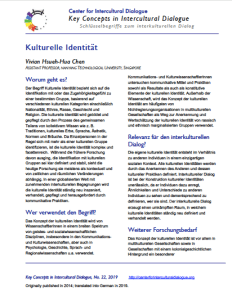
Key Concepts in ICDContinuing translations of Key Concepts in Intercultural Dialogue, today I am posting KC#22: Cultural Identity, which Vivian Hsueh-Hua Chen wrote for publication in English in 2014, and which Alina Timofte has now translated into German.

As always, all Key Concepts are available as free PDFs; just click on the thumbnail to download. Lists of Key Concepts organized chronologically by publication date and number, alphabetically by concept, and by languages into which they have been translated, are available, as is a page of acknowledgments with the names of all authors, translators, and reviewers.

KC22 Cultural Identity_GermanChen, V. H.-H. (2019). Kulturelle Identität. (A. Timofte, trans). Key Concepts in Intercultural Dialogue, 22. Available from:
https://centerforinterculturaldialogue.org/wp-content/uploads/2019/03/kc22-cultural-identity_german.pdf

If you are interested in translating one of the Key Concepts, please contact me for approval first because dozens are currently in process. As always, if there is a concept you think should be written up as one of the Key Concepts, whether in English or any other language, propose it. If you are new to CID, please provide a brief resume. This opportunity is open to masters students and above, on the assumption that some familiarity with academic conventions generally, and discussion of intercultural dialogue specifically, are useful.

Wendy Leeds-Hurwitz, Director
Center for Intercultural Dialogue


Creative Commons License
This work is licensed under a Creative Commons Attribution-NonCommercial-NoDerivatives 4.0 International License.