CFP Discourse & Rhetoric Amid COVID-19

“PublicationCall for papers: Special issue on Discourse and Rhetoric amid COVID 19 Pandemic: Dis/Articulating The ‘New Normal’ for Rhetoric and Communications E-Journal. Deadline: October 1, 2020.

Guest Editors: Andrea Valente and Paola Giorgis

The coronavirus disease (SARS-CoV-2) with its global and local pandemic has been on the top agenda of Government leaders, scientists, health professionals, as well as on the daily headlines across journalistic media. New governmental measures, decrees, scientific recommendations, and sanitary campaigns emerge everyday to combat or alleviate the pandemic which are endorsed and spread through mainstream media. On the one hand, a new discourse and rhetoric has been articulated to create, support, and even impose a ‘new normal’ that reconfigures how human beings communicate, interact, and socialize in public and private spaces. On the other hand, the new normal has triggered responses from skeptics, ‘Covideniers’ and protesters who try to disarticulate it by polarizing and politicizing the coronavirus pandemic.

With this in mind, this Special Edition invites junior and senior scholars to collaborate with articles that explore and analyze the various languages, rhetorical strategies, and discourses used during the Covid19 pandemic in order to either articulate (e.g. construct, endorse, conform) or disarticulate (e.g. contest, deny, undermine) the ‘new normal’. This Special Edition looks forward to collaborations in the field of argumentative theory, critical/discourse analysis, rhetoric, critical sociolinguistics, communication studies, and others alike.

RAI Film Festival (UK)

Film FestivalsRoyal Anthropological Institute (RAI) Film Festival, Bristol, UK. Deadline: 15 August 2020.

The RAI Film Festival celebrates documentaries and non-fiction films from around the globe that engage with themes of culture & society. It has a special focus on anthropological and ethnographic films. First held in 1985, and one of the longest-established in its field, the RAI FILM FESTIVAL serves as a leading forum for exploring the multiple relationships between documentary film-making, anthropology, visual culture, and the advocacy of cultural diversity and intercultural dialogue through film.

Calling for short, mid- and feature length documentaries, ethnographic / anthropological films, student films. Open to all.

The 17th RAI Film Festival will take place 25-28 March 2021 in Bristol, UK.

KC35 Media Ecology Translated into Russian

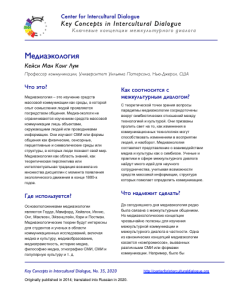
Key Concepts in ICDContinuing translations of Key Concepts in Intercultural Dialogue, today I am posting KC#35: Media Ecology, which Casey Man Kong Lum wrote for publication in English in 2014, and which Milana Petrova has now translated into Russian.

As always, all Key Concepts are available as free PDFs; just click on the thumbnail to download. Lists of Key Concepts organized alphabetically by concept, chronologically by publication date and number, and by languages into which they have been translated, are available, as is a page of acknowledgments with the names of all authors, translators, and reviewers.


KC35 Media Ecology_RussianLum, C. M. K. (2020). Media ecology [Russian]. (M. Petrova, trans). Key Concepts in Intercultural Dialogue, 35. Available from https://centerforinterculturaldialogue.org/wp-content/uploads/2020/05/kc35-media-ecology_russian.pdf

If you are interested in translating one of the Key Concepts, please contact me for approval first because dozens are currently in process. As always, if there is a concept you think should be written up as one of the Key Concepts, whether in English or any other language, propose it. If you are new to CID, please provide a brief resume. This opportunity is open to masters students and above, on the assumption that some familiarity with academic conventions generally, and discussion of intercultural dialogue specifically, are useful.

Wendy Leeds-Hurwitz, Director
Center for Intercultural Dialogue


Creative Commons License
This work is licensed under a Creative Commons Attribution-NonCommercial-NoDerivatives 4.0 International License.

York St. John U: TESOL/Linguistics (UK)

“JobLecturer, TESOL and Linguistics, School of Education, Language and Psychology, York St. John University, York, UK. Deadline: 15 June 2020.

York St. John University is currently seeking a Lecturer in TESOL and Linguistics to start 1st August 2020. The successful candidate will join a team of fifteen Languages and Linguistics academics based within the School of Education, Language and Psychology. They offer BA and MA programmes in British Sign Language, Deaf Studies, Educational Linguistics, English Language and Linguistics, Intercultural Communication, Japanese, Korean, Language and Social Justice, and TESOL. The successful candidate will contribute to undergraduate and postgraduate programmes in TESOL and Linguistics.

Candidates should have the experience and expertise to teach across a range of linguistics modules such as introductory grammar and phonetics, second language acquisition and multilingualism. It is essential that candidates hold a doctoral level qualification, or are near completion, and are actively engaged in research. Research expertise should be in TESOL, and may also be related to one or more of the following areas: applied linguistics; corpus linguistics; digital communication; discourse analysis; forensic linguistics; language acquisition; psycholinguistics; queer and feminist linguistic theory; sociolinguistics; syntax.

Hong Kong Baptist U: Translation/Intercultural Studies (China)

“Job2 positions for Assistant Professor, Department of Translation, Interpreting and Intercultural Studies, Hong Kong Baptist University, Hong Kong, China. Deadline: July 19, 2020.

Preference will be given to those with expertise in at least one of the following clusters: (i) translation theory; (ii) translation technology, translation-related applications of big data, and localization; (iii) interpreting studies; and (iv) intercultural studies, preferably with interests in minority cultures. Given the Chinese/English orientation of the majority of the Department’s course offerings, a command of Chinese is expected.


Being Korean AND Black

“Book Notes

Kang Hyun-kyung. (May 23, 2020). I am Korean yet culturally black. The Korea Times.

Cindy Wilson, author of Too Much Soul: The Journey of an Asian Southern Belle, was born I Wol-yang in Seoul and adopted by African-American parents in 1975 when she was a few months old. Her name was changed to Cindy and she was brought to America by her adoptive parents the following year. Raised in Mississippi, Wilson identifies as being part of the African American community, even though she is Asian.

Too much soul

The article, and the book that sparked it, seem likely to start interesting class discussions about racial vs. cultural identity. Biracial students, or students adopted across racial lines as in this case, are often particularly skilled at helping other students in a course help learn how to gracefully discuss the issues.


Abe: Using Film in ICD

Intercultural PedagogyAbe, a film by Brazilian director Fernando Grostein Andrade, uses fusion foods as a way to approach intercultural dialogue.

Finding one’s identity is a challenge everyone faces, but few have the pressure that 12-year-old Abe feels as the son of an Israeli mother and Palestinian father. Though his parents have raised him in a secular household, both sets of grandparents insist he chooses between being Jewish or Muslim. Abe’s passion for food allows him some escape from the escalating family tensions. While exploring Brooklyn to discover new foods, he meets Chico, a Brazilian chef who believes “mixing flavors can bring people together.”

If you use other films in your work or teaching that relate to intercultural dialogue, please take a moment to send an email with a short note, as CID is currently preparing a list of such films to post as a resource.

Carnegie African Diaspora Fellowship Program

FellowshipsFellowships, Carnegie African Diaspora Fellowship Program. Deadline: June 30, 2020.

The Carnegie African Diaspora Fellowship Program (CADFP) is a scholar fellowship program for educational projects at African higher education institutions. Offered by IIE in collaboration with the United States International University-Africa, the program is funded by a grant from Carnegie Corporation of New York. A total of 471 African Diaspora Fellowships have been awarded for scholars to travel to Africa since the program’s inception in 2013. CADFP exemplifies Carnegie’s enduring commitment to higher education in Africa. IIE manages and administers the program, including applications, project requests and fellowships. USIU-Africa provides strategic direction through the Advisory Council.

Accredited African universities in six host countries (Ghana, Kenya, Nigeria, South Africa, Tanzania and Uganda) can submit a project request to host an African-born scholar currently living in the United States or Canada to work on projects in research collaboration, graduate student teaching/mentoring and curriculum co-development. Or African-born academics currently living in the United States or Canada and working at institutions of higher education can submit a Scholar Application to the Scholar Roster.

Creative Tourism in the Regeneration of Communities (Portugal but online)

EventsOnline Seminar: So, what’s next? The role of creative tourism in the regeneration of communities. University of Coimbra, Portugal. June 2, 2020, 16h00 – Portugal/Lisbon timezone. Deadline to register: May 31, 2020

In this moment of transition, this webinar contributes to current discussions on the future of small-scale and community-based creative tourism, and on community recovery and resilience. How can we work collectively to move forward together?

The Covid-19 pandemic in 2020 has provided a stark moment of renewed reflection and contemplation on the realities of our interconnected world. It has highlighted the necessity of working together on both a local community and global scale to improve our quality of social solidarity, and to advance ideas and practices that can renew and provide mutual benefit, contribute to local vitality, and foster the sharing of cultural expressions. It has also led many to consider how to redirect travel and tourism to more meaningful and responsible ends. In our individual pods of isolation, the level of virtual reaching out and sharing was highlighted, and the importance of cultural practices in crafting these bridges and inter-locale connections was underscored.

Moving forward, there is a sense that this pandemic will change the way we act in future – individually, collectively in our geographic communities, and more widely in our nations and international networks. In this context, travel and tourism will resume but are likely be profoundly changed. Travelers may increasingly seek out places of beauty, of respite, of renewal. Domestic tourism may be reemphasized. Connections with others may be re-conceived and fostered on a more humane basis as co-travelers on a closely interconnected planet. A sense of rebuilding and renewal may prevail.

CID Video Competition: Last Week!

CID Video Competition

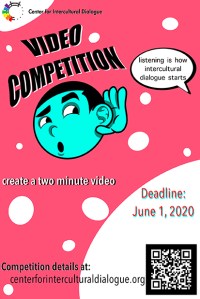
The CID video competition remains open, but just 1 week remains to the final deadline of June 1, 2020. 


CID VIdeo Competition 2020

Final hints for those entering the competition:

Please read the original description of the requirements. And please follow the rules so we don’t have to disqualify your submission. (Bare minimum: it has to be about listening, in the context of intercultural dialogue. It has to be 30 seconds to 2 minutes in length. It has to be a video. It has to be original, and your own work. When you’re ready, upload your video here (NOT to your own YouTube or Vimeo channel!).

Listening is an act of community, which takes space, time, and silence. -Ursula K. Le Guin

If you have questions, see previously published competition rules, FAQ, and resources. Look at the 2018 or 2019 award winning videos. Read the reflection by one winning team about creating their video. If you still have questions that aren’t answered, then send an email. When you’re ready to submit an entry, click here.

Wendy Leeds-Hurwitz, Director
Center for Intercultural Dialogue