Utrecht U: Media, Arts & Society (The Netherlands)

“JobAssistant Professor in Media, Arts & Society, Department of Media and Culture Studies, Faculty of Humanities, Utrecht University, the Netherlands. Deadline: 15 August 2021.

The Department of Media and Culture Studies invites applications for an Assistant Professorship in Media, Arts & Society, starting January 1, 2022 (earlier is negotiable). The appointment includes 30 percent research time. The candidate is expected to actively contribute to the research agenda of Media and Culture Studies and to participate in research collaboration within the department and beyond.

For this position, the Department is looking for candidates who contribute to research into the role of media, art and technology in contemporary culture, questions about the impact of the algorithmic turn on various cultural, artistic and social practices, and forms of knowledge production, and into the role of the humanities in responding to contemporary cultural transformations and societal challenges. Of specific interest to the Department are candidates who will contribute to trans- and interdisciplinary research agendas around participatory practices and civic engagement, and/or critical perspectives for fostering diversity and justice in our mediatized society.

U Aberdeen: Director for Social Inclusion & Cultural Diversity (UK)

“Job

Director, Interdisciplinary Centre for Social Inclusion and Cultural Diversity, University of Aberdeen,  Aberdeen, UK. Deadline: 6 August 2021.

The University of Aberdeen wishes to appoint, at Professorial level, a Director to lead its interdisciplinary Centre for Social Inclusion and Cultural Diversity.  The ideal candidate should have extensive internationally-renowned academic expertise in an underpinning discipline within Social Inclusion and Cultural Diversity, with a proven track record of interdisciplinary research, as well as success in meeting or exceeding challenging targets. For this role candidates will be an experienced academic leader with outstanding leadership, human resources, financial accountability and negotiating skills. You will also have an in-depth knowledge of high-level Government policy and business as well as a strong understanding of government and other funding streams.

Peace Direct Free Course on Conflict

Intercultural PedagogyConflict Transformation: Your Practical Toolkit for Peacebuilding, Peace Direct, Online course. Deadline: Free until August 31, 2021, available at a cost after that.

Peace Direct has launched a new course for people wanting to learn more about peacebuilding. The course is available online and is free until the end of August during the test phase. The course is self paced, and takes on average between two hours and two weeks to complete. The course can be used by peacebuilders or anyone working in conflict situations, as a practical toolkit for peacebuilding. It is relevant to people working in fields such as: human rights, development, democracy, healing and environmental sustainability as well as other areas of work related to peace. Upon completion, participants should have a greater knowledge of the practical skills and techniques required to resolve conflict and build peace successfully at a local level.

The course consists of eight modules:

  • Perspectives and values
  • Self-awareness and learning
  • Influencing through relationships: conflict and power
  • Violence, peace and healing
  • Participative conflict analysis
  • Strategy and nonviolence
  • Exploring options from ourselves to building a movement
  • Being the change

KC16: Migration Translated into French

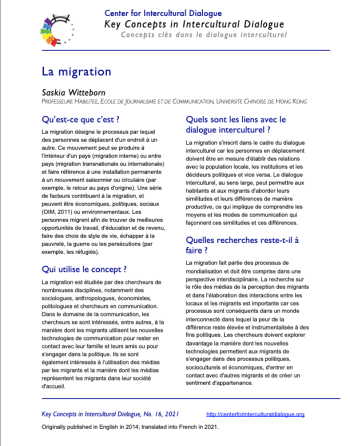
Key Concepts in ICDContinuing translations of Key Concepts in Intercultural Dialogue, today I am posting KC#16: Migration, which Saskia Witteborn wrote for publication in English in 2014, and which Mohammed Guamguami has now translated into French.

As always, all Key Concepts are available as free PDFs; just click on the thumbnail to download. Lists of Key Concepts organized chronologically by publication date and number, alphabetically by concept, and by languages into which they have been translated, are available, as is a page of acknowledgments with the names of all authors, translators, and reviewers.

KC16 Migration_French

Witteborn, S. (2021). La migration. (M. Guamguami, Trans.). Key Concepts in Intercultural Dialogue, 16. Available from: https://centerforinterculturaldialogue.org/wp-content/uploads/2021/06/kc16-migration_french.pdf

If you are interested in translating one of the Key Concepts, please contact me for approval first because dozens are currently in process. As always, if there is a concept you think should be written up as one of the Key Concepts, whether in English or any other language, propose it. If you are new to CID, please provide a brief resume. This opportunity is open to masters students and above, on the assumption that some familiarity with academic conventions generally, and discussion of intercultural dialogue specifically, are useful.

Wendy Leeds-Hurwitz, Director
Center for Intercultural Dialogue


Creative Commons License
This work is licensed under a Creative Commons Attribution-NonCommercial-NoDerivatives 4.0 International License.

Identity, Digital Storytelling & Linguistic Citizenship (UK but Online)

Events

Identity, Digital Storytelling and Linguistic Citizenship, Hub for Education & Language Diversity, King’s College, London, UK, 22 July 2021, 15:00 BST.

This event is part of the Hub for Education & Language Diversity (HELD) summer school, July 21-23, 2021, but is open to everyone.

What is the relationship between identity, digital storytelling and linguistic citizenship? Due to advances in digital technology, there are new relations of power at micro and macro levels, and digital literacy has become essential in “claiming the right to speak.” As language learners navigate these changing times, they need to negotiate new identities, investments, and imagined futures.

In this presentation, Dr Bonny Norton demonstrates that while there are social structures that may constrain a language learner’s linguistic citizenship, digital stories in multiple languages can help these learners claim the right to be heard. Drawing on her recent research on digital storytelling in both wealthy and poorly resourced communities worldwide, she discusses how freely available digital stories in multiple languages can harness the linguistic capital of language learners in homes and schools, with exciting implications for the promotion of linguistic citizenship in communities worldwide.

KC17 Multilingualism Translated into French

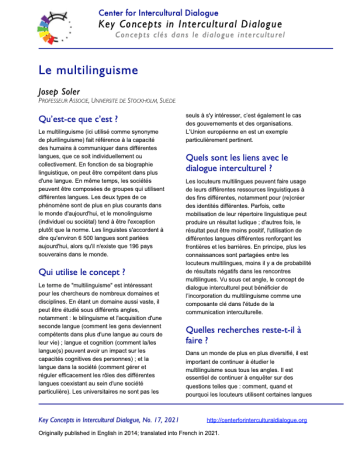
Key Concepts in ICDContinuing translations of Key Concepts in Intercultural Dialogue, today I am posting KC#17: Multilingualism, which Josep Soler wrote for publication in English in 2014, and which Mohammed Guamguami has now translated into French.

As always, all Key Concepts are available as free PDFs; just click on the thumbnail to download. Lists of Key Concepts organized alphabetically by conceptchronologically by publication date and number, and by languages into which they have been translated, are available, as is a page of acknowledgments with the names of all authors, translators, and reviewers.

KC17 Multilingualism_FrenchSoler, J. (2021). Le multilinguisme. (M. Guamguami, Trans.). Key Concepts in Intercultural Dialogue, 17. Available from: https://centerforinterculturaldialogue.org/wp-content/uploads/2021/06/kc17-multilingualism_french.pdf

If you are interested in translating one of the Key Concepts, please contact me for approval first because dozens are currently in process. As always, if there is a concept you think should be written up as one of the Key Concepts, whether in English or any other language, propose it. If you are new to CID, please provide a brief resume. This opportunity is open to masters students and above, on the assumption that some familiarity with academic conventions generally, and discussion of intercultural dialogue specifically, are useful.

Wendy Leeds-Hurwitz, Director
Center for Intercultural Dialogue


Creative Commons License
This work is licensed under a Creative Commons Attribution-NonCommercial-NoDerivatives 4.0 International License.

KC33: Moral Conflict Translated into French

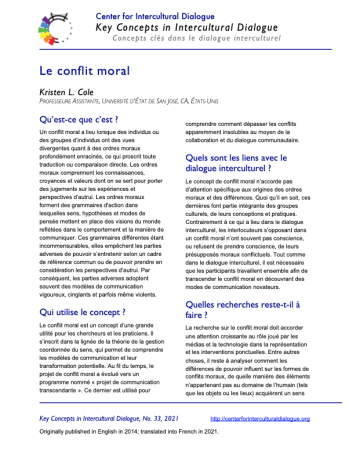
Key Concepts in ICDContinuing translations of Key Concepts in Intercultural Dialogue, today I am posting KC#33: Moral Conflict, which Kristen L. Cole wrote for publication in English in 2014, and which Suzie Suriam Wordofa has now translated into French.

As always, all Key Concepts are available as free PDFs; just click on the thumbnail to download. Lists of Key Concepts organized chronologically by publication date and number, alphabetically by concept, and by languages into which they have been translated, are available, as is a page of acknowledgments with the names of all authors, translators, and reviewers.

KC33 Moral conflict_FrenchCole, K. L. (2021). Le conflit moral. (S. S. Wordofa, Trans.). Key Concepts in Intercultural Dialogue, 33. Retrieved from: https://centerforinterculturaldialogue.org/wp-content/uploads/2021/07/kc33-moral-conflict_french.pdf

If you are interested in translating one of the Key Concepts, please contact me for approval first because dozens are currently in process. As always, if there is a concept you think should be written up as one of the Key Concepts, whether in English or any other language, propose it. If you are new to CID, please provide a brief resume. This opportunity is open to masters students and above, on the assumption that some familiarity with academic conventions generally, and discussion of intercultural dialogue specifically, are useful.

Wendy Leeds-Hurwitz, Director
Center for Intercultural Dialogue


Creative Commons License
This work is licensed under a Creative Commons Attribution-NonCommercial-NoDerivatives 4.0 International License.

Suzie Suriam Wordofa Profile

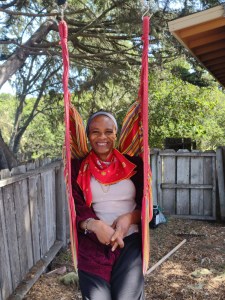
ProfilesDr. Suzie Suriam Wordorfa was born in mainland France. Her roots are in Martinique, in the Caribbean. She studied French Literature, Comparative Literature, and Linguistics in Paris before getting her Ph.D. in French and Francophone Studies at the University of Montreal.

Suzie Wordofa

She has taught French/Francophone Language and Culture mostly at the college level for over 20 years. She lives in California with her family and chairs the French Department of a premium language institute.


Work for CID:
Suzie Suriam Wordofa translated KC33: Moral Conflict into French. She also has served as a reviewer for French.

Northwestern U Qatar: Associate Dean (Qatar)

“Job

Associate Dean for Faculty Affairs, Northwestern University Qatar, Doha, Qatar. Deadline: 15 August 2021.

Northwestern University in Qatar is seeking an experienced, collaborative, and faculty-oriented leader and distinguished scholar for the newly created full-time position of Associate Dean for Faculty Affairs. Northwestern Qatar is one of three campuses of Northwestern University (Chicago, Doha, Evanston) and one of several institutions in the Qatar Foundation’s Education City in Doha, Qatar. The university offers undergraduate programs in Communication, Journalism and Strategic Communication, and Liberal Arts, in addition to graduate and executive education.

This is a senior faculty position. Candidates must have a distinguished record of scholarly and/or creative accomplishments that makes them eligible for appointment to a senior faculty position in Communication, Journalism, or Liberal Arts. Research program should be global, transnational, or comparative and should include the Arab World, Africa, Asia, or Latin America. Candidates are encouraged to continue pursuing their research program.

UNESCO: Chief of Inclusion, Rights & Dialogue (France)

“Job

Chief of Inclusion, Rights and Dialogue Section, Social and Human Sciences Sector,  UNESCO,  Paris, France. Deadline: 25 July 2021.

The Inclusion, Rights, and Dialogue Section of UNESCO supports Member States to promote inclusive policies and actions, by countering racism and discrimination, advancing intercultural dialogue and pursuing gender equality.

Under the supervision of the Assistant Director-General for the Social and Human Sciences Sector (ADG/SHS), the incumbent will be responsible for a number of flagship programs and projects, such as: UNESCO’s Roadmap on Anti-racism and non-discrimination; intercultural dialogue and competencies; arts for human rights and social justice; the promotion of gender equality and the fight against gender stereotypes; the international coalition of inclusive and sustainable cities; the Slave Route Project; the right to science and scientific freedom. The successful candidate will lead the design, coordination, execution and evaluation of the program and projects for the Inclusion, Rights and Dialogue Section.