U Colorado Denver: Health Communication (China)

“JobInstructor of Health Communication, International College of Beijing, University of Colorado Denver, Beijing, China. Deadline: open until filled, posted February 28, 2022.

The University of Colorado Denver Department of Communication invites applications for a full-time, non-tenure-track teaching position at the International College of Beijing (ICB). The job will commence in Beijing in Fall 2022, with arrival required potentially several weeks before then due to evolving COVID-19 travel and quarantine requirements. Depending on the performance of the individual hired, multi-year renewals are possible.

They seek to hire a colleague who can teach a wide range of Communication courses to support our health communication certificate, such as health communication, designing health messages, and advanced health communication, as well as introductory level communication courses required for the major and courses supporting one or more of the Department’s pathways in global and intercultural communication, media and cultural studies, and strategic communication. Above all else, we seek a dynamic teacher committed to best practices in student-centered pedagogy and advancing the internationalization of communication via hands-on, skills-based, experiential and problem-based learning. The ICB is a unique international collaboration embodying best practices in international and intercultural communication, so the ideal candidate will function not only as a classroom teacher and student advocate, but as a cultural ambassador helping to merge U.S.-style pedagogies with Chinese cultural practices.
Applied Multilingualism: Philip Crowther Reporting in 6 Languages

Applied ICD

Philip Crowther, reporter from Luxembourg, files his reports for The Associated Press in no fewer than six languages.

As a result of his multilingualism, he’s getting a lot of newspaper coverage for his skill: in the Huffington Post, Independent, Daily Mail, Metro, and The Wrap, among others.

Presumably, if more people were so functionally multilingual, intercultural dialogues would be made easier.

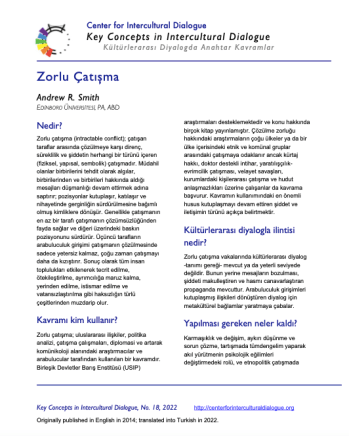
KC18 Intractable Conflict Translated into Turkish

Key Concepts in ICDContinuing translations of Key Concepts in Intercultural Dialogue, today I am posting KC18: Intractable Conflict, which Andrew R. Smith wrote for publication in English in 2015, and which Candost Aydın has now translated into Turkish.

As always, all Key Concepts are available as free PDFs; just click on the thumbnail to download. Lists of Key Concepts organized chronologically by publication date and number, alphabetically by concept, and by languages into which they have been translated, are available, as is a page of acknowledgments with the names of all authors, translators, and reviewers.

KC18 Intractable Conflict_TurkishSmith, A. R. (2022). Intractable conflict [Turkish]. (C. Aydın, Trans.). Key Concepts in Intercultural Dialogue, 18. Retrieved from: https://centerforinterculturaldialogue.org/wp-content/uploads/2022/01/kc18-intractable-conflict_turkish.pdf

If you are interested in translating one of the Key Concepts, please contact me for approval first because dozens are currently in process. As always, if there is a concept you think should be written up as one of the Key Concepts, whether in English or any other language, propose it. If you are new to CID, please provide a brief resume. This opportunity is open to masters students and above, on the assumption that some familiarity with academic conventions generally, and discussion of intercultural dialogue specifically, are useful.

Wendy Leeds-Hurwitz, Director
Center for Intercultural Dialogue


Creative Commons License
This work is licensed under a Creative Commons Attribution-NonCommercial-NoDerivatives 4.0 International License.

Sabrina Sharma Profile

ProfilesSabrina Sharma is an author in Australia, with a background in Christian Human Rights Law and Community engagement.

Sabrina Sharma

She was admitted to The Supreme Court of Victoria (Australia) in 2007 and later on to The High Court of Fiji in 2017. She founded The Fiji Rural Women Empowerment Network to assist disadvantaged women from rural areas across Fiji to access educational platforms and empowerment workshops. As International Ambassador to Almanah Hope Centre in Teidamu, Fiji she has worked with the Centre’s founders to empower widows and survivors of domestic violence across Fiji. Having worked extensively in Fiji across a cross-section of fields (Ministry, Domestic Violence awareness, poverty alleviation and more), she was awarded the Medal of the Order of Fiji in 2020 by Fiji’s former President and retired Major-General Konrote. She was further given the “2021 Champion for Change” Award by UK’s Lead5050 Organization in recognition for her community efforts and engagement.

Sabrina has returned to Australia where she continues to serve a multicultural and diverse community through positive engagement, dialogue and writing her books. One of her published works, Dialogue in Action, speaks of the importance of dialogue with others to deepen our appreciation and understanding of other cultures.

Sabrina’s contributions to community life and the legal sector can be found below:


Work for CID:
Sabrina Sharma wrote a guest post on dialogue as reflected thought.

Peace-building and Dispute Resolution (USA but Online)

Events12th Annual International Cyber-Conference on Dispute Resolution: Peace-building and Dispute Resolution – A Bridge to the Future, California State University Domingo Hills, Online, 6 April 2022.

You are invited to the 12th Annual International Cyber-Conference on Dispute Resolution, Wed. April 6 @ Noon – 2:30 pm (US Pacific Coast Time). Feel free to invite your friends, colleagues, and community members to participate in this international event. Professors are encouraged to invite their students. Organizers also welcome practitioners and practitioner organizations.

Each year, the Cyber-conference has promoted a global town-hall style dialogue between practitioners, students, professors, mediators, arbitrators, Indigenous Peacemakers, scholars, lawyers, judges, law-makers, teachers, community leaders, and restorative practitioners working in both the public and private sector. The conference supports the work of those building safer and healthier communities.

For further information or if you have questions please contact Brian Jarrett at bjarrett AT csudh.edu.

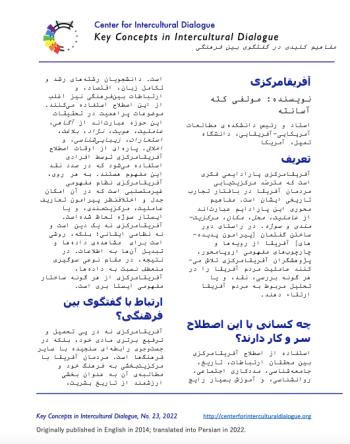
KC23 Afrocentricity Translated into Persian

Key Concepts in ICDContinuing translations of Key Concepts in Intercultural Dialogue, today I am posting KC#23: Afrocentricity, which Molefi Kete Asante wrote for publication in English in 2014, and which Maryam Ahmadi has now translated into Persian.

As always, all Key Concepts are available as free PDFs; just click on the thumbnail to download. Lists of Key Concepts organized alphabetically by concept, chronologically by publication date and number, and by languages into which they have been translated, are available, as is a page of acknowledgments with the names of all authors, translators, and reviewers.

KC23 Afrocentricity_PersianAsante, M. K. (2022). Afrocentricity [Persian]. (M. Ahmadi, Trans.). Key Concepts in Intercultural Dialogue, 23. Available from: https://centerforinterculturaldialogue.org/wp-content/uploads/2022/01/kc23-afrocentricity_persian.pdf

If you are interested in translating one of the Key Concepts, please contact me for approval first because dozens are currently in process. As always, if there is a concept you think should be written up as one of the Key Concepts, whether in English or any other language, propose it. If you are new to CID, please provide a brief resume. This opportunity is open to masters students and above, on the assumption that some familiarity with academic conventions generally, and discussion of intercultural dialogue specifically, are useful.

Wendy Leeds-Hurwitz, Director
Center for Intercultural Dialogue


Creative Commons License
This work is licensed under a Creative Commons Attribution-NonCommercial-NoDerivatives 4.0 International License.

U Leiden: Interculturality (Netherlands)

“Job

University Lecturer in Interculturality, Centre for the Arts in Society, University of Leiden, Netherlands. Deadline: 31 March 2022.

The Leiden University Centre for the Arts in Society (LUCAS) is seeking to hire a University Lecturer (UD) with an expertise in intercultural and postcolonial studies, transnationalism, migration and globalization studies, and critical race theory in relation to arts, culture and society in Europe; as well as familiarity with film, literature or media studies, with an emphasis on new digital technologies.

The successful applicant will conduct research and teach courses at BA and MA levels. These include the BA Film and Literary Studies, BA International Studies (track Europe), the MA programmes Literary Studies (track Literature in Society) and Media Studies (track Cultural Analysis), and BA courses at Leiden University College (The Hague).

LUCAS is an international academic community that is firmly committed to developing critical and inclusive approaches to culture, art and society, and to increasing its own diversity and inclusiveness. While the focus of this position is on interculturality within and in relation to Europe, we therefore particularly welcome candidates who are well acquainted with, for example, African, Caribbean, Asian, Pacific, Latin American, Romani and/or indigenous cultures and arts, and/or the cultures and arts of migrant communities.

OpenMind: Director of Education (USA)

“Job

Director of Education, OpenMind Platform, New York, NY. Deadline: Open until filled (posted Mar 7, 2022).

OpenMind is looking for their first Director of Education — an educational expert with particular expertise in conflict resolution and/or teaching controversial topics. In this role, you will play a critical role in the creation of their educational tools and advancing their thought leadership agenda.

As the leading in-house subject matter expert, you will play a leading role in creating the content for educational tools. You will also be expected to contribute to their thought leadership strategy by writing op-eds, blog posts, and white papers, serving as an expert for media interviews, and developing educational content for large-scale marketing campaigns. The ideal candidate will have experience with faciliation, and from time to time will lead workshops and webinars for educators and other stakeholders.

Over time, you will be responsible for hiring and leading the curriculum team. You will be expected to serve as a player-coach who contributes to and manages the team’s projects and priorities. As a small team, Directors should expect to roll up their sleeves and have a direct hand in executing their team’s projects.

About OpenMind: “In recent years, our society has become increasingly divided. Rather than appreciating our differences, all too often, people view the world through an “us versus them” lens. OpenMind is a non-profit organization that works to address these issues by translating the latest behavioral science research into educational tools that are practical, scalable, and evidence-based in order to equip people with the mindset and skillset to bridge divides. Our educational tools are built primarily for use in higher education and high schools, but they are also used in workplaces and community organizations.”

There are several other positions available as of this writing.

Analyzing Race/ism in Interaction (A Virtual Workshop)

Events

Analyzing Race/ism in Interaction: A workshop for Emerging Scholars,
Virtual Workshop, 6-8 July 2022. Applications to participate close on 2 April 2022.

In this three-day workshop, participants will explore how racial identities are invoked and made relevant in everyday conversations, and learn how to analyze race, racism, and discrimination in social interaction. Participants will draw on their expertise on race and learn how to conduct fine-grained analysis of language and culture using ethnomethodology and conversation analysis (EMCA). The course will take place over three days and will consist of four sessions. For each session, participants will watch on their own time a one-hour pre-recorded lecture, and then participate in a two-hour facilitated workshop that reviews and works with the material introduced in the lecture. The workshop will take place online, in real-time; however, it will take place in two streams based on location and time zone.

Lecture Session topics include: Theories of race and interaction; Professional data practices  Transcription; Analyzing race in interaction. Lecturers include: Francesca Williamson, Kevin Whitehead, Alexa Hepburn, Joseph Garafanga, Leah Wingard,  Natasha Shrikant, and Tim Berard.

Any questions should be directed to the organizing committee at analysingrace AT conversationanalysis.org 

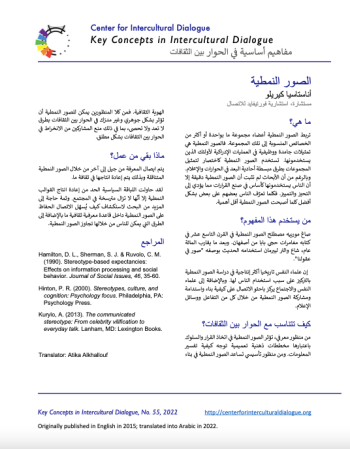
KC55 Stereotypes Translated into Arabic

Key Concepts in ICDContinuing translations of Key Concepts in Intercultural Dialogue, today I am posting KC#55: Stereotypes, which Anastacia Kurylo wrote in 2014, and which Atika Alkhallouf has now translated into Arabic.

As always, all Key Concepts are available as free PDFs; just click on the thumbnail to download the PDF. Lists organized chronologically by publication date and numberalphabetically by concept in English, and by languages into which they have been translated, are available, as is a page of acknowledgments with the names of all authors, translators, and reviewers.

KC55 Stereotypes_ArabicKurylo, A. (2022). Stereotypes [Arabic]. (A. Alkhallouf, Trans.) Key Concepts in Intercultural Dialogue, 55. Available from: https://centerforinterculturaldialogue.org/wp-content/uploads/2022/01/kc55-stereotypes_arabic.pdf

The Center for Intercultural Dialogue publishes a series of short briefs describing Key Concepts in Intercultural Dialogue. Different people, working in different countries and disciplines, use different vocabulary to describe their interests, yet these terms overlap. Our goal is to provide some of the assumptions and history attached to each concept for those unfamiliar with it. As there are other concepts you would like to see included, send an email to the series editor, Wendy Leeds-Hurwitz. If there are concepts you would like to prepare, provide a brief explanation of why you think the concept is central to the study of intercultural dialogue, and why you are the obvious person to write up that concept.


Creative Commons License
This work is licensed under a Creative Commons Attribution-NonCommercial-NoDerivatives 4.0 International License.