Madeleine Bausch Profile

ProfilesMadeleine Bausch is currently a Ph.D. candidate (University of Passau, Germany), as well as researcher and lecturer at the University of Chile in Santiago de Chile.

Madeleine BauschShe holds a B.A. from University of Mannheim, Germany (2013) in Culture and Business Studies with a specialization in Romance linguistics and an M.A. in International Cultural and Business Studies from the University of Passau (2017). In her Ph.D. (2022) at the Chair of Intercultural Communication (University of Passau), she examined the transfer of organizational practices (quality management) of German family-led companies in Brazil from an interpretive paradigm using qualitative, case-based methodology. In addition, she has participated in projects examining the development of the research field of International and Intercultural Management.

In research and teaching, she primarily deals with intercultural management and intercultural communication in organizations, as well as creativity and innovation in multicultural workplaces and urban ecosystems. Her main focus of intercultural studies is on the Latin American and European regions. During and between her studies, she has spent several years in South America, mainly in Chile and Brazil.

Madeleine has lectured at the University of Passau (Germany), University of Chile (Chile), Estonian Business School (Estonia), Turkish-German University (Turkey), University Jyväskylä (Finland), and Aix-Marseille University (France).

She is co-author of the textbook Constructive Intercultural Management (2021) with Christoph Barmeyer and Ulrike Mayrhofer, and has published in international journals such as International Business Review, International Journal of Cross-Cultural Management, and SAGE Open. Moreover, she has authored and co-authored several book chapters, including on the transfer of managerial practices (2021), on central scholars of intercultural management (forthcoming, in German), and on business school legitimacy (forthcoming).

She is an alumna of the Studienstiftung des Deutschen Volkes, an active member of AIB, EIBA, and GEM&L, and chairwoman of the German association of Students for Liberty (Studenten für die Freiheit e.V.).

She can be contacted via mbausch AT fen.uchile.cl

Selected publications:

Barmeyer, C., Bausch, M., & Mayrhofer, U. (2021). Constructive intercultural management: Integrating cultural differences successfully. Cheltenham, UK: Edward Elgar.

Bausch, M., Barmeyer, C., & Mayrhofer, U. (2021). Facilitating factors in the cross-cultural transfer of management practices: The case of a German multinational in Brazil. International Business Review, 101921. https://doi.org/10.1016/j.ibusrev.2021.101921

Wieczorek, O., Eckl, M., Bausch, M., Radisch, E., Barmeyer, C., & Rehbein, M. (2021). Better, Faster, Stronger: The Evolution of Co-authorship in International Management Research Between 1990 and 2016. SAGE Open, October-December, 1 –15. https://doi.org/10.1177%2F21582440211061561

Bausch, M., Barmeyer, C., & Mayrhofer, U. (2020). Cultural challenges and quality management practices of a German multinational in Brazil. In B. Amann & J. Jaussaud (Eds.), Cross-cultural challenges in international management (pp. 74-93). New York: Routledge.

Barmeyer, C. & Bausch, M. (2020). Comprendre l’évolution du management interculturel sur la base des revues académiques entre 2001 et 2016. In F. Goxe, N. Prime, & M. Viegas-Pires (Eds.), La recherche en management international: continuité et ruptures (pp. 199-227). Paris, France: Vuibert.

Bausch, M., Barmeyer, C. & Grigo, B. (2020). Internationaler transfer von qualitätsmanagementpraktiken: Erfolgsfaktoren der interkulturellen zusammenarbeit bei liebherr Brasilien. Zeitschrift Führung + Organisation, 89(2), 121-126.

Barmeyer, C., Bausch, M., & Moncayo, D. (2019). Cross-cultural management research: Topics, paradigms, and methods—A journal-based longitudinal analysis between 2001 and 2018. International Journal of Cross Cultural Management, 19(2), 218-244.
https://doi.org/10.1177/1470595819859603


Work for CID:
Madeleine Bausch wrote KC104: Constructive Intercultural Management and has translated it into GermanPortuguese, and Spanish.

CFP Nordic Migration Research: RE:MIGRATION (Denmark)

ConferencesCall for papers: Nordic Migration Research conference, RE:MIGRATION – New perspectives on movement, research, and society, University of Copenhagen, Denmark, 17-19 August 2022. Deadline: 4 April, 2022.

The term RE: – familiar from the subject lines of email threads – means regarding or in response to, and as such RE:MIGRATION is an invitation to reflect on key questions in migration studies in the current moment as interventions in an ongoing conversation. However, as a prefix, re- also introduces a temporality. It can speak both to a fresh start – rebuilding or reimagining – and to inevitable repetition. It therefore also invites us to consider migration not as singular or exceptional, but as part of the very rhythm of social life across the globe.

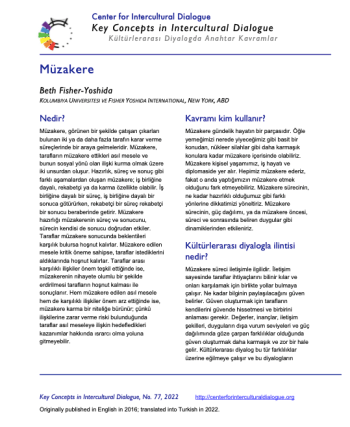
KC77 Negotiation Translated into Turkish

Key Concepts in ICDContinuing translations of Key Concepts in Intercultural Dialogue, today I am posting KC77: Negotiation, which Beth Fisher-Yoshida wrote for publication in English in 2016, and which Candost Aydın has now translated into Turkish.

As always, all Key Concepts are available as free PDFs; just click on the thumbnail to download. Lists of Key Concepts organized chronologically by publication date and number, alphabetically by concept, and by languages into which they have been translated, are available, as is a page of acknowledgments with the names of all authors, translators, and reviewers.

KC77 Negotiation_TurkishFisher-Yoshida, B. (2022). Negotiation [Turkish]. (C. Aydın, Trans.). Key Concepts in Intercultural Dialogue, 77. Retrieved from: https://centerforinterculturaldialogue.org/wp-content/uploads/2021/12/kc77-negotiation_turkish.pdf

If you are interested in translating one of the Key Concepts, please contact me for approval first because dozens are currently in process. As always, if there is a concept you think should be written up as one of the Key Concepts, whether in English or any other language, propose it. If you are new to CID, please provide a brief resume. This opportunity is open to masters students and above, on the assumption that some familiarity with academic conventions generally, and discussion of intercultural dialogue specifically, are useful.

Wendy Leeds-Hurwitz, Director
Center for Intercultural Dialogue


Creative Commons License
This work is licensed under a Creative Commons Attribution-NonCommercial-NoDerivatives 4.0 International License.

U of the South: Dialogue Across Difference (USA)

“Job

Director, Dialogue Across Difference Programs at University of the South, Sewanee, TN, USA. Deadline: Open until filled (posted January 2022).

Committed to creating and maintaining a diverse and inclusive campus with respectful engagement in the communities we support, Sewanee’s Office of Civic Engagement seeks to enhance the impact of its current Dialogue Across Difference Program under the leadership of its next director of dialogue programs. Working with faculty, staff, and students in the College and the School of Theology, the Director of Dialogue across Difference Programs creates, promotes, and presents training and initiatives focused on democratic engagement and enhanced mutual understanding through respectful on dialogue on racial, religious, ethnic, and political differences.

U Warwick: TESOL and Intercultural Communication – 2 positions (UK)

“Job2 positions: Assistant Professor of TESOL, and Assistant Professor of Intercultural Communication, Department of Applied Linguistics, University of Warwick, UK. Deadline: 14 March 2022.

University of Warwick is looking for two experienced and creative Senior Teaching Fellows (Assistant Professor – Teaching) who will contribute to the department’s teaching provision at undergraduate and postgraduate levels and the support activities associated with these.

  1. Assistant Professor of TESOL:

You will be an applied linguist with a strong academic and professional background in TESOL who is able to deliver master’s modules on language testing and assessment and contribute to teaching in one or more of the following areas: discourse analysis, curriculum and materials development, online pedagogies. You will have a PhD in a relevant field or be very close to completion and you will have experience of teaching at university level.

2. Assistant Professor of Intercultural Communication

You will be an academic with a professional background in intercultural communication who is able to deliver master’s modules on quantitative research methodology and contribute to teaching and master’s research supervision in two or more of the following areas: intercultural competence assessment, cross-cultural psychology, cross-cultural marketing, international development. You will have a PhD in a relevant field or be very close to completion and you will have experience of teaching at university level.

CFP Journal of Transdisciplinary Peace Praxis

“Publication

Call for Papers for the 8th issue of Journal of Transdisciplinary Peace Praxis. Deadline: 15 March 2022.

The Journal of Transdisciplinary Peace Praxis (JTPP) is concentrating the eighth issue on the broad theme of modelling and encouraging the values of peace and restoration in a fractured/polarised world order. A critical set of skills for those either working in the field of conflict resolution or aspiring to be peacemakers, modelling peaceful nonviolent values are in short supply in our postmodern and post-truth reality. They encourage all those working in the expansive and growing field of Peace, Conflict, and Justice Studies to submit their conference presentation papers, praxis and book review ideas, and full-length manuscripts for publication, especially those addressing:

  • The interplay between restorative and peacemaking values;
  • Non-traditional, or lesser known, exemplars of peacemaking and peacebuilding;
  • The challenges of embracing inclusive excellence in peacework;
  • The difficulties of justifying peacework in our capitalist and neoliberal world system.


CID Poster #11: Language and Intercultural Communication (reprise)

CID Posters(We are reprising the series of posters, because it has been several years since they were originally created, and they are much too wonderful to let them not be noticed by newcomers to the site!)

This is CID Poster #11, designed by Brandon Peña, illustrating a quote related to KC78: Language and Intercultural Communication by Jane Jackson. This is the first designed by someone other than Linda J. de Wit. It came about because he is a student of Anna Klyueva, at the University of Houston-Clear Lake, and she turned posters into a course project (other faculty are welcome to do so as well, of course).

CID Poster #11: Language and Intercultural Communication

Just in case anyone wants to cite this poster, the following would be the recommended format:

Center for Intercultural Dialogue. (2018). Language and intercultural communication. CID Posters, 11. Available from:
https://centerforinterculturaldialogue.org/wp-content/uploads/2018/02/language-and-intercultural-communication-poster.png

As with other series, CID Posters are available for free on the site; just click on the thumbnail to download a printable PDF. They may be downloaded, printed, and shared as is, without changes, without cost, so long as there is acknowledgment of the source.

As with other series, if you wish to contribute an original contribution, please send an email before starting any work to receive approval, to minimize inadvertent duplication, and to learn about technical requirements. As is the case with other CID Publications, posters should be created initially in English. Given that translations of the Key Concepts in Intercultural Dialogue have received so many views, anyone who wishes to translate their own poster into another language (or two) is invited to provide that as well. If you want to volunteer to translate someone else’s poster into a language in which you are fluent, send in a note before starting, to receive approval and to confirm no one else is working on the same one.

Wendy Leeds-Hurwitz
Director, Center for Intercultural Dialogue
intercult.dialogue AT gmail.com


Creative Commons License
This work is licensed under a Creative Commons Attribution-NonCommercial-NoDerivatives 4.0 International License.

Teaching Literature in the Language Classroom (Greece but Online)

EventsTeaching literature in the language classroom: The basis of establishing an intercultural dialogue and students redefining their own identity, Communication Institute of Greece, February 25, 2022, 15:00 – 16:00 EET time, Online via zoom.

This workshop will demonstrate how teaching literature in the foreign language classroom can provide a platform for students to start a dialogue over a contentious subject that they would not approach otherwise. Examples will be presented from francophone literature alongside their translations. The workshop will run in English.

Led by the Vice-president of Research and Academic Affairs of the Communication Institute of Greece and Associate Professor in Education UCL Institute of Education University of London, UK,
Dr. Fotini Diamantidaki.

Study Abroad NYU London: Intercultural Perspectives on Teaching and Learning (UK)

Study Abroad

Summer 2022 Study Abroad: Intercultural Perspectives on Teaching and Learning, New York University in London, UK, July 4 – 18, 2022. Deadline: March 23, 2022 (or until all places filled).

Examine intercultural perspectives on teaching and learning across national borders. Explore the role that class, race, gender, economics, politics, religion, and cultural heritage play in the evolving dynamics in language policy, bilingual and world language education, and international education.

Participants in the Summer 2022 program in London will critically reflect upon the challenges and opportunities facing educators, school administrators, policy-makers, community organizers, students, etc., in language education, intercultural relations, and international education in the United Kingdom. Our studies will consider the impact of large-scale events across the UK and around the world, such as the anti-globalization forces behind Brexit, the COVID-19 pandemic on education and intergroup relations, the evolving Sino-British relationship over the political transformation in Hong Kong, cross-border infusion and adaptation of immigrants or refugees.

Through seminars and guided site visits, we will share insights with scholars, teachers, policy-makers, writers, administrators, and immigrant community organizers in language, as well as international and intercultural education. Museum visits, theatrical performances, and day trips to important cultural sites are being planned to enrich our experience in intercultural learning positions.

NOTE: This course will be taught by Professor Casey Lum, Associate Director of the Center for Intercultural Dialogue.

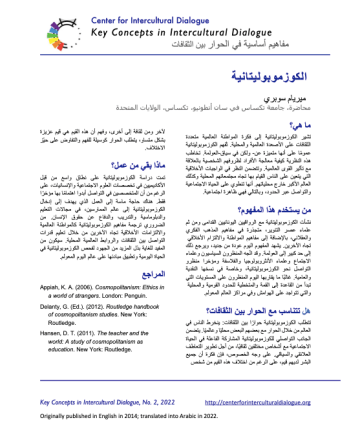
KC2: Cosmopolitanism Translated into Arabic

Key Concepts in ICDContinuing translations of Key Concepts in Intercultural Dialogue, today I am posting KC#2: Cosmopolitanism, which Miriam Sobre wrote for publication in English in 2014, and which Mohammed Guamguami has now translated into French.

As always, all Key Concepts are available as free PDFs; just click on the thumbnail to download. Lists of Key Concepts organized alphabetically by conceptchronologically by publication date and number, and by languages into which they have been translated, are available, as is a page of acknowledgments with the names of all authors, translators, and reviewers.

KC2 Cosmopolitanism_ArabicSobre, M. (2022). Cosmopolitanism [Arabic]. (M. Guamguami, Trans.). Key Concepts in Intercultural Dialogue, 2. Available from: https://centerforinterculturaldialogue.org/wp-content/uploads/2022/01/kc2-cosmopolitanism_arabic.pdf

If you are interested in translating one of the Key Concepts, please contact me for approval first because dozens are currently in process. As always, if there is a concept you think should be written up as one of the Key Concepts, whether in English or any other language, propose it. If you are new to CID, please provide a brief resume. This opportunity is open to masters students and above, on the assumption that some familiarity with academic conventions generally, and discussion of intercultural dialogue specifically, are useful.

Wendy Leeds-Hurwitz, Director
Center for Intercultural Dialogue


Creative Commons License
This work is licensed under a Creative Commons Attribution-NonCommercial-NoDerivatives 4.0 International License.