CFP Howard J of Communications: Intersectionality

“PublicationCall for articles: Special Issue of Howard Journal of CommunicationsInvestigating Intersectionality in Communication. Deadline: 30 September 2022.

Kimberlé Crenshaw, a few decades ago, conceptualized the term intersectionality to vividly argue the impact of a person’s multiple and interacting social identities on how they are treated by others. For communication scholars, it exposed the insufficiency and inadequacy of work that focus on studying single variables and it alerted us to the need to incorporate the effects of multiple embedded variables during communication. For instance, the fact that one is a woman, African American, and lesbian and/or living with a disability may interactively impact her status within society and the effects of how others communicate with her. This complexity identifies the realism of life. Although, Crenshaw coined the term intersectionality in 1989 and it was added to the Oxford Dictionary in 2015. Although the concept is increasingly discussed in academic literature, it is not yet fully explored and understood.

Therefore, the Howard Journal of Communications calls on scholars to submit manuscript for a special issue intended to deeply explore intersectionality within the field of communication as it pertains to African American social conditions. This call provides a wide range of choices for exploring communication and social conditions with the central theme of intersectionality. Submissions should be, preferably, research-based, and no more than 10,000 characters (including references) long. Suggested themes are listed as follows.

– Reconceptualizing identity in intersectionality
– Intersectional rhetoric
– Intersectionality: Theory or praxis?
– Research methods for exploring intersectionality
– Intersectionality critique
– Re-examining historical scholarship in communication and intersectionality
– Communication technologies and intersectional issues
– Other possible topics

CFP 8th International Conference on Multicultural Discourses (South Africa)

ConferencesCall for papers: 8th International Conference on Multicultural Discourses, December 12-14, 2022, University of the Western Cape, Rondebosch, South Africa. Deadline: 1 October 2022 (extended to 15 November 2022).

The 8th International Conference on Multicultural Discourses, under the auspices of the International Association of Multicultural Discourses, will be co-organized by the Centre for Advanced Studies of African Society (CASAS), the University of the Western Cape, South Africa, and the School of Contemporary Chinese Discourse Studies, Hangzhou Normal University, China. The conference theme will be: The Choice/Voice of Cooperation in the Post-pandemic World.

Mankind is witnessing yet again the centennial moment of global transformation and the world is ridden with grave challenges and great opportunities. To answer to these uncertain winds of change, scholars from diverse fields such as communication, media, language, literature, culture, history, international relations, etc. are invited to offer their insights into topics of, but not restricted to:
· Discourses of globalization, cultural equality, interconnection;
· Discourses of security, conflict, war, peace;
· Discourses of protectionism, (in)tangible borders, immigration, racism;
· Discourses of development, cooperation, common prosperity;
· Discourses of digital, multi-modal, cinematic representations;
· Discourses of nuclear armament, climate change, poverty.

A World Without Borders?

Resources in ICD“ width=Crawford, James. (2022). The edge of the plain: How borders make and break our world. Edinburgh, UK: Canongate.

Crawford blends history, travel and reportage to take readers on a wide-ranging journey through the history of borders and an examination of their role in shaping our world today. This seems a useful discussion for courses considering intercultural dialogue as a topic, given that such dialogue assumes the existence of various sorts of borders.

There’ve been all of these issues around borders, and I wanted to understand where they came from…Every border, in a sense, is a story, and it’s a story that we tell our selves

James Crawford (from CNN interview)

The Edge of the Plain explores how borders have grown and evolved to take control of our landscapes, our memories, our identities and our destinies. As nationalism, climate change, globalisation, technology and mass migration all collide with ever-hardening borders, something has to give. And Crawford asks, is it time to let go of the lines that divide us?

There is an interview of the author by Christiane Amanpour on CNN which also might be useful as a course resource.


Hebrew U: Communication & Journalism (Israel)

“Job

Tenure track position in Communication and Journalism, Faculty of Social Sciences, Hebrew University of Jerusalem, Jerusalem, Israel. Deadline: 30 September 2022.

The Noah Mozes Department of Communication and Journalism at The Hebrew University of Jerusalem invites outstanding candidates in communication to apply for a tenure-track position starting July, 2023. The department is particularly interested in candidates with demonstrated expertise in one of the following fields of research:

* Language, media and communication
* Cinema and visual media

Applicants must hold a Ph.D. degree at the time of hire, and demonstrate an active research program including peer-reviewed international publications in the relevant area. The person hired will teach introductory and advanced courses in communications in their areas of specialization. They will also be expected to supervise Masters and Ph.D. students and to contribute to departmental and university service.

U Hong Kong: Japanese Studies: Japan and the World (Hong Kong)

“Job

Professor/Associate Professor/Assistant Professor in Japanese Studies (Japan and the World) in the School of Modern Languages and Cultures, University of Hong Kong, Hong Kong, China. Deadline: 1 October 2022.

Applications are invited for appointment as Tenure-Track Professor/Associate Professor/Assistant Professor in Japanese Studies (Japan and the World) in the School of Modern Languages and Cultures, to commence on July 1, 2023 or as soon as possible thereafter, on a three-year fixed-term basis, with the possibility of renewal and with consideration for tenure before the expiry of a second three-year fixed-term contract. The level of appointment will be determined based on qualifications and experience of the successful candidate. Exceptionally outstanding candidates at the Professor/Associate Professor level may be considered for appointment on tenure terms subject to approval.

Applicants should have an internationally recognised record of research excellence and possess proficient or near-proficient fluency in Japanese and English. We particularly encourage applications from scholars specializing in modern or contemporary Japan, whose work engages in the study of Japan in connection to other cultures and world regions, including in East Asia and beyond. Relevant areas of specialization include such fields as Anthropology, Sociology, International Relations, Media and Cultural Studies, Popular Culture, Literature, History, and other related areas. A digital approach to humanities, either methodologically or as research involving digital media (animation, gaming, etc.), is an additional advantage.

A Pot of Courage: Food and Intercultural Dialogue (Australia)

Applied ICDA Pot of Courage in Ballarat, Australia, is a not-for-profit social enterprise cafe empowering women of diverse cultural backgrounds through hospitality training and employment opportunities.

Sharing stories is what. . .breaks down cultural barriers.

A Pot of Courage founder Shiree Pilkinton turned a women’s group into a cookbook and a not-for-profit, converting cooking skills into income. “We call it an intercultural cafe because it’s more active than a multicultural cafe,” says Pilkinton. “Whether you’re Anglo Australian, Aboriginal or Persian, it doesn’t matter – there’s a place for you here.”

See the original article: Levin, Sofia. (11 July 2022). This Ballarat hidden gem empowers women through a culturally diverse cafe. SBS.

Create Wikipedia Entries on ICD Topics

Intercultural Pedagogy

Wiki Education is asking that faculty consider assigning students to write articles for Wikipedia. Wikipedia has limited entries on intercultural dialogue-related topics. The two seem a natural fit.

In Wiki Education’s Wikipedia Student Program, college and university instructors assign students to write Wikipedia articles, empowering them to share knowledge with the world. Students research course-related topics that are missing, underrepresented, incomplete or inaccurate, synthesize the available literature, and use free tools and trainings to add information to Wikipedia. They are now accepting submissions for the Fall 2022 term.

I’ve not used Wikipedia assignments in courses because I retired before this became a thing. However, I learned the process in order to create a page for the Center for Intercultural Dialogue, and later was asked by a  colleague to please create an entry for intercultural dialogue as a topic, as there was not yet anything available on the site. So I know it’s not difficult, and I also know that there is not as much content on related topics as there might be. Therefore, I suggest that anyone looking for a new and interesting type of applied assignment might want to consider the creation of Wikipedia pages as a possibility as a way to ensure that Wikipedia has the most up-to-date content relevant to intercultural dialogue topics.

For students, one benefit is that it is possible to check how many times anyone has viewed an entry. The ICD entry has been available for under two years, but has already had over 5000 views. Having that kind of impact should help motivate any student to do their best work.

Wendy Leeds-Hurwitz, Director
Center for Intercultural Dialogue

AEJMC Emerging Scholars Grants: 2023

Grants

AEJMC Emerging Scholars Program 2023 Research or Teaching Grants. Deadline: 3 October 2022.

The Association for Education in Journalism and Mass Communication (AEJMC) Emerging Scholars Program will award $3,500 research and teaching grants to up to four research or teaching proposals to encourage innovative and timely projects in journalism and mass communication.AEJMC members may submit proposals for these grants in the fall of 2022, and selections will be announced by early January 2023.

The AEJMC Emerging Scholars Program is designed to develop and nurture JMC teachers and researchers by fostering an intellectually stimulating environment. This program’s mission is to identify, encourage and recognize some of AEJMC’s most promising emerging scholars by providing funding for research or teaching projects. If requested, proposals selected for funding will be matched with a recognized scholar to serve as a mentor throughout the project. The mentor would serve as a resource and sounding board for the project. Proposals should outline an individual’s own significant research or teaching project. Proposals may also be submitted by a research team, which would share the award amount if selected.

U Amsterdam: Diaries on Self-representation, Cultural Diversity, and Migration (Netherlands)

Postdocs
Postdoctoral Researcher, Amsterdam Diaries: Self-representation, Cultural Diversity, and Migration,
Universiteit van Amsterdam, Netherlands. Deadline: 1 September 2022.

The Amsterdam School of Regional, Transnational and European Studies (ARTES) currently has a vacant Postdoc researcher position as part of the broader field Cultural Heritage and Identity. Within this field the focus is on material and immaterial heritage, including digital Humanities and on Cultural Heritage and societal changes. You will be part of an interdisciplinary research team that collects and analyzes diaries of ordinary people of the 19th and 20th centuries who wrote about their daily lives in Amsterdam. In the light of Amsterdam’s 750th anniversary in 2025, the team investigates what diaries can tell us about lived and narrated experiences of Amsterdam as a multicultural city.

British Values in Intercultural Education in the UK

“Associate

What has come to be known as “British values” caught the attention of the participants in my recent summer study abroad program on Intercultural Perspectives on Teaching and Learning.

First published on November 27, 2014, by the UK’s Department of Education under the 2010 to 2015 Conservative and Liberal Democrat coalition government, the guidance “aims to help both independent and state-maintained schools understand their responsibilities in this area. All have a duty to ‘actively promote’ the fundamental British values of democracy, the rule of law, individual liberty, and mutual respect and tolerance of those with different faiths and beliefs” and to ensure young people leave school prepared for life in modern Britain (GOV.UK).

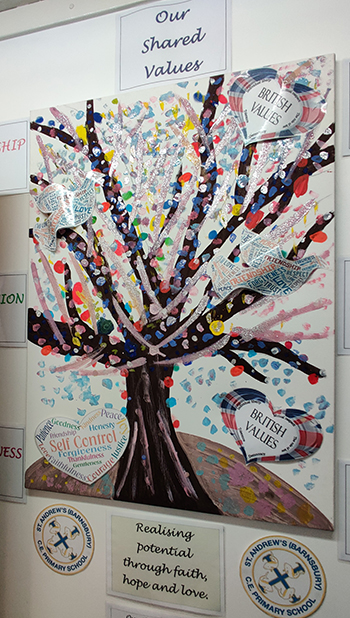
British values poster
A big poster display with a highlight on British values in St. Andrew’s (Barnsbury) CofE Primary School in London. (Photo credit: Casey Lum)

Indeed, a great deal of what we witnessed during our co-curricular field study visits of four state-funded primary and secondary schools in London attested to the schools’ curricular efforts for nurturing multicultural sensibilities among their students. However, the notion and the government-mandated promotion of “British values” has not gone without attracting diverging interpretations or reactions since the guidance’s initial announcement and implementation (see for example “The problem with teaching ‘British values’ in school“).

During a semi-formal interview, a high-ranking administrator at St. Andrew’s (Barnsbury) CofE [Church of England] Primary School (himself a veteran teacher) observed that many of his contemporaries were unsure what the concept really was when it was introduced; many others continue to be weary about it today. Given the country’s colonial history, for example, questions have been raised about whether these values were nationalistic in nature or not. But over the years, our host added, many educators in the UK have come to appreciate what those values entail and can do in promoting what we would call intercultural competence among the young. In fact, Mayflower Primary School in Towers Hamlets, another of the schools we visited, maintains a dedicated web page to showcase the school’s interpretation of and approach to promoting British values.

Casey Man Kong Lum, Associate Director
Center for Intercultural Dialogue