United Nations U: Media & Engagement (Japan)

“JobMedia and Engagement Specialist, United Nations University, Tokyo, Japan. Deadline: Open until position is filled.


For the past four decades, United Nations University (UNU) has been an important think tank for impartial research on the pressing global problems of human survival, conflict prevention, development, and welfare. Based at UNU’s Headquarters in Tokyo, the Institute for the Advanced Study of Sustainability (UNU-IAS) is charged with the mission of serving the international community through policy-relevant research and capacity development focused on sustainability, including its social, economic, and environmental dimensions.

The Media & Engagement Specialist will promote UNU-IAS and its activities to raise visibility and impact. She/he will play a key role in implementing the communications strategy of UNU-IAS, with the overall goal of shaping, packaging, and delivering the institute’s products and expertise to maximize impact, effect positive change, and drive further demand for UNU-IAS work. Required qualifications and experience include, but are not limited to: a master’s degree or equivalent qualification in communications, journalism, sustainable development, environment, social sciences, international relations, or a related field; equivalent experience in combination with a bachelor’s degree will be considered a minimum of 5 years of working experience in public information, journalism, international relations, public relations or related area is required, preferably in an international setting.
UNESCO: Communications Consultant in Gender and Education (France)

“Job

Communications Consultant (Gender and Education), UNESCO, Paris, France. Deadline: 15 September, 2021.

Under the overall supervision of the Director of the Division for Education 2030 and the Chief of the Section of Education for Inclusion and Gender Equality, and the direct supervision of the Communication Officer on one part and the Liaison Officer for the Joint Program on the other part, the Contractor will support the digital and audio-visual communication efforts of the Section and the visibility efforts of the Joint Program (from 1 September to 30 December 2021). Among other duties, the successful candidate will help to implement the digital communication plan and update/improve it as needed based on upcoming landmarks and events, including a working list of outputs and timeline. Required qualifications include, but are not limited to, advanced university degree (Masters or equivalent) in communications, media/journalism, political science, social science or a related field. No less than two years of experience developing, producing, disseminating and monitoring creative communication and digital content, of which preferably one year at international level. Excellent knowledge of both English and French.

Claiming the Power of Dialogue toolkit (France)

Applied ICD

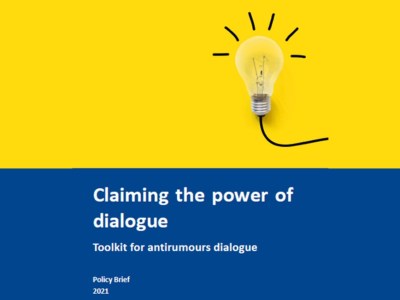
Claiming the Power of Dialogue: Toolkit for Antirumours Dialogue, Council of Europe, Strasbourg, France. Published April, 2021.

Imagine you are having a conversation with your neighbours when they drop a negative comment about migration. We all face similar situations from time to time – how have you handled them?

Did you let it pass or did you speak up? Did you explain why the comment was discriminatory or hurtful? In the policy brief “Claiming the power of dialogue: Toolkit for antirumours dialogue,” strategies for face to face dialogue are presented with the aim of providing the readers with a simple toolkit to engage in active antirumours dialogue. The policy brief complements the Antirumours handbook and other antirumours materials, and is part of a series of papers and training materials developed for the Academy on Alternative Narratives and Intercultural Communication.

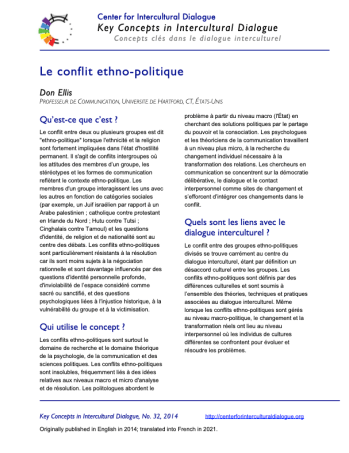
KC32 Ethno-Political Conflict Translated into French

Key Concepts in ICDContinuing translations of Key Concepts in Intercultural Dialogue, today I am posting KC32: Ethno-Political Conflict , which Donald G. Ellis published in English in 2014, and which Mohammed Guamguami has now translated into French.

As always all Key Concepts are availableas free PDFs; just click on the thumbnail to download. Lists organized  chronologically by publication date and numberalphabetically by concept in English, and by languages into which they have been translated, are available, as is a page of acknowledgments with the names of all authors, translators, and reviewers.

KC32 Ethnopolitical conflict_French

Ellis, D. (2021). Le conflit ethno-politique. (M. Guamguami, Trans.). Key Concepts in Intercultural Dialogue, 32. Available from: https://centerforinterculturaldialogue.org/wp-content/uploads/2021/07/kc32-ethnopolitical-conflict_french.pdf

If you are interested in translating one of the Key Concepts, please contact me for approval first because dozens are currently in process. As always, if there is a concept you think should be written up as one of the Key Concepts, whether in English or any other language, propose it. If you are new to CID, please provide a brief resume. This opportunity is open to masters students and above, on the assumption that some familiarity with academic conventions generally, and discussion of intercultural dialogue specifically, are useful.

Wendy Leeds-Hurwitz, Director
Center for Intercultural Dialogue


Creative Commons License
This work is licensed under a Creative Commons Attribution-NonCommercial-NoDerivatives 4.0 International License.

U Edinburgh: Muslim Societies in a Globalized World (UK)

FellowshipsFellow in Contemporary Muslim Societies in a Globalized World, Alwaleed Centre for the Study of Islam in the Contemporary World, University of Edinburgh, Edinburgh, UK. Deadline: 16 September, 2021.

The Alwaleed Centre for the Study of Islam in the Contemporary World at the University of Edinburgh is looking for an early career fellow to contribute to its growing research, teaching and outreach program on contemporary Muslim societies in a globalized world. The post-holder will conduct research into the contemporary social/political/religious dynamics of a key region, or regions, of the Muslim world. Priority will be given to applicants whose research focuses on regions not currently well covered by the Centre’s team (e.g. Sub-Saharan Africa, South Asia, Central Asia, East Asia, The Americas) or on supra-national processes. Applications from candidates whose work engages with broader transnational, international or global contexts would be particularly welcomed, as the post-holder will work with the Centre’s director to develop a research cluster on the globalized Muslim world. The post-holder will also be expected to contribute to the Alwaleed Centre’s teaching and outreach activities. The school welcomes applications for this post from all qualified candidates and particularly welcome applications from members of minority ethnic groups, who are currently under-represented in the School of Literatures, Languages and Cultures.

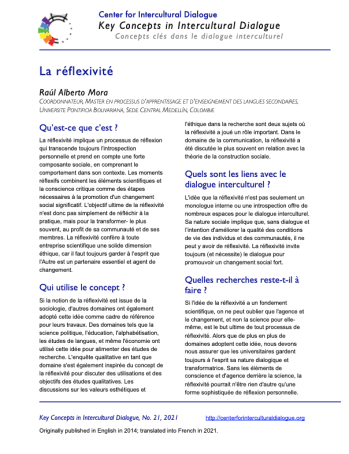
KC21 Reflexivity Translated into French

Key Concepts in ICDContinuing translations of Key Concepts in Intercultural Dialogue, today I am posting KC21: Reflexivity, which Raúl Alberto Mora published in English in 2014, and which Mohammed Guamguami has now translated into French.

As always, all Key Concepts are available as free PDFs; just click on the thumbnail to download. Lists of Key Concepts organized chronologically by publication date and number, alphabetically by concept, and by languages into which they have been translated, are available, as is a page of acknowledgments with the names of all authors, translators, and reviewers.

KC21 Reflexivity_FrenchMora, R. A. (2021). La réflexivité. (M. Guamguami, trans.). Key Concepts in Intercultural Dialogue, 21. Available from: https://centerforinterculturaldialogue.org/wp-content/uploads/2021/07/kc21-reflexivity_french.pdf

If you are interested in translating one of the Key Concepts, please contact me for approval first because dozens are currently in process. As always, if there is a concept you think should be written up as one of the Key Concepts, whether in English or any other language, propose it. If you are new to CID, please provide a brief resume. This opportunity is open to masters students and above, on the assumption that some familiarity with academic conventions generally, and discussion of intercultural dialogue specifically, are useful.

Wendy Leeds-Hurwitz, Director
Center for Intercultural Dialogue


Creative Commons License
This work is licensed under a Creative Commons Attribution-NonCommercial-NoDerivatives 4.0 International License.

King’s College London: Cultural Competency (UK)

“JobLecturer in Cultural Competency, King’s College London, London, UK. Deadline: 5 September, 2021.

King’s College London wishes to appoint a full-time Lecturer in Cultural Competency (Academic Education Pathway), tenable for three years, from September 2021. The successful candidate will be based in the Faculty of Arts & Humanities, and join colleagues in the Cultural Competency Institute, which oversees the cross-Faculty development and implementation of Cultural Competency at King’s. The successful candidate will play a key role in the collaborative envisioning, planning, and organization of this Institute. In particular, they will help develop, convene, teach, and assess a range of intellectually vibrant cross-Faculty undergraduate modules in topics relating to Cultural Competency. These modules will draw on the latest research and pedagogy, articulating the significant interface between culture(s), language(s), and identity/identities, exploring both the theorization of Cultural Competency across disciplines, and its application in diverse social, community, and professional contexts. The school is committed to ensuring that applicants from under-represented backgrounds, and/or those with protected characteristics, feel confident applying to work with us. It strongly encourages applications from members of groups with protected characteristics, and/or that have been marginalized on any grounds, so that the school better reflect the community it serves.

Making Better Social Worlds for the 21st Century (Online)

ConferencesMaking Better Social Worlds for the 21st Century conference, CMM Institute with AFT & FKCC, USA & UK, September 23-25, 2021 (online). No deadline, but advance registration is required to receive login information.

Making Better Social Worlds for the 21st Century is a special online conference being hosted jointly by the CMM Institute (USA), the Association for Family Therapy (UK) and the Friends of the Kensington Consulting Centre (KCC, also in the UK). Contributors and participants at the conference will be exploring and reflecting upon the values, ethics and practices of all three host organizations and sharing new developments that can help make a better and more just world for all of us. This conference is fully virtual: all sessions will take place online, with a combination of live and pre-recorded sessions. Replays will also be available for many of the sessions.

The CMM Institute is a connector and cultivator of all things to do with the theory and practice of the Coordinated Management of Meaning (CMM) that contributes to making better social worlds. AFT, the Association for Family Therapy and Systemic Practice, is a registered charity working to benefit the public by promoting effective family therapy and systemic services and high standards of professional training and practice. FKCC, Friends of the Kensington Consulting Centre, work collectively to grow the values, ethics and practices emanating from the KCC school of therapy, consultation, management and research. 

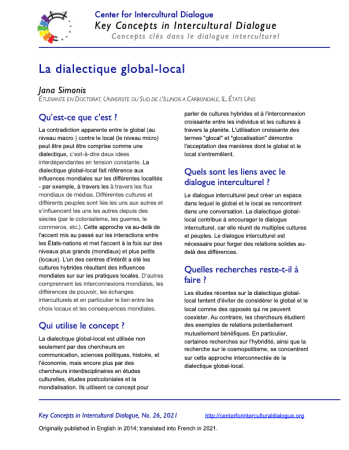
KC26 Global-Local Dialectic Translated into French

Key Concepts in ICDContinuing translations of Key Concepts in Intercultural Dialogue, today I am posting KC#26 Global-local dialectic, which Jana Simonis published in English in 2014, and  which Mohammed Guamguami has now translated into French.

As always, all Key Concepts are available as free PDFs; just click on the thumbnail to download. Lists of Key Concepts organized chronologically by publication date and number, alphabetically by concept, and by languages into which they have been translated, are available, as is a page of acknowledgments with the names of all authors, translators, and reviewers.

KC26 Global-local dialectic_French

Simonis, J. (2021). La dialectique global-local. (M. Guamguami, Trans.). Key Concepts in Intercultural Dialogue, 26. Available from: https://centerforinterculturaldialogue.org/wp-content/uploads/2021/07/kc26-global-local-dialectic_french.pdf

If you are interested in translating one of the Key Concepts, please contact me for approval first because dozens are currently in process. As always, if there is a concept you think should be written up as one of the Key Concepts, whether in English or any other language, propose it. If you are new to CID, please provide a brief resume. This opportunity is open to masters students and above, on the assumption that some familiarity with academic conventions generally, and discussion of intercultural dialogue specifically, are useful.

Wendy Leeds-Hurwitz, Director
Center for Intercultural Dialogue


Creative Commons License
This work is licensed under a Creative Commons Attribution-NonCommercial-NoDerivatives 4.0 International License.

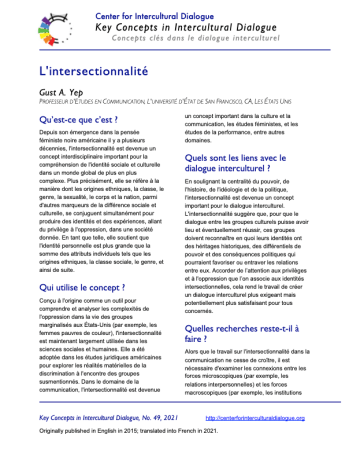
KC49 Intersectionality Translated into French

Key Concepts in ICDContinuing translations of Key Concepts in Intercultural Dialogue, today I am posting KC#49: Intersectionality, which Gust Yep published in English in 2015, and which Mohammed Guamguami has now translated into Spanish.

As always, all Key Concepts are available as free PDFs; just click on the thumbnail to download the PDF. Lists organized chronologically by publication date and numberalphabetically by concept in English, and by languages into which they have been translated, are available, as is a page of acknowledgments with the names of all authors, translators, and reviewers.

KC49 Intersectionality_French

Yep, G. (2021). L’intersectionnalité. (M. Guamguami, Trans.). Key Concepts in Intercultural Dialogue, 49. Available from:
https://centerforinterculturaldialogue.org/wp-content/uploads/2021/06/kc49-intersectionality_french.pdf

The Center for Intercultural Dialogue publishes a series of short briefs describing Key Concepts in Intercultural Dialogue. Different people, working in different countries and disciplines, use different vocabulary to describe their interests, yet these terms overlap. Our goal is to provide some of the assumptions and history attached to each concept for those unfamiliar with it. As there are other concepts you would like to see included, send an email to the series editor, Wendy Leeds-Hurwitz. If there are concepts you would like to prepare, provide a brief explanation of why you think the concept is central to the study of intercultural dialogue, and why you are the obvious person to write up that concept.


Creative Commons License
This work is licensed under a Creative Commons Attribution-NonCommercial-NoDerivatives 4.0 International License.