Gabriel Furmuzachi Profile

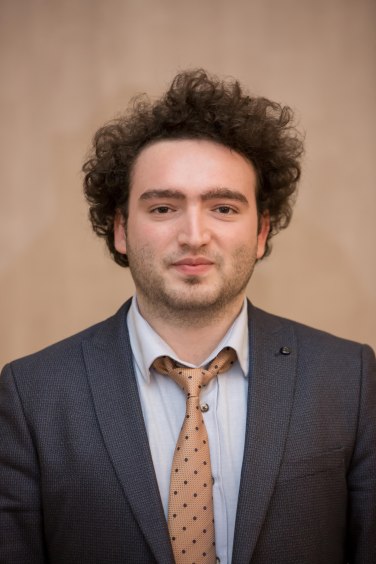
ProfilesGabriel Furmuzachi has a Ph.D. in philosophy from the University of Vienna (Austria).

Gabriel Furmuzachi

His academic work deals with issues such as multiculturalism and cosmopolitanism, language learning, communication and narrative identity. His present research interests gravitate around the idea of dialogue as a means of bringing cultures closer and of cosmopolitanism (both in its guise as identity and responsibility and as moral and institutional cosmopolitanism). He also has written essays about metaphors and emotions, the accommodationist use of reason in Canadian philosophy, the relationship between reason and nature, aesthetics and more.His non-academic work consists in surveying the international fine art trade (with emphasis on Eastern European art), buying and selling nineteenth and twentieth century paintings.

He is also involved in a series of projects spread on a wide cultural spectrum including, for example, Space and Place (a non-profit group based in Vienna, Austria, focused on urbanism and social interventions aiming at promoting cultural and social diversity in the city), Liternautica (a Romanian literature portal where he is part of the editorial team, encouraging young and established Romanian writers and building bridges between literary traditions) and Revista Timpul (where he is contributing with interviews and essays on various themes).


Work for CID:

Gabriel Furmuzachi wrote a guest post, Migration, Language and Dialogue, and conducted an interview: Vienna Coffeehouse Conversations: An interview with Eugene Quinn. He also translated KC1: Intercultural Dialogue, KC3: Intercultural Competence, and KC16: Migration into Romanian.

PLURAL+ 2017 Youth Video Festival

Applied ICDDo you have something to say about the themes of diversity, migration, social inclusion, and xenophobia? Submit videos less than 5 minutes in length to the PLURAL+ 2017 Youth Video Festival. Deadline: June 4, 2017

PLURAL+ is a joint initiative of the United Nations Alliance of Civilizations (UNAOC) and the International Organization for Migration (IOM) with the support of a wide network of international partners.

View winning videos from past and present PLURAL+ Youth Video Festivals, chosen by an international jury and partners from thousands of submissions from around the globe.

Save

Key Concept #1: Intercultural Dialogue Translated into Chinese

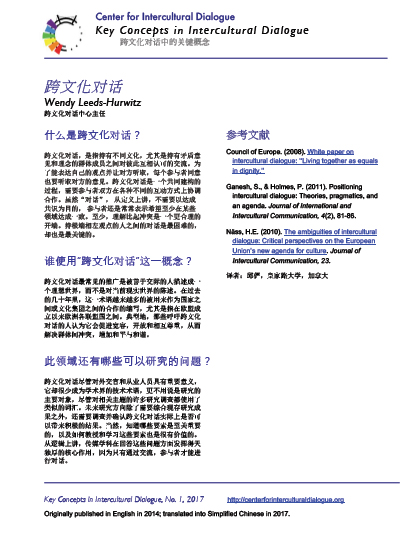
Key Concepts in ICDContinuing translations of Key Concepts in Intercultural Dialogue, today I am posting KC#1: Intercultural Dialogue, which I wrote and first published in English in 2014, and which Yan Qiu has now translated into Simplified Chinese.

As always, all Key Concepts are available as free PDFs; just click on the thumbnail to download. Lists of Key Concepts organized chronologically by publication date and number, alphabetically by concept, and by languages into which they have been translated, are available, as is a page of acknowledgments with the names of all authors, translators, and reviewers.

KC1 ICD_Chinese-simLeeds-Hurwitz, W. (2017). Intercultural dialogue [Simplified Chinese]. (Y. Qiu, Trans). Key Concepts in Intercultural Dialogue, 1. Available from: https://centerforinterculturaldialogue.org/wp-content/uploads/2017/05/kc1-icd_chinese-sim.pdf

If you are interested in translating one of the Key Concepts, please contact me for approval first because dozens are currently in process. As always, if there is a concept you think should be written up as one of the Key Concepts, whether in English or any other language, propose it. If you are new to CID, please provide a brief resume. This opportunity is open to masters students and above, on the assumption that some familiarity with academic conventions generally, and discussion of intercultural dialogue specifically, are useful.

Wendy Leeds-Hurwitz, Director
Center for Intercultural Dialogue


Creative Commons License
This work is licensed under a Creative Commons Attribution-NonCommercial-NoDerivatives 4.0 International License.

Goldsmiths Job Ad: Media & Communications (UK)

Lecturer in Media and Communications
Goldsmiths, University of London – Department of Media and Communications

The Department of Media and Communications seeks a temporary appointment to teach across our UG and MA curriculum. The appointed person will teach convene the BA Anthropology and Media, teach two modules on social theory and media rituals and deliver undergraduate learning and dissertation support.

Please note this post is fixed term from 1 September 2017 to 30 June 2018.

World Day for Cultural Diversity for Dialogue and Development

EventsSince 2002, May 21 has been chosen by the United Nations as World Day for Cultural Diversity for Dialogue and Development. As the UN page for the event points out: “Three-quarters of the world’s major conflicts have a cultural dimension. Bridging the gap between cultures is urgent and necessary for peace, stability and development.”

Here is their recommended list of Ten simple things YOU can do to celebrate the Day

  1. Visit an art exhibit or a museum dedicated to other cultures.
  2. Invite a family or people in the neighborhood from another culture or religion to share a meal with you and exchange views on life.
  3. Rent a movie or read a book from another country or religion than your own.
  4. Invite people from a different culture to share your customs.
  5. Read about the great thinkers of other cultures than yours (e.g. Confucius, Socrates, Avicenna, Ibn Khaldun, Aristotle, Ganesh, Rumi).
  6. Go next week-end to visit a place of worship different than yours and participate in the celebration.
  7. Play the “stereotypes game.” Stick a post-it on your forehead with the name of a country. Ask people to tell you stereotypes associated with people from that country. You win if you find out where you are from.
  8. Learn about traditional celebrations from other cultures; learn more about Hanukkah or Ramadan or about amazing celebrations of New Year’s Eve in Spain or Qingming festival in China.
  9. Spread your own culture around the world through our Facebook page and learn about other cultures.
  10. Explore music of a different culture.

City, University of London Job Ad: Media & Communications (UK)

Lecturer in Media and Communications (Digital Media)
City, University of London – School of Arts and Social Sciences – Department of Sociology

City, University of London is a global university committed to academic excellence with a focus on business and the professions and an enviable central London location.

City is in the UK’s top twenty (Guardian University Guide) and the world’s top four per cent (Times Higher Education World University Rankings). City attracts around 19,500 students (35% postgraduate), is well above the sector average for graduate employability in most subjects, and is eleventh in the UK for starting salaries and second in London for student satisfaction. City joined the University of London in 2016.

In the last REF, City doubled the proportion of its total academic staff producing world-leading or internationally excellent research.

The Department of Sociology is a leading centre for research and education. The REF confirmed the high quality of its research and the Department rose in the GPA rankings to equal-16th in the UK. 74% of its submitted research was graded as world-leading or internationally excellent, increasing from 45% in the 2008 RAE.

Person Specification
We are seeking to appoint an outstanding academic to a Lectureship in Media & Communications (Digital Media) to further enhance research and education in this area.

The appointed individual will demonstrate emerging strengths in research and publication and the ability to educate and supervise at undergraduate and postgraduate levels. The successful candidate will play a key role in developing a growing and dynamic research-driven Department.

Additional Information
City offers a sector-leading salary, pension scheme and benefits including a comprehensive package of staff training and development.

The role is available from autumn 2017.

Closing date: 11.59pm on 30th May 2017.

Interview date: 19th June 2017.

City, University of London is a global university committed to academic excellence with a focus on business and the professions and an enviable central London location.

City is in the UK’s top twenty (Guardian University Guide) and the world’s top four per cent (Times Higher Education World University Rankings). City attracts around 19,500 students (35% postgraduate), is well above the sector average for graduate employability in most subjects, and is eleventh in the UK for starting salaries and second in London for student satisfaction. City joined the University of London in 2016.

In the last REF, City doubled the proportion of its total academic staff producing world-leading or internationally excellent research.

The Department of Sociology is a leading centre for research and education. The REF confirmed the high quality of its research and the Department rose in the GPA rankings to equal-16th in the UK. 74% of its submitted research was graded as world-leading or internationally excellent, increasing from 45% in the 2008 RAE.

Person Specification
We are seeking to appoint an outstanding academic to a Lectureship in Media & Communications (Digital Media) to further enhance research and education in this area.

The appointed individual will demonstrate emerging strengths in research and publication and the ability to educate and supervise at undergraduate and postgraduate levels. The successful candidate will play a key role in developing a growing and dynamic research-driven Department.

Additional Information
City offers a sector-leading salary, pension scheme and benefits including a comprehensive package of staff training and development.

The role is available from autumn 2017.
Closing date: 11.59pm on 30th May 2017.
Interview date: 19th June 2017.


Linda J. de Wit Profile

CID People

Linda J. de Wit holds a BSc in Political Science, a BA in Philosophy, and an MA in Global Studies.


She is connected to CID as a graphic design consultant since 2020. In 2017 she completed an internship working on projects related to CID’s publications and visual identity.

Linda has worked in development, education, and graphic design, and enjoys photography and language learning. Having lived across four continents, though most of the time in the Middle East, she developed a broad interest in intercultural communication and dialogue.

She wrote her master’s thesis about the Egyptian community in Dubai – one of the most international places in the world – from the frameworks of transnationalism and social identity theory.

You can find her design work, photography, and articles she has written on her website LindaJW.com.


Work for CID:

Linda de Wit produced 13 of the 14 CID Posters, the poster for the 2018 video competition, the current CID brochure, CID letterhead, and prepared the layout and design for In Dialogue: CID Occasional Papers. She also designed the CID Report for the UNESCO Futures of Education initiative.

In addition, she wrote two guest posts, Andalusia’s ambivalence: Between convivencia and Islamophobia, and Amritsar: Conflict and harmony, and translated KC1: Intercultural Dialogue and KC28: Postcolonialism into Dutch.

Key Concept #78: Language and Intercultural Communication Translated into Turkish

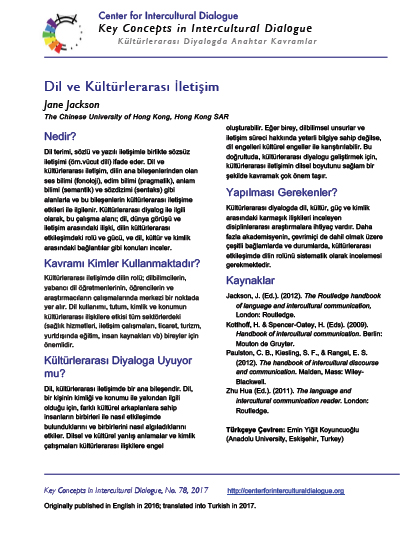
Key Concepts in ICDContinuing translations of Key Concepts in Intercultural Dialogue, today I am posting KC78: Language and Intercultural Communication, which Jane Jackson wrote in 2016 in English, and which Emin Yiğit Koyuncuoğlu has now translated into Turkish.

As always, all Key Concepts are available as free PDFs; just click on the thumbnail to download. Lists of Key Concepts organized chronologically by publication date and number, alphabetically by concept, and by languages into which they have been translated, are available, as is a page of acknowledgments with the names of all authors, translators, and reviewers.

KC78 Language and Intercultural Communication_TurkishJackson, J. (2017). Dil ve Kültürlerarası İletişim (E. Y. Koyuncuoğlu, Trans.). Key Concepts in Intercultural Dialogue, 78. Available from: https://centerforinterculturaldialogue.org/wp-content/uploads/2017/05/kc78-language-intercultural-comm_turkish.pdf

If you are interested in translating one of the Key Concepts, please contact me for approval first because dozens are currently in process. As always, if there is a concept you think should be written up as one of the Key Concepts, whether in English or any other language, propose it. If you are new to CID, please provide a brief resume. This opportunity is open to masters students and above, on the assumption that some familiarity with academic conventions generally, and discussion of intercultural dialogue specifically, are useful.

Wendy Leeds-Hurwitz, Director
Center for Intercultural Dialogue


Creative Commons License
This work is licensed under a Creative Commons Attribution-NonCommercial-NoDerivatives 4.0 International License.

Emin Yiğit Koyuncuoğlu Profile

ProfilesEmin Yiğit Koyuncuoğlu is part of the European Solidarity Corps for Fundacja EkoRozwoju, an environmental organization in Wraclaw, Poland.

He has a BA in Communication Design and Management from the University of Anadolu (Turkey), including a year of studying Tourism Management at the University of Primorska (Slovenia). After graduation, he spent a year as Communications Assistant to Darüşşafaka Society, the oldest educational NGO in Turkey, providing high quality primary and high school education to students whose parent(s) are deceased.

While a student, he completed a Marketing internship in Tallinn (Estonia), and worked as a tour guide and as a staff member with Tourcon Turizm ve Kongre Hizmetleri in Antalya (Turkey), helping that organization prepare for national and international conferences. As a travel enthusiast and hitchhiker, he manages a Facebook page about his experiences, improving social media and video editing skills. He considers himself a linguaphile currently learning the art of translation.


Work for CID:

Emin Yiğit Koyuncuoğlu translated KC78: Language and Intercultural Communication, and KC94: Cross-Cultural Kids into Turkish.

Global Campus Human Rights Journal

Publication OpportunitiesThe Global Campus of Human Rights is proud to announce the launch of the Global Campus Human Rights Journal (gchrj), a peer-reviewed online publication serving as a forum for rigorous scholarly analysis, critical commentaries, and reports on recent developments pertaining to rights and democratisation globally. The first issue is now available online.

gchrj is edited by a team of three, led by Frans Viljoen, Director of the Centre for Human Rights and Professor in the Faculty of Law at the University of Pretoria in South Africa, who is assisted by two co-editors: Vahan Bournazian, Professor at Yerevan State University in Armenia, and Matthew Mullen, Lecturer at Mahidol University of Bangkok in Thailand. They are supported by an International Editorial Advisory Board of experts from a group of world-renowned universities, within and outside the Global Campus of Human Rights, covering a wide range of disciplines.

“There is an increasing need for a forum fostering dialogue and collaboration between stakeholders, including academics, activists in human rights and democratisation, ngos and civil society”  Prof. Viljoen said. “gchrj will be able to fill this need by adopting multi- and inter-disciplinary perspectives, and using comparative approaches”.

The challenges of today’s world are multifaceted and transnational in nature. They cause heated debate and controversy and require multi-layered answers. The contribution of gchrj is to provide expertise to guide responses and solutions and to infuse them with ethical, human rights-based perspectives.

STRUCTURE and SUBMISSIONS
gchrj consists of two sections, each containing full-length peer-reviewed academic articles. The first section contains solicited and unsolicited articles on various themes. The second section provides an overview of recent regional developments on human rights and democratisation across the globe, including analyses of decisions or findings of relevant courts or other bodies.

gchrj is an open access journal and is published biannually. Submissions (in English, French or Spanish) are welcome at any time and should be sent to Isabeau de Meyer. No fees are charged for submission or article processing. Submissions should conform to the guidelines for authors.