UNESCO: Advisor for Communication/Information (Morocco)

“JobAdvisor for Communication and Information, Communication and Information Sector, UNESCO, Rabat, Morocco. Deadline: December 26, 2020.

The Advisor for Communication and Information, under the direct supervision of the Director of UNESCO Office in Rabat and the overall authority of the Assistant Director-General, Communication and Information (ADG/CI) as well as in close cooperation with staff of CI Sector at Headquarters (Directors, Chiefs of Section, Programme Specialists) and in Field Offices of the region, is responsible for developing, planning and managing a programme of work and as a team leader may manage, supervise and guide a team of staff to ensure the delivery of programme initiatives and project activities, from funding proposals to project design to evaluation and reporting.

The Conversation as a Resource (Australia)

Applied ICDThe Conversation, a nonprofit, independent news organization in Australia, has published a number of articles on intercultural dialogue topics. These should also be useful in teaching.

Global Migration Film Festival 2020

Film Festivals

Global Migration Film Festival, International Organization for Migration, Geneva, Switzerland, November 28-December 18, 2020. 

The Global Migration Film Festival showcases films that capture the promise and challenges of migration, , and the unique contributions that migrants make to their new communities. The goal of the festival is to pave the way for greater discussion around one of the greatest phenomenon of our time.

This year’s film festival is taking place despite the global health emergency brought on by COVID-19, with the selected films offered through a virtual platform.

The objective of the GMFF is to use films as educational tools that influence perceptions of and attitudes towards migrants, by bringing attention to social issues and creating safe spaces for respectful debate and interaction. The Festival is an innovative creative avenue for normalizing discussions of migration through storytelling, and it is an advocacy tool that can also draw attention to the United Nations’ Sustainable Development Goals (SDGs), thus helping all nations as they work to meet them.


NCA IDEA Strategic Plan Task Force

Professional OpportunitiesCall for Participation: NCA IDEA (Inclusion, Diversity, Equity, Access) Strategic Plan Task Force, National Communication Association, Washington, DC. Deadline: January 15, 2021.

NCA is committed to inclusion, diversity, equity, and access and seeks to address how the association can be responsive and transformative in this historical juncture when questions of justice and representation dominate both our national conversations as well as our professional and institutional inquires and actions. Following in the spirit of the recent renaming of the NCA Diversity Council as the IDEA Council, the commitment to create several NCA IDEA Awards for scholarship and institutional excellence, and other significant progress that NCA has made in changing key processes, the next step is to engage in the creation of a comprehensive IDEA – inclusion, diversity, equity, and access – strategic plan for NCA.

This call seeks volunteers to be members of this IDEA Strategic Plan Task Force. Additionally, any volunteers who are interested in co-chairing this Task Force also are welcome. To volunteer, please send an e-mail message explaining your interest in being on the Task Force and highlighting your experience in inclusion, diversity, equity, and access work in NCA or at your home institution. Please send your statement of interest and a CV to Roseann M. Mandziuk by January 15, 2021.

The IDEA Strategic Plan Task Force will be officially constituted and publicly announced by February 1, 2021. The Task Force’s charge will be to produce an IDEA Strategic Plan to be submitted to NCA’s Executive Committee by February 1, 2022.

Collaborative work among Task Force members to create the IDEA Strategic Plan will take place using video conferencing and other electronic means. The Task Force will meet at the 107th NCA Convention in Seattle in November 2021, and also will host a discussion forum at this Convention to gather member input and to share their work to that point. Pending approval by the NCA Executive Committee, the NCA IDEA Strategic Plan would be officially presented at our 108th Annual Convention in 2022 to the Legislative Assembly for adoption, after which the Task Force will be disbanded.


CFP Migrant Belongings: Digital Practices and the Everyday (Online)

ConferencesCall for submissions: Migrant Belongings: Digital Practices and the Everyday, Diaspora, Migration and the Media section of European Communication Research and Education, 21-23 April 2021, Utrecht University, The Netherlands, but online. Deadline: panel submissions 31 January 2021; abstracts 15 February 2021.

Migrant belonging through digital connectivity refers to a way of being in the world that cuts across national borders, shaping new forms of diasporic affiliations and transnational intimacy. This happens in ways that are different from the ways enabled by the communication technologies of the past. Scholarly attention has intensified around the question of how various new technical affordances of platforms and apps are shaping the transnationally connected, and locally situated, social worlds in which migrants live their everyday lives.

This international conference focuses on the connection between the media and migration from different disciplinary vantage points. Connecting with friends, peers and family, sharing memories and personally identifying information, navigating spaces and reshaping the local and the global in the process is but one side of the coin of migrant-related technology use: this Janus-faced development also subjects individuals as well as groups to increased datafied migration management, algorithmic control and biometric classification as well as forms of transnational authoritarianism and networked repression.

Cultural Diplomacy in the Times of COVID-19 (Pakistan)

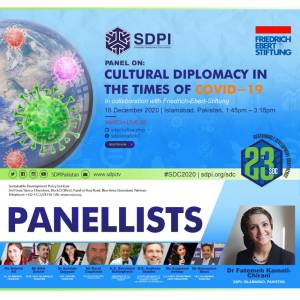
EventsCultural Diplomacy in the Times of COVID-19, as part of 23rd Sustainable Development Conference, Islamabad, Pakistan, 14-17 December, 2020.

The Sustainable Development Policy Institute (SDPI) is pleased to announce its Twenty-third Sustainable Development Conference (SDC) from 14 – 17 December 2020 in Islamabad, Pakistan. The overarching theme of this year’s Conference is Sustainable Development in the Times of COVID-19. This year, keeping the COVID-19 pandemic in mind, organizers are looking at a conference where some speakers will be able to attend in person taking care of the social distancing and other precautionary measures, while the rest will participate through a web-based platform meant for virtual conference.

Cultural Diplomacy in the Times of COVID-19

Culture is one of the main topics of this conference. The panel “Cultural Diplomacy in the Times of COVID-19” is scheduled on 16th December, 1.45-3.15 pm (Pakistan Standard Time). The panel is supported by both SDPI and the German foundation, Friedrich Ebert Stiftung, Pakistan, and will be chaired by Dr. Fatemeh Kamali- Chirani, who is affiliated with CID.

John Corbett Interview

“Interviews”Dr. John Corbett was interviewed about the concepts of communicative competence and intercultural competence, on December 12, 2020, by Rehana Paul, CID intern.

Dr. Corbett answers the following questions:

  • What is communicative competence?
  • How do communicative competence and intercultural dialogue fit together?
  • How does intercultural language education relate to these other terms?
  • How has COVID-19 influenced telecollaboration in intercultural communication?
  • Compare communicative competence to intercultural competence.

For further information, see his one-page summary:
Corbett, J. (2014). Communicative competence. Key Concepts in Intercultural Dialogue, 9.


U Glasgow: Multiple Faculty Positions (UK)

“Job

Lecturer in Sociology (Media and Communications) plus multiple other faculty positions, University of Glasgow, Glasgow, UK. Deadline: January 10, 2021.

The School of Social and Political Sciences seeks to appoint a Lecturer in Sociology (Media and Communications). We especially welcome applications from candidates with expertise in the practice of journalism and/or digital media. The Lecturer will develop, lead and sustain research and scholarship of international standard, engaging with the media and communication and other research areas in Sociology and related School research themes such as inclusive economy, democracy, migration and social movements, equality, human rights and governance. You will contribute to an excellent student experience by delivering, organising and reviewing agreed teaching, assessment and administration processes to enhance learning and teaching in the School of Social and Political Sciences. We especially encourage applications from women, disabled and ethnic minority candidates, as these groups are underrepresented in the School.

There are multiple other faculty positions available at the University of Glasgow:

Sciences Po: Postdoc in Migration and Integration in Europe (France)

PostdocsPostdoctoral researcher in migration and integration in the European public space, Fondation Nationale des Sciences Politiques (Sciences Po), Paris, France. Deadline: 23 December 2020.

The Center for International Research (CERI) is recruiting a postdoctoral researcher to work on a HERA (Humanities in a European Research Area) Joint Research Programme titled “Negociating Diversity in Expanded European Public Spaces” (PLURISPACE) under the supervision of Prof. Riva Kastoryano, the Project Leader. He or she will be in charge of overlooking CERI’s contribution to the international project’s team. The project started on May 31st, 2019 and the CERI is the lead institution. Partners are the University of Bristol, the University of Oslo, and the University Pompeu Fabra. The PLURISPACE team has delivered already a report on the advancement of the project, a working paper, and started content analysis of official documents on national and local levels.

PHD in Political Science or Sociology expected, as well as fluency in both English and French. The position requires previous scientific production and experience of working on projects devoted to the study of migration, integration, citizenship, identities, recognition in France and Europe, a knowledge of French and European institutions as well as policies with regard to immigration, integration and citizenship.


KU Leuven/U Melbourne PHD Studentship (Belgium/Australia)

“Studentships“
PhD studentship in Language Sciences, at KU Leuven for a joint research project with U Melbourne, Leuven, Belgium & Melbourne, Australia. Deadline: 24 December 2020.

The doctoral project that is to be carried out with KU Leuven as the host institution will analyze the policies, practices and effects of official translations that address culturally and linguistically diverse (CALD) communities in Brussels. It will ascertain the provision of translation in public services in terms of numbers of translations, types of translations, target languages and types of administrations involved. It will identify the levels at which translation policies, both overt and covert, are formulated and enacted, how translations reach the various language communities, and the role of volunteer translation practices from NGOs and grassroots citizens’ initiatives in public services, particularly with respect to the reworking, re-narration and interpreting of information.

The candidate will select one or two language communities for detailed analysis of the reception processes, with particular attention to instances of trust and distrust in official behavior-change communication. The nature and topic of the communication will correspond to the issues of importance at the time of the study.

The research should lead to an evaluation of the way translation policies are formulated and enacted, with an assessment of their success in achieving trust relationships and influencing changes in behavior. At each stage of the research, comparison will be made with the same policies and practices in the city of Melbourne, with one year of the research being carried out at the University of Melbourne.