Brahim Oulbeid Profile

ProfilesBrahim Oulbeid (Ph.D.), Visiting Lecturer in Arabic and French in the Five College Consortium and Westfield State University, Amherst, MA, USA.

Brahim OulbeidBrahim earned a Ph.D. in Education under the Language, Literacy and Culture concentration at the University of Massachusetts-Amherst College of Education, and has M.A.s in Education and Teaching French. He received his B.A. in English Language and Literature, along with Arabic and French teaching certificates, in Morocco. In addition to language courses, he teaches Introduction to Linguistic Anthropology and Introduction to Arab Cultures.

Brahim’s research interests include Second Language Pedagogy, Bilingual Education, and Language, Culture and Identity. His dissertation explored non-native Arabic teachers’ experiences as learners of Arabic, teacher trainees, and classroom practitioners. Specifically, it uncovered their understanding of the interconnections between language and culture and their own positioning in their classrooms and their institutions.

Selected publications

Barron, I., Abdallah, G., Lala, E., & Oulbeid, B. (2021). Dispossession in occupied Palestine: Children’s focus group reflections on mental health. European Journal of Trauma & Dissociation, 6(2), 100236.

Oulbeid, B. (2018). Arabic language teaching in the US: Two Arabic language users views on culture and self-positioning as teachers. In M. T. Alhawary (Ed.). The Routledge handbook of Arabic second language acquisition (pp. 402-421). New York: Routledge.

Moustafa, S., & Oulbeid, B. (2016). Language and Muslim immigrant childhoods: Review of The politics of belonging, by García-Sánchez. Anthropology & Education Quarterly, 47(1), 105-107.

Oulbeid, B. (2008). Teaching and the struggle for democracy. In S. Nieto (Ed.), Dear Paulo: Letters from those who dare teach (pp. 180-181). Boulder, CO. Paradigm Publishers.


Work for CID:

Brahim Oulbeid has served as a reviewer of Arabic translations.
CFP Language Policy & Planning 2022 (Hybrid)

Conferences
Call for Papers: Language Policy and Planning: Language Policy, Linguistic Human Rights, and Cultural Genocide, August 25-27, 2022, McGill University, Montréal, QC, Canada, and online). Deadline: 28 February 2022.

LPP2022 will be a space for Canadian and international researchers to share their research about oppressed language rights and literacy practices in Canada and other parts of the world. This year’s theme (non-exclusive) will bring together researchers interested in the impact of language policy on the minoritization of language speakers and the oppression of their linguistic human rights. LPP2022 will have a hybrid (virtual and in-person) format. Organizers hope that this format will maximize the participation of underfunded educators and researchers who come from communities whose languages have been affected by colonial language policies. The event will highlight research that attempts to deconstruct colonial views of language education, which advocate forms of toxic monolingualism that not only target minoritized students’ mother tongues but that put their lives in danger, as has been the case with Canadian residential schools. The three plenary speakers, Owennatekha (Brian Maracle), Abduweli Ayup, and Jaffer Sheyholislami, are scholars who come from linguistically oppressed communities and who have been studying language issues in those communities for years.

LPP2022 will continue the plurilingual policy started at LPP2021. Abstracts must be submitted in English or French, but the language(s) of presentation may include any language(s) of your choice, as long as material to help viewers understand the slides is made available in English or French.

KC24 Asiacentricity Translated into Turkish

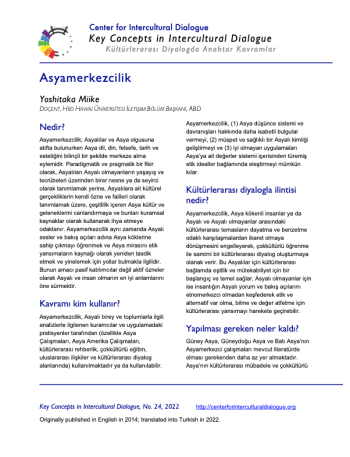
Key Concepts in ICDContinuing translations of Key Concepts in Intercultural Dialogue, today I am posting KC24: Asiacentricity, which Yoshitaka Miike wrote for publication in English in 2014, and which Candost Aydın has now translated into Turkish.

As always, all Key Concepts are available as free PDFs; just click on the thumbnail to download. Lists of Key Concepts organized alphabetically by concept, chronologically by publication date and number, and by languages into which they have been translated, are available, as is a page of acknowledgments with the names of all authors, translators, and reviewers.KC24 Asiacentricity_TurkishMiike, Y. (2022). Asiacentricity [Turkish]. (C. Aydın, Trans.). Key Concepts in Intercultural Dialogue, 24. Available from:
https://centerforinterculturaldialogue.org/wp-content/uploads/2021/12/kc24-asiacentricity_turkish.pdf

If you are interested in translating one of the Key Concepts, please contact me for approval first because dozens are currently in process. As always, if there is a concept you think should be written up as one of the Key Concepts, whether in English or any other language, propose it. If you are new to CID, please provide a brief resume. This opportunity is open to masters students and above, on the assumption that some familiarity with academic conventions generally, and discussion of intercultural dialogue specifically, are useful.

Wendy Leeds-Hurwitz, Director
Center for Intercultural Dialogue


Creative Commons License
This work is licensed under a Creative Commons Attribution-NonCommercial-NoDerivatives 4.0 International License.

U Manchester: Intercultural Communication (UK)

“JobLecturer in Intercultural Communication , The University of Manchester, Manchester, UK. Deadline: 24 January 2022.


Applications are invited for the teaching and research post of Lecturer in Intercultural Communication, which is tenable from 1 September 2022 and offered on an open-ended basis. The appointed person will teach on the MA program in Intercultural Communication. The candidate must have a PhD (awarded) in a relevant field and demonstrable teaching experience in Intercultural Communication at university level as well as in curriculum and program development. Your research may focus on any aspect of Intercultural Communication. Only applicants with high quality publications will be considered. A successful record of grant capture and of PhD supervision would be highly advantageous. Experience with virtual learning environments and in developing online teaching materials is essential. Expertise in translation studies and/or foreign language proficiency would be beneficial. You must have excellent interpersonal skills and be able to empathize with students.

U New Hampshire: Public Dialogue & Deliberation (USA)

“JobAssociate Professor of Communication (Public Dialogue and Deliberation), Communication Department, University of New Hampshire, Durham, NH, USA. Deadline: January 21, 2022.

The Department of Communication at the University of New Hampshire, Durham, invites applications for the position of Associate Professor beginning August 2022. UNH actively creates an educational environment that fosters diversity, inclusion and quality engagement for all. Application by members of all underrepresented groups is encouraged.

Applicants must have a Ph.D. in Communication (or a closely related discipline). The Department seeks a communication scholar with an established publication record and excellent teaching history advancing knowledge in the areas of Public Dialogue and Deliberation, with expertise in organizational communication and inter-organizational collaboration.

CFP Representations of Xenophobia, Racism, Nationalism

“PublicationCall for Curators: Special Issue of In Media ResRepresentations of Xenophobia, Racism, and Nationalism. Deadline: 4 February 2022.

Ideologies of racism, nationalism, and xenophobia have always existed. They are certainly dangerous and spread all over the world. However, there appears to be a recent increase in the depictions of these themes in film and media. In Media Res is looking to explore the representation of racist violence, aggressive expressions of nationalism, and social exclusion in film and media.

The goal is to examine these themes in film and media in more detail; from many perspectives and variable aspects in politics, society, psychology, culture, and many more. They are inviting submissions proposals which deal with one or more of the following issues: xenophobia; racism; racist hatred/violence; (religious/ethnic) intolerance; social exclusion; discrimination; nationalism; eurocentrism. This call for proposals aims to devote considerable attention to how the phenomena of racism, nationalism and xenophobia are represented in artistic practices in film, and media.

CID Poster #4: Types of Cultural Communication (reprise)

CID Posters(We are reprising the series of posters, because it has been several years since they were originally created, and they are much too wonderful to let them not be noticed by newcomers to the site!)

This is the next of the posters designed by Linda J. de Wit, then in her role as CID intern. The need for clarification between intercultural/ intracultural/ cross-cultural/ international forms of communication has been made obvious by the number of times I’ve been asked to explain the differences. These terms have been discussed at length in many publications; one direct source is:

Leeds-Hurwitz, W. (1990). Culture and communication: A review essay. Quarterly Journal of Speech, 76, 85-96.

The idea to use fruit for the visual explanation of the different terms was Linda’s, and came from proverbs: in English, one is told not to compare apples and oranges; in many other languages, the fruits referred to are apples and pears. The poster thus implicitly refers to the relativist idea that cultures shouldn’t be judged in comparison to others.

Types of Cultural Communication
Just in case anyone wants to cite this poster, the following would be the recommended format:

Center for Intercultural Dialogue. (2017). Types of cultural communication. CID Posters, 4. Available from:
https://centerforinterculturaldialogue.org/wp-content/uploads/2017/07/fruit.png

As with other series, CID Posters are available for free on the site; just click on the thumbnail to download a printable PDF. They may be downloaded, printed, and shared as is, without changes, without cost, so long as there is acknowledgment of the source.

As with other series, if you wish to contribute an original contribution, please send an email before starting any work to receive approval, to minimize inadvertent duplication, and to learn about technical requirements. As is the case with other CID Publications, posters should be created initially in English. Given that translations of the Key Concepts in Intercultural Dialogue have received so many views, anyone who wishes to translate their own poster into another language (or two) is invited to provide that as well. If you want to volunteer to translate someone else’s poster into a language in which you are fluent, send in a note before starting, to receive approval and to confirm no one else is working on the same one.

Wendy Leeds-Hurwitz
Director, Center for Intercultural Dialogue
intercult.dialogue AT gmail.com


Creative Commons License
This work is licensed under a Creative Commons Attribution-NonCommercial-NoDerivatives 4.0 International License.

Maryam Ahmadi Profile

ProfilesMaryam Ahmadi is a Ph.D. candidate in the Rhetoric, Politics, & Culture program in the Department of Communication Arts at the University of Wisconsin-Madison.

Maryam Ahmadi

She holds a BA in English Literature and an MA in Political Sociology from the University of Tehran, and a second MA in Communication Arts from the University of Wisconsin-Madison. Her research interests lie at the intersection of rhetorical theory and history, the study of colonialism and empire, and global/non-Western rhetorics. In her current work, she focuses on the suasive discourse of “occidentosis” (gharbzadegi) within the context of Iran’s encounter with colonial modernity to consider how Persian rhetorical practices and theories emerge from a semicolonial locus of enunciation.


Work for CID:

Maryam Ahmadi translated KC23: Afrocentric and KC24: Asiacentricity into Persian.

CFP Communication of Culture and Islamic Fundamentalism

“PublicationCall for Abstracts: Special Issue of Frontiers in Communication: Communication of Culture and Islamic Fundamentalism Deadline: 31 January 2022.

This Research Topic is planned to coincide with the ongoing political developments in Afghanistan, and the emergence and re-emergence of Islamic fundamentalism throughout the world. Editors of the special issue (Diyako Rahmani, Jiyar Aghapouri, & Soumia Bardhan) invite submissions on a broad range of topics related to the communication of Islamic fundamentalism. They encourage submissions and commentary from multiple disciplinary perspectives including cultural and media/communication studies, sociology, political science, human rights, and other relevant fields. While this Research Topic is open to the studies of Islamic fundamentalism broadly, it will put particular emphasis on the Taliban takeover of Afghanistan as a case to illuminate the theoretical and empirical caveats concerning the socio-cultural and socio-political impacts of fundamentalist ideologies.

KC27 Globalization Translated into Turkish

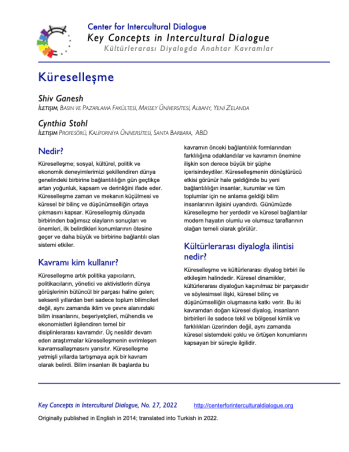
Key Concepts in ICDContinuing translations of Key Concepts in Intercultural Dialogue, today I am posting KC 27: Globalization, which Shiv Ganesh and Cynthia Stohl wrote for publication in English in 2014, and which Candost Aydın has now translated into Turkish.

As always, all Key Concepts are available as free PDFs; just click on the thumbnail to download. Lists of Key Concepts organized chronologically by publication date and number, alphabetically by concept, and by languages into which they have been translated, are available, as is a page of acknowledgments with the names of all authors, translators, and reviewers.

KC27 Globalization_TurkishGanesh, S., & Stohl, C. (2022). Globalization [Turkish]. (C. Aydın, Trans.). Key Concepts in Intercultural Dialogue, 27. Retrieved from: https://centerforinterculturaldialogue.org/wp-content/uploads/2021/12/kc27-globalization_turkish.pdf

If you are interested in translating one of the Key Concepts, please contact me for approval first because dozens are currently in process. As always, if there is a concept you think should be written up as one of the Key Concepts, whether in English or any other language, propose it. If you are new to CID, please provide a brief resume. This opportunity is open to masters students and above, on the assumption that some familiarity with academic conventions generally, and discussion of intercultural dialogue specifically, are useful.

Wendy Leeds-Hurwitz, Director
Center for Intercultural Dialogue


Creative Commons License
This work is licensed under a Creative Commons Attribution-NonCommercial-NoDerivatives 4.0 International License.