Roxanna Senyshyn Profile

ProfilesRoxanna Senyshyn is Associate Professor of Applied Linguistics and Communication Arts and Sciences at Pennsylvania State University, Abington College.

Roxanna SenyshynHer teaching and research focus on intercultural communication and second language learning and teaching. Specifically, her research interests include intercultural and transformative learning in teacher education, intercultural competencies for academic and professional purposes, and ESL pedagogy and assessment with a focus on academic writing.

One strand of Dr. Senyshyn’s research examines the need to prepare both preservice and inservice teachers for working with English language learners in multilingual and multicultural classroom settings.  Through community-based scholarship, she investigates the impact of intercultural engagement and learning on different constituents. From the student perspective, she has studied the impact of intercultural learning through engagement of domestic students with their international peers in semester long projects. She has studied this influence through the lens of Mezirow’s transformative learning theory, which encourages critical reflection and examination of personal beliefs and actions to allow for a change in perspectives and behavior. She has also used transformative learning framework in a faculty professional development context as an assessment tool to investigate the impact of professional development on faculty practices surrounding teaching and learning in a linguistically and culturally diverse college classroom.

The other strand of Dr. Senyshyn’s research focuses on intercultural learning and intercultural competence development to aid in the process of adjustment and acculturation of international students. The primary focus for this scholarship has been on identifying challenges that international students experience when adjusting to both academic and social demands in U.S. colleges and universities and assessing academic support to aid these students in their successful transition. In one of her recent projects, she examined the impact of first-year seminar experience and out-of-class engagement with domestic students on international students’ intercultural competence development.

In addition to her experience in academia, Dr. Senyshyn has been a consultant for BGRS Intercultural and Language Training doing training and coaching for inbound and outbound expatriates and their families in the greater Philadelphia area (Pennsylvania, U.S.).

Selected publications:

Senyshyn, R. with Lypka, A. (2024). Voices of courage and vulnerability: Teaching English in a society at war (Ukraine 2022-2023). Sunshine TESOL Press.

Senyshyn, R. (2024). Humanizing and amplifying voices of displaced children: A narrative of an eight-year-old’s journey and integration. In T.M. Shah (Ed.), Children and youth as ‘sites of resistance’ in armed conflict (pp. 35-54). London, UK: Emerald Publishing.

Han, S. & Senyshyn, R. (2024). Dynamic intercultural learning and collaboration: transforming language teacher perspectives and practices. Journal for Multicultural Education, 18(4), 1-19.

Senyshyn, R.M. (2024). Immigrant families and communities as agents of interculturality in pre-service teacher education. In A.F. Selvi & C. Kocaman (Eds.), International perspectives on critical English language teacher education: Theory and practice (pp. 229-235). New York, NY: Bloomsbury Publishing.

Senyshyn, R. M. (2023). Translanguaging as transformation: The collaborative construction of new linguistic realities. Language and Intercultural Communication, 23(1), 140-142.

Senyshyn, R. M. (2021). Navigating linguistic and cultural identities: (Re)positioning oneself through critical awareness. In A. F. Selvi & B. Yazan (Eds.), Language teacher education for Global Englishes: A practical resource book (pp. 188-196). New York, NY: Routledge.

Senyshyn, R.M. & Martinelli, A. (2021). Learning to support and sustain cultural (and linguistic) diversity: Perspectives of preservice teachers. Journal for Multicultural Education, 15(1). 20-37.

Senyshyn, R. M. (2020). Transformative intercultural learning: Research to practice in teacher education. In C.E. Poteau (Ed.), Pedagogical approaches to intercultural competence development (151-173). Newcastle upon Tyne, UK: Cambridge Scholars Publishing.

Senyshyn, R. M. (2019). A first-year seminar course that supports the transition of international students to higher education and fosters the development of intercultural communication competence. Journal of Intercultural Communication Research, 48(2), 150–170.

Senyshyn, R. M., & Smith, P. (2019). Global awareness dialogue project: Exploring potential for faculty transformation through professional development. Journal of Transformative Education, 17(4), 318–336.

Senyshyn, R.M. (2019). A first-year seminar course that supports the transition of international students to higher education and fosters the development of intercultural communication competence. Journal of Intercultural Communication Research, 48(2), 150-170.

Senyshyn, R.M. (2019). Facilitating transformative intercultural learning. TESOL Connections, February 2019.

Senyshyn, R.M. (2018). Teaching for transformation: Converting intercultural experience of preservice teachers into intercultural learning. Intercultural Education, 29(2), 163-184.

Senyshyn, R.M. (2018). Facilitating preservice teachers’ transformation through intercultural learning: Reflections from a self-study. In J. Sharkey & M. M. Peercy (Eds.), Self-study of language and literacy teacher education practices: Culturally and linguistically diverse contexts (pp.167-184). London, UK: Emerald Group Publishing.

Chamberlin-Quinlisk, C. R. & Senyshyn, R. (2012). Language teaching and intercultural education: Making critical connections. Intercultural Education, 23, 15-23.

Senyshyn, R.M. & Chamberlin-Quinlisk, C.R. (2009).  Assessing effective partnerships in intercultural education: Transformative learning as a tool for evaluation. Communication Teacher, 23 (4), 167-178.

Senyshyn, R.M.  (2001).  Learning cross-cultural competencies: Implications for international management education.  Perspectives in Higher Education Reform.  Proceedings of the 11th Annual International Conference of Alliance of Universities for Democracy, Volume 10, Sofia, Bulgaria.

Senyshyn, R.M., Warford, M., & Zhan, J.  (2000).  Academic and non-academic issues of adjustment to American higher education.  Journal of International Education, 30(1) 17-35.


Work for CID:
Roxanna Senyshyn translated KC3: Intercultural CompetenceKC5: Intercultural Communication, and KC19: Multiculturalism into Ukrainian. She also has served as a reviewer of Ukrainian translations. She will also be participating in an expert group organized by the Center.

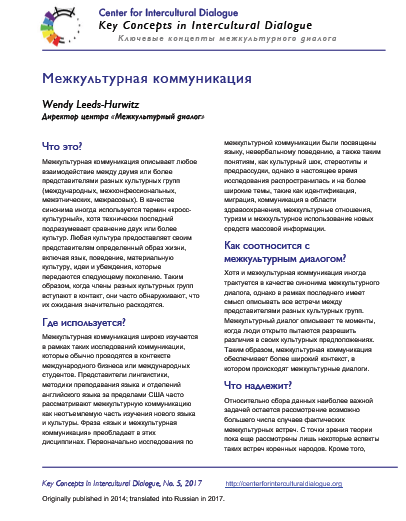
Key Concept #5: Intercultural Communication Translated into Russian

Key Concepts in ICDContinuing translations of Key Concepts in Intercultural Dialogue, today I am posting KC#5: Intercultural Communication, which I wrote for publication in English in 2014, and which Inga Milēviča has now translated into Russian.

As always, all Key Concepts are available as free PDFs; just click on the thumbnail to download. Lists of Key Concepts organized chronologically by publication date and number, alphabetically by concept, and by languages into which they have been translated, are available, as is a page of acknowledgments with the names of all authors, translators, and reviewers.

KC5 Intercultural Communication_Russian
Leeds-Hurwitz, W. (2017). Intercultural communication [Russian]. (Inga Milēviča Trans). Key Concepts in Intercultural Dialogue, 5. Available from:
https://centerforinterculturaldialogue.org/wp-content/uploads/2017/07/kc5-icc_russian.pdf

If you are interested in translating one of the Key Concepts, please contact me for approval first because dozens are currently in process. As always, if there is a concept you think should be written up as one of the Key Concepts, whether in English or any other language, propose it. If you are new to CID, please provide a brief resume. This opportunity is open to masters students and above, on the assumption that some familiarity with academic conventions generally, and discussion of intercultural dialogue specifically, are useful.

Wendy Leeds-Hurwitz, Director
Center for Intercultural Dialogue


Creative Commons License
This work is licensed under a Creative Commons Attribution-NonCommercial-NoDerivatives 4.0 International License.

CID Poster #4: Types of Cultural Communication

CID PostersThis is the next of the posters designed by Linda J. de Wit, in her role as CID intern. The need for clarification between intercultural/ intracultural/ cross-cultural/ international forms of communication has been made obvious by the number of times I’ve been asked to explain the differences. These terms have been discussed at length in many publications; one direct source is:

Leeds-Hurwitz, W. (1990). Culture and communication: A review essay. Quarterly Journal of Speech, 76, 85-96.

The idea to use fruit for the visual explanation of the different terms was Linda’s, and came from proverbs: in English, one is told not to compare apples and oranges; in many other languages, the fruits referred to are apples and pears. The poster thus implicitly refers to the relativist idea that cultures shouldn’t be judged in comparison to others.

Types of Cultural Communication
Just in case anyone wants to cite this poster, the following would be the recommended format:

Center for Intercultural Dialogue. (2017). Types of cultural communication. CID Posters, 4. Available from:
https://centerforinterculturaldialogue.org/wp-content/uploads/2017/07/fruit.png

As with other series, CID Posters are available for free on the site; just click on the thumbnail to download a printable PDF. They may be downloaded, printed, and shared as is, without changes, without cost, so long as there is acknowledgment of the source.

As with other series, if you wish to contribute an original contribution, please send an email before starting any work to receive approval, to minimize inadvertent duplication, and to learn about technical requirements. As is the case with other CID Publications, posters should be created initially in English. Given that translations of the Key Concepts in Intercultural Dialogue have received so many views, anyone who wishes to translate their own poster into another language (or two) is invited to provide that as well. If you want to volunteer to translate someone else’s poster into a language in which you are fluent, send in a note before starting, to receive approval and to confirm no one else is working on the same one.

Wendy Leeds-Hurwitz
Director, Center for Intercultural Dialogue
intercult.dialogue AT gmail.com


Creative Commons License
This work is licensed under a Creative Commons Attribution-NonCommercial-NoDerivatives 4.0 International License.

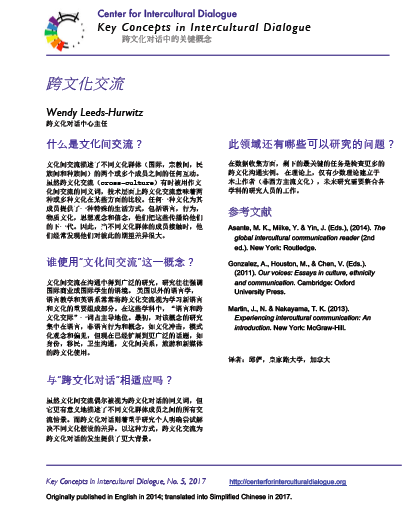
Key Concept #5: Intercultural Communication Translated into Simplified Chinese

Key Concepts in ICDContinuing translations of Key Concepts in Intercultural Dialogue, today I am posting KC#5: Intercultural Communication, which I first published in English in 2014, and which Yan Qiu has now translated into Simplified Chinese.

As always, all Key Concepts are available as free PDFs; just click on the thumbnail to download. Lists of Key Concepts organized chronologically by publication date and number, alphabetically by concept, and by languages into which they have been translated, are available, as is a page of acknowledgments with the names of all authors, translators, and reviewers.

KC5 ICC_Chinese-simLeeds-Hurwitz, W. (2017). Intercultural communication [Simplified Chinese]. (Y. Qiu, Trans). Key Concepts in Intercultural Dialogue, 5. Available from:
https://centerforinterculturaldialogue.org/wp-content/uploads/2017/07/kc5-icc_chinese-sim.pdf

If you are interested in translating one of the Key Concepts, please contact me for approval first because dozens are currently in process. As always, if there is a concept you think should be written up as one of the Key Concepts, whether in English or any other language, propose it. If you are new to CID, please provide a brief resume. This opportunity is open to masters students and above, on the assumption that some familiarity with academic conventions generally, and discussion of intercultural dialogue specifically, are useful.

Wendy Leeds-Hurwitz, Director
Center for Intercultural Dialogue


Creative Commons License
This work is licensed under a Creative Commons Attribution-NonCommercial-NoDerivatives 4.0 International License.

CID Poster #1: Intercultural Communication/Competence/Dialogue

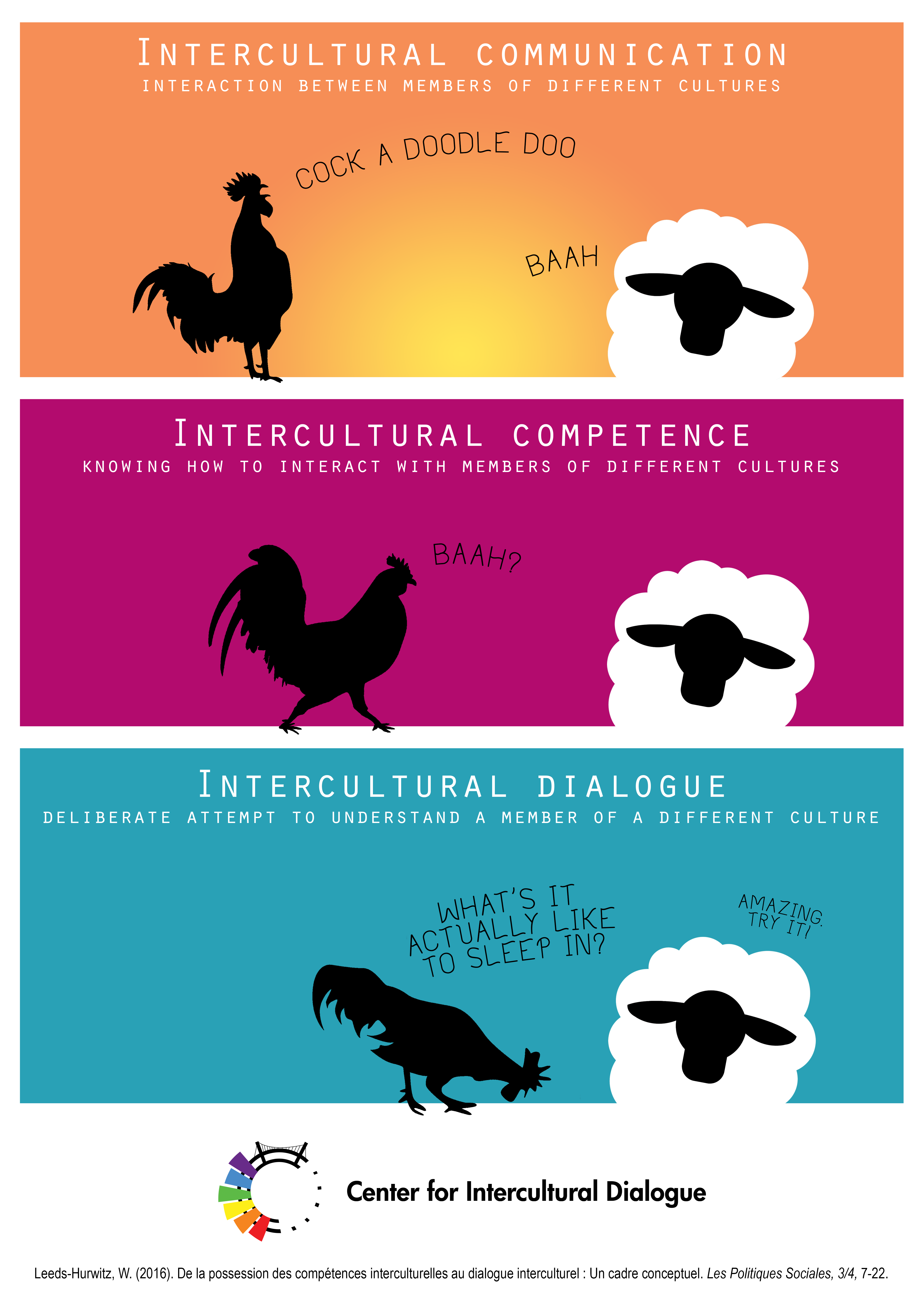
CID PostersThis is the first of the posters designed by Linda J. de Wit, in her role as CID intern. This one provides a quick and easy way to understand, and differentiate between, the concepts of “intercultural communication,” “intercultural competence,” and “intercultural dialogue,” using a rooster and a sheep to represent members of different cultures (and she notes that the animals are vector designs by vecteezy.com). The article where these explanations of these concepts (as well as lots of other concepts) were published is:

Leeds-Hurwitz, W. (2016). De la possession des compétences interculturelles au dialogue interculturel: Un cadre conceptuel [Moving from having intercultural competencies to constructing intercultural dialogues: A conceptual framework]. Les Politiques Sociales, 3/4, 7-22.

Intercultural communication/competence/dialogue

Just in case anyone wants to cite this poster, the following would be the recommended format:

Center for Intercultural Dialogue. (2017). Intercultural communication, intercultural competence, intercultural dialogue. CID Posters, 1. Available from:
https://centerforinterculturaldialogue.org/2017/06/28/cid-poster-1/

As with other series, CID Posters are available for free on the site; just click on the thumbnail to download a printable PDF. They may be downloaded, printed, and shared as is, without changes, without cost, so long as there is acknowledgment of the source.

Now that the first poster is available as a model, the series is open to submissions. If you wish to contribute an original design, please send an email before starting any work to receive approval, to minimize inadvertent duplication, and to learn about technical requirements. As is the case with other CID Publications, posters should be created initially in English. Given that translations of the Key Concepts in Intercultural Dialogue have received so many views, where specific quotes are provided, anyone who wishes to translate their own poster into another language (or two) is invited to design that as well. If you want to volunteer to translate someone else’s poster into a language in which you are fluent, send in a note before starting, to receive approval and to confirm no one else is working on the same one.

Wendy Leeds-Hurwitz
Director, Center for Intercultural Dialogue
intercult.dialogue AT gmail.com


Creative Commons License
This work is licensed under a Creative Commons Attribution-NonCommercial-NoDerivatives 4.0 International License.

Lauren Mark Profile

ProfilesLauren Mark is a doctoral student and Graduate Teaching Associate at the Hugh Downs School of Human Communication at Arizona State University. Lauren is currently researching the possibility of bringing Asian epistemologies to Western contexts.

Lauren Mark

She is a certified Civil Dialogue Facilitator and holds an M.Ed in Educational Organization, Leadership and Policy, an M.A. in Dance, and a B.A. in English Literature and French. Prior to joining Hugh Downs, Lauren worked as a co-founder and project manager of two cross-cultural learning organizations in Taipei, Taiwan – Becoming, 緣創an intercultural development platform, and the East West Culture Project. Lauren has also worked as a translator and interpreter in Taiwan and Israel across a variety of business and artistic sectors.Rooted in her experiences in the field, Lauren’s general research interests focus on identity shifts in acculturation. Her studies focus on the intersection of ethnic, linguistic and performative factors in acculturation, as well as how local cultures influence people’s ways of being.

Pedagogically, Lauren explores innovative means to bring embodied self-reflexivity to classroom contexts, within courses such as Communication and Creativity, Intercultural Communication, and Identity, Performance, and Communication. Her work in this arena began with her thesis work, Visible Histories, in which she explored how the sharing of embodied reminiscence and the collective physical reconstruction of memories served as a meeting ground for multiple generations exploring the art of dance. Lauren continues to experiment with ways that purposeful nonverbal communication can enhance reflexivity and promote collective care. This is an extension of her previous work in Taiwan, where she managed creative interdisciplinary labs and choreographed works that tested the boundaries between audience and performers.

Publications:

Mark, L. (2019). An Exploratory study of part time minorities: Finding home as a minority member. Journal of Intercultural Communication Research, 3. doi: 10.1080/17475759.2019.1602071

Wells, T., Mark, L., and Sandoval, J. (2019). Affect, space and the everyday: A reconsideration of waste in academic inquiry. Taboo: The Journal of Culture and Education. Special Ed. Waste. [Manuscript accepted].

Ray, C. D., Floyd, K., Mongeau, P. A., Mark, L., Shufford, K. N., & Niess, L. C. (2019). Planning improves vocal fluency and appearance of concern when communicating emotional support. Communication Research Reports, 36, 57-66. doi: 10.1080/08824096.2018.1560251

Brezis, R. S., Singhal, N., Daley, T., Barua, M., Piggot, J., Chollera, S., Mark, L., & Weisner, T. (2016). Self- and other-descriptions by individuals with autism spectrum disorder in Los Angeles and New Delhi: Bridging cross-cultural psychology and neurodiversity. Culture and Brain, 4(2), 113-133.


Work for CID:
Lauren Mark wrote Constructing Intercultural Dialogues #7: When the East Meets the Middle East.

Study of CID Social Media Followers

About CIDFrom October 2016 to March 2017, Min He conducted research to learn about the social media subscribers of the Center for Intercultural Dialogue. As CID aims to establish connections between scholars active in intercultural communication, understanding the large follower base is important.

The study is based on those subscribers for whom enough details could be obtained, amounting to 967 individuals out of the total of 2802 followers CID had across all social media platforms as of January 11, 2017 when data collection stopped and analysis began. LinkedIn, Facebook and Twitter were the three major resources for data collection, as they provide the greatest amount of detail about subscribers, either individually (LinkedIn) or as a group (Facebook and Twitter).

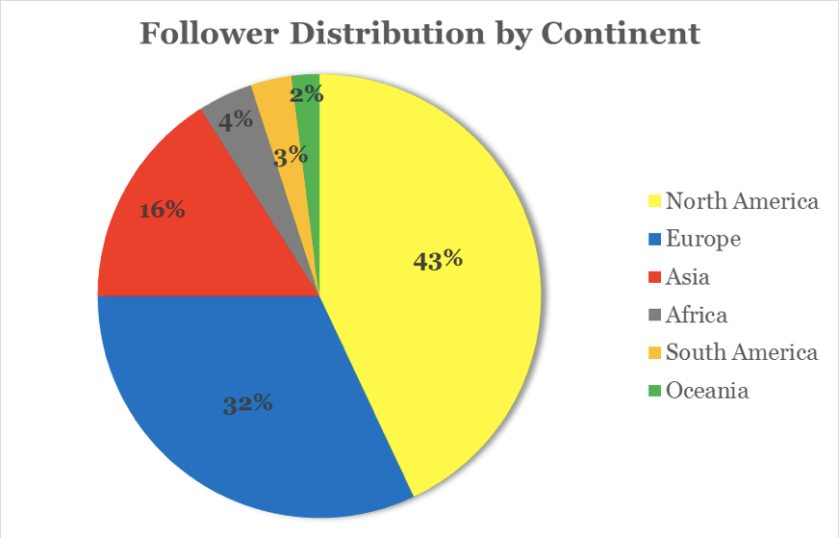
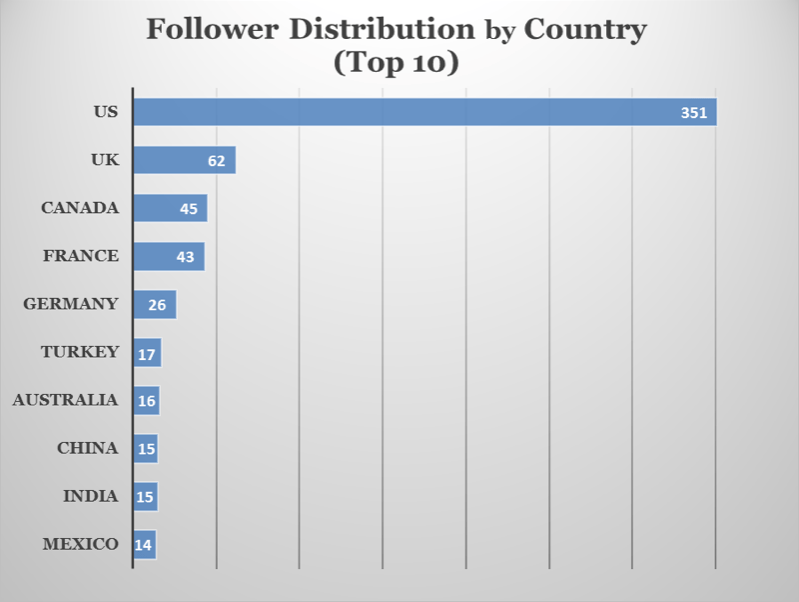
The results of the study show that CID has social media subscribers across the globe. The largest single group is based in the USA, but the majority of followers is based in other countries, as the charts below illustrate. The data represent the 967 followers’ countries of residence: in many cases their respective countries of origin are different.

CID subscribers by continent


CID subscribers by country

As CID especially aims at serving scholars, it is not surprising that most followers in the subset have substantial education: almost three quarters have completed a master’s degree, and almost 40% a Ph.D.

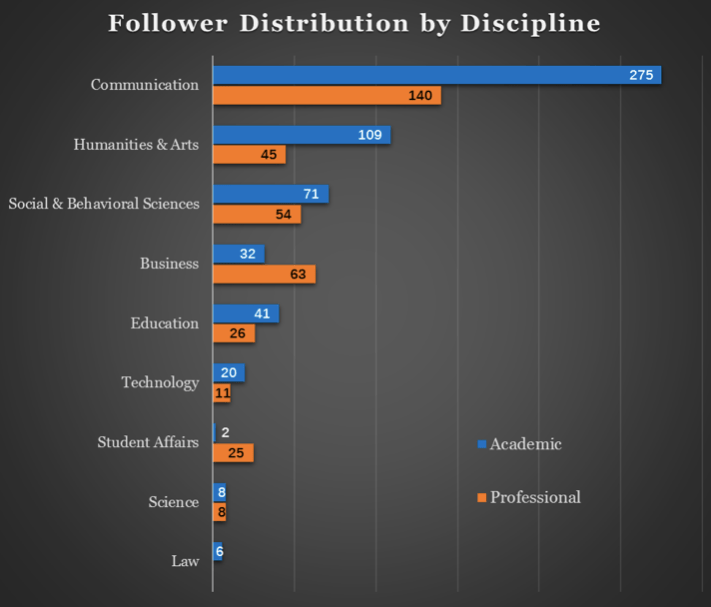
Not surprisingly, the majority of the followers in the subset are based within academia (58%), with most of the rest being professionals of various sorts (37%). For either group, most persons are active in the discipline of Communication. The following charts show the exact distribution.

CID followers by discipline

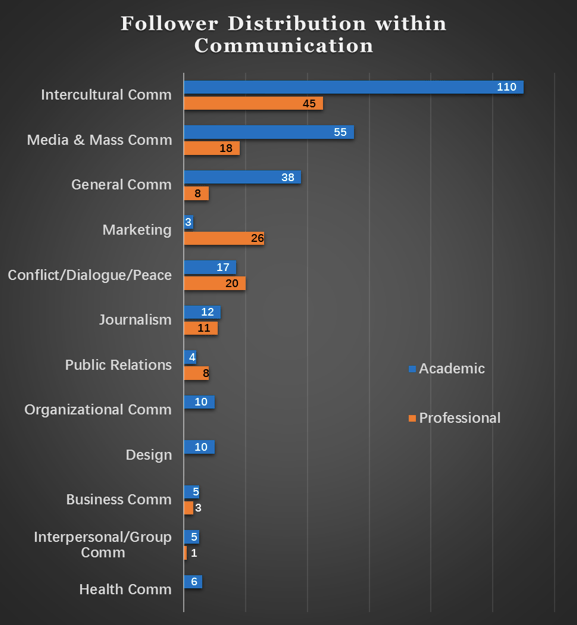
Within Communication, the single largest specialization is Intercultural Communication, for obvious reasons.

CID subscribers within Communication

In conclusion, the study shows that the followers of CID form a large and varied group of persons engaged with intercultural dialogue on different levels. As the CID embraces diversity and integrates multicultural members drawn from around the world into a single network, it builds a borderless online community for scholars and practitioners alike. To that end, the CID LinkedIn group has proven particularly appropriate for helping to establish connections.

Use of New Media in Intercultural Communication Education

Intercultural PedagogyA few months ago, Sachiyo Shearman and Mariko Eguchi shared a request for participants in a survey they were conducting about the use of new media when teaching intercultural communication. They have now completed the survey and compiled the results, which they are making available to CID readers.

Here’s their conclusion:

“The majority of professors and instructors who we have surveyed use some form of experiential learning, ranging from in-class role playing, case studies, and simulation games, and to the assignments that involve intercultural contacts. Only about one third of instructors who we surveyed actually have incorporated computer-mediated intercultural encounter into their classes, and some ideas includes online guest lectures, in-class video-conferencing interview sessions, and using programs such as Soliya Net. We can categorize a variety of new media: asynchronous or synchronous platforms, text-based or audio/video based, or first generation or second generation web technology. There are benefits and limitations for each type of new media and examples are discussed in the chapter. Nowadays, we tend to combine these different types of new media, as we use it in our classroom. Our intention is not to say that new media technology is better than the conventional approaches to the intercultural pedagogy. All of the approaches of intercultural communication teaching – lectures, intercultural training, and study abroad programs, are indispensable. We believe that the use of new media in intercultural communication provides us with an additional valuable approach for us to facilitate students’ learning at the multi-dimensional level. When computer-mediated intercultural contacts are provided, students are actively engaged as they interact with students in other countries.”

Their results are being published as:
Shearman, S. M. & Eguchi, M. (Forthcoming). “I have to text my classmate in China!”: Use of new media in intercultural communication classes toward multidimensional learning. In N. Bilge & M. I. Marino (Eds.), Reconceptualizing New Media and Intercultural Communication in a Networked Society.


Save

Elizabeth S. Parks Profile

ProfilesElizabeth S. Parks (Ph.D., University of Washington) is an Assistant Professor of Communication Studies at Colorado State University.Elizabeth Parks

She has degrees in Communication (M.A., University of Washington), Deaf Studies: Cultural Studies (M.A., Gallaudet University), Communication Studies (B.A., Creighton University), Sign Language Interpreting (Iowa Western Community College), and a graduate certificate in Values in Society (University of Washington). She uses her many years of international fieldwork experience with diverse cultural communities to ground her scholarship in listening and dialogue, communication ethics, cultural studies, and disability studies.

Embracing a mixed method approach that draws from both social sciences and humanities, her current research focuses on the ways in which cultural diversity and embodied difference impacts perceptions and practices of “good listening” that ultimately promote ethical dialogue across difference. Fluent in American Sign Language, she pays particular attention to the ways that diverse sensory and linguistic experiences impact the ways that we conceptualize and experience listening in our relationships. She works actively with the Center for Public Deliberation at Colorado State University to expand the ways that everyday dialogue and deliberation are practiced in everyday democracy. Her first book, The Ethics of Listening: Creating Space for Sustainable Dialogue, was published in 2019 and she is the recipient of a 2019-2020 J. William Fulbright Foreign Scholarship Award. She has twice served as a guest editor for Listening: Journal of Communication Ethics, Religion, and Culture and her research has been published in journals such as the Journal of International and Intercultural CommunicationInternational Journal of Listening, Ethics & Behavior, Journal of Research in Gender Studies, Critical Issues in Language Studies, Journal of International Communication, MultilinguaJournal of Cross-Cultural and Interlanguage Communication, and Organizational Development Journal.

Her personal website can be found at www.elizabethsparks.org.


Work for CID:

Elizabeth Parks wrote Constructing Intercultural Dialogues #6: The Privilege of Listening First. She also served as a judge for the 2020 CID Video Competition.

St Cloud State U Job Ad: Communication Studies

Assistant Professor Communication Studies – One-year Fixed Term at St. Cloud State University
Start date: August 16, 2017

The department is seeking candidates with a broad background in Speech Communication/Communication Studies, college teaching experience in an undergraduate program and evidence of effective working relationships with peers and students.  This position is a one-year fixed-term position.

Teach introductory intercultural communication course and introductory communication studies course. Other responsibilities could include public speaking, small group communication, interpersonal communication, or intercultural communication related courses. Additional responsibilities, such as committee work, will be assigned.

Required:
-M.A./M.S. in Communication Studies/Speech Communication, at time of appointment
-Teaching experience in an undergraduate program
-Evidence of effective working relationships with peers and students
-Coursework or teaching experience in intercultural communication
-Coursework or teaching experience in the hybrid communication course or its components (interpersonal, small group, public speaking)
-Evidence of demonstrated ability to teach and work with persons from culturally diverse backgrounds

Preferred:
–  Ph.D., at time of appointment
– Experience teaching online courses
To apply for this position, please continue the process online

Application Review begins April 23, 2017; position is open until filled.

Required documents to be submitted with a completed application include:
-Cover Letter
-Resume/Curriculum Vitae
-Evidence of effective teaching.  At minimum representative samples of teaching evaluations and course syllabi.
-Contact information for three (3) current, professional references
-Copies of Transcript(s) (undergraduate/graduate/PhD); if advanced to finalist, official transcripts will be required.
-Evidence of commitment to incorporating diversity issues and perspectives.  At minimum, include a narrative describing how the candidate has or will incorporate these perspectives in teaching and professional activities.
-Note each required document must be uploaded for your application to be considered.

Contact Information:
Eddah Mutua, Search Committee Chair
Communication Studies/Intercultural Communications Professor

Vacancies at SCSU are contingent on university budgets and funding.

*Employment for this position is covered by the collective bargaining agreement for the Inter Faculty Organization.