Paris Institute for Advanced Studies (France)

“Fellowships“Call for Research fellows, Paris Institute for Advanced Study, Paris, France. Deadline: 15 April 2019.

 

The Paris Institute for Advanced Study welcomes applications from high level international scholars and scientists in the fields of the humanities and the social sciences for a research stay of five or ten months, during the academic year 2020-2021. The Paris IAS gives its research fellows the unique opportunity to work freely on the project of their choice. They will benefit from the scientific environment of the Institute and receive support for creating contacts with researchers in the academic institutions of Greater Paris. Each cohort of fellows includes about 20 researchers from all backgrounds, disciplines and nationalities.

Current calls include Blue Sky Fellowships and Dark Clouds Fellowships, among others.

CFP Media, Culture & Society (Argentina)

Conferences

Call for papers, Contemporary Developments on Media, Culture and Society: Argentina and Latin America, August 27-28, 2019, Universidad de San Andrés in Buenos Aires, Argentina. Extended Deadline: April 30, 2019.

Northwestern University and Universidad de San Andrés (Argentina) invite submissions to the conference “Contemporary Developments on Media, Culture and Society: Argentina and Latin America.” This will be the fifth annual conference organized by The Center for the Study of Media and Society in Argentina (MESO) on the interactions between media, culture and society. This fifth annual conference is sponsored by the Center for Global Culture and Communication at Northwestern University.

Submissions should contribute to ongoing conversations about media, culture, and society in empirical, theoretical or methodological ways. They might also broaden our knowledge about the relationship between media, culture, and society at the national and regional level. Papers may refer to different aspects of communication, media, and cultural goods and services in the areas of journalism, entertainment -cinema, theater, television, music, etc. – advertising and marketing, public relations, social media, and video games, among others.

KC22 Cultural Identity Translated into German

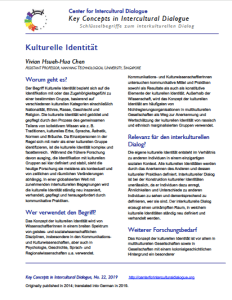
Key Concepts in ICDContinuing translations of Key Concepts in Intercultural Dialogue, today I am posting KC#22: Cultural Identity, which Vivian Hsueh-Hua Chen wrote for publication in English in 2014, and which Alina Timofte has now translated into German.

As always, all Key Concepts are available as free PDFs; just click on the thumbnail to download. Lists of Key Concepts organized chronologically by publication date and number, alphabetically by concept, and by languages into which they have been translated, are available, as is a page of acknowledgments with the names of all authors, translators, and reviewers.

KC22 Cultural Identity_GermanChen, V. H.-H. (2019). Kulturelle Identität. (A. Timofte, trans). Key Concepts in Intercultural Dialogue, 22. Available from:
https://centerforinterculturaldialogue.org/wp-content/uploads/2019/03/kc22-cultural-identity_german.pdf

If you are interested in translating one of the Key Concepts, please contact me for approval first because dozens are currently in process. As always, if there is a concept you think should be written up as one of the Key Concepts, whether in English or any other language, propose it. If you are new to CID, please provide a brief resume. This opportunity is open to masters students and above, on the assumption that some familiarity with academic conventions generally, and discussion of intercultural dialogue specifically, are useful.

Wendy Leeds-Hurwitz, Director
Center for Intercultural Dialogue


Creative Commons License
This work is licensed under a Creative Commons Attribution-NonCommercial-NoDerivatives 4.0 International License.

Johns Hopkins U: Director International Students (USA)

“JobDirector for International Students, Johns Hopkins University, Baltimore, MD. Deadline: Open until filled (posted 3/7/19).

The Director for International Students (the “Director”) provides strategic leadership and policy development related to international students and scholars as part of the OIS leadership team. This person is responsible for ensuring compliance with all Department of Homeland Security, Student and Exchange Visitor Program, and Department of State regulations related to international students and scholars, and possessing general knowledge of other government agency rules that are applicable to the JHU international population (e.g., SSA, MVA, etc.).

American U: Intercultural Understanding (USA)

“JobMultiple Instructors of Intercultural Understanding, American University, Washington, DC. Deadline: 30 June 2019.

The School of Professional & Extended Studies (SPExS) at American University seeks outstanding applicants for multiple term faculty openings beginning in fall 2019. Each appointment is for nine months, and will commence in mid-August 2019 and conclude at the end of May 2020. The positions are full-time, non-tenure track faculty appointments. Rank and salary will be dependent on experience and qualifications. SPExS is seeking experienced instructors to teach Intercultural Understanding to first year students across a range of programs, including the Washington Mentorship Program (WMP) and the International Accelerator Program (IAP).

Intercultural Understanding seeks to encourage a better understanding of the dimensions of experience and belief that distinguishes cultures and countries from one another, and conversely, the commonalities that bind human experience together. The main objective of the course is to improve the intercultural competencies and communication skills of students, and to enhancestudents’ abilities to think critically and creatively about today’s social challenges. The course includes field trips, participation in cultural events, and simulation exercises.

Alina Timofte Profile

ProfilesAlina Timofte is currently a Lecturer for Transferable Skills at the University of Konstanz, Germany. Her teaching and research interests cluster around three themes: a) 21st-century skills (global citizenship, intercultural communication, and critical thinking), b) service learning, and c) academic writing.

Alina TimofteShe is also a practicing GlobeSmart Profile℠ certified consultant, utilizing the GlobeSmart Profile, a statistically validated cultural intelligence software developed by Aperian Global, mostly in academic contexts (as in her seminar “Globally Competent Citizens: Communicating Across Cultures”). Previously, she was a Research Fellow at the Center of Excellence “Cultural Foundations of Social Integration” at the University of Konstanz. The main activities within this academic position were working on a literary science project focusing on Austrian literature after 1945, as well as writing and publishing research articles in peer-reviewed journals.
She holds a Master of Arts with honours in German Studies, with cultural theory, sociology, multilingualism, and translation studies as additional fields. In 2009, she received the Alumni Award for Excellence “Best Exam Achievement by a Graduate Student of Literature” at the University of Konstanz. Her Master’s thesis dealt with the solitude vs. sociability debate in connection with cultural criticism in the European literary anthropology of the 18th century, with a special emphasis on contributions by Jean-Jacques Rousseau, J. G. Zimmermann, and Immanuel Kant.

Following her Bachelor’s in German Studies and Classical Philology at the University “Alexandru Ioan Cuza,” Alina worked as a Cultural Program Coordinator at the Goethe-Zentrum associated with Goethe-Institut in Iasi, Romania.

Alina has a track record of research, teaching, and curriculum design in cultural studies, intercultural communication, and literary criticism. Her work and study has been supported by grants from the German Research Foundation (DFG), German Academic Exchange Service (DAAD), as well as from the Herbert-Quandt-Foundation (Humanities Fellowship), among others.

Her research articles, reviews, and translations have appeared in Limbus. Australian Yearbook of German Literary and Cultural Studies, IASL: International Archives for Social History of the German Literature, Recherches Germaniques, Literaturkritik as well as in other journals and volumes.

On a more personal note, Alina lives with her German-Romanian-Senegalese family in the picturesque city of Konstanz, where they are jointly navigating the complex waters of living multilingually and multiculturally. She sees herself as an educator and a life-long learner at heart, and a world citizen in the making.


Work for CID:

Alina Timofte has translated KC5: Intercultural Communication, KC12: Third Culture Kids, KC22: Cultural Identity, KC49: Intersectionality, KC55: Stereotypes, and KC93: Transnationalism into German, and KC22: Cultural Identity into Romanian. She has also served as a reviewer for German.

PHD Research Fellow: English Language & Literature Pedagogy (Norway)

“Fellowships“PhD Research Fellow Position in English Language and Literature Subject Pedagogy, Nord University, Bodø, Norway. Deadline: 25 March 2019.

The Faculty of Education and Arts, Nord University (Bodø, Norway) invites applications for a position as a PhD research fellow in English. The PhD position is for a period of three years, with the opportunity for a fourth year. The PhD candidate will be a member of the Nord Research Group for Children’s Literature in ELT, a cross-campus research group within the English Department that aims to deepen interdisciplinary and international connections for children’s literature in language education with 6–16-year-olds (grades 1 to 10). Our projects embrace children’s literature in education – image-mediated (e.g. picturebooks, graphic novels), action-mediated (e.g. drama), creative writing and intercultural competence through texts – and English Language Teaching (ELT) research.

Study Abroad: Food Media, Communication & Trends (Italy)

Study AbroadStudy abroad summer 2019: Food Media, Communication and Trends Course, Rome, Italy, May 20-June 22, 2019.

Students have the possibility to earn three credits for this course from the University of Massachusetts Amherst. There are no prerequisites. The course is offered within the Critical Studies on Food in Italy Summer 2019 program which assists students in understanding the role of food in human cultures as well as the range of choices and values implicit in the foods eaten in Italy and elsewhere.  Students can also select from the other courses provided in the program: Critical Studies on Food; Food, Nutrition, and Culture in Italy; Food Waste in Italy;  Italian Language for Food and Business (Italian) (all 3 credits).  Some scholarships are available.

Gustolab International also offers courses in Vietnam (June 30-July 27) and Japan (May 26-June 23).

New Zealand Discourse Conference

ConferencesCall for papers: 7th New Zealand Discourse Conference, 3-6 December, 2019, Massey University, Wellington Campus, New Zealand. Deadline: 31 March 2019.

The New Zealand Discourse Conference is a biennial event which brings together scholars working in a range of fields loosely categorised as discourse analysis. The conference welcomes contributions that consider discourse and interaction in a variety of contexts, drawing on a diverse range of theoretical and analytical approaches. Frequently addressed topics in the past have included: Political discourse, Discourse and identity, Language, gender and sexuality, Multimodal discourse analysis, Narrative, stance and positioning, Media discourse, Health communication, and Discourse and interaction in educational settings.

CID Video Competition FAQ 2019

Job adsAs people are learning of the CID Video Competition, they have been asking questions. In hopes this will help others, the questions will be posted, along with answers. As further questions are asked, they will be answered here.

Please read the entry rules carefully! If submissions do not meet the requirements, they cannot be considered for a prize until and unless they are revised. When ready, submit your video.

What exactly is intercultural dialogue, anyway?
Here’s the short answer: Intercultural dialogue requires at least two people, and they have to come from different cultural groups (international, interracial, interethnic, interfaith). It is active (people actually communicating in some way, having dialogue) rather than passive (knowledge in people’s heads). Here’s a longer answer: Key Concepts in Intercultural Dialogue #1: Intercultural Dialogue. For more details, see this list of additional resources.

What about intergenerational dialogue, is that intercultural as well?
NO, intergenerational dialogue within a single culture is not usually considered a form of intercultural dialogue. An argument could presumably be made, but that may be difficult given the short time limit for the video.

Do all forms of social media have to be addressed?
NO, at least one, but as many as you like. Remember that the point is to show how social media influence intercultural dialogue – the goal is NOT to give a history or critique of social media.

Since Google Translate helps people communicate across language barriers when using social media such as Facebook, could that be considered as a form of social media for the video competition? What about Line, a freeware app for instant communication?
YES, both would be appropriate to consider as social media in this context.

Can a group of students submit a video instead of one person?
Yes, absolutely. In fact, that is encouraged, as a way to ensure different points of view.

Can faculty members participate?
NO, this is a competition for students only. Faculty members can serve as informal advisers or critics, and are certainly asked to encourage participation, or even require participation as a course requirement if that suits their needs. But faculty members should NOT be part of the group that actually works on the video, and should NOT be the one submitting a video.

Can audiotapes be submitted in lieu of videotapes?
NO, sorry, audiotapes are NOT videotapes.

Where should videos be uploaded?

Videos should be uploaded here. You have to create an account when you get to the site, with your email, name, and a password. Videos should NOT be uploaded directly to YouTube or any other server.

Help, I don’t understand the directions when I get to the upload site!

When you click on the link, you will be asked to “Login or create an account.” The first time there, you need to create an account. That means you provide your email address, first name, last name, and make up a password which you provide twice to confirm. Then you click on “Register.” At that point you need to answer all the questions on the application. If you don’t finish the first, time, when you go back to the site you will need to choose login. Your email is your “Login ID” and the password is the same one you provided.

My students are having difficulty submitting their videos. Can a faculty member help with this step?
YES, absolutely. The goal is to have student-created videos. There’s no problem with a faculty member helping to get those videos uploaded so they can be entered in the competition. However, please do NOT do it for them – that means, the account should not be in the faculty member’s name. Let the student create an account, and then help as needed with any technical or translations issues.

My students created videos as a course assignment, so there are several to be uploaded. Does each video need to be submitted separately?
YES, absolutely. Each video, whether created by one student or by a group of students, should be uploaded separately so it can be evaluated by the judges.

Four of us worked on a video together. Do we submit it once or 4 times?
ONLY ONCE! A group video should be submitted once, with all students who worked on the video being listed as authors. Choose a student who checks their email fairly often as the one to upload the video, so if there are any questions, they will see the email and be able to respond.

Can 30-minute videos be considered?
What part of “no less than 30 seconds, no more than 2 minutes long” is unclear?

Is there a language requirement for the videos?
YES, the videos must be in English or subtitled in English. Permitting other languages would imply having judges who know all the several dozen languages currently represented on the site, which would be impossible. However, choosing to have most of the video silent, with minimal talking, or using subtitles, are appropriate ways to finesse the language requirement for those who primarily use other languages.

Do the videos have to be live action?
NO, animation was successfully incorporated into several of last year’s submissions. However, a PowerPoint slideshow is unlikely to result in an award.