UTS Postdoctoral Fellowships (Australia)

PostdocsChancellor’s Postdoctoral Research Fellowships, University of Technology Sydney, Australia. Deadline for expressing interest: 17 May 2019.

The Chancellor’s Postdoctoral Research Fellowship (CPDRF) Scheme develops research, teaching and learning, management and communication skills to shape the next generation of leading academics at UTS. The scheme includes the Chancellor’s Postdoctoral Indigenous Research Fellowship (CPDIRF), aimed at attracting and retaining outstanding Indigenous early career researchers.

Both the CPDRF and CPDIRF offer:

  • A four-year combination research and teaching appointment
  • Academic Salary Level B, Step 2 ($102,952 base salary as of 1 November 2018) plus 17 per cent employer-provided superannuation contribution
  • Research project funding of up to A$50,000

Meeting of Minds@HKU (Hong Kong)

“JobMeeting of Minds@HKU Forum for Outstanding Young Scholars, October 14 -15, 2019, Hong Kong.

The Meeting of Minds@HKU Forum for Outstanding Young Scholars is a 2-day forum to discuss grand challenges through the lens of advanced knowledge, discovery and innovation across science, the humanities, and social sciences. This forum engages participants in intellectually stimulating and creative dialogue to explore how to ignite collective will, wisdom and innovation to improve the human condition. Participants interested in joining HKU as assistant professors will be invited for recruitment interviews, so this is both a conference and a job opportunity.

Workshop: Using MCA in Culturally Diverse Settings (Netherlands)

EventsMethod workshop: “At home, I have chores. I am Polish” – Membership categorization analysis as a method to analyze interaction in culturally diverse settings, May 17th, 2019 (13:00 – 17:30), Erasmus University Rotterdam, Rotterdam, the Netherlands.

Membership categorization analysis (MCA) is a valuable approach for researchers focusing on discourse in culturally diverse settings as it provides insights into how individuals are positioned in social interaction, how groups are generated, and how thereby specific moral orders are established. MCA was established by the early Harvey Sacks and further developed within the field of ethnomethodology. The important question for participants in interactions as well as observers is which categories become relevant, why they are made relevant, and why at this very moment. Furthermore, the analysis of categories, relations between categories, and conclusions people draw from these categories elucidate a huge part of mundane sense-making, yet also moral reasoning. Today, MCA is often combined with conversation analysis, yet not exclusively so.

Keynote speaker: Dr. Daniel Rellstab, Professor for Intercultural German Studies and Multilingualism, University of Education, Schwäbisch Gmünd, Germany.

In the last part of this method workshop, doctoral students working on the broad topic of social identities are invited to present their work in a 3-minute / 2 slide-presentation. Doctoral students who wish to present should include a brief description of their topic and method (max. 150 words).

The event is free for NeFCA members and PhD students (10€ fee for non-members) and includes tea/coffee.

Videos from TV2: All that we Share (Denmark)

Intercultural PedagogyTV2 Denmark created  the Alt Det Vi Deler (All that we share) video 2 years ago, showing multiple ways to group individuals to either emphasize their differences, or their commonalities.

This year they’ve done it again, posting All that we share: Connected. Again, this is a fantastic way to demonstrate shared history, even (especially) when what we share is invisible.

Either would make a wonderful prompt for class discussions of cultural differences and/or assumptions about identity and/or group membership. Students could be asked to create a version for their own communities. Here’s a video adapting the original ad from Nigeria, and others from France, Canada, and the UK.

KC93 Transnationalism Translated into German

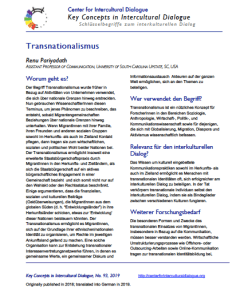
Key Concepts in ICDContinuing translations of Key Concepts in Intercultural Dialogue, today I am posting KC#93: Transnationalism, which Renu Pariyadath wrote last year, and which Alina Timofte has now translated into German.

As always, all Key Concepts are available as free PDFs; just click on the thumbnail to download the PDF. Lists organized chronologically by publication date and numberalphabetically by concept in English, and by languages into which they have been translated, are available, as is a page of acknowledgments with the names of all authors, translators, and reviewers.

KC93 Transnationalism_GermanPariyadath, R. (2019). Transnationalismus [German]. (A. Timofte, trans.) Key Concepts in Intercultural Dialogue, 93. Available from:
https://centerforinterculturaldialogue.org/wp-content/uploads/2019/03/kc93-transnationalism_german.pdf

The Center for Intercultural Dialogue publishes a series of short briefs describing Key Concepts in Intercultural Dialogue. Different people, working in different countries and disciplines, use different vocabulary to describe their interests, yet these terms overlap. Our goal is to provide some of the assumptions and history attached to each concept for those unfamiliar with it. As there are other concepts you would like to see included, send an email to the series editor, Wendy Leeds-Hurwitz. If there are concepts you would like to prepare, provide a brief explanation of why you think the concept is central to the study of intercultural dialogue, and why you are the obvious person to write up that concept.


Creative Commons License
This work is licensed under a Creative Commons Attribution-NonCommercial-NoDerivatives 4.0 International License.

CFP Non-Professional Interpreting/Translation (Netherlands)

ConferencesCall for Papers: Conference on Non-Professional Interpreting and Translation, June 24-26, 2020, University of Amsterdam, The Netherlands. Deadline: 15 September 2019.

The Fifth International Conference on Non-Professional Interpreting and Translation (NPIT5) Organising Committee invites proposals for presentations on any theoretical, empirical, ethical and methodological aspect of research related to the conference theme, Bridging diverse worlds: Expanding roles and contexts of non-professional interpreters and translators. For all proposals the official conference language will be English.

Due to increased globalisation and migration waves, the research field of non-professional interpreting and translation studies has gained in prominence and acknowledgement in recent years. Nonetheless, to receive the recognition it deserves within the field of interpreting and translation studies, the critical and expanding role of non-professional interpreters and translators within increasingly complex and diverse contexts, needs continued attention from academia and practice. Pushing definitional and theoretical boundaries of interpreting and translation, it is a dynamic and still under-researched field that does not necessarily conforms to norms guiding professional multilingual communicative practices, though in many settings and contexts non-professional interpreting and translation is, in fact, more common in bridging diverse cultural and linguistic worlds, than professional interpreting and translation.

By bringing together researchers from various disciplines and practitioners from diverse settings, NPIT5 aims to provide a forum for researchers and practitioners within the field to share and discuss recent and relevant work within this discipline and related to the activities of non-professional interpreters and translators. Furthermore, this forum serves to expand the theoretical, methodological, ethical and disciplinary approaches related to this form of linguistic and cultural mediation. It builds on discussions initiated at the first four international conferences on Non-Professional Interpreting and Translation held in Bologna/Forlì (2012), Mainz/Germersheim (2014), Zurich (2016), and Stellenbosch (2018).

CID Video Competition Now Open!

Job ads
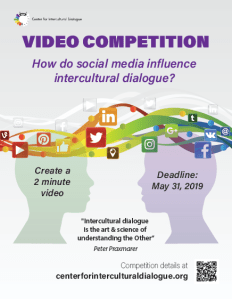
The CID video competition for 2019 is now is open for submissions. To submit an entry, click here. Final deadline:
May 31, 2019.

CID Video Competition 2019

CID’s second video competition is now open for submissions by students enrolled in any college or university during the 2018-2019 academic year, anywhere in the world. And this year, high school students can enter as well, if they want. The question posed this year is “How do social media influence intercultural dialogue?” Answer the question in a 90-120 second video for a top prize of $200. Three top prizes and several awards of excellence will be announced in July, and all winning videotapes will be posted to this website, as well as to all the social media where CID maintains a presence.

See previously published competition rules, FAQ, and resources. See last year’s winning videos. See the reflection by one winning team on creating their video. Or send an email with a question.

Learning & Development, UNESCO (France)

“JobHead of Learning and Development Unit, Bureau of Human Resources Management, UNESCO, Paris, France. Deadline: 3 May 2019.

The Head of the Learning and Development Unit plays a key role in the delivery of UNESCO’s human resource strategic objectives and UNESCO’s related Learning and Development Action Plan. The plan will be implemented over five years and aims to develop a skilled and competent UNESCO workforce at all levels of the Organization. The Head of Unit will be a senior learning and development professional with a track record of success. Require excellent knowledge of English and good knowledge of French as well as another UNESCO official language (Arabic, Chinese, Russian, Spanish).

U Westminster MPhil/PHD Studentships Linguistics (UK)

“Studentships“MPhil or PHD Studentships, School of Humanities, University of Westminster, London, UK. Deadline: 17 May 2019.

The School of Humanities at the University of Westminster is offering two studentships, including a fee waiver of home/EU fees* and stipend of £16,777 per annum for three years full-time study, to commence in either September 2019 or January 2020. The School of Humanities, based in the University’s historic Regent Street building, offers a vibrant, multidisciplinary research environment with a well-established PhD programme in, or across, a wide range of disciplines, including Contemporary Chinese Studies, English Language, English Literature, French and Francophone Studies, History, Linguistics, Museums and Heritage, Translation Studies, Visual Culture and Cultural Studies.

The Westminster Forum for Languages and Linguistics would particularly welcome applications from prospective PhD candidates in their specialist areas in sociolinguistics and historical linguistics:

  • Multilingualism including community/heritage languages
  • Migration, exile, language and spaces
  • Language contact including creole languages
  • Language and gender
  • Historical study of the English language

To discuss informally where your research idea might fit within these specialisms, or for queries about any aspect of the application process, please contact Dr Helen Glew.

CFP Local Alignments, Global Upheaval (Canada)

ConferencesCall for proposals: Local Alignments, Global Upheaval: Re-Imagining Peace, Legitimacy, Jurisdiction and Authority, October 4-6, 2019, Canadian Mennonite University, Winnipeg, Canada. Deadline: May 1, 2019.

Annual conference of the Peace and Justice Studies Association (PJSA) & Peace and Conflict Studies – Canadian Association (PACS-Can) invites peace and justice scholars and students, community-based practitioners, experiential educators, musicians, artists, and social movement organizers to join in conversations reimagining peace through local alignments amidst global upheavals. 

Calling upon the depth and breadth of the inter-disciplinary peace scholarship and conflict resolution practices reflected in the PJSA and PACS-Can membership, this conference aims to further dialogue, mobilize strategy, and catalyze new insights and practices that empower global change through interconnected local actions. Participants are encouraged to frame their contributions to the conference in ways that shed light on the dynamics of social upheavals and revolutionary social histories.