KC49 Intersectionality Translated into Portuguese

Key Concepts in ICDContinuing translations of Key Concepts in Intercultural Dialogue, today I am posting KC#49: Intersectionality, which Gust Yep published in English in 2015, and which Filipa Subtil has now translated into Portuguese.

As always, all Key Concepts are available as free PDFs; just click on the thumbnail to download the PDF. Lists organized chronologically by publication date and numberalphabetically by concept in English, and by languages into which they have been translated, are available, as is a page of acknowledgments with the names of all authors, translators, and reviewers.
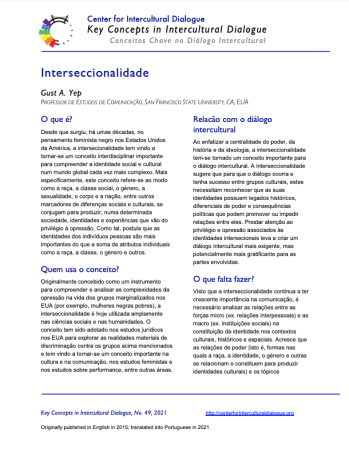
KC49 Intersectionality_Portuguese

Yep, G. (2021). Interseccionalidade. (F. Subtil, Trans.). Key Concepts in Intercultural Dialogue, 49. Available from: https://centerforinterculturaldialogue.org/wp-content/uploads/2021/09/kc49-intersectionality_portuguese.pdf

The Center for Intercultural Dialogue publishes a series of short briefs describing Key Concepts in Intercultural Dialogue. Different people, working in different countries and disciplines, use different vocabulary to describe their interests, yet these terms overlap. Our goal is to provide some of the assumptions and history attached to each concept for those unfamiliar with it. As there are other concepts you would like to see included, send an email to the series editor, Wendy Leeds-Hurwitz. If there are concepts you would like to prepare, provide a brief explanation of why you think the concept is central to the study of intercultural dialogue, and why you are the obvious person to write up that concept.


Creative Commons License
This work is licensed under a Creative Commons Attribution-NonCommercial-NoDerivatives 4.0 International License.

SDSU: Asst Prof of Conflict Communication/Civil Discourse (USA)

“JobAssistant Professor of Conflict Communication / Civil Discourse, San Diego State University, CA, USA. Deadline: October 11, 2021 (or until filled).

The School of Communication at San Diego State University (SDSU) invites applications for a tenure-track faculty position in Conflict Communication/Civil Discourse, at the level of advanced assistant professor, to start August 2022.

Responsibilities: The successful candidate is expected to have a scholarly research agenda examining conflict communication or civil discourse from an interpersonal, organization, group, health, or intercultural, perspective. The faculty member will be able to teach curriculum at the undergraduate and graduate level. Courses include, but are not limited to, topics in communication theory, methodology, and conflict management. The candidate will also have the opportunity to create and teach classes aligned with their particular research interests, including upper division and graduate level courses. The successful candidate will also be expected to provide service to the School, College, University, and professional communication organizations. Faculty members are expected to serve on and chair master’s thesis and comprehensive examination committees, and mentor early career faculty members as appropriate.

Saint Louis U: Race & Media (USA)

“JobAssistant Professor of Race and Media, Department of Media and Cinema Studies, Saint Louis University, Missouri, USA. Deadline: Review to begin 18 October, 2021, until position is filled.

Saint Louis University is seeking applicants for a tenure-track position in the Department of Communication. We are seeking a candidate with expertise in race, media and social justice. The position is at the assistant professor level, to begin in Fall 2022. Duties include teaching courses such as media and society, stereotyping and bias in media and other courses in the Journalism and Media Studies concentration, along with courses in the department’s core curricula and in our graduate program. Candidates are expected to participate in service and maintain an active program of published research. Tenure-track faculty in our department teach two courses each semester. Earned doctorate by August 1, 2022, documented teaching experience and excellence and record or promise of published scholarly research. A successful candidate will demonstrate meaningful commitment to social justice, equity and inclusion in their teaching, research and service.

Michigan State U: Interethnic & Intercultural Communication (USA)

“JobTenure track open rank in Interethnic and Intercultural Communication, Department of Communication, Michigan State University,  East Lansing, MI USA. Deadline: September 8, 2023; posted September 8, 2021.

The College of Communication Arts and Sciences at Michigan State University invites applicants for a multi-position thematic hire with a focus on race, ethnicity, gender, and/or social inequality. They seek scholars whose research, teaching, outreach and/or service seek to address systemic inequities and who will advance the College’s commitment to diversity, equity, and inclusion. The goal of the thematic hire is to grow our collaborative network of scholars focused on communication and disparities across a broad range of subdisciplines, bringing together new hires and existing faculty experts. Successful candidates will be part of a community of scholars and practitioners working to enhance social justice through research in the fields of communication, journalism studies, advertising, public relations, information science, game studies, and communicative sciences and disorders. The hiring initiative will bring in five new faculty over two years.

One open rank tenure stream faculty position will be in the Department of Communication. The optimal candidate should be able to teach courses in interethnic and intercultural communication as well as a secondary area in organizational, interpersonal, or persuasive communication. They are particularly interested in scholars who contribute to and test communication theory in diversity and intercultural communication contexts. Qualified applicants should have a social scientific focus, a background in quantitative research methods, and expertise to teach both graduate and undergraduate courses. Candidates must have a commitment to mentoring graduate students, teaching, high-quality empirical research, and external grant activity. Applicants should have a Ph.D. in Communication or a related field.

NOTE: This is Posting #732271, once you get to the MSU site.

EIUC Electoral Observers Training 2021 (Italy)

Applied ICD

Training seminar for International Electoral Observers, Global Campus of Human Rights, Venice, Italy, 15-20 November 2021. Deadline: 29 October 2021.

The Global Campus of Human Rights has developed a course aiming at providing training to civilian staff in election observation missions at the first steps of their career (i.e. short term observers). Selected applicants will be allowed to become aware of the role, the tasks and the status of international observers, and will be given a theoretical and practical training on election observation and election observation missions functioning. The training will take place in Venice, at the Global Campus of Human Rights Headquarters, from 15-20 November 2021.

After the successful brand new online edition of February 2021, a second edition of the course will offer selected participants a new challenging experience in distance learning education.

CFP Difficult Conversations Concerning Identity & Difference

“PublicationCall for extended abstracts: Difficult Conversations Concerning Identity and Difference, Special issue of Human Communication Research. Deadline: November 7, 2021.

Guest Editors: Srividya Ramasubramanian, Syracuse University and Jordan Soliz, University of Nebraska-Lincoln

From community dialogues about polarizing social issues to managing different ideologies and identities in families to critical conversations about different lived experiences (e.g., differences in experiences of bias and discrimination, experiences with chronic illness and disability), our daily lives are often infused with conversations that can be characterized as difficult, contentious, uncomfortable, or anxiety-inducing often requiring courageous, bold, and vulnerable engagement by individuals, organizations, and communities.

Further, popular conceptions of what constitutes “appropriate” conversations can often silence dissent, suppress voices of marginalized communities, or ignore experiences of individuals. These difficult conversations and dialogue are often necessary to achieve social justice goals, to build inclusive community or relational solidarity, to enhance individual well-being, to critically engage social issues and truth-telling, or to serve as the foundation for community-led initiatives to enact social change. As such, we benefit from additional inquiries, theorizing, and critical examination on what contributes to effective and empowering conversations in these contexts as well as the personal, social, institutional, and cultural factors that influence engagement in and outcomes of these interactions.

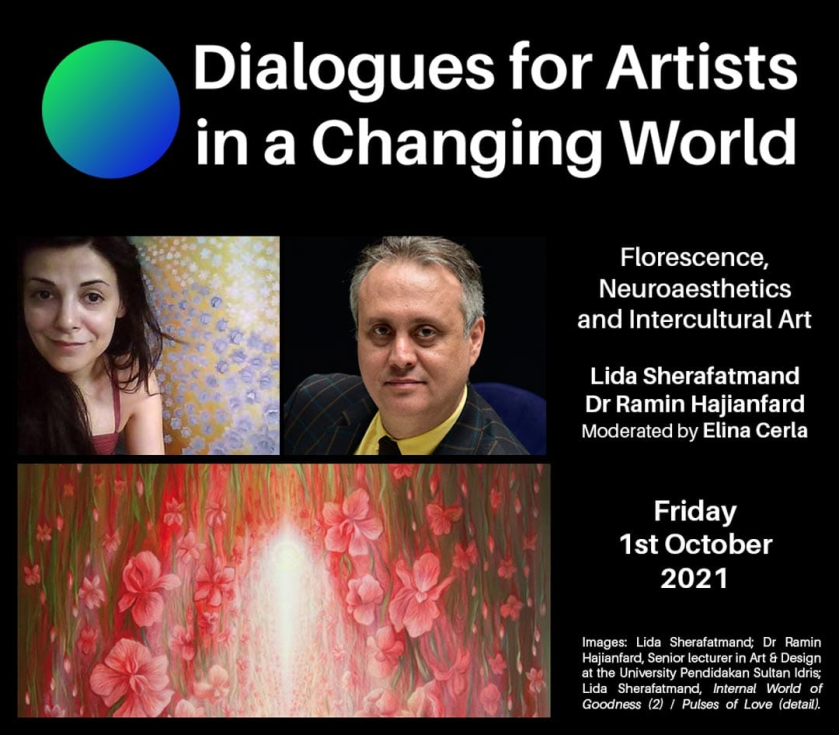
Dialogues for Artists in a Changing World (Malaysia but Online)

EventsDialogues for Artists in a Changing World: Florescence, Neuroaesthetics, and Intercultural Art, University Pendidakan Sultan Idris, Selangor, Malaysia, Online, October 1, 2021.

Dialogues for Artists in a Changing World

Florescence is the term used to refer to flowering; a potent image that recurs throughout art history with shifting contexts and symbolism. Lida Sherafatmand, co-author of the Manifesto of Florescencism, will discuss her belief in the power of art to contribute to social and environmental equilibrium, and its ability to resonate beyond geographic borders. Dr. Ramin Hajianfard, Senior Lecturer in Art & Design at the University Pendidakan Sultan Idris, Malaysia, whose research interests include peace painting and intercultural aesthetics, will participate as well. Touching on the importance of art having an awareness of other disciplines, including psychology and social science, the conversation will explore the political power of an aesthetics of gentle beauty and the importance for painting to be in constant conversation with many different spheres, as well as how research into neuroaesthetics can widen the scope of understanding of the ways in which art interacts with and affects viewers.

The event is scheduled for Friday, October 1, 2021. The times are as follows:
Malaysia – 10.50pm / 11pm start
Central Europe – 4.50pm / 5pm start
UK/Ireland – 3.50pm / 4pm start
East Coast US – 10.50am / 11am start
West Coast US – 7.50am / 8am start

(Follow the link in the first paragraph to participate.)

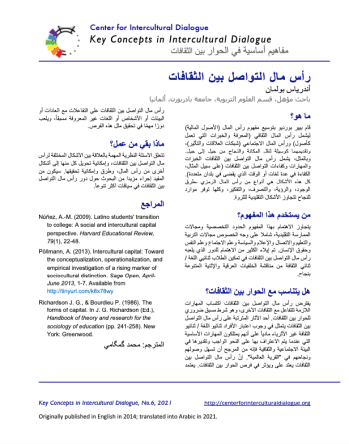
KC6 Intercultural Capital Translated into Arabic

Key Concepts in ICDContinuing translations of Key Concepts in Intercultural Dialogue, today I am posting KC#6: Intercultural Capital, which Andreas Pöllmann wrote for publication in English in 2014, and which Mohammed Guamguami has now translated into Arabic.

As always, all Key Concepts are available as free PDFs; just click on the thumbnail to download. Lists of Key Concepts organized chronologically by publication date and number, alphabetically by concept, and by languages into which they have been translated, are available, as is a page of acknowledgments with the names of all authors, translators, and reviewers.

KC6 Intercultural capital_Arabic

Pöllmann, A. (2021). Intercultural capital [Arabic]. (M. Guamguami, Trans). Key Concepts in Intercultural Dialogue, 6. Available from:
https://centerforinterculturaldialogue.org/wp-content/uploads/2021/09/kc6-intercultural-capital_arabic.pdf

If you are interested in translating one of the Key Concepts, please contact me for approval first because dozens are currently in process. As always, if there is a concept you think should be written up as one of the Key Concepts, whether in English or any other language, propose it. If you are new to CID, please provide a brief resume. This opportunity is open to masters students and above, on the assumption that some familiarity with academic conventions generally, and discussion of intercultural dialogue specifically, are useful.

Wendy Leeds-Hurwitz, Director
Center for Intercultural Dialogue


Creative Commons License
This work is licensed under a Creative Commons Attribution-NonCommercial-NoDerivatives 4.0 International License.
CFP Historizing International Organizations

“PublicationCall for papers: Historizing International Organizations and Their Communication – Institutions, Practices, Changes, Special issue of Studies in Communication Sciences. Deadline: January 30, 2022.

The Thematic Section will focus on the history of international organizations and their communication. Since the second half of the 19th century, for numerous and diverse areas of social life, globally active international organizations of varying degrees of institutionalization and scope, both non-governmental and intergovernmental, have been founded and have dedicated themselves to the global challenges of the first modern age. The most famous of these is certainly the League of Nations, which was established in 1919 as the predecessor institution of the United Nations.

From a media-historical perspective, international organizations played a highly visible role in the transnational intertwining and consolidation processes of journalism, culture, media, politics, technology, and the public sphere in the 19th and 20th centuries. Against the background of the much-discussed boundaries between secret diplomacy and public diplomacy, especially after the First World War, such organizations contributed to the development of the first arenas and forms of international and transnational public spheres whose orientation was toward global governance. To spread their concerns and goals globally, they: constantly used the latest communication technologies and the growing diversity of the media for their communication; organized and professionalized their information work; and developed specific information-policy instruments and strategies for that purpose.

SUNY New Paltz: Communication & Culture (USA)

“JobAssistant Professor of Communication and Culture, Department of Communication, SUNY New Paltz, NY, USA. Deadline: Open until filled; posted September 10, 2021.

The Department of Communication at the State University of New York at New Paltz seeks an assistant professor of Communication and Culture beginning in Fall of 2022. We especially encourage applications from individuals who can bring diverse cultural and ethnic perspectives and experiences to the campus and who can advise and mentor all members of our diverse student body. The successful candidate will teach undergraduate courses such as: Communication Among Cultures; Storytelling and Culture; Nonverbal Communication; Communication, Culture, and Difference; Qualitative Research Methods; Interpersonal Communication Seminar.

A master’s program in Strategic Communication is being developed, and the successful candidate may also teach courses within that program. The normal teaching load is 9 credits per semester. Although teaching is the primary responsibility at SUNY New Paltz, scholarly work and ongoing service to the department and college are expected.