
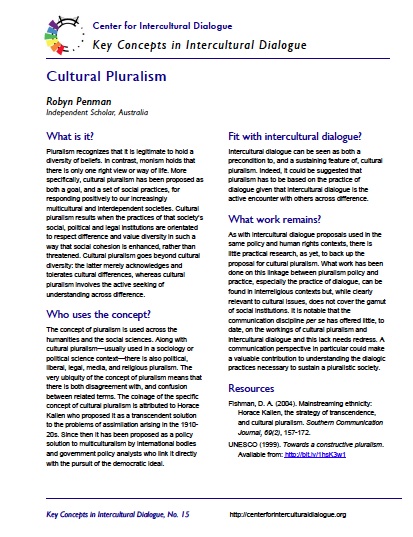
Key Concepts #15: Cultural Pluralism by Robyn Penman

Key Concepts in ICDThe next issue of Key Concepts in intercultural Dialogue is now available. This is KC15: Cultural Pluralism by Robyn Penman. As always, all Key Concepts are available as free PDFs; just click on the thumbnail to download.Lists organized  chronologically by publication date and numberalphabetically by concept in English, and by languages into which they have been translated, are available, as is a page of acknowledgments with the names of all authors, translators, and reviewers.
kc15-sm

Penman, R. (2014). Cultural pluralism. Key Concepts in Intercultural Dialogue, 15. Available from:
https://centerforinterculturaldialogue.org/wp-content/uploads/2014/05/key-concept-cultural-pluralism.pdf

The Center for Intercultural Dialogue publishes a series of short briefs describing Key Concepts in intercultural Dialogue. Different people, working in different countries and disciplines, use different vocabulary to describe their interests, yet these terms overlap. Our goal is to provide some of the assumptions and history attached to each concept for those unfamiliar with it. As there are other concepts you would like to see included, send an email to the series editor, Wendy Leeds-Hurwitz. If there are concepts you would like to prepare, provide a brief explanation of why you think the concept is central to the study of intercultural dialogue, and why you are the obvious person to write up that concept.


Creative Commons License
This work is licensed under a Creative Commons Attribution-NonCommercial-NoDerivatives 4.0 International License.
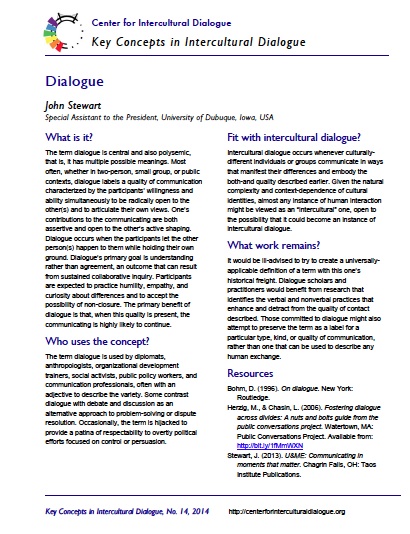
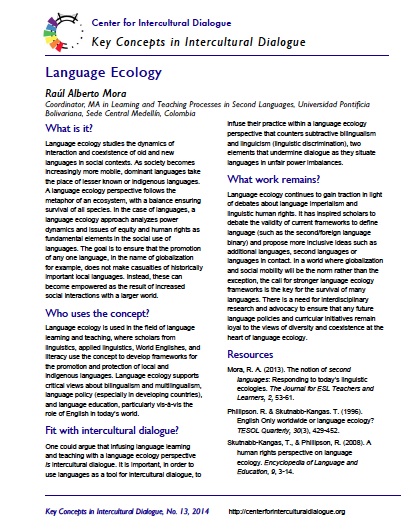
Key Concepts #14: Dialogue by John Stewart

Key Concepts in ICDThe next issue of Key Concepts in intercultural Dialogue is now available. This is KC14: Dialogue by John Stewart. As always, all Key Concepts are available as free PDFs; just click on the thumbnail to download.Lists organized  chronologically by publication date and numberalphabetically by concept in English, and by languages into which they have been translated, are available, as is a page of acknowledgments with the names of all authors, translators, and reviewers.

kc14-smStewart, J. (2014). Dialogue. Key Concepts in Intercultural Dialogue, 14. Available from:
https://centerforinterculturaldialogue.org/wp-content/uploads/2014/05/key-concept-dialogue.pdf

The Center for Intercultural Dialogue publishes a series of short briefs describing Key Concepts in intercultural Dialogue. Different people, working in different countries and disciplines, use different vocabulary to describe their interests, yet these terms overlap. Our goal is to provide some of the assumptions and history attached to each concept for those unfamiliar with it. As there are other concepts you would like to see included, send an email to the series editor, Wendy Leeds-Hurwitz. If there are concepts you would like to prepare, provide a brief explanation of why you think the concept is central to the study of intercultural dialogue, and why you are the obvious person to write up that concept.


Creative Commons License

This work is licensed under a Creative Commons Attribution-NonCommercial-NoDerivatives 4.0 International License.
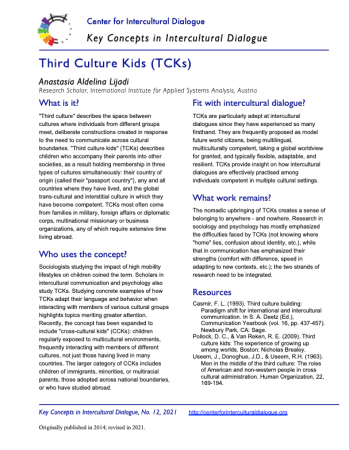
Key Concepts #13: Language Ecology by Raúl Alberto Mora

Key Concepts in ICDThe next issue of Key Concepts in intercultural Dialogue is now available. This is KC13: Language Ecology by Raúl Alberto Mora. As always, all Key Concepts are available as free PDFs; just click on the thumbnail to download.Lists organized  chronologically by publication date and numberalphabetically by concept in English, and by languages into which they have been translated, are available, as is a page of acknowledgments with the names of all authors, translators, and reviewers.

kc13-sm

Mora, R. A. (2014). Language ecology. Key Concepts in Intercultural Dialogue, 13. Available from:
https://centerforinterculturaldialogue.org/wp-content/uploads/2014/05/key-concept-language-ecology.pdf

The Center for Intercultural Dialogue publishes a series of short briefs describing Key Concepts in intercultural Dialogue. Different people, working in different countries and disciplines, use different vocabulary to describe their interests, yet these terms overlap. Our goal is to provide some of the assumptions and history attached to each concept for those unfamiliar with it. As there are other concepts you would like to see included, send an email to the series editor, Wendy Leeds-Hurwitz. If there are concepts you would like to prepare, provide a brief explanation of why you think the concept is central to the study of intercultural dialogue, and why you are the obvious person to write up that concept.


Creative Commons License
This work is licensed under a Creative Commons Attribution-NonCommercial-NoDerivatives 4.0 International License.
Key Concepts #12: Third Culture Kids by Anastasia Lijadi

Key Concepts in ICDThe next issue of Key Concepts in intercultural Dialogue is now available. This is KC12: Third Culture Kids by Anastasia Adelina Lijadi. As always, all Key Concepts are available as free PDFs; just click on the thumbnail to download.Lists organized  chronologically by publication date and numberalphabetically by concept in English, and by languages into which they have been translated, are available, as is a page of acknowledgments with the names of all authors, translators, and reviewers.

KC12 TCKs_v2Lijadi, A. A. (2021). Third culture kids. Key Concepts in Intercultural Dialogue, 12. Available from: https://centerforinterculturaldialogue.org/wp-content/uploads/2021/05/kc12-tcks_v2.pdf

The Center for Intercultural Dialogue publishes a series of short briefs describing Key Concepts in intercultural Dialogue. Different people, working in different countries and disciplines, use different vocabulary to describe their interests, yet these terms overlap. Our goal is to provide some of the assumptions and history attached to each concept for those unfamiliar with it. As there are other concepts you would like to see included, send an email to the series editor, Wendy Leeds-Hurwitz. If there are concepts you would like to prepare, provide a brief explanation of why you think the concept is central to the study of intercultural dialogue, and why you are the obvious person to write up that concept.


Creative Commons License
This work is licensed under a Creative Commons Attribution-NonCommercial-NoDerivatives 4.0 International License.
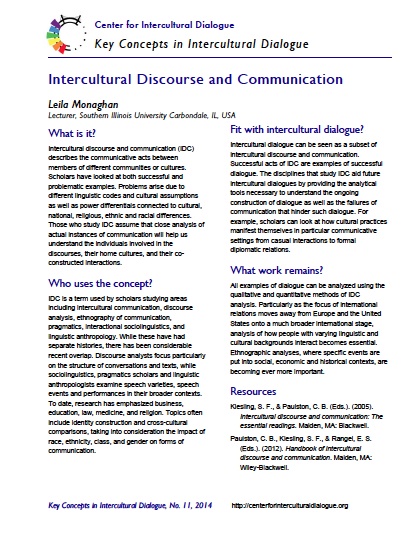
Key Concepts #11: Intercultural Discourse & Communication by Leila Monaghan

Key Concepts in ICDThe next issue of Key Concepts in intercultural Dialogue is now available. This is KC11: Intercultural Discourse & Communication by Leila Monaghan. As always, all Key Concepts are available as free PDFs; just click on the thumbnail to download.Lists organized  chronologically by publication date and numberalphabetically by concept in English, and by languages into which they have been translated, are available, as is a page of acknowledgments with the names of all authors, translators, and reviewers.

kc11-smMonaghan, L. (2014). Intercultural discourse and communication. Key Concepts in Intercultural Dialogue, 11. Available from:
https://centerforinterculturaldialogue.org/wp-content/uploads/2014/04/key-concept-intercult-discourse-comm.pdf

The Center for Intercultural Dialogue publishes a series of short briefs describing Key Concepts in intercultural Dialogue. Different people, working in different countries and disciplines, use different vocabulary to describe their interests, yet these terms overlap. Our goal is to provide some of the assumptions and history attached to each concept for those unfamiliar with it. As there are other concepts you would like to see included, send an email to the series editor, Wendy Leeds-Hurwitz. If there are concepts you would like to prepare, provide a brief explanation of why you think the concept is central to the study of intercultural dialogue, and why you are the obvious person to write up that concept.


Creative Commons License
This work is licensed under a Creative Commons Attribution-NonCommercial-NoDerivatives 4.0 International License.
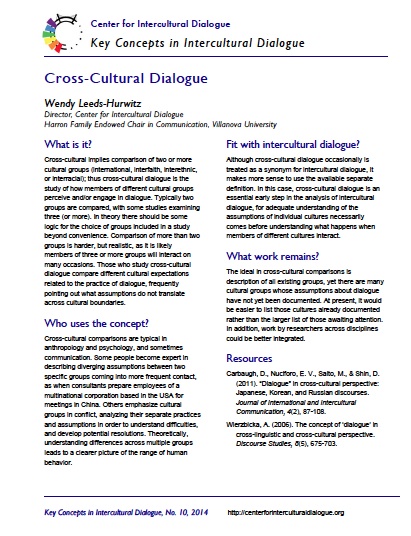
Key Concepts #10: Cross-Cultural Dialogue by Wendy Leeds-Hurwitz

Key Concepts in ICDThe next issue of Key Concepts in intercultural Dialogue is now available. This is KC10: Cross-Cultural Dialogue by Wendy Leeds-Hurwitz. As always, all Key Concepts are available as free PDFs; just click on the thumbnail to download.Lists organized  chronologically by publication date and numberalphabetically by concept in English, and by languages into which they have been translated, are available, as is a page of acknowledgments with the names of all authors, translators, and reviewers.

KC10-sm

Leeds-Hurwitz, W. (2014). Cross-cultural dialogue. Key Concepts in Intercultural Dialogue, 10. Available from:
https://centerforinterculturaldialogue.org/wp-content/uploads/2014/04/key-concept-cross-cultural-dialogue.pdf

The Center for Intercultural Dialogue publishes a series of short briefs describing Key Concepts in intercultural Dialogue. Different people, working in different countries and disciplines, use different vocabulary to describe their interests, yet these terms overlap. Our goal is to provide some of the assumptions and history attached to each concept for those unfamiliar with it. As there are other concepts you would like to see included, send an email to the series editor, Wendy Leeds-Hurwitz. If there are concepts you would like to prepare, provide a brief explanation of why you think the concept is central to the study of intercultural dialogue, and why you are the obvious person to write up that concept.


Creative Commons License
This work is licensed under a Creative Commons Attribution-NonCommercial-NoDerivatives 4.0 International License.
New Intercultural Dialogue book out

Intercultural dialogue: Modern paradigm and experience of the neighborhood has just been published as an ebook, and is available for free (just click on the thumbnail below if you want a copy). The editor is Liubou Uladykouskaja, Director of the Institution Intercultural Dialogue in Minsk, Belarus.

ICD-Belarus-coverIn the original Cyrillic, the citation would be:

Міжкультурны дыялог: сучасная парадыгма і во­пыт су­cедства : зб. навук. арт. / склад. і навук. рэд.Л. Уладыкоўская. – Мінск : ДIКСТ БДУ, 2014.


This collection includes selected materials from the international scientific conference of the same name organized by the Polish Institute in Minsk, the State Institute of Management and Social Technologies of the Belarusian State University, the Institution “Intercultural Dialogue” (held in Minsk on May 24, 2013) , as well as scientific developments of foreign authors. The articles discuss various aspects and modern concepts of intercultural dialogue and the basis of its research methodology. Chapters are written in Belarusian, Polish, English and Russian; the authors are from the US, Belarus, Poland, and Ukraine.

The one chapter in English is by the CID Director, Wendy Leeds-Hurwitz, based on a paper delivered at the World Forum on Intercultural Dialogue in Baku, Azerbaijan in 2011. In English, that citation would be:

Leeds-Hurwitz, W. (2014). Dialogue about dialogue: Taking a (meta)communication perspective on intercultural dialogue. In L. Uladykouskaja (Ed.), Intercultural dialogue: Modern paradigm and experience of the neighborhood (pp. 6-13). Minsk, Belarus: Belarusian State University.

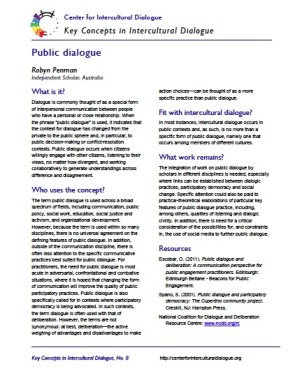
Key Concepts #8: Public Dialogue by Robyn Penman

Key Concepts in ICDThe next issue of Key Concepts in intercultural Dialogue is now available. This is KC8: Public Dialogue by Robyn Penman. As always, all Key Concepts are available as free PDFs; just click on the thumbnail to download. Lists organized  chronologically by publication date and numberalphabetically by concept in English, and by languages into which they have been translated, are available, as is a page of acknowledgments with the names of all authors, translators, and reviewers.

KC8-sm

Penman, R. (2014). Public dialogue. Key Concepts in Intercultural Dialogue, 8. Available from:
https://centerforinterculturaldialogue.org/wp-content/uploads/2014/03/key-concept-public-dialogue.pdf

The Center for Intercultural Dialogue is publishing a series of short briefs describing Key Concepts in intercultural Dialogue. The logic is that different people, working in different countries and disciplines, use different vocabulary to describe their interests, yet these terms overlap. Our goal is to provide some of the assumptions and history attached to each concept for those unfamiliar with it. As there are other concepts you would like to see included, send an email to the series editor, Wendy Leeds-Hurwitz. If there are concepts you would like to prepare, provide a brief explanation of why you think the concept is central to the study of intercultural dialogue, and why you are the obvious person to write up that concept.


Creative Commons License
This work is licensed under a Creative Commons Attribution-NonCommercial-NoDerivatives 4.0 International License.
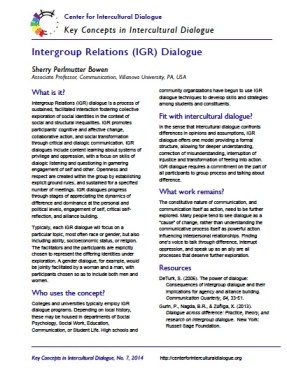
Key Concepts #7: IGR Dialogue by Sherry Perlmutter Bowen

Key Concepts in ICDThe next issue of Key Concepts in intercultural Dialogue is now available. This is KC7: Intergroup Relations (IGR) Dialogue by Sherry Perlmutter Bowen. As always, all Key Concepts are available as free PDFs; just click on the thumbnail to download. Lists organized  chronologically by publication date and numberalphabetically by concept in English, and by languages into which they have been translated, are available, as is a page of acknowledgments with the names of all authors, translators, and reviewers.

KC7-sm

Bowen, S. P. (2014). Intergroup relations (IGR) dialogue. Key Concepts in Intercultural Dialogue, 7. Available from:
https://centerforinterculturaldialogue.org/wp-content/uploads/2014/03/key-concept-igr.pdf

The Center for Intercultural Dialogue is publishing a series of short briefs describing Key Concepts in intercultural Dialogue. The logic is that different people, working in different countries and disciplines, use different vocabulary to describe their interests, yet these terms overlap. Our goal is to provide some of the assumptions and history attached to each concept for those unfamiliar with it. As there are other concepts you would like to see included, send an email to the series editor, Wendy Leeds-Hurwitz. If there are concepts you would like to prepare, provide a brief explanation of why you think the concept is central to the study of intercultural dialogue, and why you are the obvious person to write up that concept.


Creative Commons License
This work is licensed under a Creative Commons Attribution-NonCommercial-NoDerivatives 4.0 International License.
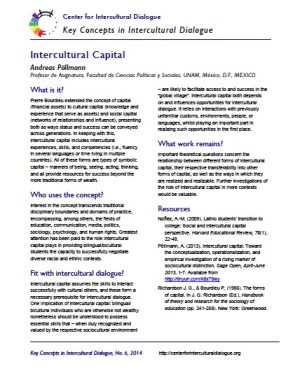
Key Concepts #6: Intercultural Capital by Andreas Pöllmann

Key Concepts in ICDThe next issue of Key Concepts in intercultural Dialogue is now available. This is KC6: Intercultural Capital by Andreas Pöllmann. As always, all Key Concepts are available as free PDFs; just click on the thumbnail to download. Lists organized  chronologically by publication date and numberalphabetically by concept in English, and by languages into which they have been translated, are available, as is a page of acknowledgments with the names of all authors, translators, and reviewers.

Key Concept 6

Pöllmann, A. (2014). Intercultural capital. Key Concepts in Intercultural Dialogue, 6. Available from:
https://centerforinterculturaldialogue.org/wp-content/uploads/2014/03/key-concept-intercultural-capital1.pdf

The Center for Intercultural Dialogue is publishing a series of short briefs describing Key Concepts in intercultural Dialogue. The logic is that different people, working in different countries and disciplines, use different vocabulary to describe their interests, yet these terms overlap. Our goal is to provide some of the assumptions and history attached to each concept for those unfamiliar with it. As there are other concepts you would like to see included, send an email to the series editor, Wendy Leeds-Hurwitz. If there are concepts you would like to prepare, provide a brief explanation of why you think the concept is central to the study of intercultural dialogue, and why you are the obvious person to write up that concept.


Creative Commons License
This work is licensed under a Creative Commons Attribution-NonCommercial-NoDerivatives 4.0 International License.