Key Concept #25: Metacommunication by Wendy Leeds-Hurwitz

Key Concepts in ICDThe next issue of Key Concepts in intercultural Dialogue is now available. This is KC25: Metacommunication by Wendy Leeds-Hurwitz. As always, all Key Concepts are available as free PDFs; just click on the thumbnail to download. Lists organized  chronologically by publication date and numberalphabetically by concept in English, and by languages into which they have been translated, are available, as is a page of acknowledgments with the names of all authors, translators, and reviewers.

kc25-sm

Leeds-Hurwitz, W. (2014). Metacommunication. Key Concepts in Intercultural Dialogue, 25. Available from:
https://centerforinterculturaldialogue.org/wp-content/uploads/2014/07/key-concept-metacomm.pdf

The Center for Intercultural Dialogue publishes a series of short briefs describing Key Concepts in intercultural Dialogue. Different people, working in different countries and disciplines, use different vocabulary to describe their interests, yet these terms overlap. Our goal is to provide some of the assumptions and history attached to each concept for those unfamiliar with it. As there are other concepts you would like to see included, send an email to the series editor, Wendy Leeds-Hurwitz. If there are concepts you would like to prepare, provide a brief explanation of why you think the concept is central to the study of intercultural dialogue, and why you are the obvious person to write up that concept.


Creative Commons License
This work is licensed under a Creative Commons Attribution-NonCommercial-NoDerivatives 4.0 International License.

CFP Irish regional press (Dublin)

Proposals are invited for papers to be presented at an upcoming interdisciplinary conference on the Irish regional press to be held at Dublin City University (DCU) on Friday 12 December 2014. The conference aims to address the historical and contemporary development of the regional press in the major urban centres and rural areas across Ireland. This conference is organised in association with the Newspaper and Periodical History Forum of Ireland (NPHFI).

Papers might address, but are not limited to, the historical and contemporary consideration of the following themes in relation to the Irish regional press:
·         Biographies of reporters, editors or owners
·         History of individual newspapers
·         Corporate and business organisation
·         Political influence and / or affiliation
·         Professional networks
·         Sport
·         Gender
·         Technological and communication developments
·         The community and social role of the regional press
·         The Irish Language and the regional press
·         The urban-rural divide
·         Union organisation

Papers which address these themes, and others, from an historical or regional perspective, through case studies or quantitative and qualitative analysis are welcome. The conference is open to all disciplines. Early career researchers and postgraduate students are particularly encouraged to contribute.

Abstracts of no more than 300 words, for papers of twenty minutes, should be emailed to irishregionalpress@gmail.com by Friday 3 October 2014. Abstracts should clearly indicate the proposed title, the paper’s main aims, and the name and affiliation of the author(s ). Abstracts should be accompanied by a brief biography and contact details.

For further information or enquiries please contact either Ian Kenneally (ian.kenneally@gmail.com) or James O’Donnell (jamesthomasodonnell@gmail.com

). It is intended that the papers and discussion at this conference will contribute to an edited volume on the history of the Irish regional press to be published with a leading academic publishing house.

EIUC Training for Int’l Electoral Observers

EIUC Training Seminar for International Electoral Observers

Early birds enrollment until 15 September

The EIUC training seminar for International Short-Term Observers is now ready to accept candidatures.

With the patronage of Italian, Spanish and Czech MFA, EIUC has developed two three day modules aiming at providing training to civilian staff in election observation missions at the first steps of their career (i.e. short term observers). Selected applicants will be allowed to become aware of the role, the tasks and the status of international observers, and will be given a theoretical and practical training on election observation and election observation missions functioning.

The first module (17-19 November 2014) will highlight the quantitative observation of the STOs. Starting with a thorough introduction on the international observation theory and legal standards the first module will analyse the practical life of a short term observer from the selection procedure to the end of mission including the observation of the polls, the filling of the forms, the reporting system and the code of the conduct.

The second module (20-22 November 2014) will introduce the participants to the long-term election observation by analysing in depth some of the aspects related to an international observation mission such as working relations, team-building, interviewing techniques and coordination of the STOs.

EIUC will accept candidatures for each separate module or both combined. Applicants will therefore have a possibility to choose the module which is more closely related to their interests and experience or combine the two of them for a more complete understanding of the topic.

The faculty is composed by well-known international trainers and professionals with a long standing practical experience in election observation missions within international organisations such as the European Union and the Organisation for Security and Cooperation in Europe.

Interested candidates should register by compiling the online application form.

More information can be found at: http://www.eiuc.org/ieo/
For further enquiries please contact us at: training.ieo@eiuc.org

Save

Global Campus of Human Rights (Italy)

Late announcement: On Monday, 28 July, EIUC will hold a one-day event aimed at raising awareness of the Global Campus and fostering debate on some of the main issues connected with the human rights of migrants. In this regard, the event will bring into focus the UN Migrant Workers Convention.

The conference, to be held at the EIUC premises in the Monastery of San Nicolò in Lido-Venezia, will feature some of the leading experts on the Convention, including academics affiliated with universities within the network of the Global Campus regional master’s programmes. It will be attended by students from all of the regional master’s programmes and will consist of lectures, panel discussions and breakout sessions where participants will have an opportunity to brainstorm on overcoming obstacles to ratification of the UN Migrant Workers Convention. The Convention is one of the ten core international human rights instruments, but since it was adopted by the UN General Assembly in 1990 it has been ratified by just 47 States.

Further information about the event is available here.

Conquering the Cultural Barriers of Teaching in Thailand by Charles McKinney

Guest PostsConquering the Cultural Barriers of Teaching in Thailand. Guest post by Charles McKinney.

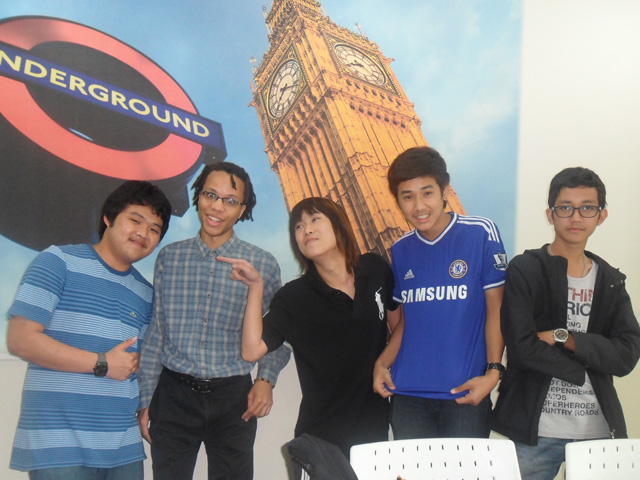
Charles McKinney with students

I moved to Bangkok, Thailand in January 2013 to earn my master’s degree as a full-time student at Webster University Thailand. I needed to find work to support myself. After two months of hunting, I landed a job at a private language school teaching English, something I was qualified to do as a TESOL-certified American with two years of previous overseas ESL expertise.

Having never taught Thai students before, I initially struggled to satisfy their learning needs. The students expected me to teach by talking; they wanted to participate as little as possible. My boss told me that, unlike American students who take an active role, Thai students are often quite passive learners.

Classes were mostly one-on-one, a new format for me. A few lessons were cancelled after students griped about my teaching methods, disliking the fact that I was following the textbook lesson plan precisely rather than teaching from my knowledge of the topics and using the book minimally. I started out teaching academic writing and grammar to adolescents who found the material dry; thus my challenge was to make it more interesting for them.

Really, I had no lessons in technique: my busy boss usually gave me the necessary resources to teach and then left me to figure out the rest on my own with minimum advice. So, after nearly a month of floundering to improve my teaching performance my boss decided to give me a two-month hiatus (although I did not know this at the time). It turned out she was right: I needed more time to adapt to the culture and the students.

A few months later, I was called back to teach a new academic writing class for a mid-career professional who wanted to return to school. This time I brought my computer with me, using the Internet as an aid to my lesson plan. I prepared PowerPoint presentations to convey the material in an engaging and orderly manner. Throughout the two-month class, we managed to build rapport and exchange cultural knowledge that helped us to understand one another as individuals.

“Here are pictures of my Buddhist monk ceremony, a rite of passage that many Thai men experience,” my student shared with me one day. In return, I showed him a student newspaper from my college days. “This is my pride and joy as former editor-in-chief of the paper; you can learn about my culture through this medium,” I told him. It was one of those cultural insight moments I cherished. As our class progressed, he gave my boss positive feedback about me – and my confidence in my new techniques improved.

I was not only the first American, but the first African-American teacher this school hired. I have now taught students from Bhutan and Russia as well as Thailand. This experience has taught me the values of patience, flexibility, humility and effective cross-cultural communication. Teachers can make a difference in students’ lives, especially in cultures that are drastically different from their own, but students also make a difference in their teachers’ lives. They learned some English, but I learned about their cultures. Creating a comfortable space for students to be themselves, and remembering that teachers also learn from their students, can foster wonderful intercultural dialogues.

Charles McKinney is a recent MA media communications graduate from Webster University Thailand. Having embarked on a rewarding career of ESL/EFL teaching as an expat in East Asia, Charles is hoping to secure an English Language Fellowship with the US Embassy for the new school year and is making plans to possibly join the Peace Corps next year. CID’s website was helpful during Charles’s master’s thesis research, and he wrote this essay as a way of giving back. Contact him through LinkedIn.

Download the entire post as a PDF.

Key Concept #24: Asiacentricity by Yoshitaka Miike

Key Concepts in ICDThe next issue of Key Concepts in intercultural Dialogue is now available. This is KC24: Asiacentricity by Yoshitaka Miike. As always, all Key Concepts are available as free PDFs; just click on the thumbnail to download.Lists organized  chronologically by publication date and numberalphabetically by concept in English, and by languages into which they have been translated, are available, as is a page of acknowledgments with the names of all authors, translators, and reviewers.
kc24-sm

Miike, Y. (2014). Asiacentricity. Key Concepts in Intercultural Dialogue, 24. Available from:
https://centerforinterculturaldialogue.org/wp-content/uploads/2014/07/key-concept-asiacentricity2.pdf

The Center for Intercultural Dialogue publishes a series of short briefs describing Key Concepts in intercultural Dialogue. Different people, working in different countries and disciplines, use different vocabulary to describe their interests, yet these terms overlap. Our goal is to provide some of the assumptions and history attached to each concept for those unfamiliar with it. As there are other concepts you would like to see included, send an email to the series editor, Wendy Leeds-Hurwitz. If there are concepts you would like to prepare, provide a brief explanation of why you think the concept is central to the study of intercultural dialogue, and why you are the obvious person to write up that concept.


Creative Commons License
This work is licensed under a Creative Commons Attribution-NonCommercial-NoDerivatives 4.0 International License.

Coastal Carolina U job ad

Assistant Professor of Intercultural/International Communication
Coastal Carolina University

The Department of Communication, Languages and Cultures at Coastal Carolina University invites applications for a tenure-track position as Assistant Professor for Intercultural/International Communication.

A Ph.D. in Communication, Anthropology, or Language with teaching experience and coursework in intercultural/international is required. Preference will be given to applicants who are qualified to teach (have 18 credit hours) in one of the Department’s areas of language instruction:  German, French or Italian.  A record that indicates the potential for scholarly productivity and success, and demonstrated interest in institutional service is required. Candidates should ideally possess instructional/research interests and competencies in key areas that could include cross-cultural communication, acculturation, language and culture, semiotics or sociolinguistics. Additional languages and/or cultural proficiencies may be considered. The successful candidate will work with members of the Department to strategically develop courses in intercultural/international communication. Teaching assignments may include evening/weekend courses. The appointment will be effective either January 9, 2015 or August 16, 2015 depending on availability of the candidate.

The Department of Communication, Languages and Cultures is one of Coastal Carolina University’s newest departments serving approximately 600 majors. The Department offers programs and courses in Communication Studies, Health Communication, Interactive Journalism and Media, Public Relations/Integrated Communication, Spanish, French, Italian, and German. Our faculty is committed to excellence in teaching, research, and the integration of ideas, technologies, and developments within the discipline. The department provides students with the skills and knowledge to compete in an increasingly global workforce, to facilitate understanding of effective communication practices in varied contexts, and to foster cultural awareness and appreciation of diverse communities within the US and abroad.

Coastal Carolina University is a public mid-size, comprehensive liberal arts-oriented institution. Coastal Carolina University is located in Conway, South Carolina, just nine miles from the Atlantic coastal resort of Myrtle Beach, one of the fastest growing metropolitan areas in the nation. The University has an enrollment of 9,000 students and will have continued growth for the next several years. Coastal Carolina University is part of the South Carolina system of public education and has close ties with its founders, the Horry County Higher Education Commission.

Candidates should submit a letter of application (outlining interest in the position, qualifications, and approach to teaching and learning), a current CV, a list of three references, and transcripts of all graduate work (copies are acceptable at this time) electronically. Coastal Carolina University is building a culturally diverse faculty and strongly encourages applications from women and minority candidates. CCU is an EO/AA employer. Screening of candidates will begin immediately. Applications should be received by October 15, 2014.

Save

Fulbright deadline nearing

The deadline for Fulbright Core applications for Academic Year 2015-2016 is August 1st, 2014.

This year’s competition includes 584 awards.  Of these,  419 are All Discipline awards and are open to applicants from virtually any discipline – from Computer Science to Art.  Scholars and professionals from post-docs to emeriti are able to apply for programs all over the globe.

For information about awards offered in specific disciplines or areas of the world and about the application, see our archived Webinars or register for an upcoming one. The Fulbright Scholar Application and Reviewing Your Fulbright Application Package might prove to be helpful for those with questions about the application process.

Upcoming webinars include:

08 July – Fulbright Opportunities in Europe: A Second Look at Central and Eastern Europe
09 July – Fulbright Distinguished Awards
11 July – All Discipline Awards – What Are They?
14 July – Have You Thought About? – Some Hidden Gems
17 July – Fulbright Flex Awards
18 July – How to Craft a Successful  Project Statement
23 July – Reviewing Your Fulbright Application Package
30 July – Reviewing Your Fulbright Application Package

CFP Media, War and Memory (New Zealand)

Conference Call for Papers: Media, War and Memory
September 18–19, 2014
Venue: Sir Paul Reeves Building, AUT University (Auckland, New Zealand)

Keynote Speakers: Andrew Hoskins, University of Glasgow and Fay Anderson, Monash University

A century after 1914, it is timely to consider how World War I was started, prosecuted and reported on, from different national perspectives. How does this conflict appear in retrospect? As a prequel to World War II? The ‘beginning’ of the 20th century? Or as an avoidable, stand-alone catastrophe? These questions provoke wider reflection upon the connections between media, war and memory. What are these connections? How have they changed over time? Conference participants will, we hope, respond to these questions.

To this end, the following themes suggest themselves:
World War I
• Paths to war, patterns of news coverage
• Diplomacy, communication and the telegraph
• Atrocities and propaganda
• Frontline testimonials, journalism, poetry
• Domestic dissent

Race, culture, genocide
• Imperialism, colonialism, indigineity
• Jewish holocaust
• Armenian massacres
• Testimonies, amnesia Gender and depictions of war
• Masculinity, heroism
• War and patriarchy
• War, rape, testimony
• Women war journalists
• Women combatants

Journalism, media, civil conflict
• Spanish civil war
• Sri Lanka
• Balkans, Bosnia, Serbia
• US civil war
• Occupation, resistance, testimony

War, historiography and revisionism
• War novels
• Non-fiction tomes, wars, battles
• Military biographies
• Documentaries
• Conflicting retrospectives of major conflicts

Australia and NZ coverage of ‘overseas’ conflicts
• Boer War, WWI, WWII
• Cold war conflicts; Malaysia, Vietnam, Timor, Kuwait, Iraq, Afghanistan etc.
• ANZAC mythologies
• Wartime censorship
• War, mobilization and dissent

War, propaganda, ideology
• Chomsky, Herman and the ‘propaganda’ model
• News ‘framing’ and war coverage
• Orientalism and colonial wars
• War and national identity
• Memorialism; ceremonies, monuments, museums
• Forgotten wars

Frontline war reporting
• War correspondents
• ‘Embedded’ journalists • Journalistic ethics
• Patriotism and ‘independent’ reporting

Information-communication technologies and war
• Global television, 24/7 ‘real time’ wars
• War and media spectacle
• Media space, battle space, ‘full spectrum dominance’
• Information and cyber warfare
• Online journalism, blogospheres, social media

Media constructions of ‘terrorism’
• Legitimate vs. illegitimate violence
• Terrorists, revolutionaries, freedom fighters
• Post 9-11 media discourses in US, Middle East
• Terrorism and orientalism

Abstracts due: July 30, 2014 (400 words maximum)

Send to: Verica Rupar
Curriculum Leader, Journalism
School of Communication Studies
AUT University

Poetry Contest: Roads and Bridges for Peace

6th INTERNATIONAL POETRY CONTEST – UPF Argentina
“Roads and Bridges for Peace”
Following the International Day of Peace 2014

Since wars begin in the minds of men, it is in the minds of men that the defenses of peace must be constructed.” — Preamble of UNESCO’s Constitution(1945)

BASES
1. Objective: Despite the historical disappointments and conflicts are still around, a peaceful world remains as an inalienable imperative, an inescapable moral duty, a possible goal, and a task to perform. Culture, especially literature, can contribute to this based on universal values, and transcending frontiers, traditions, ideologies, and religions. We expect this wish, this special and universal yearn in the hearts of peoples and cultures, can be captured in the writings of the 6th International Poetry Contest of the UPF Argentina, this year under the title “Roads and Bridges for Peace.” The International Day of Peace 2014, established by the UN (Resolution 36/67), joins this event to “commemorate and strengthen the ideals of peace in each nation and each people, and among them.

2. Formalities: The 6th International Poetry Contest “Roads and Bridges for Peace” is open to writers, poets, students, and every person who feels inspired to express a content of universal value about this topic. Each participant can submit one poem in Spanish, and it must be written in it: author’s name and surname, city, province/state, and country. There should also be a telephone number and an email so as to report the Jury’s evaluation, the winning poems, and other details. The format will be a written poem in verse, which should not exceed one A4 page, letter N° 12. The poem can be sent by email or by post to: Av. Rivadavia 755 – 3° Piso “F” (C1002AAF) – Buenos Aires – Argentina.

3. Launching of the Contest: June 1st, 2014.

4. Last day of receipt: Thursday, July 31, 2014. Meeting of the Jury: from August 12 to 22, 2014.

5. Jury: Consists of Prof. Bertha Bilbao Richter, literary critic, member of the Hispanic Cultural and Literary Institute (ILCH) and the Argentinian Society of Writers (SADE); Ms. Liria Guedes, writer and Honor Band of the SADE, member of the American Association of Poetry and the ILCH; writer Mabel Fontau, Honor Band of SADE, member of the ILCH and Gente de Letras; poet Donato Perrone, from the Ateneo Poético Argentino “Alfonsina Storni”, Coordinator of the Lyric Space from Café Tortoni, and representative of the Group of Poets Livres de Santa Catarina (Brazil); and a local representative of the Universal Peace Federation (UPF); all of them being Ambassadors for Peace of the UPF. The Jury’s decision is final and it has the right to solve any problem which is not covered by these Bases.

6. Godmothers: The writer and poet Juana Alcira Arancibia, founder and president of the Hispanic Cultural and Literary Institute (ILCH) and director-editor of the prestigious international literary magazine “Alba de América”; the Brazilian poet Marina Fagundes Coello, bilingual writer (Portuguese–Spanish), member of the ILCH, and member of different literary circles of outstanding trajectory in America; and the writer and poet Nélida Pessagno, vice-president of the SADE and Main Counselor of the “El Libro” Foundation.

7. Awards: The winning poem will be read by the author, or by someone they choose, at the Award Ceremony. They will also receive the Certificate of Recognition and the poem will be spread nationally and internationally. It will be also given four Honorable Mentions, five Special Mentions, and two Mentions with its certificates. Each person who receives one of these distinctions will also receive presents, and their poems will be included in the next book edition, as a way of promoting the values of a culture of peace.

8. Award Ceremony: The delivery of awards will take place in the Celebration of the International Day of Peace, in an artistic, cultural, and interreligious event that organizes the Universal Peace Federation (UPF) Argentina according to the UN date (Resolución 36/67), on Monday, September 22, 2014, and whose details will be reported opportunely.

9. Organization: the UPF Argentina, whose mottos worldwide are: “The hope of all times is a unified world of peace” and “A global family centered on God”, organizes this 6th International Poetry Contest, sponsored by the International Educative Foundation (FEI).

Joining this Contest implies accepting these Bases.

UNIVERSAL PEACE FEDERATION (UPF) – Status ECOSOC ONU
UPF Argentina: Av. Rivadavia 755 – 3° Floor “F” (C1002AAF) – Buenos Aires – Tel/Fax: (+54-11) 4343-3005