UNESCO Youth Eyes on the Silk Roads Photo Contest 2022

Photo ContestYouth Eyes on the Silk Roads Photo Contest, UNESCO, Paris, France. Deadline: 17 July 2022.

The annual Youth Eyes on the Silk Roads International Photo Contest offers an exciting opportunity for young people from all over the world to capture their understanding of the shared heritage of the Silk Roads through the lens of their camera. As the visual arts, and in particular photography, are so often used by today’s youth as a powerful tool for communication and self-expression, images have the potential to play a significant role in raising awareness of the key issues facing our contemporary world and help promote peace and understanding. The photo contest provides an opportunity for young people to connect with one another in a digital space and share their creativity and vision for our future.

The Silk Roads are an expansive region composed of a network of maritime and land routes. Originating in East Asia, South Asia, and Southeast Asia the Silk Roads cross the Central Asian sub-continent, the Russian steppe, the Iranian and Anatolian plateaus, and the Arabian Peninsula. They also stretch through North Africa and Northeast Africa, from Tanzania to Morocco. Additionally, they pass through Eastern and Southern Europe, before reaching France and the Iberian Peninsula. Please see the map here

The Youth Eyes on the Silk Roads Photo Contest is an opportunity for young people who live or have travelled within these regions to share their perceptions and further their understanding of the common cultural heritage and pluralistic identities emerging from the interactions and exchanges taking place along the Silk Roads. The contest encourages the use of photography to extend these cultural interactions and encounters in the contemporary world, to foster mutual understanding and promote peace amongst the diverse populations encompassed by the Silk Roads.

The contest is divided into two age categories: 14-17 year olds, and 18-25 year olds. For the 4th edition of the contest this year participants are invited to submit their photographs that best encapsulate the shared heritage of the Silk Roads through the two themes of ‘Faith and Spiritualities’, and ‘Living Together’. Examples of some of the very best photographs from the previous contests can be found here.

CFP Academy of Professional Dialogue (UK but Online)

Conferences

Call for papers: 5th Academy of Professional Dialogue conference: Dialogue as Story, 1-3 November, 2022, UK but Online. Deadline: none listed.

The Academy of Professional Dialogue (AofPD) will be holding its fifth Annual Conference online from Tuesday 1st November to Thursday 3rd November. This year’s theme will be ‘Dialogue as Story’. The idea behind this is that when people come into any Dialogue, they bring their own story. This is closely connected with the idea of ‘identity’. The stories we have about ourselves form our identities.

This also applies to groups of people. Groups frequently come together around their shared stories, and over time they may also create new stories together. Different people and groups also often have different stories about the same thing – for example, in organisations, people at different levels and in different parts of an organisation will probably have different stories about the organisation they are all part of. All these different stories lead to fragmentation between different people and different groups. Dialogue provides a means of sharing and understanding the different stories, reducing this fragmentation, and ultimately helping to change everyone’s story going forward. It’s probably worth saying that this isn’t the same as ‘Storytelling’. In fact, ‘Storytelling’ itself is more about monologue. Instead, Dialogue is key to exploring, revealing and understanding different stories.

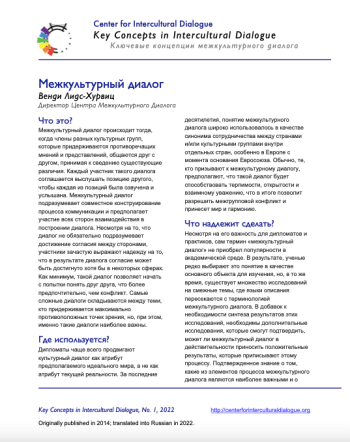
KC1 Intercultural Dialogue Translated into Russian

Key Concepts in ICDContinuing translations of Key Concepts in Intercultural Dialogue, today I am posting KC#1: Intercultural Dialogue, which I wrote for publication in English in 2014, and which Anton Dinerstein has now translated into Russian.

As always, all Key Concepts are available as free PDFs; just click on the thumbnail to download. Lists of Key Concepts organized chronologically by publication date and number, alphabetically by concept, and by languages into which they have been translated, are available, as is a page of acknowledgments with the names of all authors, translators, and reviewers.

KC1 Intercultural Dialogue_Russian

Leeds-Hurwitz, W. (2022). Intercultural dialogue [Russian]. (A. Dinerstein, Trans.). Key Concepts in Intercultural Dialogue, 1. Available from: https://centerforinterculturaldialogue.org/wp-content/uploads/2022/03/kc1-intercultural-dialogue_russian.pdf

If you are interested in translating one of the Key Concepts, please contact me for approval first because dozens are currently in process. As always, if there is a concept you think should be written up as one of the Key Concepts, whether in English or any other language, propose it. If you are new to CID, please provide a brief resume. This opportunity is open to masters students and above, on the assumption that some familiarity with academic conventions generally, and discussion of intercultural dialogue specifically, are useful.

Wendy Leeds-Hurwitz, Director
Center for Intercultural Dialogue


Creative Commons License
This work is licensed under a Creative Commons Attribution-NonCommercial-NoDerivatives 4.0 International License.

U Gothenburg: Intercultural Communication (Sweden)

“Job

Senior Lecturer in Intercultural Communication, Department of Applied Information Technology, University of Gothenburg, Sweden. Deadline: 17 May 2022.

Subject area description: The topic of communication focuses on understanding various forms of communication in different contexts. Communication is an interdisciplinary area at the intersection of social sciences, humanities and technology. Intercultural communication explores the influence of culture on communication in different areas of application, ranging from business to cooperation and conflict.

Job assignments: This position of senior lecturer includes teaching and skills development, with the aim that the teaching will be research connected. In this position you are expected to:

  • Teach courses in the international Master’s in Communication programme (which is taught entirely in English).
  • Ensure that your teaching efforts are based on research-related competence.
  • Prepare and deliver entire courses or parts of courses and be able to take on course responsibilities.
  • Grade examination assignments.
  • Supervise master’s theses widely across the field of communication.
  • Other administrative tasks related to the position might be relevant.

City U Macau: Several Positions in Applied Linguistics & English (China)

“JobSeveral positions are available in Applied Linguistics & English Studies, City University of Macau, Macau, China. Deadline: 21 May 2022.

1. Assistant Professor, Applied Linguistics & English Studies

2. Associate Professor, Applied Linguistics & English Studies

3. Professor, Applied Linguistics and English Studies

In each case, they are looking for at least two areas of the following aspects of Applied Linguistics and English Studies: Applied Linguistics; AI for linguistic studies; Multimodality learning; Corpus Linguistics; Teaching languages to young learners; language development; Psycholinguistics; Intercultural Communication; Second language acquisition; Research methods in social sciences; Multilingual education; translation; speech and language therapy; language disability.

Story Circles for Intercultural Conversations: Cornell U

Applied ICD

Story circles encourage intercultural conversations at Cornell University, Ithaca, NY, USA.

“Launched by the Office of Global Learning, the story circles initiative is intended to bridge the gaps in intercultural understanding between Cornell’s international and domestic populations. The project began as OGL explored ways to promote belonging among international students at the height of the pandemic, when students were scattered across the globe – in Ithaca, at Study Away, or studying remotely from their home countries. The workshops make use of UNESCO’s Story Circles methodology, which has been tested to nurture cultural diversity across the world.”

For details of what Cornell is doing, see the original article:
Pradhan, Priya. (2022, April 26). Story circles foster intercultural conversations, belonging. Cornell Chronicle.


Plurispace Podcasts

PodcastsIntersectionality of Concepts for the Management of Diversity and the Perception of Civil Society podcast, Plurispace, Paris, France.

On this podcast, Luana Franco Rocha (SciencesPo – CERI) talked with Riva Kastoryano (SciencesPo – CERI), leader of the PLURISPACE project and the principal investigators Tariq Modood (University of Bristol), John Erik Fossum (University of Oslo) and Ricard Zapata-Barrero (Universitat Pompeu Fabra) about the four concepts that are at the core of PLURISPACE (multiculturalism, interculturalism, transnationalism and cospomolitanism) and how they are connected, as well as to some empirical outcomes.

Cinema as Social Space of Cultural Encounters and Conflicts (Norway)

Events

NOS-HS Workshop: Cinema as space of encounters before, during and after WWII, 29-30 Sep. 2022, Kristiansand, Norway. Deadline: 22 May 2022.

The workshop “Cinema as space of encounters before, during and after WWII” is the first in the workshop series “Cinema, War and Citizenship at the Northern Periphery: Cinemas and their audiences in the Nordic countries, 1935-1950”. It asks how the Second World War altered the cinema-going experiences and the social functions of the movie theatre. The Nordic countries were affected very differently by the war. While Denmark and Norway were occupied by Nazi Germany, Iceland was first occupied by British and then by US forces. Finland fought alongside Nazi Germany and then against it, while Sweden remainedofficially neutral, but experienced a large influx of refugees from neighbouring countries. The movie theatre became a battleground between different factions of society. At the same time, the movie theatres became a space of cultural encounters with the enemy or the ally, both on screen and in the auditorium.

In the workshop organizers want to discuss how different social groups and individuals experienced and used the cinema especially in the Nordic countries (Denmark, Finland, Iceland, Norway, and Sweden) before, during and after WWII (1935-50). The focus is on the audiences and the cinema as space. Neglected aspects, such as rural cinema audiences, or the operation of mobile cinemas, are of particular interest. Potential topics for presentations include Cinema as social space of cultural encounters and conflicts.

The number of participants will be limited to approx. 20 persons to allow for fruitful discussion and exchange. Accommodation in Kristians and and meals will be provided, travel costs (economy flights and/or public transport) will be reimbursed.

Practicing Relational Ethics in Organizations (Online)

EventsPracticing Relational Ethics in Organizations, Taos Institute, Chagrin Falls, OH, USA, 18 May 2022, 9-10:30 am EST (Online).

This workshop includes an introductory presentation by the authors, Gitte Haslebo and Maja Loua Haslebo, reflections on real life stories of ethical dilemmas and conflict in organization, dialogue on questions from participants, and final perspectives.

  • How can leaders and consultants handle conflicts and dilemmas in organizations with inspiration from social constructionist theory?

  • Which alternatives to universal theories of ethics can leaders and consultants draw on from relational ethics?

  • Looking at stories with ethical dilemmas or conflict, how can we co-create better actions and outcomes for all parties drawing on relational ethics?

Recommended reading before participation: Chapter 8 in the book Practicing Relational Ethics in Organizations: Moral compass points in relational ethics, pp. 267-287. Download the free book.

Gitte Haslebo: Organizational psychologist, founder of a major Danish consultancy firm.

Maja Loua Haslebo: Organizational psychologist, independent consultant in private and public organizations.

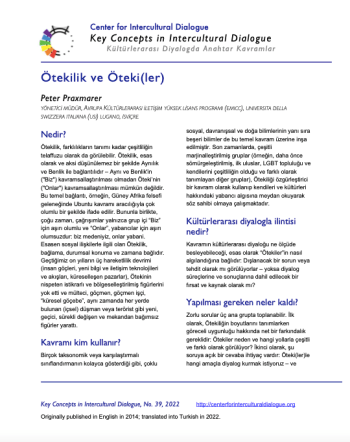
KC39 Otherness and the Other(s) Translated into Turkish

Key Concepts in ICDContinuing translations of Key Concepts in Intercultural Dialogue, today I am posting KC39: Otherness and the Other(s), which Peter Praxmarer wrote for publication in English in 2014, and which İçten Duygu Özbek has now translated into Turkish.

As always, all Key Concepts are available as free PDFs; just click on the thumbnail to download. Lists of Key Concepts organized chronologically by publication date and number, alphabetically by concept, and by languages into which they have been translated, are available, as is a page of acknowledgments with the names of all authors, translators, and reviewers.

KC39 Otherness_TurkishPraxmarer, P. (2022). Otherness and the Other(s) [Turkish]. (İ. D. Özbek, Trans.). Key Concepts in Intercultural Dialogue, 39. Retrieved from: https://centerforinterculturaldialogue.org/wp-content/uploads/2022/03/kc39-otherness_turkish.pdf

If you are interested in translating one of the Key Concepts, please contact me for approval first because dozens are currently in process. As always, if there is a concept you think should be written up as one of the Key Concepts, whether in English or any other language, propose it. If you are new to CID, please provide a brief resume. This opportunity is open to masters students and above, on the assumption that some familiarity with academic conventions generally, and discussion of intercultural dialogue specifically, are useful.

Wendy Leeds-Hurwitz, Director
Center for Intercultural Dialogue