Cinema as Social Space of Cultural Encounters and Conflicts (Norway)

Events

NOS-HS Workshop: Cinema as space of encounters before, during and after WWII, 29-30 Sep. 2022, Kristiansand, Norway. Deadline: 22 May 2022.

The workshop “Cinema as space of encounters before, during and after WWII” is the first in the workshop series “Cinema, War and Citizenship at the Northern Periphery: Cinemas and their audiences in the Nordic countries, 1935-1950”. It asks how the Second World War altered the cinema-going experiences and the social functions of the movie theatre. The Nordic countries were affected very differently by the war. While Denmark and Norway were occupied by Nazi Germany, Iceland was first occupied by British and then by US forces. Finland fought alongside Nazi Germany and then against it, while Sweden remainedofficially neutral, but experienced a large influx of refugees from neighbouring countries. The movie theatre became a battleground between different factions of society. At the same time, the movie theatres became a space of cultural encounters with the enemy or the ally, both on screen and in the auditorium.

In the workshop organizers want to discuss how different social groups and individuals experienced and used the cinema especially in the Nordic countries (Denmark, Finland, Iceland, Norway, and Sweden) before, during and after WWII (1935-50). The focus is on the audiences and the cinema as space. Neglected aspects, such as rural cinema audiences, or the operation of mobile cinemas, are of particular interest. Potential topics for presentations include Cinema as social space of cultural encounters and conflicts.

The number of participants will be limited to approx. 20 persons to allow for fruitful discussion and exchange. Accommodation in Kristians and and meals will be provided, travel costs (economy flights and/or public transport) will be reimbursed.

Practicing Relational Ethics in Organizations (Online)

EventsPracticing Relational Ethics in Organizations, Taos Institute, Chagrin Falls, OH, USA, 18 May 2022, 9-10:30 am EST (Online).

This workshop includes an introductory presentation by the authors, Gitte Haslebo and Maja Loua Haslebo, reflections on real life stories of ethical dilemmas and conflict in organization, dialogue on questions from participants, and final perspectives.

  • How can leaders and consultants handle conflicts and dilemmas in organizations with inspiration from social constructionist theory?

  • Which alternatives to universal theories of ethics can leaders and consultants draw on from relational ethics?

  • Looking at stories with ethical dilemmas or conflict, how can we co-create better actions and outcomes for all parties drawing on relational ethics?

Recommended reading before participation: Chapter 8 in the book Practicing Relational Ethics in Organizations: Moral compass points in relational ethics, pp. 267-287. Download the free book.

Gitte Haslebo: Organizational psychologist, founder of a major Danish consultancy firm.

Maja Loua Haslebo: Organizational psychologist, independent consultant in private and public organizations.

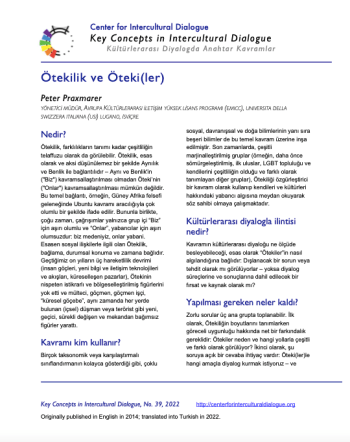
KC39 Otherness and the Other(s) Translated into Turkish

Key Concepts in ICDContinuing translations of Key Concepts in Intercultural Dialogue, today I am posting KC39: Otherness and the Other(s), which Peter Praxmarer wrote for publication in English in 2014, and which İçten Duygu Özbek has now translated into Turkish.

As always, all Key Concepts are available as free PDFs; just click on the thumbnail to download. Lists of Key Concepts organized chronologically by publication date and number, alphabetically by concept, and by languages into which they have been translated, are available, as is a page of acknowledgments with the names of all authors, translators, and reviewers.

KC39 Otherness_TurkishPraxmarer, P. (2022). Otherness and the Other(s) [Turkish]. (İ. D. Özbek, Trans.). Key Concepts in Intercultural Dialogue, 39. Retrieved from: https://centerforinterculturaldialogue.org/wp-content/uploads/2022/03/kc39-otherness_turkish.pdf

If you are interested in translating one of the Key Concepts, please contact me for approval first because dozens are currently in process. As always, if there is a concept you think should be written up as one of the Key Concepts, whether in English or any other language, propose it. If you are new to CID, please provide a brief resume. This opportunity is open to masters students and above, on the assumption that some familiarity with academic conventions generally, and discussion of intercultural dialogue specifically, are useful.

Wendy Leeds-Hurwitz, Director
Center for Intercultural Dialogue

U Manchester: Lecturers in Translation & Intercultural Studies (UK)

“Job

Two Lecturer positions are available at the University of Manchester, Manchester, UK. Deadline for both: 13 May 2022.

1. Lecturer in Intercultural Communication

Applications are invited for the teaching and research post of Lecturer in Intercultural Communication, which is tenable from 1 September 2023 and offered on an open-ended basis. The appointed person must be able to deliver courses that successfully cover or combine the study of several of the following:

  • Intercultural communication in the context of crisis communication, diplomacy, international development, international migration
  • Intercultural communication in international media production and consumption
  • Intercultural communication in business or institutional contexts
  • Intercultural communication in transnational popular culture
  • Intercultural competence skills training
  • Critical intercultural communication in social identity formation / social movements
  • Postcolonial intercultural communication

2. Lecturer in Translation and Intercultural Studies

This permanent appointment will make a major contribution to Translation and Interpreting Studies at MA level through delivery of theoretical core courses and practice-oriented course units in some of the following areas:

  • audio-visual translation
  • commercial translation
  • legal translation
  • medical translation
  • scientific translation
  • technical translation
  • translating for international organisations
  • public service interpreting

Applicants must be fluent in English and at least one other language (preferably Mandarin) and must have experience developing online teaching materials.

U Penn: Outreach Coordinator of South Asia Center (USA)

“Job
Outreach Coordinator in SAS South Asia Center
, University of Pennsylvania, Philadelphia, PA, USA. Deadline: open until filled (posted 5 May 2022).

The Outreach Coordinator, reporting to the Associate Director and the Center Director, is responsible for administrative support for Center programs, as well as planning and implementing global and South Asia-specific outreach programs intended to inform the Penn community, K-12, post-secondary schools and the general public about South Asia (India, Pakistan, Sri Lanka, Bangladesh, Nepal, and Afghanistan). The outreach coordinator is responsible for outreach activities that involve (1) Elementary and secondary schools; (2) Postsecondary institutions; and (3) Business, media, and the general-public. General duties include event and program coordination; strengthening present and forging new partnerships with the Center’s outreach constituencies, particularly schools and teachers in the region; helping develop the Center’s online resources, and various financial processes.

The Outreach coordinator is also responsible for planning, implementing, and promoting structured research and academic opportunities on and in South Asia involving Penn faculty, students, and alumni. The position will support and organize academic programming including summer research internships and promotion of South Asia-related research at Penn and in South Asia via newsletter, website, and social media venues.

The Center is supported by a grant from the US Department of Education and will require some data collection of outreach programming for annual reports. Position is contingent on continued funding.

Trinity College Dublin: Turkish Cultural History (Ireland)

“Job
Yunus Emre Institute Lectureship in Turkish Cultural History, Yunus Emre Institute, Trinity College Dublin, Ireland, UK. Deadline: 16 May 2022.

The Department of Near and Middle Eastern Studies welcomes applications for the position of Lecturer (Yunus Emre Institute Lectureship in Turkish Cultural History) in Turkish Cultural History. Applications from candidates with a specialisation in the social and/or cultural history of the Ottoman Empire will be particularly welcome. Applicants must hold a PhD and have a strong research profile appropriate to their career stage. They will be expected to demonstrate an ability to address wider thematic debates and to teach survey courses to undergraduates, as well as offer more advanced research led modules in their area of specialisation. They will also be expected to develop modules for post graduate students. The successful candidate will develop new modules as well as contribute to modules in the Department of Near and Middle Eastern Studies and in the School of Languages, Literatures and Cultural Studies. The successful candidate will also be expected to undertake the organisation of public events and outreach related to Turkish Cultural History in consultation with the Head of Department of Near and Middle Eastern Studies and the Yunus Emre Institute.

Digital Linguistic Diversity in the Global South (Germany but Online)

EventsThe ordinariness of digital linguistic diversity in the Global South, guest lecture by Sender Dovchin, sponsored by Digital Language Variation in Context, University of Hamburg, Germany. Online, 12 May 2022.

Recent debates of linguistic diversity have problematised paradigms such as bi/multilingualism, and code-switching for reifying static language boundaries and for their inability to account for communicative practices constructed out of a diversity of linguistic repertoires. Instead, trans- perspectives have been introduced to capture the critical linguistic diversity, especially in the context of digital platforms. This emergent trans- tradition in reflects the difficulty, if not futility, of demarcating linguistic features according to specific languages, for the fluid movement between and across languages.

Yet, this recent tradition still tends to celebrate and thus exoticize the presumed digital linguistic diversity in and from the Global South, although it is indeed ‘quite normal’, ‘unremarkable’ ‘ordinary’, ‘basic’, ‘everyday’, and by no means a new phenomenon. In so doing, scholarship inadvertently constructs and exoticizes a linguistic Other whose digital linguistic diversity are expected to be made legible according to normative epistemologies of diversity.

This lecture is based on the premise that the analytic potential of the trans- tradition can be enhanced through a stronger focus on such practices as reflective of everyday, quotidian, basic, mundane, unremarkable, banal, and ordinary occurrences, rather than of peculiar, exotic, eccentric or unconventional ones. It is important to recognise that digital linguistic diversity in and from the Global South is neither to celebrate nor to deplore, but something to observe and examine with interest like anything else, as it is inevitable that peoples and cultures have always been mixing and mingling. I conclude that ‘linguistic ordinariness’ is rather ‘diverse’ – a necessary condition of ‘linguistic diversity’ is its ‘ordinariness’.

Dr Sender Dovchin is an Associate Professor and Principal Research Fellow and Director of Research at the School of Education, Curtin University, Australia.

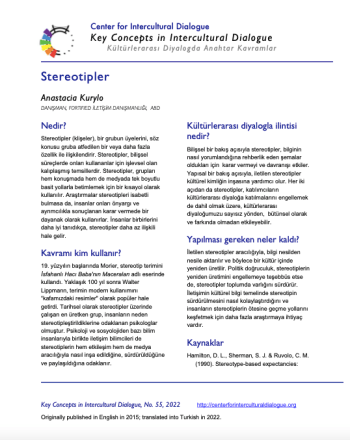
KC55 Stereotypes Translated into Turkish

Key Concepts in ICDContinuing translations of Key Concepts in Intercultural Dialogue, today I am posting KC55: Stereotypes, which Anastacia Kurylo wrote in 2014, and which İçten Duygu Özbek has now translated into Arabic.

As always, all Key Concepts are available as free PDFs; just click on the thumbnail to download the PDF. Lists organized chronologically by publication date and numberalphabetically by concept in English, and by languages into which they have been translated, are available, as is a page of acknowledgments with the names of all authors, translators, and reviewers.

KC55 Stereotypes_TurkishKurylo, A. (2022). Stereotypes [Turkish]. (İ. D. Özbek, Trans.) Key Concepts in Intercultural Dialogue, 55. Available from: https://centerforinterculturaldialogue.org/wp-content/uploads/2022/03/kc55-stereotypes_turkish.pdf

The Center for Intercultural Dialogue publishes a series of short briefs describing Key Concepts in Intercultural Dialogue. Different people, working in different countries and disciplines, use different vocabulary to describe their interests, yet these terms overlap. Our goal is to provide some of the assumptions and history attached to each concept for those unfamiliar with it. As there are other concepts you would like to see included, send an email to the series editor, Wendy Leeds-Hurwitz. If there are concepts you would like to prepare, provide a brief explanation of why you think the concept is central to the study of intercultural dialogue, and why you are the obvious person to write up that concept.


Creative Commons License
This work is licensed under a Creative Commons Attribution-NonCommercial-NoDerivatives 4.0 International License.

French Institutes for Advanced Study: Fellowships 2023-24 (France)

Fellowships

Fellowships in 2023-2024, French Institutes for Advanced Study, 6 locations in France. Deadline: 2 June 2022 (later extended to 9 June 2022)

The French Institutes for Advanced Study Fellowship Programme offers 10-month fellowships in the six Institutes of Aix-Marseille, Loire Valley (Orléans-Tours), Lyon, Montpellier, Nantes and Paris. It welcomes applications from high-level international scholars to develop their innovative research projects in France. For the 2023-2024 academic year, FIAS offers 37 fellowship positions: 4 in Aix-Marseille, 3 in Loire Valley (Orléans-Tours), 10 in Lyon, 3 in Montpellier, 4 in Nantes, and 13 in Paris.

The call is open to all disciplines in the social sciences and the humanities (SSH) and all research fields. Research projects in other sciences and in arts that propose a strong interaction and dialogue with the SSH are also eligible. Some host IAS have scientific priorities that need to be taken into full consideration before applying.

The FIAS fellows will be free to organize their research while benefiting from the support and conducive scientific environment offered by the IAS characterised by a multidisciplinary cohort of fellows and by close relation to the local research centres and laboratories.

PLURAL+ Youth Video Festival 2022

Film Festivals
#PLURALplus22 call for videos: Youth video festival on migration, diversity, and social inclusion, a UNAOC and IOM initiative. Deadline: 17 June 2022.

In a world often characterized by intolerance and cultural divisions, the PLURAL+ Youth Video Festival recognizes youth as powerful agents of social change and empowers them to share their creative vision with the world and foster respect for diversity. Launched in 2009, PLURAL+ is a joint initiative of the United Nations Alliance of Civilizations (UNAOC) and the International Organization for Migration (IOM), with a network of more than 50 partner organizations around the globe. Every year, PLURAL+ gives young people around the world the opportunity to express their vision and their creativity through multimedia production. PLURAL+ invites young people of up to 25 years old to submit original and creative short films focusing on the themes of migration, diversity, social inclusion, and the prevention of xenophobia.

PLURAL+ video entries are five minutes maximum and can be of any genre (animation, documentary, music video, comedy, etc.) as long as they convey a message that can contribute to making the audience think in constructive ways about the pressing social issues of migration, diversity, social inclusion, and the prevention of xenophobia. In addition, videos can be in any language as long as English subtitles are provided.