
KC8 Public Dialogue Translated into Greek

Key Concepts in ICDContinuing translations of Key Concepts in Intercultural Dialogue, today I am posting KC#8: Public Dialogue, which Robyn Penman wrote for publication in English in 2014, and which Anastasia Karakitsou has now translated into Greek.

As always, all Key Concepts are available as free PDFs; just click on the thumbnail to download. Lists of Key Concepts organized chronologically by publication date and number, alphabetically by concept, and by languages into which they have been translated, are available, as is a page of acknowledgments with the names of all authors, translators, and reviewers.
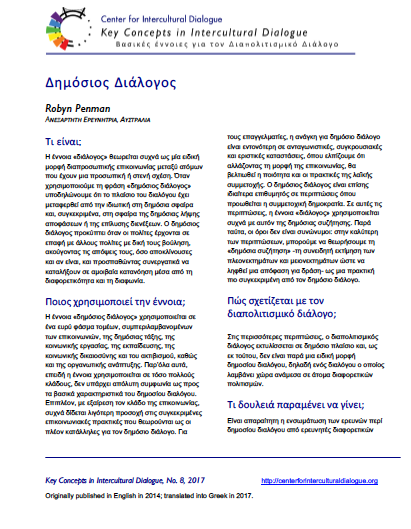
KC8 Public Dialogue_GreekPenman, R. (2017). Public Dialogue [Greek]. (A. Karakitsou, trans). Key Concepts in Intercultural Dialogue, 8. Available from:
https://centerforinterculturaldialogue.org/wp-content/uploads/2014/03/key-concept-public-dialogue.pdf

If you are interested in translating one of the Key Concepts, please contact me for approval first because dozens are currently in process. As always, if there is a concept you think should be written up as one of the Key Concepts, whether in English or any other language, propose it. If you are new to CID, please provide a brief resume. This opportunity is open to masters students and above, on the assumption that some familiarity with academic conventions generally, and discussion of intercultural dialogue specifically, are useful.

Wendy Leeds-Hurwitz, Director
Center for Intercultural Dialogue


Creative Commons License
This work is licensed under a Creative Commons Attribution-NonCommercial-NoDerivatives 4.0 International License.
KC18 Intractable Conflict Translated into Russian

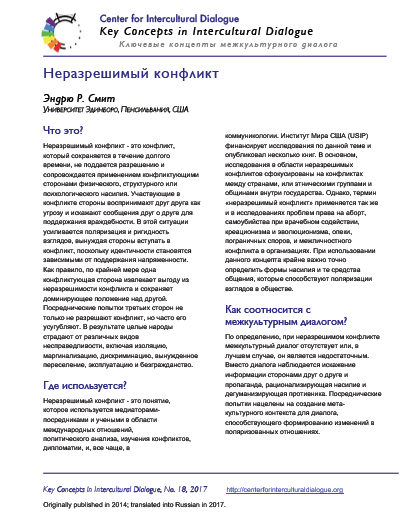
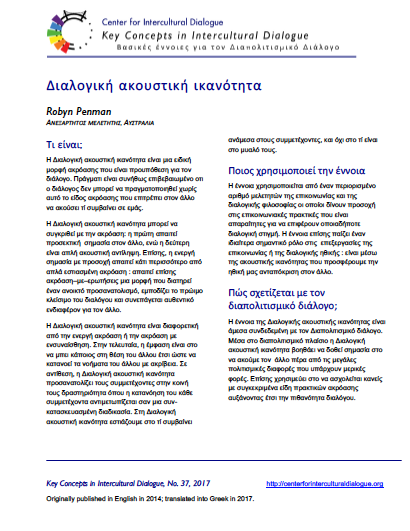
Key Concepts in ICDContinuing translations of Key Concepts in Intercultural Dialogue, today I am posting KC#18: Intractable Conflict, which Andrew R. Smith published in English in 2014, and which Anna Klyueva has now translated into Russian.

As always, all Key Concepts are available as free PDFs; just click on the thumbnail to download. Lists of Key Concepts organized chronologically by publication date and number, alphabetically by concept, and by languages into which they have been translated, are available, as is a page of acknowledgments with the names of all authors, translators, and reviewers.

KC18 Intractable Conflict_RussianSmith, A. R. (2017). Intractable conflict [Russian]. (A. Klyueva, trans). Key Concepts in Intercultural Dialogue, 18. Available from:
https://centerforinterculturaldialogue.org/wp-content/uploads/2017/10/kc18-intractable-conflict_russian.pdf

If you are interested in translating one of the Key Concepts, please contact me for approval first because dozens are currently in process. As always, if there is a concept you think should be written up as one of the Key Concepts, whether in English or any other language, propose it. If you are new to CID, please provide a brief resume. This opportunity is open to masters students and above, on the assumption that some familiarity with academic conventions generally, and discussion of intercultural dialogue specifically, are useful.

Wendy Leeds-Hurwitz, Director
Center for Intercultural Dialogue


Creative Commons License
This work is licensed under a Creative Commons Attribution-NonCommercial-NoDerivatives 4.0 International License.
KC37 Dialogic Listening Translated into Greek

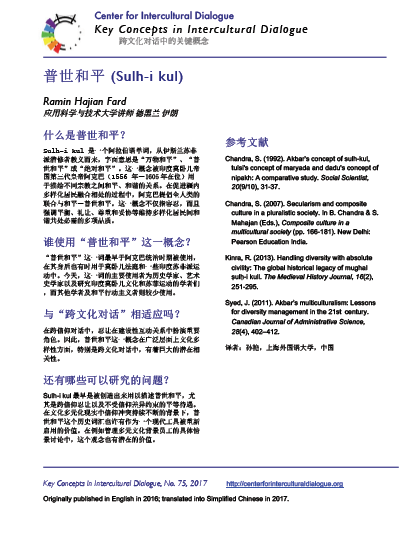
Key Concepts in ICDContinuing translations of Key Concepts in Intercultural Dialogue, today I am posting KC#37: Dialogic Listening, which Robyn Penman wrote for publication in English in 2014, and which Rania Spiridakou has now translated into Greek.

As always, all Key Concepts are available as free PDFs; just click on the thumbnail to download. Lists of Key Concepts organized chronologically by publication date and number, alphabetically by concept, and by languages into which they have been translated, are available, as is a page of acknowledgments with the names of all authors, translators, and reviewers.

KC37 Dialogic Listening_GreekPenman, R. (2017). Dialogic listening [Greek]. (R. Spiridakou, trans). Key Concepts in Intercultural Dialogue, 37. Available from:
https://centerforinterculturaldialogue.org/wp-content/uploads/2017/10/kc37-dialogic-listening_greek.pdf

If you are interested in translating one of the Key Concepts, please contact me for approval first because dozens are currently in process. As always, if there is a concept you think should be written up as one of the Key Concepts, whether in English or any other language, propose it. If you are new to CID, please provide a brief resume. This opportunity is open to masters students and above, on the assumption that some familiarity with academic conventions generally, and discussion of intercultural dialogue specifically, are useful.

Wendy Leeds-Hurwitz, Director
Center for Intercultural Dialogue


Creative Commons License
This work is licensed under a Creative Commons Attribution-NonCommercial-NoDerivatives 4.0 International License.
KC75 Sulh-i kul Translated into Simplified Chinese

Key Concepts in ICDContinuing translations of Key Concepts in Intercultural Dialogue, today I am posting KC#75: Sulh-i kul, which Ramin Hajianfard wrote for publication in English in 2016, and which Yan Sun has now translated into Simplified Chinese.

As always, all Key Concepts are available as free PDFs; just click on the thumbnail to download. Lists of Key Concepts organized chronologically by publication date and number, alphabetically by concept, and by languages into which they have been translated, are available, as is a page of acknowledgments with the names of all authors, translators, and reviewers.

KC75 Sulh-i-kul_Chinese-simHajianfard, R. (2017). Sulh-i kul [Chinese]. (Y. Sun, trans). Key Concepts in Intercultural Dialogue, 75. Available from:
https://centerforinterculturaldialogue.org/wp-content/uploads/2017/10/kc75-sulh-i-kul_chinese-sim.pdf

If you are interested in translating one of the Key Concepts, please contact me for approval first because dozens are currently in process. As always, if there is a concept you think should be written up as one of the Key Concepts, whether in English or any other language, propose it. If you are new to CID, please provide a brief resume. This opportunity is open to masters students and above, on the assumption that some familiarity with academic conventions generally, and discussion of intercultural dialogue specifically, are useful.

Wendy Leeds-Hurwitz, Director
Center for Intercultural Dialogue


Creative Commons License
This work is licensed under a Creative Commons Attribution-NonCommercial-NoDerivatives 4.0 International License.
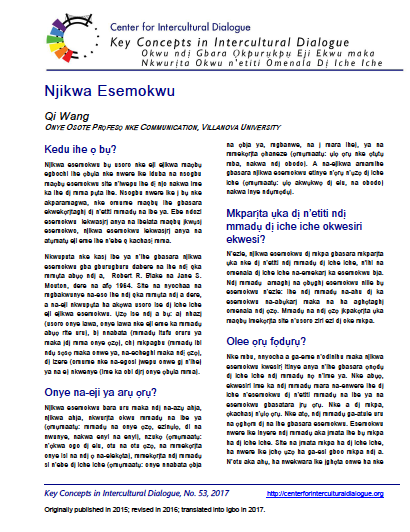
KC53: Conflict Management Translated into Igbo

Key Concepts in ICDContinuing translations of Key Concepts in Intercultural Dialogue, today I am posting KC#53:Conflict Management, which Qi Wang wrote in English in 2015, and which Kingsley Oluchi Ugwuanyi has now translated into Igbo.

As always, all Key Concepts are available as free PDFs; just click on the thumbnail to download. Lists of Key Concepts organized chronologically by publication date and number, alphabetically by concept, and by languages into which they have been translated, are available, as is a page of acknowledgments with the names of all authors, translators, and reviewers.

KC53 Conflict Management_IgboWang, Q. (2017). Conflict management [Igbo]. (K. O. Ugwuanyi, trans). Key Concepts in Intercultural Dialogue, 53. Available from:
https://centerforinterculturaldialogue.org/wp-content/uploads/2017/10/kc53-conflict-management_igbo1.pdf

If you are interested in translating one of the Key Concepts, please contact me for approval first because dozens are currently in process. As always, if there is a concept you think should be written up as one of the Key Concepts, whether in English or any other language, propose it. If you are new to CID, please provide a brief resume. This opportunity is open to masters students and above, on the assumption that some familiarity with academic conventions generally, and discussion of intercultural dialogue specifically, are useful.

Wendy Leeds-Hurwitz, Director
Center for Intercultural Dialogue


Creative Commons License
This work is licensed under a Creative Commons Attribution-NonCommercial-NoDerivatives 4.0 International License.
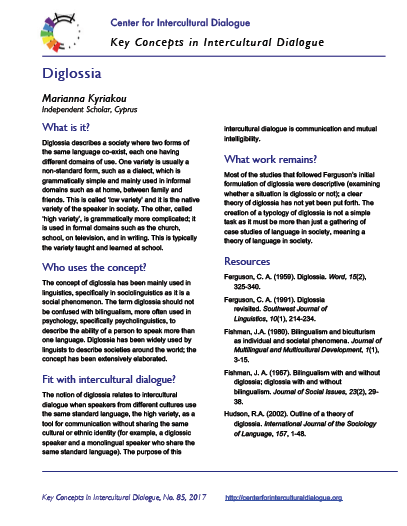
KC85: Diglossia by Marianna Kyriakou

Key Concepts in ICDThe next issue of Key Concepts in intercultural Dialogue is now available. This is KC#85: Diglossia, by Marianna Kyriakou. Click on the thumbnail to download the PDF. Lists organized chronologically by publication date and numberalphabetically by concept in English, and by languages into which they have been translated, are available, as is a page of acknowledgments with the names of all authors, translators, and reviewers.

KC85 DiglossiaKyriakou, M. (2017). Diglossia. Key Concepts in Intercultural Dialogue, 85. Available from:
https://centerforinterculturaldialogue.org/wp-content/uploads/2017/10/kc85-diglossia.pdf

The Center for Intercultural Dialogue publishes a series of short briefs describing Key Concepts in Intercultural Dialogue. Different people, working in different countries and disciplines, use different vocabulary to describe their interests, yet these terms overlap. Our goal is to provide some of the assumptions and history attached to each concept for those unfamiliar with it. As there are other concepts you would like to see included, send an email to the series editor, Wendy Leeds-Hurwitz. If there are concepts you would like to prepare, provide a brief explanation of why you think the concept is central to the study of intercultural dialogue, and why you are the obvious person to write up that concept.


Creative Commons License
This work is licensed under a Creative Commons Attribution-NonCommercial-NoDerivatives 4.0 International License.
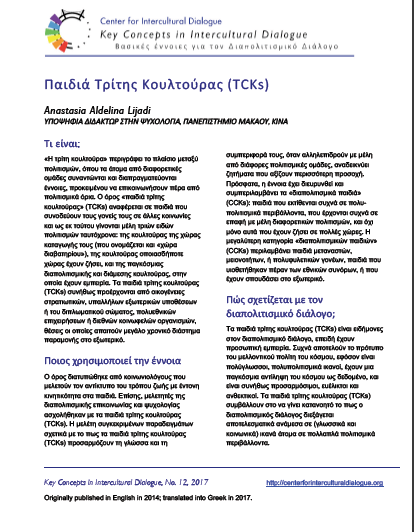
KC12 Third Culture Kids Translated into Greek

Key Concepts in ICDContinuing translations of Key Concepts in Intercultural Dialogue, today I am posting KC#12: Third Culture Kids, which Anastasia Aldelina Lijadi wrote for publication in English in 2014, and which Rania Spiridakou has now translated into Greek.

As always, all Key Concepts are available as free PDFs; just click on the thumbnail to download. Lists of Key Concepts organized chronologically by publication date and number, alphabetically by concept, and by languages into which they have been translated, are available, as is a page of acknowledgments with the names of all authors, translators, and reviewers.

KC12 TCK_GreekLijadi, A. A. (2017). Third Culture Kids [Greek]. (R. Spiridakou, trans). Key Concepts in Intercultural Dialogue, 12. Available from:
https://centerforinterculturaldialogue.org/wp-content/uploads/2017/10/kc12-tck_greek.pdf

If you are interested in translating one of the Key Concepts, please contact me for approval first because dozens are currently in process. As always, if there is a concept you think should be written up as one of the Key Concepts, whether in English or any other language, propose it. If you are new to CID, please provide a brief resume. This opportunity is open to masters students and above, on the assumption that some familiarity with academic conventions generally, and discussion of intercultural dialogue specifically, are useful.

Wendy Leeds-Hurwitz, Director
Center for Intercultural Dialogue


Creative Commons License
This work is licensed under a Creative Commons Attribution-NonCommercial-NoDerivatives 4.0 International License.
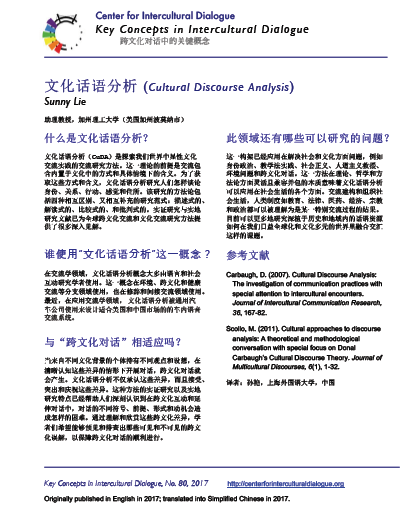
KC80: Cultural Discourse Analysis Translated into Simplified Chinese

Key Concepts in ICDContinuing translations of Key Concepts in Intercultural Dialogue, today I am posting KC#80: Cultural Discourse Analysis, which Sunny Lie wrote for publication in English in 2017, and which Yan Sun has now translated into Simplified Chinese.

As always, all Key Concepts are available as free PDFs; just click on the thumbnail to download. Lists of Key Concepts organized chronologically by publication date and number, alphabetically by concept, and by languages into which they have been translated, are available, as is a page of acknowledgments with the names of all authors, translators, and reviewers.

KC80 Cultural Discourse Analysis_Chinese-simLie, S. (2017). Cultural discourse analysis [Chinese]. (Y. Sun, trans). Key Concepts in Intercultural Dialogue, 80. Available from:
https://centerforinterculturaldialogue.org/wp-content/uploads/2017/10/kc80-cultural-discourse-analysis_chinese-sim.pdf

If you are interested in translating one of the Key Concepts, please contact me for approval first because dozens are currently in process. As always, if there is a concept you think should be written up as one of the Key Concepts, whether in English or any other language, propose it. If you are new to CID, please provide a brief resume. This opportunity is open to masters students and above, on the assumption that some familiarity with academic conventions generally, and discussion of intercultural dialogue specifically, are useful.

Wendy Leeds-Hurwitz, Director
Center for Intercultural Dialogue


Creative Commons License
This work is licensed under a Creative Commons Attribution-NonCommercial-NoDerivatives 4.0 International License.
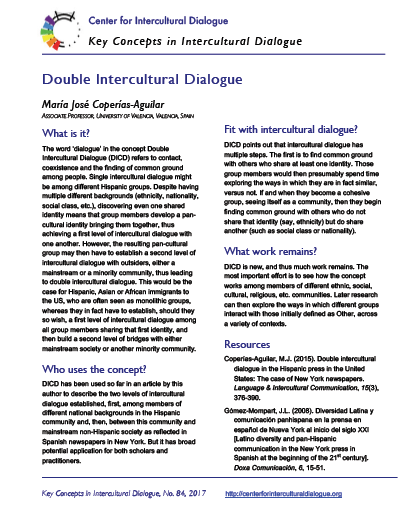
KC84: Double Intercultural Dialogue by María José Coperías-Aguilar

Key Concepts in ICDThe next issue of Key Concepts in intercultural Dialogue is now available. This is KC#84: Double Intercultural Dialogue, by María José Coperías-Aguilar. Click on the thumbnail to download the PDF. Lists organized chronologically by publication date and numberalphabetically by concept in English, and by languages into which they have been translated, are available, as is a page of acknowledgments with the names of all authors, translators, and reviewers.

KC84 Double ICDCoperías-Aguilar, M. J. (2017). Double intercultural dialogue. Key Concepts in Intercultural Dialogue, 84. Available from:
https://centerforinterculturaldialogue.org/wp-content/uploads/2017/10/kc84-double-icd.pdf

The Center for Intercultural Dialogue publishes a series of short briefs describing Key Concepts in Intercultural Dialogue. Different people, working in different countries and disciplines, use different vocabulary to describe their interests, yet these terms overlap. Our goal is to provide some of the assumptions and history attached to each concept for those unfamiliar with it. As there are other concepts you would like to see included, send an email to the series editor, Wendy Leeds-Hurwitz. If there are concepts you would like to prepare, provide a brief explanation of why you think the concept is central to the study of intercultural dialogue, and why you are the obvious person to write up that concept.


Creative Commons License
This work is licensed under a Creative Commons Attribution-NonCommercial-NoDerivatives 4.0 International License.

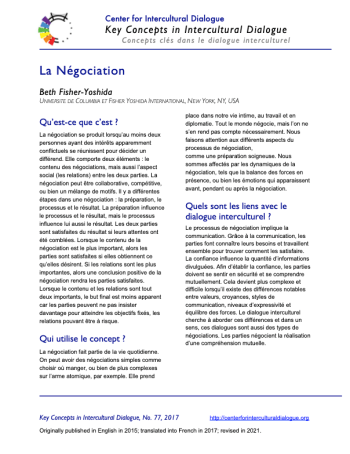
KC77: Negotiation Translated into French

Key Concepts in ICDContinuing translations of Key Concepts in Intercultural Dialogue, today I am posting KC#77: Negotiation, which Beth Fisher-Yoshida wrote for publication in English in 2016, and which Colin Olphand has now translated into French.

As always, all Key Concepts are available as free PDFs; just click on the thumbnail to download. Lists of Key Concepts organized chronologically by publication date and number, alphabetically by concept, and by languages into which they have been translated, are available, as is a page of acknowledgments with the names of all authors, translators, and reviewers.

KC77 Negotiation_French_v2Fisher-Yoshida, B. (2017). La négotiation. (C. Olphand, trans). Key Concepts in Intercultural Dialogue, 77. Available from:
https://centerforinterculturaldialogue.org/wp-content/uploads/2021/05/kc77-negotiation_french_v2.pdf

If you are interested in translating one of the Key Concepts, please contact me for approval first because dozens are currently in process. As always, if there is a concept you think should be written up as one of the Key Concepts, whether in English or any other language, propose it. If you are new to CID, please provide a brief resume. This opportunity is open to masters students and above, on the assumption that some familiarity with academic conventions generally, and discussion of intercultural dialogue specifically, are useful.

Wendy Leeds-Hurwitz, Director
Center for Intercultural Dialogue


Creative Commons License
This work is licensed under a Creative Commons Attribution-NonCommercial-NoDerivatives 4.0 International License.